
International Research Journal of Engineering and Technology (IRJET) e-ISSN:2395-0056
Volume:11Issue:12|Dec2024 www.irjet.net p-ISSN:2395-0072

International Research Journal of Engineering and Technology (IRJET) e-ISSN:2395-0056
Volume:11Issue:12|Dec2024 www.irjet.net p-ISSN:2395-0072
Saiprapul R Thotapally
Global Payments, Georgia, USA
Abstract - Generative AI systems, particularly those powered by Large Language Models (LLMs), are increasingly integrated into compliance-heavy enterprise workflows, including financial audits, healthcare compliance checks, and data privacy reviews. While these models excel at producing contextually rich and fluent responses, their reliance on probabilistic patterns rather than semantic understanding poses significant challenges. Errors such as hallucinations, biases, and factual inaccuracies risk severe legal, financial, and reputational consequences.
ThisthesisintroducestheComplexityandCriticalityMatrix, a governance framework designed to guide responsible AI deployment in regulated environments. By classifying tasks according to complexity (domain specificity) and criticality (compliance impact), the framework prescribes oversight strategies: direct LLM responses for low-risk tasks, Retrieval-Augmented Generation (RAG) for improved factual grounding where needed, and Human-in-the-Loop (HITL) interventions for high-stakes, compliance-critical scenarios. This structured approach bridges the gap between high-level AI governance principles and practical operationalization, enabling organizations to integrate oversightseamlesslywithinDevOps/MLOpspipelines.
While this work is primarily conceptual, it lays the groundwork for future empirical validation and scalability. By providing a method to balance automation with accuracy and regulatory adherence, this thesis aims to empower enterprises to confidently leverage generative AI ineventhemoststringentcompliancecontexts.
Key Words: Generative AI, Compliance, RetrievalAugmentedGeneration(RAG),Human-in-the-Loop(HITL), DevOps,MLOps,AIGovernance
LargeLanguageModels(LLMs)suchasGPT-4and BERT have demonstrated remarkable capabilities in producing contextually relevant and fluent responses [1], [2]. As these systems find use in regulated sectors financialauditing,healthcarecompliance,anddataprivacy requests organizations must ensure not only efficiency butalsostrictadherencetolegalandethicalstandards[3], [4].Misinterpretations,hallucinations,andbiasescanlead
to serious repercussions, including legal penalties, financiallosses,andreputationaldamage[5],[6].
High-level governance frameworks (e.g., NIST AI RMF [11], OECD AI Principles [15], ISO/IEC standards [12]) emphasize transparency, accountability, and fairness. However, they offer limited guidance on turning these abstract principles into daily operational practices. Enterprises struggle with questions like: When can LLM outputs be trusted as-is? When is it necessary to bolster responses with RAGfor factual correctness? Whenshould a human reviewer intervene for compliance-critical decisions?
This thesis addresses these gaps by introducing the Complexity and Criticality Matrix, a governance framework that classifies tasks according to their complexity (domain-specific knowledge required) and criticality(severityoferrors).Eachquadrantofthematrix isassociatedwithadifferentoversightstrategy:
● Low Complexity/Low Criticality: Direct LLM outputsforefficiency.
● HighComplexity/LowCriticality:SelectiveRAGto ensurefactualgrounding.
● Low Complexity/High Criticality: Prompt templates with minimal HITL checks for complianceaccuracy.
● High Complexity/High Criticality: Combined RAG and HITL interventions plus auditing for top-tier regulatoryadherence.
This structured approach operationalizes governanceprinciples,enablingorganizationstointegrate compliance checks into DevOps/MLOps pipelines [7], [8]. While no empirical results are presented here, the framework sets a foundation for future validations, including heuristic or zero-shot classification approaches forautomatingtaskcategorization.
International Research Journal of Engineering and Technology (IRJET) e-ISSN:2395-0056
Volume:11Issue:12|Dec2024 www.irjet.net p-ISSN:2395-0072
2.1LLMLimitationsandRAG
LLMs are known to hallucinate and produce unsupported statements, primarily because they generate text from probabilistic patterns rather than verified facts [3], [4]. This limitation is risky in compliance-heavy contexts, where accuracy is paramount [5]. RetrievalAugmentedGeneration(RAG)hasemergedasasolutionto enhance factual grounding by integrating authoritative external knowledge sources [9]. While RAG improves accuracy, it introduces additional latency and infrastructure complexity, necessitating selective applicationbasedontaskrequirements.
2.2 Human Oversight, Prompt Engineering, and Beyond
Prompt engineering, model cards,and biasaudits have improved transparency and reduced unwanted biases [17]–[19]. However, these approaches alone may not suffice for high-risk scenarios. Human-in-the-Loop (HITL) interventions introduce expert judgment and domain expertise, serving as a last line of defense against non-compliant outputs [10], [13]. Yet, no widely accepted methodexiststodeterminewhentoactivateHITLorRAG optimally, highlighting the need for a structured frameworkliketheComplexityandCriticalityMatrix.
2.3 Governance Frameworks and ImplementationGaps
Established governance frameworks and standards NIST AI RMF [11], ISO/IEC guidelines [12], and proposed AI regulations [15], [16] emphasize accountability, transparency, and risk management. However, these documents lack granular, actionable tools for daily operations in regulated environments. Enterprises need a mechanism to translate abstract principlesintooperationalworkflows.
The Complexity and Criticality Matrix proposed in this thesis addresses these challenges by mapping task attributes complexity and criticality to tailored oversightstrategies.Thisstructuredapproachbridgesthe gap between abstract governance principles and practical implementation, enabling organizations to deploy generativeAIresponsiblyandeffectively.
3.METHODOLOGICALAPPROACH
3.1FrameworkOverview
The Complexity and Criticality Matrix classifies tasks by their domain complexity and compliancecriticality. Complexity scales with domain specificity and required expertise, while criticality measures the severity
of errors. By defining these attributes for each query, organizations can determine the appropriate oversight level.
3.2Quadrant-BasedOversightStrategies
● LowComplexity,LowCriticality: (e.g., basic FAQs)
○ Oversight: Direct LLM outputs, prioritizingspeedandcost-efficiency.
● HighComplexity,LowCriticality: (e.g., complex informationalqueries)
○ Oversight: Moderate RAG or refined prompt engineering for improved factual grounding.
● LowComplexity,HighCriticality: (e.g.,eligibility checksunderGDPR)
○ Oversight: Strict prompt templates, partialHITLforcomplianceverification.
● High Complexity, High Criticality: (e.g., interpreting regulatory filings under HIPAA or SECrules)
○ Oversight: RAG for authoritative information plus HITL validation and auditlogstoensurecompliance.andaudit logs.
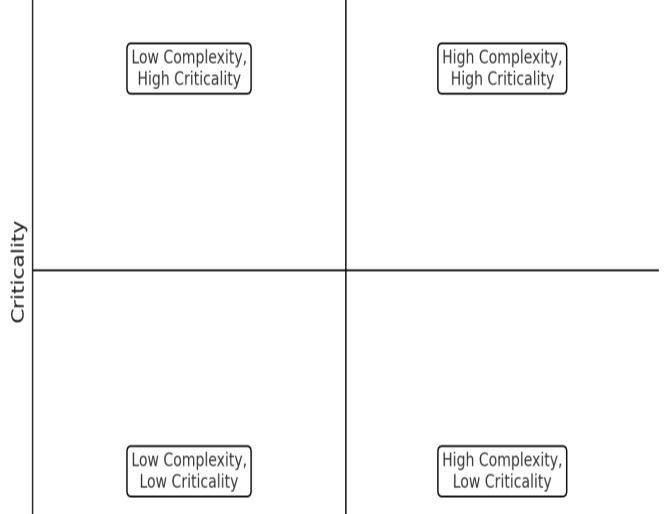
Fig-1:ComplexityandCriticalityMatrixvisualization
3.3TheoreticalFoundation
This approach aligns with risk-based governance, whereoversightintensityscaleswithpotentialharm[11], [15]. By explicitly categorizing tasks, the framework
International Research Journal of Engineering and Technology (IRJET) e-ISSN:2395-0056
Volume:11Issue:12|Dec2024 www.irjet.net p-ISSN:2395-0072
remains flexible, scalable, and adaptable to evolving regulations. It operationalizes governance principles, providing a path from abstract guidelines to concrete workflows.
4.1 Matrix as a Query Redirection and GovernanceFramework
The Complexity and Criticality Matrix serves as both a query redirection tool and an internal governance frameworkinAIsystems:
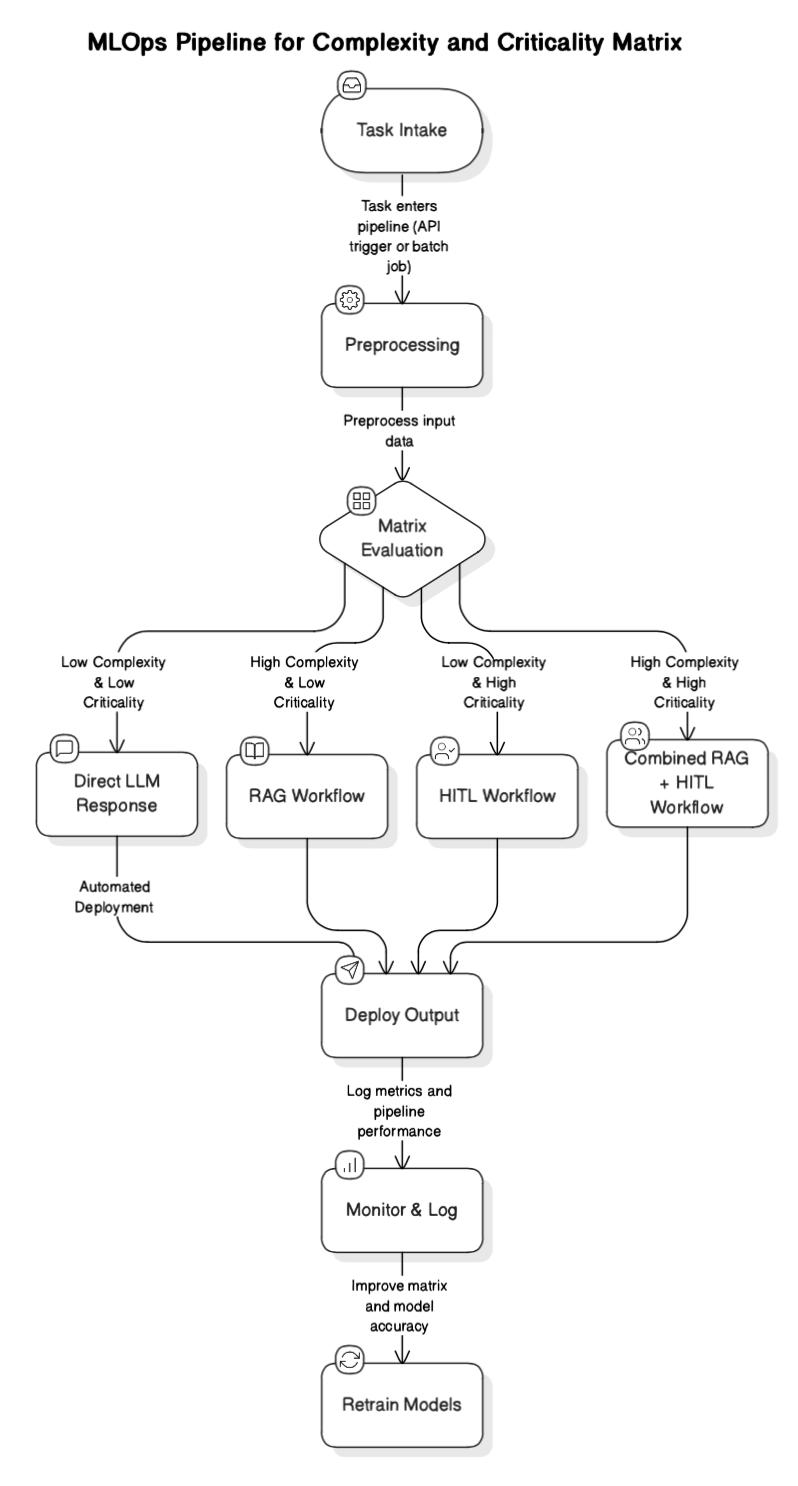
● QueryRedirection: By classifying queries based on their complexity and criticality, the matrix routes them to the most suitable model, whether that’s LLM, RAG, or HITL, ensuring accurate and efficientresponses.
● InternalGovernance: The matrix also acts as a governance mechanism, ensuring that AIgenerated responses meet industry-specific and region-specific compliance standards, applying the appropriate levels of oversight (e.g., RAG for factual grounding or HITL for compliance validation).
This dual functionality makes the matrix a powerful tool for organizations, allowing them to handle queries with compliance and efficiency while ensuring humanoversightwherenecessary.
Retrieval-Augmented
Generation: ImplementRAGbymaintaininga vector database ofauthoritativedocuments.Onreceivingaquery,perform a vector similarity search and feed the retrieved passages into the LLM prompt. Although this boosts accuracy, it addsinfrastructureandlatencyoverhead.
Human-in-the-Loop:
Forcritical outputs,route preliminaryRAG-based responses to compliance officers or domain experts. This ensures human judgment and accountability in highstakesscenarios.
4.2UseCasesAcrossVariousIndustries
The Complexity and Criticality Matrix adapts to different industries, each with unique compliance needs, by categorizing tasks and applying oversight mechanisms to ensureregulatoryadherence.
● Healthcare (e.g., HIPAA): High complexity/high criticality tasks, such as explaining privacy law penalties, use RAG plus HITL. Routine summaries (low complexity/low criticality) rely on direct LLMoutputs.
● Finance (e.g., SEC Filings): Complex regulatory interpretations trigger RAG and HITL, while simple financial FAQs are managed by LLM outputs.
● EnterpriseMonitoring: Routine log summaries (LL quadrant) are handled by LLMs, while suspicious security anomalies (HC quadrant) undergoHITLreview.
In DevOps/MLOps pipelines [7], [8], the matrix classification can be automated. Queries are tagged according to complexity and criticality, triggering the appropriate oversight strategy. Gated deployments and continuous integration checks ensure compliance standardsaremaintained.
The Complexity and Criticality Matrix serves as a dualpurpose framework that not only directs queries to the appropriate model but also ensures compliance with industry and regional regulations. It acts as a governance tool by applying oversight where necessary, whether for high-complexity/high-criticality tasks requiring RAG or HITL or for low-complexity/low-criticality tasks handled byLLMoutputs.Thisensuresthatorganizationscanscale AIsystemswhilemaintainingaccuracy,accountability,and regulatory compliance across industries like healthcare, finance,andenterprisemonitoring.
International Research Journal of Engineering and Technology (IRJET) e-ISSN:2395-0056
Volume:11Issue:12|Dec2024 www.irjet.net p-ISSN:2395-0072
Baseline LLM inference may be cost-effective but less reliable for complex or critical tasks [2], [4]. RAG introduces retrieval operations, adding infrastructure costs and milliseconds of latency [9]. HITL adds human review time and labor costs. By applying these resources selectively based on the matrix organizations can minimize overhead and ensure that costs scale only with risklevel.
Forinstance,vectorretrievalmaycost~$0.002–$0.01per query with slight latency additions [9], while LLM inference might cost ~$0.03–$0.10 per 1k tokens [2]. The matrix ensures RAG and HITL are reserved for queries whereimprovedaccuracyjustifiesextracostandlatency.
The Complexity and Criticality Matrix operationalizes governanceprinciplesfrom frameworkslikeNISTAIRMF [11], ISO/IEC standards [12], and proposed EU AI legislation[16].Whilegovernanceframeworksemphasize transparency, accountability, and fairness, they often lack actionableguidelinesforpracticalimplementationindaily AI operations. Many organizations struggle to operationalize these principles, often finding themselves caughtinlongcyclesofplanninganddocumentation.
Thisthesisintroducesapracticalgovernancesolutionthat enables organizations to align with high-level governance principleswhileprovidingconcretestepsfordeployment.
AddressingtheGapBetweenTheoryandPractice:
● Governance Principles: Existing frameworks outline governance principles, but organizations face challenges in applying these principles in real-world scenarios, particularly in regulated industries.
● ThePracticalSolution: The Complexity and Criticality Matrix operationalizes governance, providing clear guidelines on when to trust LLM outputs, when to use RAG, and when to involve HITL review. This approach makes it easier for organizations to implement and scale AI governance without getting bogged down in theoretical frameworks or over-engineered processes.
By categorizing tasks according to complexity and criticality, the matrix provides a straightforward way for organizations to ensure compliance at scale. Continuous oversight, audit trails, and HITL interventions can be integrated in a manner that aligns with governance frameworks and regulatory requirements. This reduces risksofnon-complianceandallowsorganizationstoadjust oversightdynamicallyastheygaintrustintheAIsystem’s performance
TheMatrixprovidesanoperationalframeworkthatallows organizations to meet governance standards efficiently, balancing automated processes with human oversight. Unlike theoretical frameworks that may leave organizations in an implementation gap, the Complexity and Criticality Matrix serves as a practical tool, ensuring organizations are both compliant and efficient in deployingAI.
International Research Journal of Engineering and Technology (IRJET) e-ISSN:2395-0056
Volume:11Issue:12|Dec2024 www.irjet.net p-ISSN:2395-0072
7.ChallengesandLimitations
● Task Classification Accuracy: Automatically classifying queries into complexity/criticality tiers remains non-trivial. Future research may explore zero-shot classification or heuristic rule-based approaches to improve accuracy [20], [21]. Feedback loops from HITL interventions can refine classification modelsovertime
● Balancing Automation and Oversight: While the matrix provides a structured approach, finding the optimal balance between automation and human review may be challenging. Ongoing evaluationandadjustmentsarenecessaryastrust inAIsystemsevolves.
● Scalability and Dynamic Regulations: As regulations evolve, thresholds and classification criteria may need recalibration. Future iterations could adapt dynamically, updating the RAG index and adjusting complexity/criticality tiers in response to regulatorychanges[16].
● Experimental Validation and Tooling: While this thesis lays the conceptual foundation, future work will provide empirical validation, user studies, and reference implementations. Subsequent research can test heuristic or zeroshotclassificationmodelsforquerycategorization andintegrateexplainabilitytoolstoimproveuser trust[20],[21].
8.FUTUREDIRECTIONS
Rigorous User Studies:
Validate the Complexity and Criticality Matrix by collaboratingwithdomainexperts,testingitonreal-world compliance documents, and assessing its performance acrossvariousindustriesandregulatorycontexts.
Advanced Reasoning Integration: Explore symbolic reasoning or knowledge-graph-based reasoning to reduce reliance on probabilistic outputs and furtherenhanceinterpretabilityandaccuracy.
Dynamic Thresholds: Implementadaptivemechanismsthatautomaticallyadjust complexity and criticality thresholds as models and organizational requirements evolve, minimizing manual recalibration.
Explainability Tools: Develop tools to enhance user trust by indicating which knowledge sources were retrieved during RAG and providing transparency about HITL interventions. Such
explainabilityfeaturescanimprovecomplianceconfidence anduseracceptance.
The Complexity and Criticality Matrix offers a practical governance framework for deploying generative AI systemsincompliance-heavysectors.Bymappingtasksto an appropriate oversight level, the framework transforms high-level governanceprinciplesinto actionableguidance. Itprovidesastructuredapproachtobalancingautomation with regulatory adherence, ensuring each query receives proportionatescrutiny.
Although conceptual at this stage, the matrix sets the groundwork for future research and implementation. Subsequent studies can empirically validate its effectiveness,integrateheuristicorzero-shotclassification techniques for task categorization, and develop explainability tools to foster trust and transparency. As enterprises increasingly rely on generative AI, this framework can serve as a cornerstone for responsible, efficient,andcompliantAI-drivenoperations.
[1]T.Miller,“ExplanationinArtificialIntelligence:Insights fromtheSocialSciences,” Artif.Intell.,vol.267,2019.
[2]OpenAI,“GPT-4TechnicalReport,”OpenAI,2023.
[3] Z. Ji, et al., “Survey of Hallucination in Neural Machine Translation,” EMNLP,2022.
[4] E. F. Bender, T. Gebru, et al., “On the Dangers of Stochastic Parrots: Can Language Models Be Too Big?” FAccT,2021.
[5] M. Veale, “Governing machine learning that matters: Adaptiveregulation,responsivecoordinationandtherisks ofregulatorentrepreneurship,” InternetPolicyReview,vol. 8,no.2,2019.
[6] R. Calo, “Artificial Intelligence Policy: A Primer and Roadmap,” U.C.DavisLawReview,vol.51,2018.
[7] T. Sato, “DevOps Patterns and Anti-Patterns,” IEEE Software,vol.33,no.6,2016.
[8] T. Klausen, “MLOps: ModelOps, DataOps, and EverythingInBetween,” InfoQ,2022.
[9] P. Lewis, et al., “Retrieval-Augmented Generation for Knowledge-IntensiveNLPTasks,” NeurIPS,2020.
[10] K. Starek, et al., “Guiding Humans and Machines towardBetterDecisions,” CHI,2021.
International Research Journal of Engineering and Technology (IRJET) e-ISSN:2395-0056
Volume:11Issue:12|Dec2024 www.irjet.net p-ISSN:2395-0072
[11] NIST, “Artificial Intelligence Risk Management Framework(AIRMF),”NIST,2023.
[12] ISO/IEC 27001:2013, “Information technology Security techniques Information security management systems Requirements,”ISO/IEC,2013.
[13] T. W. Simpson and B. E. Henneman, “Human-in-theLoop Systems Engineering Framework for Enhancing Human–Machine Teaming in Complex Systems,” Systems, vol.10,no.3,2022.
[14]USDept.ofHealth&HumanServices,“HIPAAPrivacy Rule,”HHS.gov.
[15] OECD, “Recommendation of the Council on Artificial Intelligence,”OECDLegalInstruments,2019.
[16]EuropeanCommission, “Proposal fora Regulation on ArtificialIntelligence,”2021.
[17] S. Liu, et al., “Pre-train, Prompt, and Predict: A Systematic Survey of Prompting Methods in NLP,” ACM Comput.Surv.,2023.
[18] J. Buolamwini and T. Gebru, “Gender Shades: Intersectional Accuracy Disparities in Commercial Gender Classification,” PMLR,2018.
[19]M.Mitchell,etal.,“ModelCardsforModelReporting,” FAT.,2019.
[20]Y.Xia,etal.,“Zero-ShotLearning AComprehensive Review,” NeuralNetworks,vol.124,2020.
[21] B. Zhang, et al., “Automated Heuristic-Based ClassificationinNLPPipelines,” IEEEAccess,vol.8,2020