
International Research Journal of Engineering and Technology (IRJET) e-ISSN: 2395-0056
Volume: 12 Issue: 06 | Jun 2025 www.irjet.net p-ISSN: 2395-0072
International Research Journal of Engineering and Technology (IRJET) e-ISSN: 2395-0056
Volume: 12 Issue: 06 | Jun 2025 www.irjet.net p-ISSN: 2395-0072
Sumit Bhatnagar
Independent Researcher, New Jersey, USA
Abstract - The rise in fraudulent activities across the banking, insurance, governmental, and law enforcement sectors has heightened the need for robust fraud detection and prevention systems. This paper explores an AI-driven approach to combat credit card-not-present (CNP) fraud, a prevalent form of fraud characterized by the unauthorized use of card details for online transactions. Given the increasing sophistication of fraud attempts, it is essential to implement effective measures that protect sensitive personal information. We present a comprehensive framework known as the Credit Card Fraud Detection and Prevention (CCFDP) system, which integrates big data analytics to identify and mitigate fraudulent activities. The CCFDPencompassesboththeFraudDetectionProcess(FDP) and the Fraud Prevention Process (FPP), with the FDP focusing on detecting suspicious behaviors and the FPP aiming to thwart potential fraud before it occurs. To enhance the efficacy of the FDP, Logistic Regression Learning (LRL), and Random Under Sampling (RU). Ensuring a balanced dataset is crucial, which is achieved through random under sampling. Additionally, to improve data organization and reduce dimensionality. In the FPP, the LRL model is utilized to predict the likelihood of successful or unsuccessful transactions, thereby enabling proactivemeasuresagainstCNPfraud.TheproposedCCFDP framework is implemented using Python, demonstrating its applicability in real-world fintech environments. This researchaimstoprovideinsightsintoeffectivestrategiesfor enhancing fraud detection and prevention capabilities, ultimately contributing to a more secure financial landscape.
Key Words: CCFDP, logistic regression learning, PCA, LRL, fraud prevention
1.INTRODUCTION
The Importance of Detecting Fraud in Financial Technology All throughout the globe, people's perspectives, behaviors, and expectations surrounding financial transactions have been transformed by the fintech revolution, which brought about a digital transformation in the financial services industry. Despite enhancing accessibility, efficiency, and innovation, financial institutions are today more vulnerable to complicated forms of fraud. Having reliable fraud detectiontoolsisoftheutmostimportanceinthisdynamic
environment. Efficient fraud detection is essential for safeguarding financial assets and maintaining the trust and reliability of digital financial services. [1-2] The integration of state-of-the-art ML and AI technology with fintech is setting the stage for a revolutionary change in the area of fraud detection. These technologies guarantee a significant improvement in the ability to detect and preventfraudulentactsbyanalyzinglargedatasetsinrealtime, recognizing complex patterns, and accurately anticipating fraudulent transactions. Implementing fraud detectionsystemspoweredbyartificialintelligenceisone way to decrease the possibility of financial crimes and establish a safe space for transactions, which keeps users loyal to fintech platforms. The use of AI and ML in the identificationoffraudisnotwithoutitschallenges,though. At one end of the spectrum are ethical considerations regarding data privacy, and at the other end of the spectrum are technical obstacles, such as regulating algorithmic biases and the need for massive processing resources. Furthermore, AI systems need to be able to identify new fraudulent schemes as they come up and constantly adjust to these approaches if they are to be effective in avoiding financial fraud. Consequently, preventing financial fraud and maintaining satisfied and confident clients are two of the most important reasons why fraud detection inside the fintech ecosystem is so important. The utilization of complex technological interventions is a must for digital financial transactions. This introductory section lays the groundwork for a comprehensive examination of how artificial intelligence and machine learning have transformed fintech fraud detection, thereby resolving one of the most pressing issuesintheeraofdigitalfinance.
Enhancing Fraud Detection with Artificial Intelligence Fintech platforms have proliferated in the digital age, ushering in a new era of remarkably quick financial transactions. Financial fraud has grown increasingly prevalent and sophisticated alongside the expansion of digital financial services, posing severe dangers to their security and integrity. Despite these challenges, AI has emerged as a revolutionary tool for enhancing fintech fraud detection. The ways in which fraud is detected and preventedhavebeenrevolutionizedbytheintroductionof artificialintelligence(AI)toolslikedeeplearning(DL)and ML. The use of AI has greatly improved the efficiency and accuracy with which fintech companies can analyze large
International Research Journal of Engineering and Technology (IRJET) e-ISSN: 2395-0056
Volume: 12 Issue: 06 | Jun 2025 www.irjet.net p-ISSN: 2395-0072
datasets, spot complex fraud patterns, and predict fraudulent transactions [3]. This enhances the safety of monetary transactions while ensuring a dependable and problem-free experience for users. The proactive capabilities of AI surpass those of traditional transaction monitoring through the integration of advanced analytics that analyze consumer behavior and communication patterns. By implementing an all-encompassing plan, potentially fraudulent activities like phishing and identity theft can be detected early on, reducing risks before they result in financial losses. Also, AI's adaptive learning algorithms are continuously getting better at predicting fraud,whichhelpsthemfoilcomplicatedschemes.Despite the great potential of AI, a number of concerns emerge when considering its use to the detection of fraud, including concerns about algorithmic bias, ethical decision-making, and data privacy. Achieving these goals andmaintainingpeople'faithrequiresAIpoliciesthatare both open and egalitarian. Using AI to improve financial technology fraud detection is the main focus of this introductory section. It highlights the importance of addressing both the practical and ethical challenges associatedwithcombatingfinancialcrimethroughtheuse of state-of-the-art AI capabilities. When it comes to safeguarding online financial transactions against the constantly evolving fraud landscape, artificial intelligence isattheforefrontofthefast-growingfintechindustry.[4]
To begin, the term "fraud" is defined simply as it pertains to financial technology. A person might be said to have committed fraud if they "intentionally deceived another person in order to obtain an unlawful benefit for themselves or to deny a right to a victim" [5]. Because fraudisanadaptivecrime,itisverydifficulttodetect[6], which is why large-scale financial statistics are necessary. A dataset is a collection of financial network transactions over a given time period. When fraud occurs in such datasets,itshowsupasan out-of-the-ordinaryrecord[7]. The anomaly detection methods utilized in the machine learningarea were employedtoidentify thesepatterns. It is not uncommon for anomaly detection systems to scan through enormous datasets for signs of fraud. Classifying out-of-the-ordinary data in such aggregations is an area wheretheyhavedemonstratedstrongperformance.These benefitsreallymakethemthebestoptionfordealingwith problemsrelatedtofraud detection.Thisarticleexamines three distinct forms of bank, credit card, and blockchainrelatedfraud.
Online purchases made with a credit card have recently exploded in popularity. A financial organization safeguards its clients' funds and records their payment
histories, while goods and services are easily accessible [8].Thesebenefitsarea big reasonwhycreditcardshave grown in popularity. Regrettably, this pattern is mirrored bytheprevalenceofcybercrimeinvolvingpurchasesmade via credit cards. The unauthorized acquisition of credit card information enables a specific form of fraud. The criminal typically does not even have physical access to the credit card. For these and other reasons, identifying and following frauds is no easy feat. To begin, there is a time-dependent determinism in the actions of both genuineandfraudulentusers.Asaresult,thereistypically a significant imbalance in the credit card data that is analyzed [9]. Frauds are difficult to spot since they don't follow a predictable pattern. Another issue is that just a tiny fraction of credit card purchases is fraudulent. The most natural course of action would be to keep tabs on user accounts and record any suspicious activity. Because of the huge number of people who already use credit cards,though,thisposesanadditionalissue[10].
In the realm of financial technology, there are various forms of fraud than credit card cybercrime. Plagiarism in online auctions and money laundering are two examples. The second category includes things like phony transactions, fraudulent loans and refunds, non-payment, and unauthorized purchases [11]. Occupational fraud refers to cybercrimes perpetrated from within an organization. A common prerequisite for such behavior is the unlawful collection of sensitive user information. The interconnectednatureofthefinancialtechnologyindustry makes it difficult to identify fraudulent transactions. This allows for the easy association of any user, item, or time period with fraud [12]. This is a major issue in nations with less stringent market regulations, such as free trade zones. The implementation and enforcement of rules like anti-money laundering (AML) at the state level is necessary to augment fraud detection [13]. The following publications use machine learning (ML) techniques appliedtofinancialdatasetstoaddressthisissue.
[14] ML and graph databases were suggested as a means ofdetectinganomaliesinfraudcontrol.Inarelatedstudy, [15] examined the phenomenon of money laundering. They unveiled a methodology for detection dubbed CoDetect, which examines a network its entities and transactions included to identify frauds and patterns in features.Formanyreal-lifefraudcases,CoDetectemploys a graph mining strategy. In their broader discussion, [16] laid out the usage of ML to detect financial transaction fraud. Adaptive Fintech security provision and anomaly detection models are derived from machine learningbasedintelligence,accordingtoathoroughframeworkfor Fintechtransactionmanagementputforwardby[17].
Volume: 12 Issue: 06 | Jun 2025 www.irjet.net p-ISSN: 2395-0072
Financial technology has been expanding at a rapid pace. Statista estimated that by 2024, the worldwide FinTech industrywouldbeworthabout$80.08billion.Evenifthis expansionisfantasticforbusiness,itdoescomewithmore dangers. There has been an upsurge in fraudulent operationsasfraudstersperceivegreateropportunitiesto exploit. Over $40 billion was lost due to fraud in the financial industryalonein2023.Thisisgreat.Inmyearly days in the financial technology industry, we made extensive use of antiquated practices, such as rule-based systems. In order to detect well-established patterns of fraud, these methods were developed. Unfortunately, these technologies were unable to adapt to the changing natureoffraudtactics.Boththeirspeedandaccuracywere lacking.Customersarefrustratedandlostfaithbecauseof the frequent occurrence of genuine transactions being marked as fraudulent. The incorrect flagging of a customer's transaction as fraudulent caused a holdup in their payment, and I recall that specific occurrence. The consumer was irritated, and our connection with them sufferedasaresult.[18]
Real-WorldApplicationsofAI-DrivenFraudDetection
It's not just a theory anymore; FinTech companies all around the globe are using AI-driven fraud detection. Think about PayPal. Once a day, they go through millions of transactions using algorithms for machine learning. Possible fraudulent acts can be detected in real-time by the AI system they employ. By taking this preventative measure, the corporation has spared itself millions in losses. One such example is Revolut, a frontrunner in the financial technology industry. AI has also been included into their fraud detection procedures. With each transaction, their system learns something new, allowing it to adapt to emerging risks. For user trust to be maintained, it is essential that legitimate transactions be executed smoothly. Having faith in one another is crucial inthebankingsector.Users will notremainiftheydonot believe their funds are secure. As an individual, I have witnessed firsthand the effects of AI in the fight against fraud. Our AI system had us on edge when we initially releasedit.Isitreallygoingtomatter?Itwasanemphatic yes. Our previous system had missed some fraudulent transactions, but this newapproach not onlycaught them all but also lowered the amount of appropriately marked realones.Thankstothis,ourclientsandwebothcameout ahead.Usingfalserepresentationsorengagingincriminal deceittounfairlybenefitoneselfattheexpenseofanother or to damage their rights or interests is fraud [1]. International online fraud has increased dramatically as a consequence of the widespread use of online payment methods and technology, causing huge monetary losses. TheproliferationofonlinepaymentmethodsandInternet
of Things (IoT) devices has led to an increase in both the volume of transactions and the probability of fraud [2]. For instance, there has been an uptick in the number of reportedinstancesofcreditcardfraudinAmerica[3].The 2023CreditCardFraudReportstatesthatin2022,65%of UScreditandcreditcardholdershadbeenvictimsoffraud atsometimeintheirlives,whichisanincreasefrom58% in 2021 [4]. Even in the Republic of Korea, people are falling victim to credit card fraud, which is a worldwide problem [5]. There is an immediate requirement for effective fraud detection systems due to the widespread nature of fraud. [19-20] When discussing methods for identifying fraudulent activity, two prominent schools of thinkingexist:useandanomalydetection[21].Thetaskof abuse detection, which employs machine learning-based classification algorithms, is to distinguish between legitimate and fraudulent transactions. Contrarily, anomaly detection creates a profile for every transaction usingitstypicalcharacteristics,asindicatedbysuccessive records. This study introduces a method for abuse detectionthatintegrateslinearregression(LR),K-nearest neighbor (KNN), and linear discriminate analysis (LDA).[22]
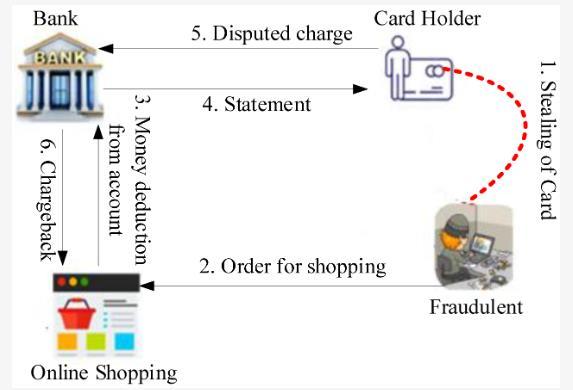
Figure1.Creditcard-fraudtransactionsystem
2.
The planned Credit Card Fraud Detection and Prevention (CCFDP) system uses advanced big data analytics to combatcreditcard-not-present(CNP)fraud.Twoprimary areasin whichit excelsare theFDPandtheFPP, or fraud detection and prevention. Logistic Regression Learning (LRL), PCA and SVD are used to decrease dimensionality; Random Under sampling is used to balance the dataset using the FDP. When the FPP notices questionable behavior, it employs the LRL model to evaluate the situationandthwartanyfraudulentattempts.ThePythonbased CCFDP system has proven to enhance the security and dependability of fintech financial transactions in
International Research Journal of Engineering and Technology (IRJET) e-ISSN: 2395-0056
Volume: 12 Issue: 06 | Jun 2025 www.irjet.net p-ISSN: 2395-0072
testing. The CCFDP approach is seen as beneficial when using a variety of statistical performance metrics, including Mean Directional Accuracy (MDA), Mean Bias Error(MBE),RelativeRoot MeanSquaredError(RRMSE), and Root Mean Squared Error (RMSE). One may compare CCFDP to other models using these metrics, including LSTM-RNN, CSLMLE, CCFDM (Enhanced Secure Deep Learning), ITCCFD, and BTG. Extensive testing demonstrates the efficacy of the Python-based CCFDP system in enhancing the security of fintech financial transactionsandincomparison,toexistingfrauddetection approaches.
Thegroupofushaslocatedthe"creditcard.csv"dataseton Kaggle,whichwillbeusedtotrainourmodel.Therearea totalof31featuresinthisfile.Creditcardpurchasesmade inSeptember2013arepartofthedataset.Withfraudulent transactions accounting for 0.172 percent of the positive class, the dataset is imbalanced. It employs PCA transformation exclusively on numerical input variables. Confidentiality constraints prevent us from disclosing the original features and extra context of the data. As a result ofprincipalcomponentanalysis(PCA),thefeatures ��={��1,��2, ,��31}F={F1,F2, ,F31}.
OnlythequantityandtiminghavebeenpreservedviaPCA. Included in the dataset, the "Time" feature details the number of seconds that passed between the initial transaction and each succeeding one. The feature "Amount" can be used to describe the amount of a transaction for example-dependent, cost-sensitive learning. When fraud is identified, the response variable, Feature "Class," gets the value 1, and otherwise, it takes the value 0. Given the class imbalance ratio, we suggest determining accuracy by squaring the precision-recall curve. The accuracy of a confusion matrix of little use when the categorization is imbalanced. Some intriguing findings have been derived from this dataset. The graphical results are drawn using the Python Polly package.[24-25].
The dataset has an asymmetrical distribution, as seen in Figure 2 Solving this issue has been crucial for detecting fraudulent behavior. The frequency of fraudulent cases is so low that any algorithm may reasonably assume all databaserequestsarelegitimate.
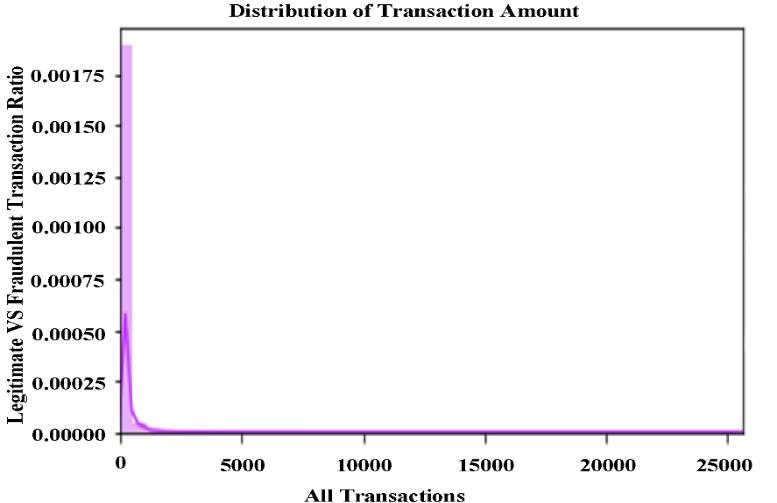
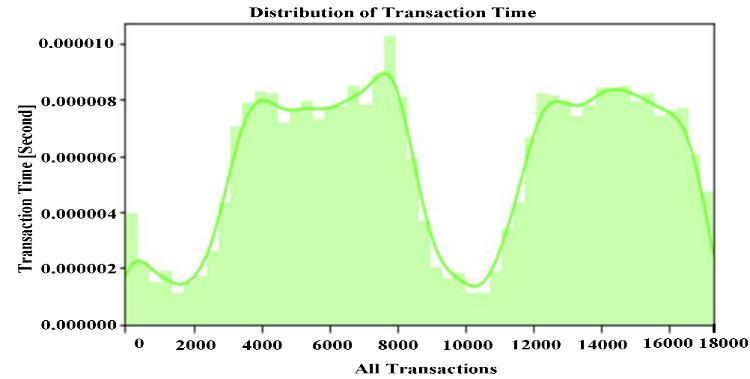
Figure 2. Shows financial dealings that are both legal and dishonest.Atitspeak,thefraudulenttransactionratewas 0.0178%,and25,000transactionswereexecuted.Figure3 Shows 18,000 transactions, together with the timestamps for each. With a maximum delay of 0.000010s, the transaction was finalized. Attacks on the transaction duringthattimearethecauseoftheincreasedlatency.
International Research Journal of Engineering and Technology (IRJET) e-ISSN: 2395-0056
Volume: 12 Issue: 06 | Jun 2025 www.irjet.net p-ISSN: 2395-0072
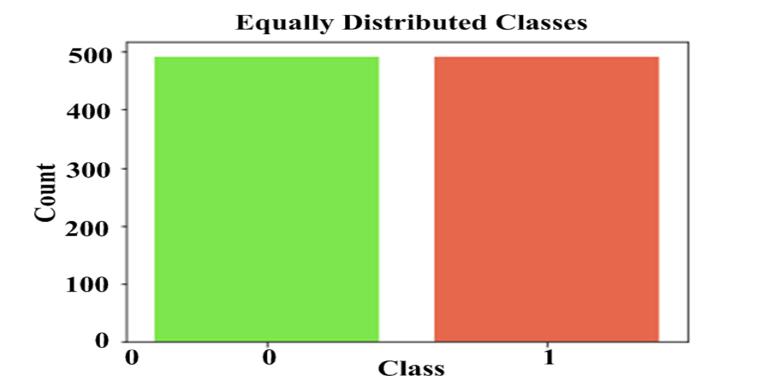
Abalanceddatasetisutilizedtotrainthemodel,asshown inFigure4usedtherandomundersamplingtechniqueto get this type of dataset. This procedure removes data points from the training dataset by randomly selecting them from the majority class. Until a more even distributionisachieved,mostclassinstancearedeletedat random via random under-sampling. Obtaining an equal number of valid and fraudulent transactions at random is thecentralgoalofthisexperiment.Additionally,itutilizes the information to generate a new data frame after selectingthem
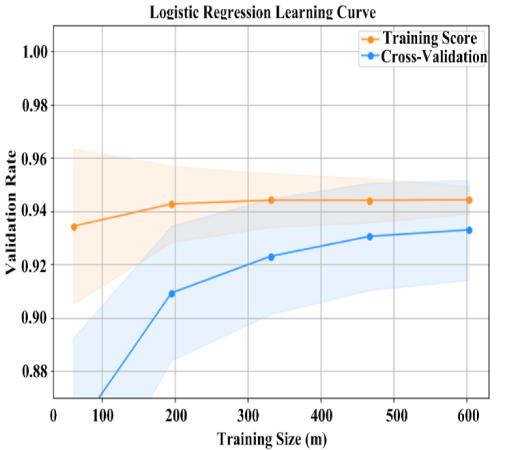
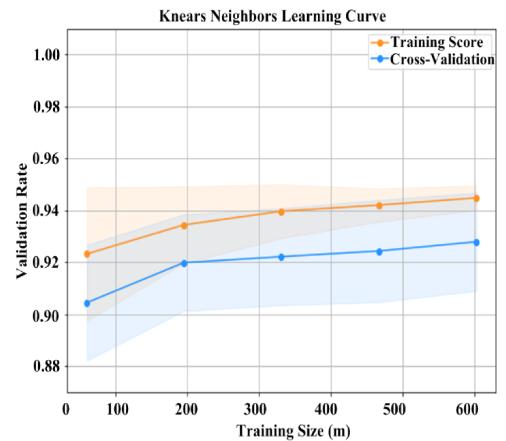
Figure 5-8 demonstrate the most sophisticated prediction classifiers' training and validation curves. Since there is little variation between the cross-validation and training scores, Logistic Regression is shown to be the most effective method. So, we've settled on this algorithm to constructourprediction model.Atrainingscore of95.1% and a cross-validation rate of 92.9 percent are output by the Logistic Regression. In this regard, two algorithms stand out: the decision tree classifier method and the knears neighbors learning algorithm. The former achieves 92.97%cross-validationand95.71%trainingscore,while the latter returns 92.11%. In comparison to other approaches, LR has a smaller discrepancy between crossvalidation88.21%andtraining-score,cominginat0.96%.
International Research Journal of Engineering and Technology (IRJET) e-ISSN: 2395-0056
Volume: 12 Issue: 06 | Jun 2025 www.irjet.net p-ISSN: 2395-0072
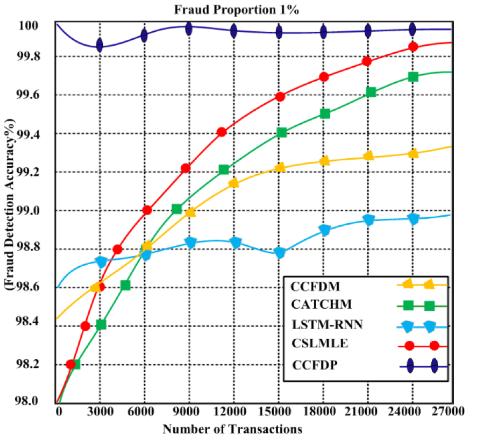
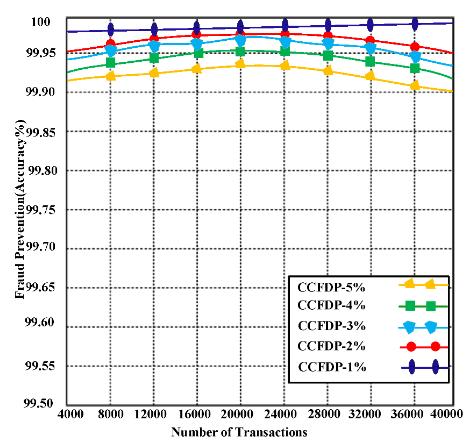
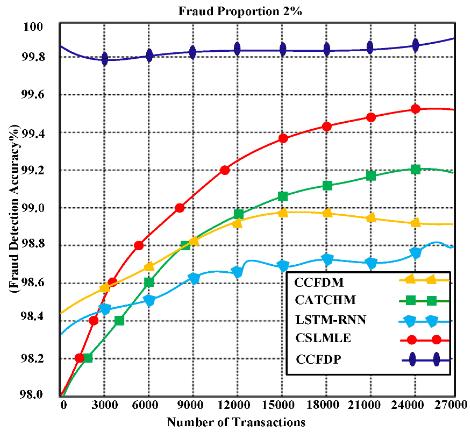
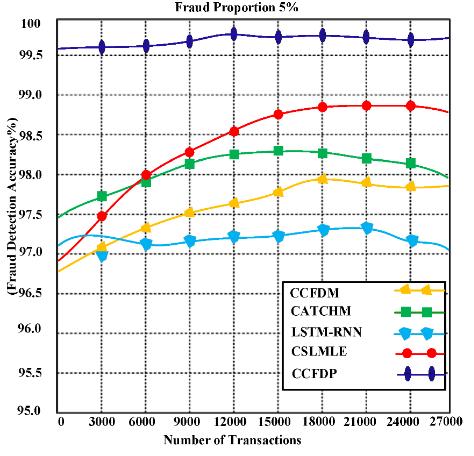
Figure9fraudsdetectionmodelswith1–5%fraud proportions.
Among the five frauds detection models tested (CCFDM, CATCHM, LSTM-RNN, CSLMLE, and CCFDP), all performed well at 1%, 2%, and 5% fraud proportions, with CCFDP reaching 100% accuracy at 1% fraud and retaining great performance at 2%. At 5%, however, accuracy drops significantly for all models except LSTMRNN andCATCHM,which reach97.5%.As the percentage of fraudulent transactions rises, the models are finding it moredifficulttodifferentiatebetweenrealandfraudulent transactions, according to this trend. It is suggested that additional model refining, feature engineering, and validation with real-world data be implemented to improveperformance,especiallyatgreaterfraudlevels.
Impressively,theCCFDPmodelachieves100%accuracyat 1% fraud, 99.95% at 2% fraud, 99.93% at 3% fraud, 99.94%at4%fraud,and99.91%at5%fraud.Thisshows thatCCFDPisverygoodatdetectingfraudandjustslightly less accurate as the fraction of fraudulent activity grows. With its reliable results, the model seems to be able to handlethedifficultiescausedbyincreasedfraudratesand isstrongindetectingfraudinmanysituations.Becauseof itsrobustness,CCFDPisanexcellentoptionforpreventing fraud in settings where the frequency of fraud can vary. The proposed CCFDP is evaluated using statistical performancemetrics,includingMeanDirectionalAccuracy (MDA), Mean Bias Error (MBE), Relative Root Mean Square Error (RRMSE), and Root Mean Square Error (RMSE), and its performance is compared against several competing methods such as CATCHM, LSTM-RNN, CSLMLE,CCFDM ,theEnhancedSecure-DeepLearning(ESDL) algorithm, Intelligent Two-Level Credit-Card Fraud Detection(ITC-CFD)andBridgetoGraph(BTG).
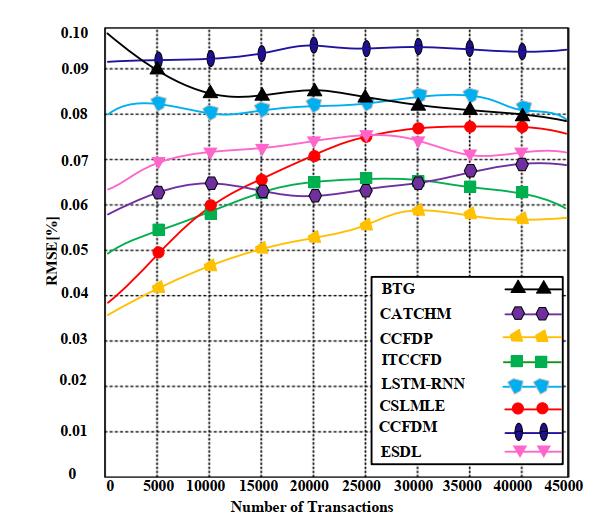
Figure10RootMeanSquareErrorperformance
Figure 10 Benchmarks for the performance of various machine learning models or techniques on a workload of 45,000 transactions, measured by Root Mean Square Error. There is probably a different model or algorithm behind each of these methods (BTG, CATCHM, CCFDP, ITCCFD, LSTM-RNN, CSLMLE, and ESDL), and their respective performance ratings. As an example, the relative performance or mistake rates of BTG and CATCHMareindicatedbytheirscores,whichare0.10and 0.05, respectively. Results for neural network-based methods like LSTM-RNN and others like CSLMLE and ESDL are 0.08 and 0.07, respectively. Accuracy, precision, and mistake rates are likely task-relevant variables that thesemeasurementsreflect.
International Research Journal of Engineering and Technology (IRJET) e-ISSN: 2395-0056
Volume: 12 Issue: 06 | Jun 2025 www.irjet.net p-ISSN: 2395-0072
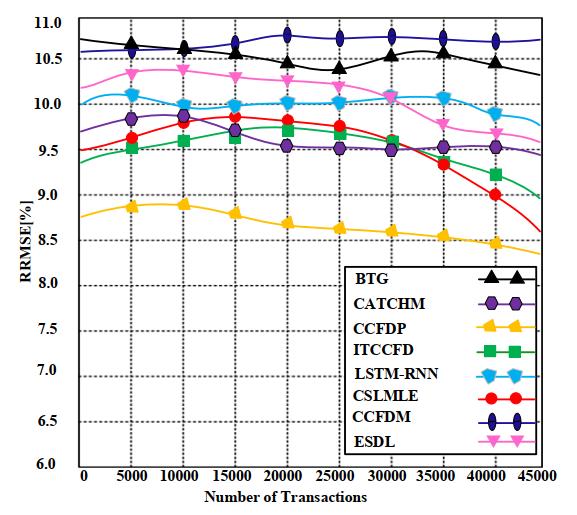
Figure11Relativerootmeansquaredperformance
Figure 11 shows Metrics for the performance of various machine learning models or strategies applied on 45,000 transactions, with larger values suggesting better performance. With a score of 10.9, BTG is the most effective model compared to CATCHM (9.9) and CCFDP (8.9). ITCCFD scores 9.4, LSTM-RNN obtains 10.1, and CSLMLE scores 9.51 in terms of performance. Both ESDL and CCFDM produce results of 10.2. These scores suggest that BTG and ESDL perform best in this context, possibly measuredbyaccuracyoranotherrelevantmetric.
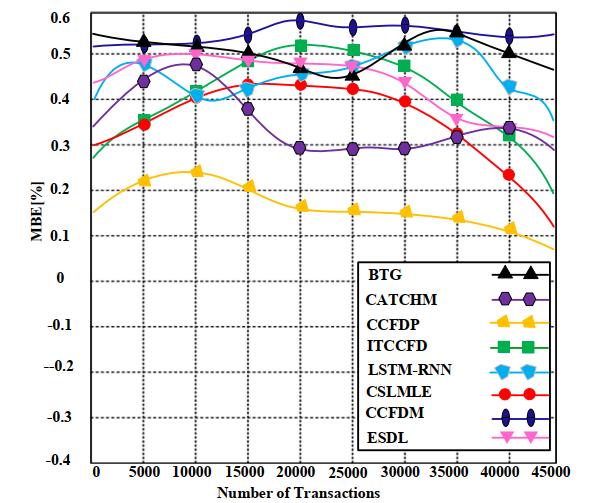
Figure12MeanBiasErrorperformances
Figure 12 shows The Mean Bias Error performance metrics for various machine learning models or techniques based on 45,000 transactions, likely representing accuracy, precision, or another evaluation
metric. BTG and CCFDM both achieve a score of 0.59, indicatingtheyperformsimilarlyandlikelybetterthanthe others.CATCHMscores0.39,whileCCFDPislowerat0.11. ITCCFD scores 0.29, LSTM-RNN reaches 0.4, CSLMLE has 0.3,andESDLperformsslightlybetterwithascoreof0.41. These values suggest that BTG and CCFDM lead in performance, while CCFDP may be the least effective in thiscontext.
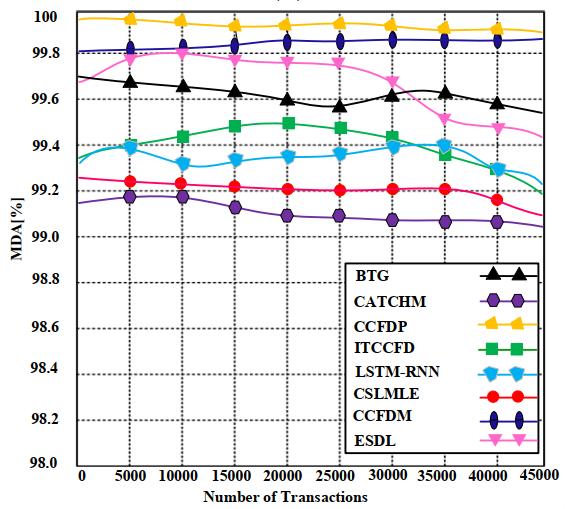
Figure13Meandirectionalaccuracy
Figure 13 shows MDA for the proposed CC-FDP and contending approaches with maximum transactions the data shows Mean directional accuracy performance metrics(likelyaccuracyorasimilarmeasure)fordifferent machine learning models or algorithms across 45,000 transactions, with all models performing at a very high level. BTG and ESDL both achieve 99.7, while CATCHM scores 99.19 and ITCCFD scores 99.39. LSTM-RNN scores 99.3,andCSLMLEandCCFDPbothreachaperfectscoreof 99.91. CCFDM leads with an even higher score of 99.99, suggesting it may be the top-performing model in this context. Overall, all models perform excellently, with minimaldifferencesintheirscores
The increased strain on fraud protection systems caused by online banking transactions has led to a dramatic increase in fraudulent behavior. They offer a CCFDP approachfordetectingandpreventingcreditcardfraudin this research. The suggested approach makes use of FDP and FPP. Four state-of-the-art methods RU, t-SNE, PCA, and SVD process make up the FDP and are utilized in the FDP module. The FPP learns via logistic regression. In addition, to improve detection accuracy, the Random undersamplingmethodhasbeenusedtoevenlydistribute realandfakesamples.Inordertoprovethatthesuggested
International Research Journal of Engineering and Technology (IRJET) e-ISSN: 2395-0056
Volume: 12 Issue: 06 | Jun 2025 www.irjet.net p-ISSN: 2395-0072
CCFDP is effective, the system has been tested on three different levels of fraud:1%,2%, and 5%. The findings validate the superiority of our proposed strategy in detectingfraud. Also,the proposedCCFDPiscompared to state-of-the-art methods for accuracy with CATCHM, LSTM-RNN, CSLMLE, CCFDM, and ESDL algorithm, Intelligent(TCCFDandBTG.Thecomparisonresultsshow that the suggested CCFDP is superior to the state-of-theart approaches currently used. More so than competing approaches, the proposed CCFDP can stop fraud in its tracks. The appropriateness of the suggested approach is further validated by the accuracy of the fraud prevention outcome. They will evaluate the spatial and temporal complexity of the planned CCFDP and other aspects of servicequalityinthenearfuture.
1. Carcillo, F. Dal Pozzolo, A. Le Borgne, Y.A. Caelen, O. Mazzer, Y. Bontempi, G. Scarff: A scalable framework for streaming credit card fraud detection with spark. Inf. Fusion 2018, 41, 182–194.
2. Kim, J.; Kim, H.J.Kim, H. Fraud detection for job placement using hierarchical clusters-based deep neural networks. Appl. Intell. 2019, 49, 2842–2861.
3. El Kafhali, S. Tayebi, M. XGBoost based solutions for detecting fraudulent credit card transactions. In Proceedings of the 2022 International Conference on Advanced Creative Networks and Intelligent Systems (ICACNIS), Bandung, Indonesia,23November2022;pp.1–6
4. Hajek, P. Abedin, M.Z. Sivarajah, U. Fraud detection in mobile payment systems using an XGBoost-based framework. Inf. Syst. Front. 2023, 25,1985–2003.
5. Seera, M.; Lim, C.P. Kumar, A. Dhamotharan, L.; Tan, K.H. An intelligent payment card fraud detectionsystem.Ann.Oper.Res.2024,334,445–467.
6. Van Belle, R.Baesens, B. De Weerdt, J. CATCHM: A novel network-based credit card fraud detection methodusingnoderepresentationlearning.Decis. SupportSyst.2023,164,113866.
7. Jha, S.; Guillen, M. Westland, J.C. Employing transaction aggregation strategy to detect credit card fraud. Expert Syst. Appl. 2012, 39, 12650–12657.
8. Tayebi, M. El Kafhali, S. Credit Card Fraud Detection Based on Hyper parameters
Optimization Using the Differential Evolution. Int. J.Inf.Secur.Priv.(IJISP)2022,16,1–21.
9. Mathew, A. Amudha, P. Sivakumari, S. Deep learning techniques: An overview. In Proceedings of the International Conference on Advanced Machine Learning Technologies and Applications, Jaipur, India, 13–15 February 2020; Springer: Singapore,2021;pp.599–608.
10. Salloum, S.A. Alshurideh, M.; Elnagar, A. Shaalan, K.Machinelearninganddeeplearningtechniques forcybersecurity:Areview.InProceedingsofthe International Conference on Artificial Intelligence and Computer Vision, Cairo, Egypt, 8–9 April 2020;Springer:Cham,Switzerland,2020;pp.50–57
11. LeCun, Y. Bengio, Y. Hinton, G. Deep learning. Nature2015,521,436–444
12. Li,Z.Pan,Z.Li,Y.;Yang,X.Geng,C.Li,X.Advanced root mean square propagation with the warm-up algorithm for fiber coupling. Opt. Express 2023, 31,23974–23989.
13. Sherstinsky, A. Fundamentals of recurrent neural network (RNN) and long short-term memory (LSTM) network. Phys. D Nonlinear Phenom. 2020,404,132306.
14. Wang, C.; Niepert, M. State-regularized recurrent neural networks. In Proceedings of the International Conference on Machine Learning. PMLR, Long Beach, CA, USA, 9–15 June 2019; pp. 6596–6606.
15. Yu, Y. Si, X. Hu, C.Zhang, J. A review of recurrent neural networks: LSTM cells and network architectures. Neural Comput. 2019, 31, 1235–1270.
16. Smagulova, K. James, A.P. A survey on LSTM memristive neural network architectures and applications. Eur. Phys. J. Spec. Top. 2019, 228, 2313–2324.
17. Garnett, R. Bayesian Optimization; Cambridge UniversityPress:Cambridge,UK,2023.
18. Swinburne, R. Bayes’ Theorem. Rev. Philos. Fr. L’etranger2004,194,250–251.
19. Dunlop, M.M. Girolami, M.A.; Stuart, A.M.; Teckentrup, A.L. How deep are deep Gaussian processes?J.Mach.Learn.Res.2018,19,1–46.
20. Wu, J. Chen, X.Y. Zhang, H. Xiong, L.D.; Lei, H.; Deng, S.H. Hyper parameter optimization for
International Research Journal of Engineering and Technology (IRJET) e-ISSN: 2395-0056
Volume: 12 Issue: 06 | Jun 2025 www.irjet.net p-ISSN: 2395-0072
machine learning models based on Bayesian optimization. J. Electron. Sci. Technol. 2019, 17, 26–40.
21. CreditCardFraudDataset.2023.Availableonline: https://www.kaggle.com/mlgulb/creditcardfraud/data (accessed on 26 December2023).
22. Abdi, H.; Williams, L.J. Principal Component analysis. Wiley Interdiscip. Rev. Comput. Stat. 2010,2,433–459.
23. El Kafhali, S. Tayebi, M. Generative adversarial neural networks based oversampling technique forimbalancedcreditcarddataset.InProceedings of the 2022 6th SLAAI International Conference on Artificial Intelligence (SLAAI-ICAI), Colombo, SriLanka,1–2December2022;pp.1–5.
24. Hordri,N.F.Yuhaniz,S.S.Azmi,N.F.M.Shamsuddin, S.M.Handlingclassimbalanceincreditcardfraud usingresamplingmethods.Int.J.Adv.Comput.Sci. Appl.2018,9,390–396.
25. Feurer, M. Hutter, F. Hyperparameter optimization. In Automated Machine Learning: Methods, Systems, Challenges; Springer: Cham, Switzerland,2019;pp.3–33.
© 2025, IRJET | Impact Factor value: 8.315 | ISO 9001:2008
| Page