
International Research Journal of Engineering and Technology (IRJET) e-ISSN: 2395-0056
Volume: 12 Issue: 10 | Oct 2025 www.irjet.net p-ISSN: 2395-0072
International Research Journal of Engineering and Technology (IRJET) e-ISSN: 2395-0056
Volume: 12 Issue: 10 | Oct 2025 www.irjet.net p-ISSN: 2395-0072
Mohd
Shahzad1, Laraib Ahmad Siddiqui2, Md Sarazul Ali3, Mohd Umar Khan4
1AWS and DevOps Engineer, Deloitte, India
2Program Control Services Analyst, Accenture, India
3Senior Associate Technical Consultant, Ahead DB, India
4Student, Aligarh Muslim University, India ***
Abstract - The Metaverse represents a transformative convergence of digital and physical realms, reshaping the design, interaction, and management of virtual spaces. This paperinvestigatesintegratingDigitalTwins,AI,andExtended Realitytocreatescalable,immersiveMetaverseenvironments. By proposing a comprehensive implementation framework, supported by real-world datasets and Python-based analysis, thisresearchbridgestheoreticaladvancementswithpractical applications. The framework focuses on real-time data integration, AI-driven optimization, and XR-enabled immersive design to enhance user experience, operational efficiency, and sustainability. Through case studies, dataset analysis, and code implementations, this paper offers architects and developers a blueprint for utilizing these technologies in Metaverse architecture.
Key Words: Digital Twins, Artificial Intelligence, Extended Reality, Metaverse Architecture, Immersive Virtual Environments, Real-Time Data, AI Optimization, Python Simulation
TheMetaverserepresentsanemergingparadigmwherethe boundaries between the physical and digital worlds increasingly converge. It constitutes an interconnected ecosystem of virtual environments that enable real-time, immersive, and persistent interactions through avatars, intelligent interfaces, and simulated spaces. Unlike conventional digital platforms, the Metaverse offers continuous, interactive, and scalable experiences that facilitatesocialengagement,collaboration,commerce,and creativeexpression.
Withinthisevolvinglandscape,keyenablingtechnologies, namely Digital Twins (DTs), Artificial Intelligence (AI), and Extended Reality (XR),serveasfoundationalpillarsfor the design, operation, and optimization of virtual architectures.Theintegrationofthesetechnologiesfosters environments that enhance user experience, improve efficiency,andpromotesustainability.Thisstudyproposesa comprehensive framework for embedding DT, AI, and XR withinMetaversearchitecturaldesignanddemonstratesits
practical applicability through case analyses, dataset evaluation,andPython-basedsimulationmodels.
2.1
The Metaverse is increasingly described as a persistent, shared, and immersive virtual realm that bridges physical anddigitalrealities(Leeetal.,2021).Intheircomprehensive survey,LeeandcolleaguescharacterizetheMetaverseasa unified ecosystem enabled by technologies such as XR, AI, blockchain,andIoT,whereuserscancollaborativelyexistand interactinrealtimeacrossspatialandtemporalboundaries. As Ning et al. also note, the Metaverse is not a monolithic spacebutanetworkofinteroperablevirtualrealmswhere social,economic,andcreativeactivitiescantakeplace(Ning etal.,2021).
Architectural design within these virtual realms demands adaptation beyond staticmodeling.Thearchitecture must evolvedynamically,respondingtouserbehavior,contextual data, and system optimization. This shift from traditional architecturetoresponsive,data-drivenvirtualarchitecture marksanewfrontierinspatialdesign.
OneoftheforemostdifficultiesinMetaversearchitectureis scalability.Supportinglargenumbersofconcurrentusersin immersive 3D environments demands low-latency networking, distributed rendering, and scalable backend infrastructure (e.g., edge computing and cloud systems (Mayeretal.,2025).
Interactivityisequallycrucial.Virtualspacesmustsupport smooth navigation, low-lag interactions, and intuitive controls to maintain user engagement and presence (especially in XR). Scholars emphasize the importance of eliminatingfrictionbetweenuserintentandsystemresponse topreserveimmersion(Lyu&Fridenfalk,2024).
Realism and immersion remain central challenges. Virtual environments must replicate the spatial, visual, and
International Research Journal of Engineering and Technology (IRJET) e-ISSN: 2395-0056
Volume: 12 Issue: 10 | Oct 2025 www.irjet.net p-ISSN: 2395-0072
behavioralrichnessofphysicalreality.Advancesinrendering techniques, physics engines, and spatial simulation are increasingly used to narrow the fidelity gap. For instance, digital twins and photorealistic modeling are leveraged to enhancerealisminvirtualenvironments.
2.3.1
DigitalTwinsarevirtualrepresentationsofphysicalsystems that update in real time with data from sensors and IoT devices.Inmanufacturing,Qi&Tao(2018)presenta 360degree review of digital twin integration with big data to supportsmartmanufacturing(e.g.,predictivemaintenance, real-time simulation, feedback control). This paradigm is extendedintovirtualenvironmentstosynchronizephysical realitywithitsdigitalcounterpart.
Further,inDigitalTwinforSmartManufacturing:AReview, authors detail how digital twins enable simulation, monitoring,andoptimizationacrossthelifecycleofphysical systems (e.g., factories, energy systems). Such capabilities translate into virtual-physical synchrony within the Metaverse,formingthebackboneforadaptivevirtualspaces.
2.3.2
AI plays a multifaceted role in the Metaverse architecture, from generative modeling to predictive adaptation. The surveyArtificialIntelligencefortheMetaverse(Huynh-Theet al.,2022)exploreshowAItechniques(vision,language,agent learning)canpowerintelligentenvironmentsandinteractive digitalagents.
In the Metaverse context, AI supports generative design (creatingoptimalspatiallayouts),personalization(adapting environments to individual behavior), and predictive analytics(forecastingcrowdpatternsorresourceneeds).
XR(VR/AR/MR)istheperceptualandinteractionlayerofthe Metaverse.Itenablesimmersivevisualizationandinteraction withvirtualspaces.AsLeeetal.(2021)emphasize,XRisa foundationalenableroftheMetaverse,drivingpresenceand embodiedinteraction(Leeetal.,2021).
XRalsosupportscollaborativedesign,allowingdistributed teams to co-navigate, co-evaluate, andco-construct virtual architectures in real time, and enables virtual tours and experientialmarketingindigitalenvironments.
This research introduces a comprehensive framework for integratingDigitalTwins(DT),ArtificialIntelligence(AI),and ExtendedReality(XR)technologiestodesign,optimize,and
managevirtualspaceswithintheMetaverse.Byleveraging datasetscombiningInternetofThings(IoT)sensordatafrom physicalenvironmentswithuserinteractiondatafromvirtual spaces, and employing Python-based analytical and simulation tools, this framework provides a systematic approach for implementing advanced technologies in Metaversearchitecture.
DigitalTwinsserveashigh-fidelityvirtualreplicasofphysical environmentsthatevolveinreal-timebasedonIoTsensor data(Qi&Tao,2018;Leeetal.,2021).
Sensors and Data Acquisition: IoT sensors continuously collectenvironmentaldatasuchastemperature,humidity, and energy consumption. Operational metrics, including systemusageandoccupancy,aretransmittedtoupdatethe virtualmodelinreal-time.
Real-TimeFeedback:ThedynamicnatureofDigitalTwins enablesimmediatefeedbackonenvironmentalconditions. Thisallowsarchitects,urbanplanners,anddevelopersto monitor and adjust virtual spaces in response to live physicalanduser-drivendata,enhancingdecision-making efficiencyandspatialaccuracy.
AIalgorithmsprocessreal-timeDigitalTwindatatopredict user behavior, optimize spatial layouts, and provide actionableinsights.
UserBehaviorPrediction:Machinelearningmodelsanalyze historical and live user interaction data (e.g., avatar positions, interaction hotspots) to forecast engagement patternsandguideproactivedesignadjustments.
Design Optimization: AI-driven spatial analysis identifies inefficiencies in layout or environmental conditions and recommends optimized configurations for both user experienceandresourceutilization(Lietal.,2021).
3.2.1
Extended Reality (XR), encompassing Virtual Reality (VR), AugmentedReality(AR),andMixedReality(MR),provides immersive platforms for the prototyping, evaluation, and collaborationofvirtualspaces.
•ImmersiveDesignReviews:Stakeholderscannavigateand interact with fully immersive 3D prototypes, assessing lighting, materials, spatial configurations, and functional workflowsbeforeimplementation.
International Research Journal of Engineering and Technology (IRJET) e-ISSN: 2395-0056
Volume: 12 Issue: 10 | Oct 2025 www.irjet.net p-ISSN: 2395-0072
• Collaborative Design Process: XR enables geographically distributed teams to collaborate in real time, facilitating iterativedesign,rapidprototyping,andcollectivedecisionmaking(Zhangetal.,2025).
IncorporatinguserfeedbackdirectlyintoXRenvironments ensures that virtual spaces are intuitive, engaging, and alignedwithuserneeds.
• User Testing: Participants interact with virtual spaces to providequalitativeandquantitativefeedbackonnavigation, usability,andaestheticappeal.
• AI-Driven Analytics: Collected feedback is processed throughAIalgorithmstoinformdesignrefinements.Adaptive modificationscanbeimplementedtoenhanceusabilityand overallusersatisfaction.
3.3.1
User interactions within the Metaverse are continuously monitored to provide a detailed understanding of virtual spaceutilization.
•UserInteractionData:Dataonavatarpositions,navigation paths, and interaction events are captured to evaluate engagement,spatialtraffic,andresourceuse.
• Dynamic Environment Simulation: Real-time data feeds drivesimulationsthatmodelenvironmentalbehaviorunder varyinguserloads,enablingarchitectstoanticipatesystem stresspointsandadjustdesignsproactively.
3.3.2 AI-Powered Analytics
AIprocessesthesedatasetstoenhanceuserexperienceand optimizeenvironmentalefficiency.
• Experience Enhancement: Predictive models identify potential bottlenecks or navigational challenges and recommendinterventionstoimproveuserflow.
• Spatial Optimization: Algorithms suggest layout modifications, dynamic reconfiguration of environmental elements, or resource allocation adjustments to maximize usabilityandenergyefficiency.
3.4.1 Energy Optimization
TheintegrationofDigitalTwinsandAIsupportssustainable virtualspacemanagementbymodelingenergyconsumption andsuggestingresource-efficientstrategies.
• Monitoring and Simulation: Energy usage in virtual environments is continuously monitored, allowing AI to recommend adjustments, such as lighting reduction in underutilizedareas.
• Sustainability Modeling: Predictive simulations assess environmental impacts, enabling designers to select configurations that minimize energy consumption and carbonfootprint.
3.4.2
AI-drivenadaptive systems in virtual environments create personalizedandefficientuserexperiences.
• Personalized Environments: Environmental parameters such as lighting, temperature, and acoustic conditions are automaticallyadjustedtoindividualuserpreferencesinreal time.
•AdaptiveSystems:Spacesdynamicallyrespondtocollective userbehavior,forexample,increasingresourceallocationor adjustinglayoutsinhigh-trafficvirtualzones.
International Research Journal of Engineering and Technology (IRJET) e-ISSN: 2395-0056
Volume: 12 Issue: 10 | Oct 2025 www.irjet.net p-ISSN: 2395-0072
ThedatasetutilizedinthisstudyintegratesInternetofThings (IoT) sensor data from physical environments with user interaction data from virtual Metaverse spaces. This comprehensive dataset facilitates the creation of Digital Twins(DTs)andsupportsArtificialIntelligence(AI)-driven optimizationswithinvirtualspaces.Thedatasetcomprises thefollowingcomponents:
•Timestamp:Theprecisetimeatwhicheachdatapointwas recorded.
•BuildingMetrics:Real-timedatacollectedfromIoTsensors inphysicalenvironments,including:
Temperature(°C)
Humidity(%)
EnergyConsumption(kWh)
•MetaverseInteractionData:Userbehaviordatafromvirtual environments,including:
Avatar Position (X, Y): Spatial coordinates of user avatarswithinthevirtualspace.
Interaction Points: Count of user interactions (e.g., clicks,toolusage)withintheMetaverse.
Anexampleofthedatasetstructureisasfollows:
Table 1: Sample IoT and Metaverse interaction dataset.
Table 2: Statistical summary of environmental and avatar interaction data.
4.3.1
The dataset was meticulously collected from IoT sensors deployed in physical buildings, capturing environmental metrics such as temperature, humidity, and energy consumption. Concurrently, user interaction data was gatheredfromtheMetaverse,recordingavatarpositionsand interactionpoints.
4.3.2
A Python-based analytical framework was developed to processthedataset.Theframeworkperformsthefollowing steps:
•DataLoading:ImportingthedatasetfromaCSVfile.
•TimestampConversion:Convertingthe'Timestamp'column toadatetimeformattofacilitatetime-seriesanalysis.
• Statistical Analysis: Computing basic statistics (mean, standard deviation, minimum, and maximum) for each numericalcolumntounderstanddatadistribution.
4.3.3
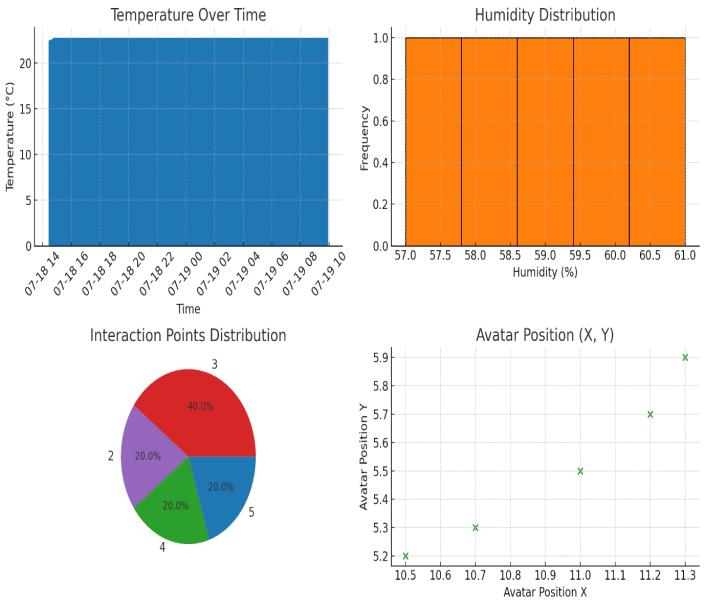
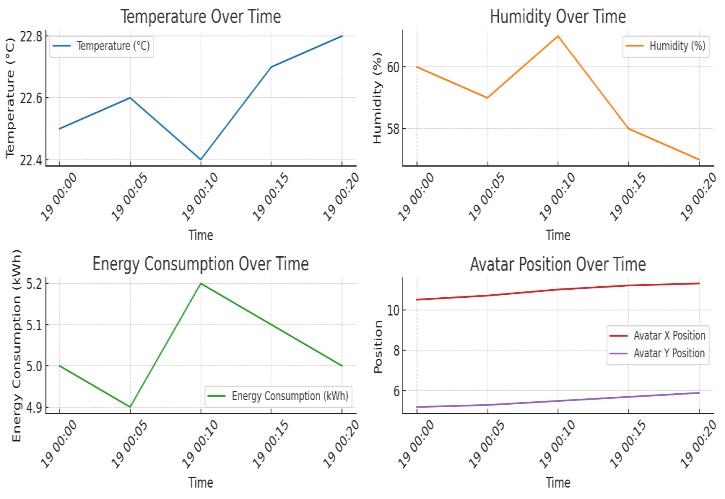
The framework generates visualizations to track temporal trendsinthedata:
•TemperatureVariation:Plottingtemperaturechangesover time.
•HumidityLevels:Visualizingfluctuationsinhumidity.
•EnergyConsumption:Analyzingenergyusagepatterns.
• Avatar Movement: Mapping avatar positions (X and Y coordinates)overtime.
International Research Journal of Engineering and Technology (IRJET) e-ISSN: 2395-0056
Volume: 12 Issue: 10 | Oct 2025 www.irjet.net p-ISSN: 2395-0072
Thesevisualizationsofferinsightsintohowenvironmental conditions and user behaviors evolve, aiding in the identificationofpatternsandanomalies.
4.3.4
The framework calculates the correlation between temperatureandenergyconsumption to identifypotential relationships between environmental factors and energy usage. Preliminary findings suggest a moderate positive correlation,indicatingthatastemperatureincreases,energy consumptiontendstorise,possiblyduetoincreasedcooling requirements.
4.3.5 Results
Theanalysisrevealsseveralkeyinsights:
• Energy Consumption Trends: Energy usage exhibits fluctuations corresponding with temperature changes, highlighting the impact of environmental conditions on energydemands.
•UserInteractionPatterns:Avatarmovementdataindicates areasofhighuseractivity,whichcaninformspatialdesign decisions.
•OptimizationOpportunities:Theidentifiedcorrelationsand patterns provide a basis for implementing AI-driven optimizations, such as adaptive energy management and personalizeduserexperiences.
prototyping,thisstudydemonstrateshowthesetechnologies cancollaborativelyenhancevirtualspacearchitecture.
KeyContributions:
1.DigitalTwinTechnology:ThisstudyillustrateshowDTs enable dynamic and real-time synchronization between physicalandvirtualspaces,facilitatingcontinuousupdates and optimizations. Such integration ensures that virtual environmentsaccuratelyreflecttheirphysicalcounterparts, enhancing the realism and responsiveness of Metaverse spaces.
2.AI-DrivenOptimization:TheapplicationofAIfacilitates intelligent space utilization and energy management, ensuringthatvirtualspacesarebothfunctionalandefficient. Machine learning algorithms analyze user behavior and environmentaldatatopredictinteractions,optimizespatial layouts, and adjust environmental conditions, thereby improvinguserexperienceandoperationalefficiency.
3. Extended Reality (XR) Tools: XR technologies, encompassingVirtualReality(VR),AugmentedReality(AR), and Mixed Reality (MR), enhance user engagement by enabling immersive experiences such as virtual campus toursandinteractivecitysimulations.Thesetoolssupport collaborative design processes and user-centered design, allowingstakeholderstointeractwithandprovidefeedback onvirtualprototypesinreal-time.
[1] Lik-HangLee,TristanBraud,PengyuanZhou,LinWang, DianleiXu,ZijunLin,AbhishekKumar,CarlosBermejo, andPanHui,“AllOneNeedstoKnowaboutMetaverse:A CompleteSurveyonTechnological Singularity,Virtual Ecosystem, and Research Agenda,” arXiv preprint arXiv:2110.05352, 2021. Available: https://arxiv.org/abs/2110.05352
[2] Huansheng Ning, Hang Wang, Yujia Lin, Wenxi Wang, Sahraoui Dhelim, Fadi Farha, Jianguo Ding, and MahmoudDaneshmand, “A Survey onMetaverse: The State-of-the-Art, Technologies, Applications, and Challenges,” arXiv preprint arXiv:2111.09673, 2021. Available:https://arxiv.org/abs/2111.09673
5. CONCLUSIONS
Thisresearchunderscores thetransformativepotential of integrating Digital Twins (DT), Artificial Intelligence (AI), andExtendedReality(XR)inthedesign,optimization,and managementofMetaverse environments.Bydeveloping a comprehensiveframeworkthatincorporatesreal-timedata integration,AI-drivenoptimization,andimmersiveXR-based
[3] A.Mayer,L.Greif,T.M.Häußermann,S.Otto,K.Kastner, S.ElBobbou,J.-R.Chardonnet,J.Reichwald,J.Fleischer, andJ.Ovtcharova,“Digitaltwins,extendedreality,and artificialintelligenceinmanufacturingreconfiguration: Asystematicliteraturereview,” Sustainability,vol.17, no. 5, p. 2318, 2025. Available: https://doi.org/10.3390/su17052318
[4] Z. Lyu and M. Fridenfalk, “Digital twins for building industrialmetaverse,” JournalofAdvancedResearch,vol.
International Research Journal of Engineering and Technology (IRJET) e-ISSN: 2395-0056
66, pp. 31–38, 2024. Available: https://doi.org/10.1016/j.jare.2024.03.004
[5] Qinglin Qi and Fei Tao, “Digital Twin and Big Data Towards Smart Manufacturing and Industry 4.0: 360 DegreeComparison,” IEEEAccess,vol.6,pp.3585–3593, 2018. Available: https://doi.org/10.1109/ACCESS.2018.2793265
[6] Thien Huynh-The, Quoc-Viet Pham, Xuan-Qui Pham, Thanh Thi Nguyen, Han Zhu, and Dong-Seong Kim, “Artificial Intelligence for the Metaverse: A Survey,” Engineering Applications of Artificial Intelligence, vol. 117, art. no. 105581, Jan. 2023. Available: https://doi.org/10.1016/j.engappai.2022.105581
[7] Z. Zhang, C. Liu, H. Kim, “TREX²: Dual-Reconstruction Framework for Teleoperated-Robot with Extended Reality,” arXiv preprint arXiv:2506.01135, 2025. Available:https://arxiv.org/abs/2506.01135
Volume: 12 Issue: 10 | Oct 2025 www.irjet.net p-ISSN: 2395-0072 © 2025, IRJET | Impact Factor value: 8.315 | ISO 9001:2008
|