
International Research Journal of Engineering and Technology (IRJET) e-ISSN: 2395-0056
Volume: 12 Issue: 03 | Mar 2025 www.irjet.net p-ISSN: 2395-0072
International Research Journal of Engineering and Technology (IRJET) e-ISSN: 2395-0056
Volume: 12 Issue: 03 | Mar 2025 www.irjet.net p-ISSN: 2395-0072
Pavan Vemuri1
1Director of Product Engineering, SDVerse LLC, Michigan, USA
Abstract – This paper introduces a transformative methodology for user engagement analysis through agentic workflows. Traditional approaches to user engagement analysis suffer from four critical limitations: resource intensity,analyticalfragmentation,poorinsightactionability, and scalability constraints. The approach in this paper demonstrates how a purpose-built multi-agent architecture directly addresses these challenges through goal-oriented autonomy, functional specialization, and contextual collaboration.Wewillfirstgothroughtheproblemstatement in detail, discuss the methodology implemented to solve the problem,comparevariousagenticframeworksandwhatthey bringtothetableforsolvingtheproblem,discussthefindings and conclude by looking at how this can shape up for the future. In the implementation process, I used the following user metrics (event frequency, session duration, and session count) to generate actionable insights with minimal human intervention. This research advances the emerging field of autonomousanalyticalsystemswhileprovidingorganizations with a concrete framework for revolutionizing their engagement intelligence operations.
Key Words: agentic workflows, autonomous analytics, user engagement, multi-agent architecture, analytical transformation, agentic principles
Inthecurrentdigitallandscape,organizationsgeneratevast amountsofuserengagementdatathroughwebapplications, mobileplatforms,and other digital touchpoints This data holds valuable insights that can drive business decisions, productimprovements,andmarketingstrategies.However, the traditional approach to analyzing such data involves significant manual effort, specialized analytical skills, and substantialtimeinvestment.
Thispaperexploreshowagenticworkflows autonomous systems where agents determine the steps to fulfill predefinedgoals cantransformtheprocessofextracting actionableinsightsfromuserengagementdata.Bydeploying AI agents with specific roles and objectives, organizations can automate complex analytical tasks while maintaining high-qualityoutputthatadaptstochangingdatapatterns.
Theextractionofmeaningfulinsightsfromuserengagement data presents critical challenges that create substantial barriers for organizations. These challenges make agentic workflowsparticularlyvaluableasasolution:
Traditionaldataanalysisdemandsnotonlyskilledanalysts but also significant time investment for processing, visualizing, and interpreting data. Organizations face a growing expertisegapasthecomplexity ofdata increases whileanalyticaltalentremainsscarce.Thiscreatessevere bottlenecks in the insight generation process, with many organizationsunabletomaintaindedicatedanalyticalteams.
Userengagementdatatypicallyexistsacrossdisconnected systems webanalytics,mobileappmetrics,CRMdata,and customer feedback each with unique formats and granularity. Analysts struggle to create unified views that capturethecompleteuserjourney.Thisfragmentationleads topartialinsightsandmissedconnectionsbetweenrelated metrics.
Even when organizations successfully generate analytical insights,theyfrequentlyfailtoconvertthesefindingsinto strategic action. Raw metrics and statistical observations rarely translate directly into implementation plans. This createsan"insightgraveyard"wherevaluable discoveries remainunutilized.
As data volumes grow exponentially, manual analysis becomes progressively more difficult to scale. When organizationsattempttoscalethroughteamexpansion,they often experience inconsistency in analytical approach, quality,andoutputformat.Thisunderminesthereliabilityof insightsforstrategicplanning
International Research Journal of Engineering and Technology (IRJET) e-ISSN: 2395-0056
Volume: 12 Issue: 03 | Mar 2025 www.irjet.net p-ISSN: 2395-0072
Themethodologyintroducesatransformativearchitecture leveragingagentic workflowsthatdirectlyaddresses each identified challenge through a purpose-built, autonomous systemforuserengagementanalysis.
3.1ArchitecturalFrameworkandDesignPrinciples
Theagenticworkflowarchitecturefollowsthreecoredesign principlesthatdifferentiateitfromtraditionalapproaches:
1. Goal-OrientedAutonomy: Agentsdeterminetheir own procedural stepsbased ondesiredoutcomes ratherthanfollowingpre-programmedinstructions
2. Functional Specialization: Each agent possesses distinctcapabilitiesoptimizedforspecificanalytical functions
3. Contextual Collaboration: Agents share information and build upon each other's outputs while maintaining awareness of the overall analyticalobjective.
3.2 Multi-Agent Architecture
Theimplementation initssimplestformcomesdowntoa sequentialworkflowcomprisingtwospecializedagentsthat directlycountertheaboveidentifiedchallenges.
1. User Engagement Data Analyst Agent
Primary Function: Process multi format raw user engagement data, identifies patternsacrossdisconnectedmetricsand extractpreliminaryinsights.
Challenge Addressed: Overcomes analytical diversification by creating unifiedinsightsintouserengagementdata.
Capability Highlight: Autonomously determines which analytical techniques canbeemployedtoidentifyinsights.
2. Report Compiler Agent
Primary Function: Transformstechnical insightsintostructured,business-oriented recommendations with implementation pathways.
Challenge Addressed: Bridgetheinsight to action gap by converting analytical findingsintostrategicdirectives
Capability Highlight: Prioritizes recommendations based on implementation feasibility and potential impact
The architectural design illustrating the above mentioned sequentialworkflowofagentscanbeviewedinFig-1below
It also identifies the flow of information from the data sources through the multi-agent system to actionable insights.
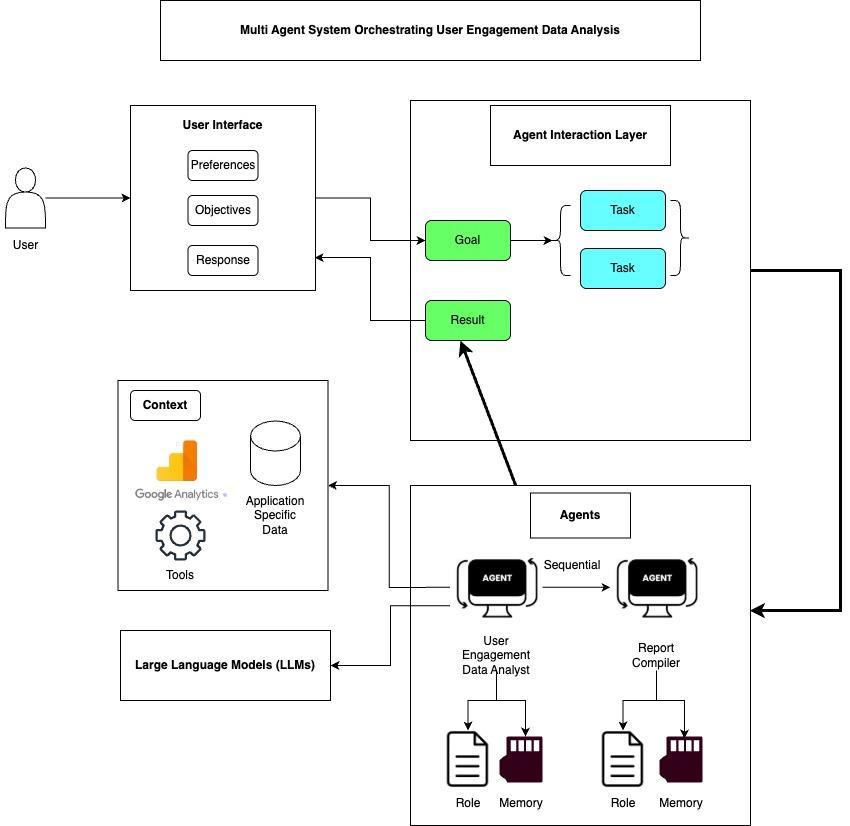
Each agent is defined with four critical parameters that governitsbehaviourandeffectiveness
Role Definition: Precisedelineationoftheagent’s functionwithinthelargeranalyticalprocess.
Goalspecification: Concrete,measurableoutcomes theagentmustachieve.
Contextual Knowledge: Backgroundinformation thatguidesdecision-makingandprovidesdomain expertise.
Tool Integration: Technical capabilities and external systems the agent can leverage to accomplishitstasks.
Thisconstructensurestheagentsremainfocusedontheir specialized functions. The actual manner in which the construct is implemented varies based on the agentic framework used but this construct helps maintain the alignmentwiththeoverallobjective.
Thereisnoquestionsofarthattheagenticframeworkisthe way to go, but there are several of them out there for our
International Research Journal of Engineering and Technology (IRJET) e-ISSN: 2395-0056
Volume: 12 Issue: 03 | Mar 2025 www.irjet.net p-ISSN: 2395-0072
choosing, and below is a comparison of how user engagementanalysisfareswithsomeofthemajoragentic frameworks. When implementing agentic workflows specificallyforuserengagementanalytics,selectingtheright frameworksignificantlyimpactsanalyticalcapabilities This section evaluates how CrewAI, LangGraph and AutoGen addresstheuniquerequirementsofuserengagementdata analysis.
Table1.Belowshowsthecomparison.
User Engagement AnalyticsCapability
Engagement Metric Integration High Medium Medium
Automated Insight Generation High Medium Medium
Engagement AnomalyDetection High Medium Low
Implementation Complexity for Engagement Analytics Low High Medium
Engagement Metric Integration: Refers to how effectively the framework combines diverse engagementmetrics(events,sessions,pageviews,etc) intocohesiveanalysis.
CrewAIexcelsthroughspecializedagentsthateach handlespecificmetricsandthencombinefindings.
LangGraph and AutoGen require more explicit programmingtoachievesimilarintegration.
Automated Insight Generation: Refers to how effectivelytheframeworktransformsrawengagement data into actionable insights without human intervention.
CrewAI’srole-basedapproachexcelsatproducing business-relevantinsightsautonomously.
LangGraphandAutoGencangenerateinsightsbut typicallyrequiremoreguidance.
Engagement Anomaly Detection: Abilitytoidentify unusualpatternsoroutliersinengagementdata
CrewAI’s specialized agent approach enables sophisticatedanomalydetectionacrossmetrics.
LangGraph can visualize anomalies through its graphstructurebutrequiresmoresetup.
AutoGen has basic statistical anomaly detection capabilities.
Implementation Complexity: Reflectshoweasilyan organization can implement and maintain the frameworkspecificallyforengagementanalyticsinthis case.
CrewAI offers the most intuitive implementation withitsrole-basedstructure.
LangGraphrequiresmorespecializedknowledgeof graphtheoryandcomplexmodeling
AutoGen presents moderate implementation challenges.
Theagenticworkflowmethodologyrepresentsaparadigm shift in user engagement analysis with far-reaching implicationsfororganizationsacrosssectors.
Thetablebelowshowcaseshowoperationaltransformation isachievedusingthismethodology.
Traditional Analysis Agentic Workflow Approach
Manual data processing requiring specializedskills
MeasurableImpact
Autonomous processing with minimal human oversight 60% reduction in analyst hours required for equivalent insight generation
SequentialAnalysis creatingbottlenecks Parallel processing acrossmultipledata dimensions 2-3Xaccelerationin timetoinsight
Inconsistent methodology betweenAnalysts
Standardized analyticalapproach with adaptive techniques
Elimination of analyst to analyst variabilityinoutput quality
Limited by human workinghours Continuous operationcapability Increased productivity without staffing increase.
This methodology delivers four strategic advantages, fundamentallyalteringanorganization’scapacitytoleverage userengagementdata.
Democratization of Advanced Analytics
The system eliminates the expertise barrier that previouslylimitedsophisticateduserengagement analysistoorganizationswithspecializedteams.
International Research Journal of Engineering and Technology (IRJET) e-ISSN: 2395-0056
Volume: 12 Issue: 03 | Mar 2025 www.irjet.net p-ISSN: 2395-0072
Decision Support Enhancement
Recommendations generated autonomously can include implementation pathways, resource requirementsandexpectedoutcomes.
Intelligence Operation Scalability
The agentic architecture allows for horizontal scalingtoaccommodateexponentialdatagrowth.
Proactive Insight Generation
Unlike reactive manual analysis triggered by specificquestions,theagenticsystemcontinuously seekspatternsandanomalies,makingtheanalysis proactive.
The article discusses a sequential agentic workflow with only 2 agents in its simplest form, which proves how powerful this paradigm shift in user engagement analysis canbe.
Thereishoweveralotofinterestingupdatesandupgrades tothisapproachtolookforwardto.
Data Collector Agent
Autonomously identifies and collects relevant user engagement metrics from various sources, eliminating manual data gathering processes and ensuring comprehensivedatacoverage.
Data Validation Agent
Verifiesdataquality,completenessandconsistencybefore analysis,identifyinganomaliesthatmightaffectanalytical accuracy.
Advanced Analyst Agent
Incorporatespredictivecapabilitiesbeyondthebasesystem, enablingforecastingoffutureengagementpatternsbasedon historicaldata.
Implementation Agent
Translatesrecommendationsintospecificactionplanswith resource requirements, timelines and success metrics, bridgingthegapbetweeninsightandexecution.
Agentic workflows have the capability of shifting organizations from question-driven to discovery driven analytical paradigms. They represent a powerful new approach to extracting actionable insights from user engagement data. By combining the advantages of autonomy, modularity, and tool integration, this methodology addresses key challenges in traditional analytical approaches while opening new possibilities for organizationalintelligence.
Also to showcase that this approach is viable I have developedasimpleimplementationanddocumentedabout it in the article you can find in reference number [3] on Dzone.
I showcased a very minimalistic/ simplistic architecture whichprovidedsignificantanalyticalvalueandwithminimal human intervention. As organizations continue to face growing volumes of user data, agentic workflows offer a scalable, efficient path to transforming that data into strategicadvantage.
[1] Hu, J., et al. (2025). Position: Towards a Responsible LLM-empowered Multi-Agent Systems. arXiv:2502.01714v1
[2] Thudumu,S.,etal.(2024).ASurveyonContext-Aware Multi-AgentSystems:Techniques,ChallengesandFuture Directions.arXiv:2402.01968v2
[3] Pavan Vemuri, DZone. (2025, February 19). Agentic Workflows for Unlocking User Engagement Insights. DZone
[4] Cemri, M., et al. (2025). Why Do Multi-Agent LLM SystemsFail?arXiv:2503.13657v1.
[5] Liu,Y.,Shi,X.,Pierce,L.,&Ren,X.(2019).Characterizing and Forecasting User Engagement with In-app Action Graph:ACaseStudyofSnapchat.arXiv:1906.00355.