
International Research Journal of Engineering and Technology (IRJET) e-ISSN: 2395-0056
Volume: 13 Issue: 04 | Apr 2026 www.irjet.net p-ISSN: 2395-0072

International Research Journal of Engineering and Technology (IRJET) e-ISSN: 2395-0056
Volume: 13 Issue: 04 | Apr 2026 www.irjet.net p-ISSN: 2395-0072
Mr. B . Eswar Babu1, Harshith Narasimha Sai Pilli2 , Bhagavathi Bandi3, Rida Falak4 ,Rohith Agarwal5
1Associate Professor, Department of Information Technology, Vidya Jyothi Institute of Technology, Telangana, India 2345B.Tech Students, Department of Information Technology, Vidya Jyothi Institute of Technology, Telangana, India
Abstract - LegalAidChain is designed as a practical solution to improve access to legal help in India, especially for people who may not have the knowledge or resources to navigate the legal system. The platform allows users to describe their problems in simple, everyday language, and then analyzes the input to identify relevant legal sections such as those from IPC, CrPC, labor laws, or women’s protection laws. Based on this, it suggests possible next steps, like filing an FIR or approaching the appropriate authority for assistance. In addition to providing guidance, the system also focuses on maintaining transparency in how cases are handled. Each case and its related information are recorded using blockchain technology, which helps ensure that the data cannot be altered or misused. This adds a layer of trust, particularly in scenarios involving free legal aid where accountability is important. Rather than replacing legal professionals, LegalBotChain acts as an initial support system that simplifies complex legal information and makes it more accessible. By combining language-based AI assistance with secure record-keeping, the platform aims to make legal help more approachable and reliable for a wider section of society.
Key Words: Artificial Intelligence, Machine Learning, Natural Language Processing, Blockchain, Legal Assistance,CaseTracking
1.INTRODUCTION
Thewaypeopleaccesslegalinformationhaschangedalot withthegrowthofdigitaltechnology.Eventhoughalarge amount of legal content is available online, many individuals still find it difficult to understand laws or figureoutwhatappliestotheirsituation.Legallanguageis often complex, and procedures are not always easy to follow, especially for those without any legal background. Because of this, many people are unable to take timely action or even recognize their rights. This gap between available legal knowledge and actual understanding highlights the need for systems that can simplify legal informationandmakeiteasiertouseinrealsituations.
At the same time, technologies like Artificial Intelligence and blockchain have started to influence how such problems can be approached. AI makes it possible to
processlargeamountsoftext,identifypatterns,andrelate userqueriestorelevantlegalconcepts.Blockchain,onthe other hand, provides a way to store information securely sothatitcannotbealteredlater,whichisimportantwhen dealingwithsensitivelegalrecords.
LegalAidChainisbuiltaroundtheseideas,aimingtomake legal assistance more accessible and easier to navigate. Userscandescribetheirissueintheirownwords,and the system attempts to interpret the input and connect it to relevant legal provisions. Instead of presenting complex legal text, it focuses on giving clear and usable guidance basedonthesituationdescribed.
To handle user input more effectively, the platform organizes the information into a structured format. This reduces confusion and helps in forming a clearer understanding of the case at an early stage. Such structured summaries can also be useful for legal professionals, as they provide a quick overview without requiringthemtogothroughunorganizeddetails.
Anotheraspectofthesystemisthatitimprovesovertime. As more data is processed, the underlying models are updated to better match current legal interpretations and patterns. This allows the system to remain relevant even aslawsandreal-worldscenariosevolve.
For maintaining trust, the platform records case-related data using blockchain, ensuring that once information is stored,itcannotbechanged.Thisaddsalevelofreliability and accountability to the process. The system is also designed to be user-friendly, with support for multiple languages and a simple interface so that people from differentbackgroundscanuseitwithoutdifficulty.
Overall,LegalAidChainfocuseson makinglegal help more approachable by combining straightforward language processing with secure record-keeping, while also ensuringthatthesystemcanscaleandadaptovertime.
The LegalAidChain system is designed as a step-by-step pipeline rather than a single complex model, making it easier to manage and extend. It starts with handling raw inputfromusers,whichmayincludecomplaintswrittenin
International Research Journal of Engineering and Technology (IRJET) e-ISSN: 2395-0056
Volume: 13 Issue: 04 | Apr 2026 www.irjet.net p-ISSN: 2395-0072
informallanguageormixedwithirrelevantdetails.Atthis stage, the text is cleaned and normalized so that it becomes more consistent. Basic preprocessing methods like tokenization, removal of unnecessary words, and correction of spelling variations are applied to reduce noiseandmakethedatausable.
Once the text is cleaned, the system extracts important details such as key terms, type of incident, possible legal entities, and any available contextual information like location or people involved. This helps convert an unstructuredcomplaintintoamoreorganizedformatthat thesystemcanworkwitheffectively.
The processed data is then passed to the classification component, where machine learning models analyze the content and assign it to a relevant legal category. These categories can include areas like criminal law, civil matters, cyber-related issues, labor concerns, or cases related to women’s rights. The model is trained on legal texts and previous case data, allowing it to gradually improveasmoreexamplesareintroduced.
After classification, the system focuses on generating usefulguidance.Insteadofpresentingrawlegalsections,it interpretstheresultandsuggestspracticalnextsteps.For example, it may recommend filing an FIR, consulting a legal authority,orapproachinga specific department.The goalhereistotranslatelegalcomplexityintoactionsthata usercanrealisticallyfollow.
For record management, the platform uses blockchain to store each complaint along with its generated output. Every entry is linked to a unique identifier, ensuring that once the data is recorded, it cannot be modified. This provides a reliable way to maintain case history and preventsanytamperingwithsensitiveinformation.
In the final stage, users are able to track their case using the assigned identifier. The system provides updates and helps them understand what to do next, rather than leaving them with static information. This adds a layer of continuitytotheentireprocess.
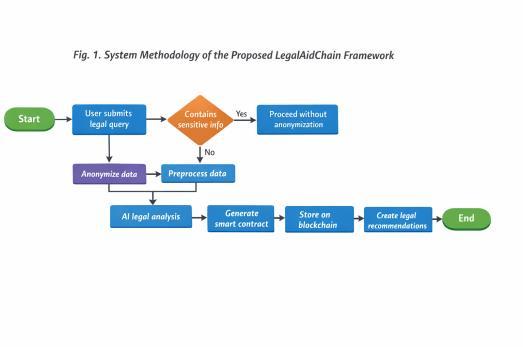
Overall, LegalAidChain works as a continuous flow where user input is refined, analyzed, and converted into meaningfulguidance,whilealsobeingsecurelystored.The structure of this pipeline helps maintain clarity, improves accuracy, and makes the system more practical for realworlduse.
The LegalAidChain system was tested using a mix of sample legal complaint data and simulated user inputs to understand how well it performs in real-world scenarios. Themaingoalofthisevaluationwastocheckwhetherthe systemcancorrectlyunderstanduserqueries,assignthem to the right legal category, and provide useful guidance basedonthatclassification.
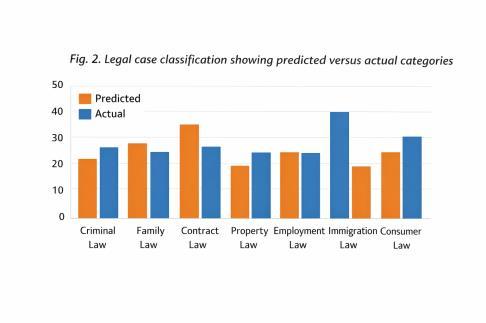
Fig.2: Legal case classification showing predicted versus actual categories
Theclassificationresultsshowthatthesystemisgenerally able to match user complaints with the correct legal categories.Whencomparingpredictedoutputswithactual labels, there is a strong level of agreement, especially for clearly defined cases. The model handles common categoriessuchascriminallaw,civildisputes,cybercrime, labor-related issues, and women’s protection cases with goodconsistency.
Performance tends to be better when the input provided bytheuserisclearandcontainsenoughdetail.Incontrast, when the complaint is vague, incomplete, or involves multiple legal aspects, the model may not always assign a perfectly accurate category. For example, situations that include both civil and criminal elements can sometimes lead to partial mismatches. Even so, the system remains reasonably stable due to its ability to extract relevant featuresandconsidercontext.
The recommendation component was evaluated based on how accurately it suggests next steps after classification.
International Research Journal of Engineering and Technology (IRJET) e-ISSN: 2395-0056
Volume: 13 Issue: 04 | Apr 2026 www.irjet.net p-ISSN: 2395-0072
Most of the generated outputs fall into acceptable ranges, with many being clearly relevant to the user’s situation. The system is able to suggest practical actions such as filing an FIR, seeking legal advice, or approaching the appropriateauthority.
Thequalityoftheserecommendationsdependsheavilyon how well the initial classification is performed and how much information the user provides. When the input is detailed, the suggestions are more specific and useful. In cases where details are missing, the system still provides guidance, but it tends to be more general rather than highlytailored.
The overall performance of the LegalAidChain system is summarized using standard evaluation metrics, as shown below:
users and reducing the workload on legal professionals throughearly-stageanalysis.
LegalAidChain is built with the aim of making legal support easier to access and understand, especially for peoplewhomaynothaveanylegalbackground.Insteadof requiring users to know specific laws or procedures, the system allows them to explain their situation in simple language. It then processes this input and connects it to relevantlegalprovisions,presentingtheoutcomeinaway thatiseasiertounderstandandactupon.Thisreducesthe effort normally required to interpret legal information manually.
To handle user inputs more effectively, the platform organizes the information into a structured format. This helps in reducing confusion and makes it easier to get a clearoverviewofthecase.Suchstructuredsummariesare usefulnotonlyforusersbutalsoforlegalprofessionals,as they can quickly understand the situation without going through unorganized details. Over time, the system also improves itself by learning from updated legal data and usage patterns, which helps maintain consistency with currentlawsandimprovesaccuracy.
The system’s performance was also measured using standard evaluation metrics. It achieved an accuracy of 92.3%, indicating that most complaints are classified correctly. Precision, recorded at 91.5%, shows that the predicted categories are usually relevant and not randomly assigned. Recall stands at 90.8%, meaning the systemisabletoidentifymostvalidcaseswithoutmissing many. The F1 score of 91.1% reflects a balanced performancebetweenprecisionandrecall.
These values suggest that the model performs reliably across different types of inputs, although the results should still be interpreted with consideration of input qualityanddatasetlimitations.
Based on the evaluation, LegalAidChain is able to provide dependable classification and reasonably accurate recommendations in most cases. Its ability to process unstructuredtextandconvertitintomeaningful guidance makes it useful as an initial support system for users seekinglegalhelp.
Therearestillsomelimitations,particularlywhendealing with unclear or incomplete inputs, but the system shows good adaptability overall. With further improvements in data quality and model refinement, it has the potential to becomeamoreeffectiveandscalablesolutionforassisting
Anotherimportantaspectofthesystemishowitmanages data. All case-related information is stored using blockchain,whichensuresthatoncearecordiscreated,it cannot be altered. Each case is linked to a unique identifier, making it easier to track and verify. This approach adds a level of reliability and accountability, whichisimportantwhendealingwithlegalinformation.
Theplatformisalsodesignedtobe easytouse fora wide range of users. Features like multilingual support and simplified explanations help people from different backgrounds understand their legal situation better. By presentinginformationinaclearerform,thesystemhelps users make decisions without unnecessary confusion or delay.
Atthesametime,thesystemisnotwithoutitslimitations. It may face difficulties when dealing with cases that are unclear, incomplete, or involve multiple legal areas at once. These situations require more context and deeper reasoning.However,suchissuescanbereducedovertime by improving the dataset and refining the underlying models.
Overall, LegalAidChain shows how combining languagebased processing with secure data handling can make legalassistancemorepracticalandaccessible.Itsimplifies the initial stages of legal support while maintaining reliability and has the potential to scale further with continuedimprovements.
International Research Journal of Engineering and Technology (IRJET) e-ISSN: 2395-0056
Volume: 13 Issue: 04 | Apr 2026 www.irjet.net p-ISSN: 2395-0072
The LegalAidChain system can be improved in several practical ways as it evolves. One important step would be to connect it with real-time legal data sources and governmentlegal aidportals.Thiswouldhelpensurethat the information provided to users stays current and reliable. Adding voice-based interaction in multiple languages could also make the platform easier to use, particularlyforpeopleinruralareasorthosewhoarenot comfortablewithtypingortechnicalsystems.
On the technical side, more advanced models can be introduced to better understand legal text and handle complex cases. Improving how the system identifies similar cases and generates recommendations would maketheoutputsmoreprecise.Theuseofsmartcontracts could also help automate certain processes, such as managing case workflows or checking eligibility for legal aid,reducingmanualeffortandincreasingtransparency.
Further improvements could involve connecting the platformwithlegalprofessionalsandorganizationssothat users can access direct support when needed. Expanding the system into a mobile application and hosting it on cloud infrastructure would make it more scalable and accessibletoalargernumberofusers.
Additional features like notifications for case updates, dashboards for monitoring system usage, secure identity verification, and clearer explanations for systemgenerated suggestions can make the platform more practical and trustworthy. Automation in handling documents could also reduce effort for both users and legalpractitioners,improvingoverallefficiency.
[1] R. Katz, “Artificial Intelligence in Law: Legal Information Systems and Decision Support,” Artificial Intelligence and Law,vol.25,no.2,pp.123–145,2017.
[2] D. Jurafsky and J. H. Martin, Speech and Language Processing, 2nd ed. Upper Saddle River, NJ, USA: PrenticeHall,2009.
[3] I. Goodfellow, Y. Bengio, and A. Courville, Deep Learning.Cambridge,MA,USA:MITPress,2016.
[4] T. Mikolov, K. Chen, G. Corrado, and J. Dean, “Efficient EstimationofWordRepresentationsinVectorSpace,” in Proc. Int. Conf. Learning Representations (ICLR), 2013.
[5] J. Devlin, M. Chang, K. Lee, and K. Toutanova, “BERT:
Pre-training of Deep Bidirectional Transformers for Language Understanding,” in Proc. NAACL-HLT, 2019, pp.4171–4186.
[6] S. Russell and P. Norvig, Artificial Intelligence: A Modern Approach,3rded.UpperSaddleRiver,NJ,USA: Pearson,2010.
[7] S. Nakamoto, “Bitcoin: A Peer-to-Peer Electronic Cash System,”WhitePaper,2008.
[8] M. Swan, Blockchain: Blueprint for a New Economy. Sebastopol,CA,USA:O’ReillyMedia,2015.
[9] K. Christidis and M. Devetsikiotis, “Blockchains and Smart Contracts for the Internet of Things,” IEEE Access,vol.4,pp.2292–2303,2016.
[10] H. Surden, “Machine Learning and Law,” Washington Law Review,vol.89,no.1,pp.87–115,2014.
[11] A. Ashley, Artificial Intelligence and Legal Analytics Cambridge,U.K.:CambridgeUniversityPress,2017.
[12] Y.Liu,T.Chen,andZ.Wang,“LegalTextClassification Using Deep Learning Models,” Expert Systems with Applications,vol.158,2020.