
International Research Journal of Engineering and Technology (IRJET) e-ISSN:2395-0056
Volume: 13 Issue: 03 | Mar 2026 www.irjet.net p-ISSN:2395-0072

International Research Journal of Engineering and Technology (IRJET) e-ISSN:2395-0056
Volume: 13 Issue: 03 | Mar 2026 www.irjet.net p-ISSN:2395-0072
Dr. Sandeep Kulkarni¹, Palak Kolambe², Ashvitha Sree³, Kirti Rasal´
¹ Assistant Professor, Department of Computer Science, Pune, Maharashtra ² B.Tech Student, Department of Computer Science
Ajeenkya DY Patil University Lohegaon, Airport Rd, Charholi Budruk, Pune, Maharashtra
Abstract - Traditional Kolam (also known as rangoli or muggu) isaculturallysignificantgeometricartform widely practiced in South India, characterized by symmetrical arrangements of dots, lines, and curves [1]. This paper presents Kolamkala, a web-based computational system designed for both the generation and analysis of Kolam patterns using a fully rule-based approach. The generation module employs coordinate-based logic on a user-defined dot grid to construct patterns that satisfy symmetry and continuity constraints. In parallel, the analysis module utilizes classical image processing techniques, including grayscale conversion, Gaussian smoothing, Canny edge detection, and contour extraction, to identify structural features such as symmetry, line patterns, and dot arrangements in uploaded Kolam images. The system is implemented using Python (FastAPI), NumPy, OpenCV, and visualizationtools such as MatplotlibandSVG, along with a responsive frontend interface. By combining cultural heritage with computational methods, Kolamkala provides an interactive and explainable platform for exploring traditional designs while contributing to the digital preservation and educational understanding of Kolam patterns.
Key Words: Kolam patterns, pattern generation, image processing, OpenCV, rule-based system, symmetry detection,culturalheritagecomputing.
Kolam is a traditional form of floor art practiced across SouthIndia,typicallydrawnusingriceflourattheentrance of homes as a symbol of prosperity, harmony, and cultural identity [2]. These designs are composed of structured arrangements of dots and continuous lines, forming intricate geometric patterns that often exhibit strong symmetry [3]. Beyond their aesthetic value, Kolam patterns reflect underlying mathematical principles, including spatial organization, symmetry, and rule-based construction[2].
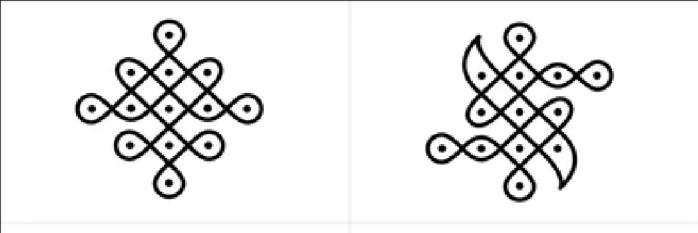
Fig -1: Example of a traditional Kolam pattern drawn using a grid of dots and continuous lines.
In traditional practice, Kolam designs are created using a gridofdots,aroundwhichlinesaredrawninacontinuous manner to form closed patterns. These designs frequently follow strict geometric constraints, such as enclosing all dots, maintaining continuity without breaks, and preservingsymmetryacrossoneormoreaxes.Asa result, Kolamcanbeinterpretedasastructuredsystemgoverned by implicit mathematical rules[2]. Despite its cultural and mathematical richness, the computational representation of Kolam remains limited. Existing digital approaches primarily focus on either pattern recognition or isolated generation techniques, often relying on complex models that lack interpretability. Furthermore, there is a lack of accessible systems that allow users to both generate and analyze Kolam designs within a single framework. To address this gap, this paper introduces Kolamkala, a webbasedsystemthatintegratespatterngenerationandimage analysis using rule-based and explainable methods. The system enables users to create Kolam patterns through customizablegridparametersandanalyzeexistingdesigns using classical image processing techniques. By bridging traditional artandcomputational logic,Kolamkala offersa practical and educational platform for understanding and preservingKolamdesignprinciples.
The study of Kolam patterns has attracted significant attention due to their unique combination of cultural relevance and mathematical structure. Kolam designs are traditionally created using grids of dots connected by

International Research Journal of Engineering and Technology (IRJET) e-ISSN: 2395-0056
Volume: 13 Issue: 03 | Mar 2026 www.irjet.net p-ISSN: 2395-0072
continuous lines and curves, often following strict geometric and symmetry-based rules. Early research has emphasized that Kolam patterns can be understood as structured systems governed by rule-based transformations, where complex designs emerge from simple geometric principles such as symmetry, repetition, and spatial organization. Several studies have explored algorithmic approaches for Kolam generation. Foundational work demonstrated that Kolam patterns can be represented using numerical sequences and grid-based constructions, highlighting their inherently procedural nature. Building on this, more recent methods have proposed rule-driven algorithms to generate one-stroke Kolam patterns by guiding line paths around predefined dot grids [1]. These approaches ensure 2 continuity and symmetry through deterministic rules, making them reliable and interpretable. However, such methods are often limited to specific Kolam styles and may lack flexibility when dealing with more complex or varied patterns. Additionally, many of these systems focus solely ongenerationwithoutprovidingmechanismsforanalyzing or validating the resulting designs. In parallel, research in computer vision has addressed the analysis of Kolam images. Classical image processing techniques, such as edge detection and contour extraction, have been used to identify structural elements including lines, loops, and enclosed regions. These approaches offer clear geometric interpretation, as each detected feature corresponds directly to a visual component of the Kolam. Some studies have extended this by combining handcrafted features, such as symmetry measures and shape descriptors, with machine learning models for pattern classification. While these hybrid systems can achieve good performance, they oftenprioritizeclassificationaccuracyoverinterpretability and do not explicitly capture the underlying construction logic of Kolam patterns. More recent work has applied deep learning techniques to Kolam recognition and classification tasks. Models such as convolutional neural networks have demonstrated the ability to learn complex visualfeaturesfromKolamimagesandhandlevariationsin style and drawing quality. However, these approaches typicallyrequirelarge datasetsfor trainingandoperate as black-box systems, offering limited insight into the geometric and rule-based nature of the patterns. As a result, they are less suitable for applications that require transparency, interpretability, or direct user interaction with the design process. A critical comparison of these approaches reveals a clear trade-off. Rule-based and algorithmic methods provide transparency and enforce geometric constraints effectively, but they may lack flexibility and adaptability. In contrast, data-driven approaches offer greater generalization but sacrifice interpretabilityandoftenfailtorepresenttheexplicitrules that define Kolam construction. Furthermore, most existing research treats Kolam generation and analysis as separate problems, resulting in fragmented solutions that do not address the full scope of user interaction with
Kolam designs. Therefore, there is a noticeable gap in the development of integrated systems that combine both generation and analysis within a single, explainable framework. Existing generation methods rarely include validation or feature extraction capabilities, while analysis systems do not support pattern creation. This separation limits both practical usability and educational value. The Kolamkala system builds upon these insights by introducing a unified approach that integrates rule-based pattern generation with classical image processing for analysis.Byemphasizingsimplicity,transparency,anduser control,itprovidesapracticalsolutionthatalignswiththe traditionalprinciplesofKolamdesignwhileaddressingthe limitationsofexistingcomputationalmethods.
Although significant progress has been made in the computationalstudyofKolampatterns,severallimitations remain in existing approaches. Many systems focus exclusively on either pattern generation or image classification,withoutprovidinganintegratedsolutionthat supportsbothfunctionalitieswithinasingleplatform.Asa result, users lack tools that allow simultaneous creation and analysis of Kolam designs. Another key limitation is the lack of explainability in modern methods. Machine learning-based approaches, while effective for classification tasks, often function as black-box systems that do not reveal the underlying design logic of Kolam patterns. This reduces their educational value and limits their ability to represent the traditional rule-based nature of the art form. Furthermore, existing algorithmic generationmethodsareoftenrestrictedtospecificpattern types and do not provide flexible, user-driven customization. Similarly, many analysis techniques are sensitive to input quality and may not reliably extract meaningful features without controlled conditions. Therefore,thereisaclearneedforasystemthatintegrates generation and analysis while maintaining transparency, flexibility, and usability. Kolamkala addresses this gap by providinga rule-based,explainableframework thatallows userstobothgenerateandanalyzeKolampatternsthrough aninteractiveweb-basedinterface.
The Kolamkala framework was implemented as a webbased application using a clear client- server architecture. The front-end was developed using HTML, Tailwind CSS, and JavaScript, providing users with an interactive interfaceforgeneratingandanalyzingKolampatterns.The back-end was built using Python with the FastAPI framework. This separation of concerns ensures that computationally intensive tasks–such as pattern generation and image processing are handled on the server, while the front-end manages user interaction and
International Research Journal of Engineering and Technology (IRJET) e-ISSN:2395-0056 Volume: 13 Issue: 03 | Mar 2026 www.irjet.net p-ISSN:2395-0072
visualization. FastAPI was selected due to its support for RESTful API development and asynchronous execution, allowingefficienthandlingofmultipleuserrequests.
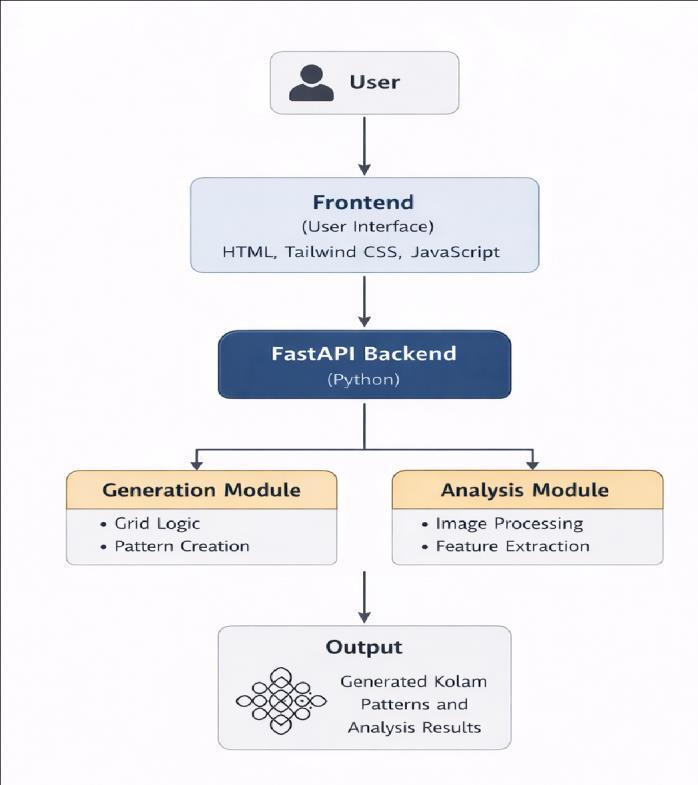
Fig -2: System architecture of the Kolamkala framework illustrating client–server interaction and module separation.
In this architecture, the front-end communicates with the back-end through HTTP requests. For example, when a user generates a Kolam pattern or uploads an image for analysis, the browser sends a request to a FastAPI endpoint. The server processes the request and returns eitheranimageorstructureddata(suchasJSON),whichis then displayed on the interface. This design ensures modularity, scalability, and ease of maintenance. It also enables accessibility, as users can access the system through a web browser without installing additional software.
The Kolam pattern generator was designed using a gridbased mathematical approach inspired by traditional Pulli Kolam principles. The process begins by defining a lattice ofanchorpoints(dots)onaCartesiangrid.
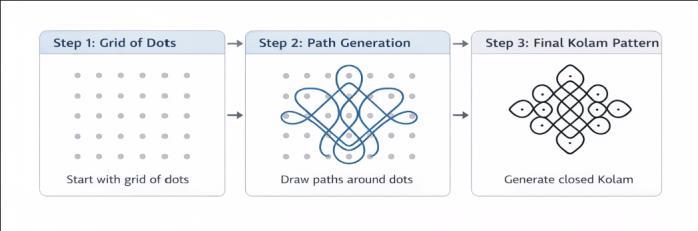
Fig -3: Step-by-step process of Kolam pattern generation from dot grid to final continuous design.
These dots serve as reference points around which the Kolamlinesare constructed.Userscanspecify parameters such as grid size and symmetry type (e.g., bilateral or rotational symmetry). Based on these inputs, the system generates a structured arrangement of dots, typically symmetric about one or more axes. Once the grid is established, the Kolam pattern is generated by tracing a continuous path around the dots. The algorithm mimics traditionaldrawingtechniquesbycreatinggeometricpaths composed of straight lines and smooth curves. For example,diagonalconnectionsat45°anglesareoftenused, followed by arcs or segments that wrap around adjacent dots.
The algorithm ensures that the generated path forms a closed loop, returning to its starting point. This is consistent with traditional Kolam designs, which are typically continuous and unbroken. Symmetry is enforced explicitly during pattern generation. After generating a base segment of the design, geometric transformations suchasreflectionandrotationare applied to replicate the pattern across the grid. NumPy is used to efficiently performthesetransformationsoncoordinatearrays.
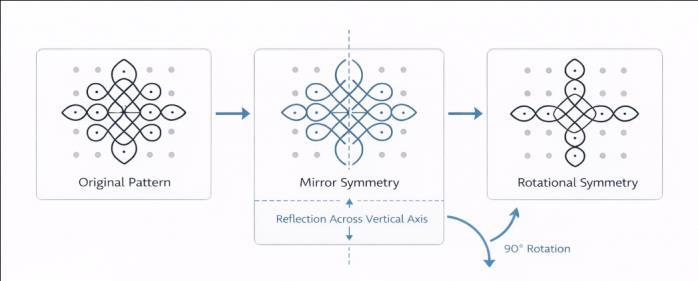
Fig -4: Illustration of symmetry transformations including mirror reflection and rotational symmetry applied in Kolam pattern generation.
Additionally, the generation process follows a rule-based traversal concept similar to a gating mechanism. Each dot istreatedasanodewithpossibleentryandexitpaths.The algorithmensuresthatexactlytwovalidpathsareselected at each dot, allowing the line to pass smoothly without intersections or breaks. This guarantees that the final pattern consists of a single continuous loop. For
International Research Journal of Engineering and Technology (IRJET) e-ISSN: 2395-0056
Volume: 13 Issue: 03 | Mar 2026 www.irjet.net p-ISSN: 2395-0072
visualization, the generated coordinates are rendered using Matplotlib for raster images and SVG for vector output. This allows high-quality display of Kolam patterns within the web interface. NumPy is used throughout to handle coordinate calculations and transformations efficiently.
The image analysis module uses a classical imageprocessing pipeline to extract meaningful and interpretablefeaturesfromuploadedKolamimages.
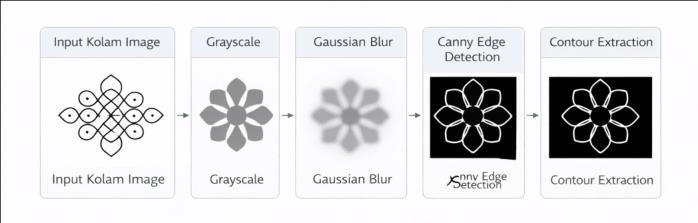
Fig -5: Image processing pipeline for Kolam analysis including grayscale conversion, Gaussian smoothing, edge detection, and contour extraction.
1. First, the input image is converted to grayscale to simplifyprocessingandremoveunnecessarycolor information. A Gaussian blur is then applied to reducenoiseandsmooththeimage,enhancingthe visibility of structural elements such as lines and curves.
2. Next, Canny edge detection is used to identify significant edges in the image. This step produces a binary edge map that highlights the main line structuresoftheKolam.
3. Contour detection is then performed using OpenCV to identify continuous shapes within the edge map. Small contours caused by noise are filtered out,andonlysignificant contours representingKolamstructuresareretained.
4. Fromthesecontours,severalquantitativefeatures are extracted. The number of dots is estimated using techniques such as circle detection, while line-based features such as total contour length andnumberofloopsarecomputedtocharacterize thepattern.
5. To evaluate symmetry, the system applies transformations such as horizontal and vertical flipping and compares the resulting images. Additional statistical measures, such as central moments, are used to assess symmetry more precisely.
6. The final output of the analysis includes interpretable features such as dot count, line density, number of loops, and symmetry scores. These features directly correspond to the structural properties of Kolam designs and providemeaningfulinsightstotheuser.
The entire pipeline is implemented using OpenCV and NumPy, relying on deterministic image-processing techniques rather than machine learning. This ensures transparency,efficiency,andexplainabilityoftheresults.
The system followed a structured data flow from user input to output generation. For pattern generation, users providedinputparametersthroughthefrontendinterface. These parameters were sent as API requests to the backend, where the generation algorithm processed them and returned a rendered image. The frontend then displayedthegeneratedpatterntotheuser.
Forimageanalysis,usersuploadedKolamimagesthrough theinterface.Thebackendprocessedtheseimagesusing thedefinedpipelineandreturnedextractedfeaturesina structuredformat.Theseresultswerepresentedinthe frontendasvisualandnumericaloutputs.
FastAPIendpointshandledallcommunication,ensuring efficientrequestprocessingandclearseparationbetween systemcomponents.
The frontend consisted of dedicated pages for pattern generationandimageanalysis.Usersinteractedwithinput forms tospecify parameters oruploadimages,andresults were displayed dynamically using JavaScript. Tailwind CSS wasusedtomaintainacleanandresponsiveinterface.The backenddefinedAPIendpointsforgenerationandanalysis tasks. Each endpoint invoked corresponding modules implemented in Python. The generation module handled gridconstructionandpatternrendering,whiletheanalysis module performed image processing and feature extraction. These modules were integrated within the FastAPI application, ensuring smooth communication betweenfrontendandbackendcomponents.
A key aspect of the system was its emphasis on explainability. All processes were based on deterministic rules rather than learned models, allowing each output to be traced back to specific computational steps. In pattern generation, the placement of lines and symmetry transformations followed clearly defined geometric rules. In image analysis, each extracted feature corresponded
International Research Journal of Engineering and Technology (IRJET) e-ISSN:2395-0056
Volume: 13 Issue: 03 | Mar 2026 www.irjet.net p-ISSN:2395-0072
directly to observable elements in the image, such as contoursordetectededges.
This transparency ensured that users could understand how patterns were generated and how features were derived, making the system suitable for both educational andanalyticalpurposes.
The system adopted a rule-based approach to align with the inherent structure of Kolam patterns, which are traditionally governed by explicit geometric rules. This approachensuredconsistency,interpretability,andeaseof implementationwithoutrequiringtrainingdata.
Classical image processing techniques were selected for analysis due to their reliability in handling high-contrast line drawings and their ability to produce interpretable results. Unlike data-driven methods, these techniques provided direct control over processing steps and eliminatedtheneedforcomplextrainingprocedures.
Overall,thedesignprioritizedsimplicity,transparency,and practicalusabilitywhile effectivelyaddressing the objectivesofKolampatterngenerationandanalysis.
The Kolamkala system successfully generated structured Kolam patterns based on user-defined grid sizes and symmetry constraints. For example, when a 5×5 grid with fourfold rotational symmetry was selected, the system producedacontinuousone-strokedesigninwhichasingle line looped around all anchor points and returned to its starting position, forminga closedand symmetricpattern. Similarly,smallergridssuchas3×3withmirrorsymmetry resulted in designs that clearly exhibited bilateral symmetryacrossbothaxes.
Across all tested configurations, the generated patterns maintained geometric correctness. The line segments accurately followed the defined grid coordinates, and the rendered outputs were visually clean and free from distortions. The system consistently ensured that all dots were enclosed within continuous loops, without improper overlaps or breaks. As the grid size increased, the complexityofthe patternsalsoincreased, producing more intricate designs while preserving structural consistency. For instance, patterns generated on larger grids such as 8×8 demonstrated multiple interlocking loops while still maintainingcontinuityandsymmetry.
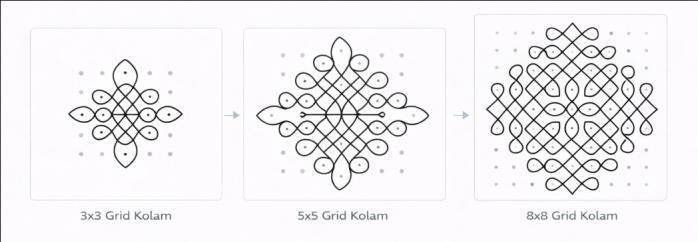
Fig -6: Generated Kolam patterns for different grid sizes (3×3, 5×5, and 8×8) demonstrating increasing complexity and structural consistency.
Ontheanalysisside,theOpenCV-basedpipelineperformed reliably for structured inputs. After applying grayscale conversionandGaussiansmoothing,Cannyedgedetection produced clear outlines of the Kolam strokes [2]. Contour detection successfully identified the main structural elements of the designs. In simpler patterns, a single dominant contour represented the primary loop, while smallercontourscorrespondedtoindividual dots.Inmore complexpatterns,multiplecontoursweredetected,butthe majoronesalignedcorrectlywiththemainsegmentsofthe design.
The system alsodemonstratedaccurate featureextraction. Dot structures were identified using contour-based filtering, and the detected number of dots matched the expected grid configurations. Similarly, loop detection corresponded well with the known structure of the generated patterns. For example, a 4×4 grid design resulted in 16 detected dots and a single continuous loop, consistentwiththeinputparameters.
Symmetry detection further validated the correctness of the system. By comparing the original image with its mirroredorrotatedversions,thesystemwasabletoassess symmetry accurately. Patterns that were intentionally symmetric showed high similarity scores, while asymmetric or distorted inputs resulted in lower values. This confirmed that the extracted features such as dot count, loop structure, and symmetry closely reflected the actualgeometryoftheKolampatterns.
Overall, the results indicate that the system produces visually consistent designs and accurately extracts structural featuresfrom inputimages. The outputsremain interpretable and reproducible, as they directly follow the definedrule-basedlogic.
The findings demonstrate that Kolamkala effectively captures the fundamental principles of traditional Kolam design. The successful generation of continuous,
International Research Journal of Engineering and Technology (IRJET) e-ISSN: 2395-0056
Volume: 13 Issue: 03 | Mar 2026 www.irjet.net p-ISSN: 2395-0072
symmetric patterns confirms that grid-based rules and geometricconstraintsaresufficienttoreproduceauthentic Kolam structures. This aligns with existing studies that describe Kolam patterns as structured arrangements of dots connected by continuous lines under symmetry constraints.
The image analysis results further support this observation. The ability of classical image processing techniques to detect edges, contours, and structural features indicates that Kolam patterns can be reliably analyzed without the need for complex learning-based models. In controlled conditions, the system’s outputs closelymatchedexpectedstructuralproperties,reinforcing thereliabilityoftheapproach.
Compared to existing methods, Kolamkala offers a distinct advantage through its emphasis on explainability. While many prior approaches rely on machine learning for classification or recognition, they often operate as blackbox systems with limited interpretability. In contrast, the rule-based design of Kolamkala ensures that every generatedpatternandextractedfeaturecanbetracedback to explicit computational steps. This makes the system more transparent and suitable for educational and analyticaluse.
Anotherstrengthofthesystemliesinitsconsistency.Given thesameinputparameters,thegeneratoralwaysproduces the same output, ensuring reproducibility. The use of numericalcomputationthroughNumPyalsocontributesto precise and visually accurate designs. Similarly, the analysispipelineproducesstableresultsforstructuredand high-quality inputs, making it reliable for typical Kolam patterns.
However,thesystemalsoexhibitscertainlimitations.Since it is based on grid-defined rules, it performs best with structuredKolamdesignsandmaynothandlefreehandor irregular patterns effectively. In such cases, the analysis pipeline may produce incomplete or fragmented results. Additionally, the performance of edge detection and contourextractiondepends onimage quality.Variationsin lighting,noise,ordrawingclaritycanaffecttheaccuracyof featuredetection.
There is also a trade-off between simplicity and flexibility. While the rule-based approach ensures transparency and reliability, it limits the system’s ability to adapt to highly diverse or unconventional patterns. In contrast, datadrivenmethodscangeneralizebetteracross variationsbut lack interpretability. Kolamkala prioritizes clarity and control over adaptability, which is appropriate for its intended purpose but restricts its scope in more complex scenarios.
One key limitation of the system is its dependence on structured, grid-based inputs. Future improvements could focus on extending the generation module to support a wider variety of Kolam styles, including more complex or free-formdesigns.
Ontheanalysisside,incorporatingadvancedpreprocessing techniquessuchasadaptivethresholdingormorphological operations could improve robustness against noise and variations in image quality. Enhancing dot detection and contourrefinementwouldfurtherincreaseaccuracy.
Anotherpotentialdirectionistointroducelimitedadaptive methods to improve flexibility while maintaining explainability.Additionally,improvingtheuserinterfaceto allowinteractiveeditingorcustomizationofpatternscould enhanceusability.
This study presented Kolamkala, a web-based computational framework for the generation and analysis oftraditional Kolampatternsusingarule-basedapproach. Theprimaryobjective wastotranslatethegeometriclogic of Kolam design into an interpretable and implementable system that allows both pattern creation and structural analysis.
The results demonstrated that the system was capable of generating consistent and visually accurate Kolam designs based on user-defined grid sizes and symmetry constraints. The generated patterns preserved key characteristics of traditional Kolams, including continuous loops, enclosed dots, and symmetrical structures. In addition, the image analysis module effectively extracted important features such as edges, contours, dot arrangements, and symmetry, confirming that classical image processing techniques are sufficient for analyzing structuredKolamdesigns.
The significance of this work lies in its emphasis on simplicity and explainability. Unlike data-driven approaches, the system relies on deterministic rules that make every output transparent and reproducible. This makes Kolamkala particularly useful for educational purposes, as users can understand how patterns are formed and how their structural properties are evaluated Furthermore, the system contributes to the digital preservation of traditional Kolam art by providing a computational representation of its underlying design principles.
However, certain limitations remain. The system is primarily designed for grid-based Kolam patterns and
International Research Journal of Engineering and Technology (IRJET) e-ISSN:2395-0056 Volume: 13 Issue: 03 | Mar 2026 www.irjet.net p-ISSN:2395-0072
performs best with clean, well-defined inputs. It may not handle freehand or irregular designs effectively, and the accuracyoftheanalysismoduledependsonimagequality. These limitations highlight the trade-off between simplicityandflexibilityinrule-basedsystems.
Future work can focus on expanding the range of supportedKolamstyles,improvingtherobustnessofimage processing under varying conditions, and enhancing user interaction through more flexible design tools. Incorporating adaptive techniques while maintaining explainability could further improve the system’s applicability.
In conclusion, Kolamkala demonstrates that traditional Kolam patterns can be effectively modeled using rulebased computational methods. By combining generation and analysis within a single framework, the system provides a practical and interpretable approach to studyingandpreservingthisculturallysignificantartform.
[1] Sahapedia,"Significance of Kolam in Tamil Culture. [Online].Available: http://www.sahapedia.org/significance-of-kolamtamil-culture
[2] Tranetal.,"KolamNetV2:DeepLearningforKolam Pattern Recognition," Nature Heritage Science, 2024.[Online].Available: https://www.nature.com/articles/s40494-02401167
[3] P.M.C.Article,"KolamDrawingsandMathematical Patterns."[Online].Available: https://pmc.ncbi.nlm.nih.gov/articles/PMC104273 18
[4] DeccanHerald,"TheMathematicsBehindRangoli," 2026.[Online].Available: https://www.deccanherald.com/dhie/socialstudies/2026/02/17/the-mathematics-behindrangoli
[5] EconomicTimes,"KolamPatternsasMathematical Codes." [Online]. Available: https://economictimes.indiatimes.com/news/indi a/h ow-kolam-patterns-in-south-india-aresecretly-mathematical-codes
[6] Algorithmic Pattern Conference, "Kolam Generation Methods,"2025.[Online].Available: https://2025.algorithmicpattern.org/proceedings/ S9NXAC/paper.html