PAVEMENT WIDENING AND OVERLAY DESIGN BY USING FALLING WEIGHT DEFLECTOMETER

Page 1

International Research Journal of Engineering and Technology (IRJET)

e-ISSN: 2395-0056

Volume: 09 Issue: 09 | Sep 2022

p-ISSN: 2395-0072

www.irjet.net

PAVEMENT WIDENING AND OVERLAY DESIGN BY USING FALLING WEIGHT DEFLECTOMETER Saurabh Kumar Yadav¹ ¹M.TechStudent, Department of Civil Engineering, Mewar University. ---------------------------------------------------------------------***--------------------------------------------------------------------1.1 Principle Abstract - Establishing the characteristics of the pavement material and its structural capability is a prerequisite for creating effective maintenance and management strategies for pavements. Studying how the pavement reacts to the imposed weight will help with this. By examining the deflection in response to the load applied at specific spots along the highway, the Falling Weight Deflectometer (FWD) and KGPBACK were used in this study to assess the performance of a road portion of the State Highway (KUNOL RELLAVADA ISARI) in the Indian state of Gujrat. An existing pavement was subjected to a dynamic load using FWD, and the pavement's response to the load was measured.The KGPBACK programme used the deflection values so acquired to calculate the elastic moduli of the modelled layers of the pavement.The IITPAVE software then used the discovered in-situ elastic moduli to build the pavement's overlay. In order to conserve and manage the Indian Highway Road network, administrators could employ the study presented in this paper's guidelines methodology.

A falling mass in the range of 50 to 350kg is drop ped from a heigh to fall in the range of 100to600mm to produce load pulses of desired peak load. The corresponding peak vertical surface deflections at different radial ocations are measured and recorded. A sufficient number of deflection transducers shall be used to adequately capture the shape of the deflection bowl. Six to nine velocity transducers (geophones) are generally adequate. A peak load of 40 kN (+/-4 kN) and pulse duration of 20-30 ms is required for flexible pavement. The target peak load of 40 kN (+/- 4 kN) applied on bituminous pavements corresponds to the load on a dual wheel set of an 80 kN standard axle load and a duration of 20-30 ms simulates traffic moving at a speed of 60 kmph. If the applied peak load differs from 40 kN within the above-mentioned range, the measured deflections have to be normalized linearly during the analysis to correspond to the standard target load of 40 kN.

Key Words: Pavement, Remaining life, Bituminous, FWD, KGPBACK, IITPAVE, IRC-115-2014.

1.2 Falling Weight Deflectometer

1.INTRODUCTION

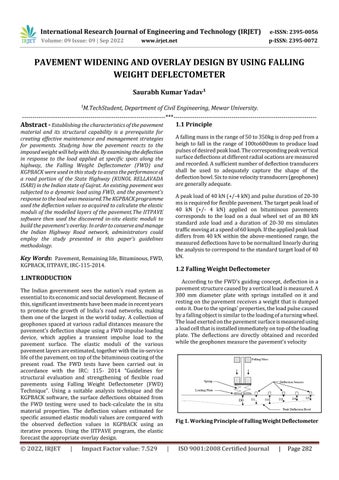
According to the FWD's guiding concept, deflection in a pavement structure caused by a vertical load is measured. A 300 mm diameter plate with springs installed on it and resting on the pavement receives a weight that is dumped onto it. Due to the springs' properties, the load pulse caused by a falling object is similar to the loading of a turning wheel. The load exerted on the pavement surface is measured using a load cell that is installed immediately on top of the loading plate. The deflections are directly obtained and recorded while the geophones measure the pavement's velocity

The Indian government sees the nation's road system as essential to its economic and social development. Because of this, significant investments have been made in recent years to promote the growth of India's road networks, making them one of the largest in the world today. A collection of geophones spaced at various radial distances measure the pavement's deflection shape using a FWD impulse loading device, which applies a transient impulse load to the pavement surface. The elastic moduli of the various pavement layers are estimated, together with the in-service life of the pavement, on top of the bituminous coating of the present road. The FWD tests have been carried out in accordance with the IRC: 115- 2014 “Guidelines for structural evaluation and strengthening of flexible road pavements using Falling Weight Deflectometer (FWD) Technique”. Using a suitable analysis technique and the KGPBACK software, the surface deflections obtained from the FWD testing were used to back-calculate the in situ material properties. The deflection values estimated for specific assumed elastic moduli values are compared with the observed deflection values in KGPBACK using an iterative process. Using the IITPAVE program, the elastic forecast the appropriate overlay design.

© 2022, IRJET

|

Impact Factor value: 7.529

Fig 1. Working Principle of Falling Weight Deflectometer

|

ISO 9001:2008 Certified Journal

|

Page 282


Turn static files into dynamic content formats.
Create a flipbook