International Research Journal of Engineering and Technology (IRJET)
e-ISSN: 2395-0056
Volume: 09 Issue: 09 | Sep 2022
p-ISSN: 2395-0072
www.irjet.net
Development of Power train in Electric Vehicles. Pranav Khaladkar1, Rohit More2, Yash Nashte3, Sayee Deshpande4 1Smt.Kashibai
Navale College of Engineering, Pune. Smt.Kashibai Navale College of Engineering, Pune. 3 Smt.Kashibai Navale College of Engineering, Pune. 4Smt.Kashibai Navale College of Engineering, Pune. ---------------------------------------------------------------------***--------------------------------------------------------------------2
Abstract - Electric vehicles (EV) are the future of not just
transportation, but also of our world. But could there ever be a more severe sort of congestion for electric vehicles? These automobiles are connected to a low voltage charging station. These automobiles don't produce any pollutants. But what if you own an electric car that is charged by solar power or household electricity? What if you could power your house and garage with this charge? You won't have to worry about the effects of gasoline exporters anymore. Drivers of electric cars must thus plan for lengthy journeys and camping. A family's carbon footprint and power costs will both be reduced by a home-built electric vehicle. Electric cars have a huge amount of promise in the future. The charging station is the logical place for these cars to start. However, this is simply the first stage in a prospective trip that may involve charging cities, houses, banks, and other industrial sectors. Therefore, the potential for electric cars is enormous. Since the mid-1980s, research facilities like NASA have been developing the technology for electric cars. In a few years, current technology will undoubtedly be far more advanced. Some predict that soon we'll see self-sustaining electric cars that gather energy through their surroundings. These cars can even run on alternate energy sources like wind and will demand extremely minimal maintenance. Hence, the research paper briefs about the wide development of the electric vehicles.
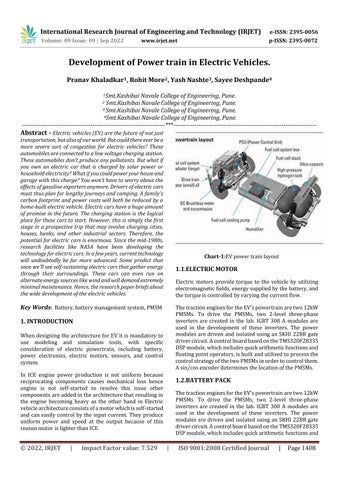
Chart-1:EV power train layout
1.1.ELECTRIC MOTOR Electric motors provide torque to the vehicle by utilizing electromagnetic fields, energy supplied by the battery, and the torque is controlled by varying the current flow.
Key Words: Battery, battery management system, PMSM
The traction engines for the EV's powertrain are two 12kW PMSMs. To drive the PMSMs, two 2-level three-phase inverters are created in the lab. IGBT 300 A modules are used in the development of these inverters. The power modules are driven and isolated using an SKHI 22BR gate driver circuit. A control board based on the TMS320F28335 DSP module, which includes quick arithmetic functions and floating point operators, is built and utilised to process the control strategy of the two PMSMs in order to control them. A sin/cos encoder determines the location of the PMSMs.
1. INTRODUCTION When designing the architecture for EV it is mandatory to use modeling and simulation tools, with specific consideration of electric powertrain, including battery, power electronics, electric motors, sensors, and control system. In ICE engine power production is not uniform because reciprocating components causes mechanical loss hence engine is not self-started to resolve this issue other components are added in the architecture that resulting in the engine becoming heavy as the other hand in Electric vehicle architecture consists of a motor which is self-started and can easily control by the input current. They produce uniform power and speed at the output because of this reason motor is lighter than ICE.
© 2022, IRJET
|
Impact Factor value: 7.529
1.2.BATTERY PACK The traction engines for the EV's powertrain are two 12kW PMSMs. To drive the PMSMs, two 2-level three-phase inverters are created in the lab. IGBT 300 A modules are used in the development of these inverters. The power modules are driven and isolated using an SKHI 22BR gate driver circuit. A control board based on the TMS320F28335 DSP module, which includes quick arithmetic functions and
|
ISO 9001:2008 Certified Journal
|
Page 1408