International Research Journal of Engineering and Technology (IRJET) e-ISSN: 2395-0056

Volume: 09 Issue: 09 | Sep 2022 www.irjet.net p-ISSN: 2395-0072
International Research Journal of Engineering and Technology (IRJET) e-ISSN: 2395-0056
Volume: 09 Issue: 09 | Sep 2022 www.irjet.net p-ISSN: 2395-0072
1 M.E. Student, Department of Transportation Engineering, Shri G. S. Institute of Technology and Science, Indore, India
2 Assistant Professor, Department of Transportation Engineering, Shri G. S. Institute of Technology and Science, Indore, India
3 Professor and Dean, Department of Transportation Engineering, Shri G. S. Institute of Technology and Science, Indore, India ***
Abstract - Intersection have essential role for the flow of vehicles. When Vehicles move on the road, they cross several intersections and users abide delay, congestion and conflict points since all the operations like merging, diverging, weaving and crossing operations are performed at the intersections. This paper aims to review the various ways to reduce the conflict points, congestion and delay at the intersection. To achieve the desired results of intersection, severalresearcherssuggestedthevariouswaysthatshouldbe adopted during the intersection design. The intersection parameterssuchasentryradiusexitradius, rightturntraffic, sight distance, setback distance, design speed, gradient, channelizedisland,designvehiclesconsideration,markingand sign boards near the intersection, and luminous intensity are studied. Intersections must be designed to accommodate vehicular traffic, non-motorized traffic, pedestrians and cyclists for their efficient movement with minimum delay at the intersection. The flow of traffic near intersections should be in the way, they create minimum conflict during the crossing at the intersection. There are software’s available which we can use to assess the flowof traffic andstudy all the conflict points and suggests the remedial measures for the particularproblem.Forminimizingtheconflictpointsproper widening, marking and channelization, and signals at the intersection should be provided to flow all the traffic with efficient way. Under mixed traffic conditions, there should be consideration of all factors of an intersection so that vehicles follow the desired path and cross the intersection with minimum delay and conflict
Key Words: Delay, Level of Service, Sight Distance, Conflict Points, Modelling of Intersection
Heterogeneityandpoorlanedisciplinearetheprimetraffic characteristicsofdevelopingcountries.LevelofServiceata signal-controlledintersectionisgenerallymeasuredinterms of delay caused to an individual vehicle. When an intersection is carrying a traffic equal in volume to its capacity under ideal roadway and traffic conditions, the operatingconditionsbecomeextremelypoor.Speeddrops downandthedelayandfrequencyofstopsmountup.The service which an intersection offers to the road users can
vary under different volumes of traffic [1] Intersection design can significantly improve traffic flow and decrease thecrashfrequency,particularlyincongestion-proneurban areas.Intersectionsafetyanalysis,likeroadsegmentsafety analysis,isconductedtoidentifyfactorsthatcontributeto thesafetyofroadusersatintersections,andtherefore,help designerstodevelopeffectivecountermeasurestoimprove safety[3].Network-widesignaltimingoptimizationcouldbe potentiallyeffectiveifdegreesofsaturationofintersections in a street network are comparatively low where the remainingintersectioncapacitiescouldstillaccommodatea significantamountoftraffic.Inthiscase,fine-tuningofsignal timing plans for intersections in one or more subarea networkscouldhelpimprovetheefficiencyofintersection capacity utilization with delay reductions [5] Long et al. highlighted that the parked cars blocked the sightlines towards the pedestrian crossings. Hence, their removal wouldbebeneficialtoprovidereciprocalvisibilitybetween pedestrians and motorists. However, it is common to find spaceswhereon-streetparkingisbanned,filledwithflower pots, trash containers, or other elements. These elements couldenforcethebanbecauseemptyspacescouldbeused unlawfully. Pedestrian’s actual crossing behavior, pedestrians are divided into three types, including adventurous,conservativeandordinary.Takingtheriskcost andtimeutilityasthebehaviordecisionbasis,thedecisionmakingmodelsofthreetypesofpedestriansareestablished. Parameters of the models for three types pedestrians are calibrated according to the collected data [6] VISSIM simulationsoftware,createsatrafficsimulationmodelofthe intersection,looksoptimisedsignal timingschemeforthe intersections and lane improvement programme Results showedthatthetwotypesofchannelizationproposedinthis paperperformedbetterthanthecurrentlypopulardesign [19]. Enhancing travel efficiency for left-turn movements wasimportantastheurbanroadnetwork developed[20]. Thevehicleconflictvaluescalculatedbytheimprovedmodel aretheunbiasedestimationsofobservedconflictvalues.The model also describes well the evolution trend of traffic conflict quantities according to traffic volumes at an unsignalizedintersection[28] Thestudyrecommendsthat the proposed model works well for the signalized intersectionoperatingwithahighproportionalshare(above 30%)ofvehicletypeTwo-wheelerinthemixedtypetraffic
International Research Journal of Engineering and Technology (IRJET) e-ISSN: 2395-0056
Volume: 09 Issue: 09 | Sep 2022 www.irjet.net p-ISSN: 2395-0072
stream. The present study suggested a simple method for estimatingthenumberofvehiclesaccommodatinginqueue formed at an approach of signalized intersection and it is limitedtotheintersectionsoperatingunderhighervolume condition[32] accelerationanddecelerationratemodelsare developed for four vehicle categories under mixed traffic conditions. Thecorrelation analysisshowedgood relation betweentheaccelerationrate/decelerationrateandspeed. Linearmodelsaredevelopedforestimatingaccelerationrate anddecelerationratebyconsideringaveragetravelspeedas independentvariable.[33]
Hightrafficgrowth,lackofproperroadtrafficmanagement andlaneindisciplineleadtodelaytothevehiclesparticularly at intersection locations. One of the effective attempts towardstrafficaswellaspedestriancontrolatintersections is signalization [21]. Intersection delay has a massive influence on the proper operation of an intersection The delay of traffic signals is one of the serious challenges affectingroadusersindevelopingcountriessuchasIndiain theirregularlifestyle.Generally,atintersections,thecauseof the delay is due to various motives [4]. The capacity and level of service of an intersection can be assessed by saturation flow. HCM2010 hasintroduced a procedure to estimatesaturationflow,assumingthatthevehiclesfollow lanediscipline.However,indevelopingcountrieslikeIndia, traffic is heterogeneous in nature, and very poor lane discipline is maintained. Due to fundamental variation in traffic characteristics and driver behavior, the models developedinUSAandUKforestimatingsaturationfloware notapplicablefordevelopingcountrieslikeIndia[22].
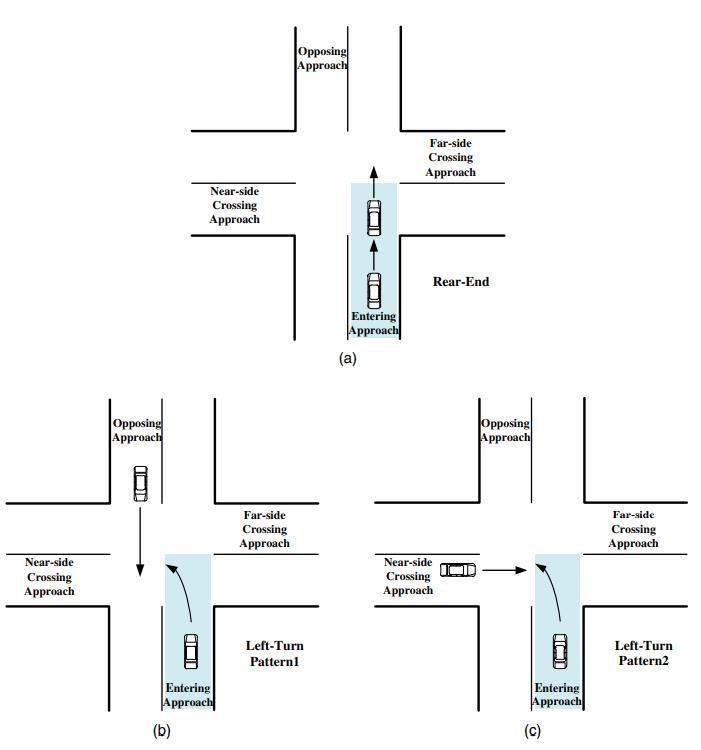
Conflicting traffic maneuvers are most common near intersections,makingthemmorepronetocrashoccurrence. Anaccurateknowledgeoftheinteractionsbetweenvarious geometric characteristics, traffic flow, and crashes at the intersection influence region could aid in reducing these crashes by identifying effective countermeasures. The instrumentsforunderstandingthesecorrelationsaresafety performancefunctions[3]
Fig -3:Crashtypesclassifiedbyconflictingvehicle maneuvers
Manypreviousstudiesmainlyfocusedondevelopingmodels toevaluatethevehicledelayofsignalizedintersectionsand on designing signal control systems. Transportation professionalsgenerallycategorizedthevehicledelayatthe signalizedintersectionsintothestopdelayanddecelerationacceleration delay [4]. To eliminate or reduce the conflict point, improve traffic safety, cut down on delays, and increaseintersectioncapacity,itis,therefore,necessaryto analyzethetrafficsituationatthemainintersectionofthe roadnetworktoidentifytherootcausesoftrafficjams.Once thisisdone,itispossibletoimplementappropriatetraffic managementorsignalcontroloptimization.Bydoingthis, thecity'strafficcongestioncanbeeffectivelyreduced.
Unsignalized T-intersections are liable to conflicts due to complexturningvehicularmaneuversandvariedvehicular speeds in developing countries. Due to the mixed traffic conditions in India, the operational characteristics and speeds of the vehicles are different. Moreover, at unsignalizedT-intersections,majorroadtrafficmovements have been given more priority, while minor road vehicles havetofindasuitablegapbetweentheconflictingstreams onmajorroadstocompletetheirmaneuvers.
International Research Journal of Engineering and Technology (IRJET) e-ISSN: 2395-0056
Volume: 09 Issue: 09 | Sep 2022 www.irjet.net p-ISSN: 2395-0072
decelerationrate,perceptionreactiontime(PRT),andgap timeacceptance[8].
Turningvehicletrajectoriesdependonthewidthoftheroad, availablevehiculargapsonmajorroads,waitingtime,speed of the vehicle on major roads, type of subject vehicle, and speedofthesubjectvehicle.Moreover,thevehiculardriver's behaviordependsupontheinteractionofthesubjectvehicle withapproachingvehiclesonmajorroadswhilecrossingthe roadataT-intersection[7]
Hummer and Mehrara demonstrated that the double contraflow intersection (DCI) has the ability to provide slightlybettercapacitythanthecontinuousflowintersection (CFI)andmedianU-turn(MUT)[9].Thepredictionmodelof potentialtrafficconflictsatanuncontrolledintersectionisa wayofusingtrafficconflicttechnologytoevaluatethesafety performance in designing or improving future traffic facilitiesandroadnetworks.Inanexistingpotentialtraffic conflicts prediction model for unsignalized intersections, there is an important assumption that conflict spots are independent [23] The average length of comer clearance, trafficflow,land-usetypes,thenumberofleft-turnlanesfor main streets, the number of through lanes for main and minor streets, the posted speed limit on main and minor streets, and leg grades were among the nine variables identified by the panel data RENB as having a significant impact on the safety at signalized intersections [11]. An intensivestudyontheintersectionsofmixedtrafficforthe high-densitydevelopmentofacity,inordertomakemixed traffic operate effectively, safely, and orderly, we must quicklyovercomethechallengesofmakingthebestuseof availableresourcesandchannelizingtrafficforrightturnsof motorized vehicles, non-vehicles, and pedestrians. The challengesthatwemustquicklyovercomeinvolvehow to make the best use of already available resources and channelize for the traffic right turn of motorized vehicles, non-vehicles,andpedestrians[24].Inordertoaddressthe issueofexcessivechannelizationforleft-turntraffic,three differenttypesofchannelizationatsignalizedintersection approaches.Theoperatingcharacteristicsofthetrafficflow in various types of channelization, potential safety, and impactonintersectioncapacitywereexamined[12].
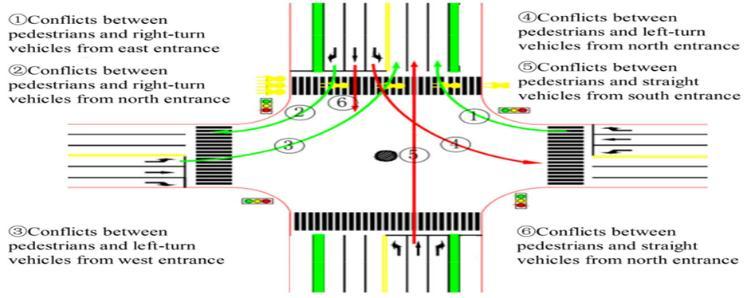
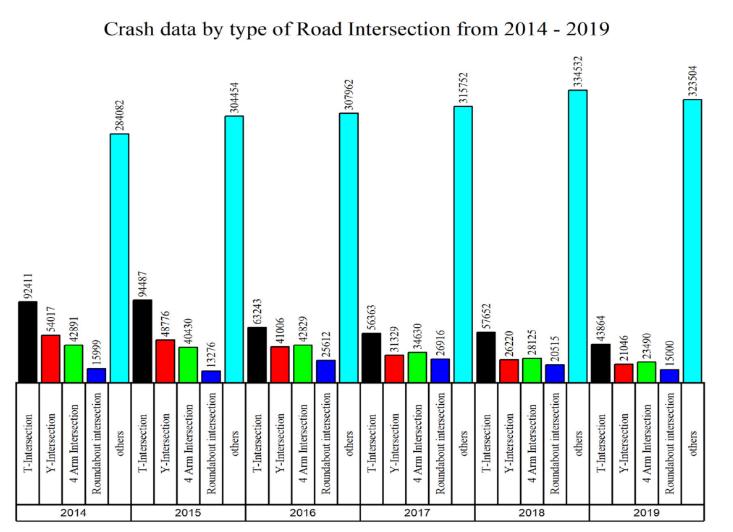
Fig -2:Showscrashdatabytypeofroadintersectionfrom 2014-2019[7]
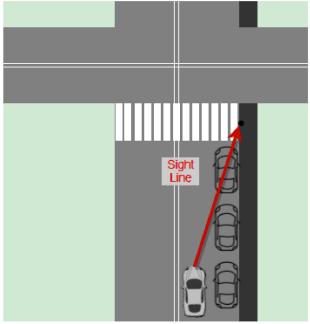
Adequatesightdistanceatintersectionsisoneofthemost crucial road design elements in an urban environment, whichisrepresentedbyanareathatneedstobeclearfrom obstructions.Roadobstructionsimpactthedriver’svisibility whenavehicleisapproachinganintersection.Whenadriver failstoobserveayieldorstopsignatatwo-way-controlled signintersectionorobserveoncomingtrafficfromthemajor road due to visibility issues from the intersection, it may increase their collision risk. Sight distance is an element associatedwithvisibilityandcentraltotheinherentsafetyof intersections. The ISD is specified in the road design guidelines, based on conservative values of speed,
Thesafetyassessmentfoundthatintersectionswithshort accessiblesightdistances(ASD)hadahigherprobabilityof collision.Oneofthemostimportantroaddesigncomponents in an urban context is enough sight distance at crossings, whichisrepresentedbyanareathatmustbefreeofbarriers [8]. Adequate sight distance at intersections is one of the mostcrucialroaddesignelementsinanurbanenvironment, whichisrepresentedbyanareathatneedstobeclearfrom obstructions,impactthedriver’svisibilitywhenavehicleis approaching an intersection. Parked autos obstructed sightlinestopedestriancrossings.Asaresult,theirremoval would be advantageous in terms of providing reciprocal visibilitybetweenpedestriansandautomobiles[13]
International Research Journal of Engineering and Technology (IRJET) e-ISSN: 2395-0056
Volume: 09 Issue: 09 | Sep 2022 www.irjet.net p-ISSN: 2395-0072
Fig -3:Sightlineblockedbyon-streetparkedtraffic[13]
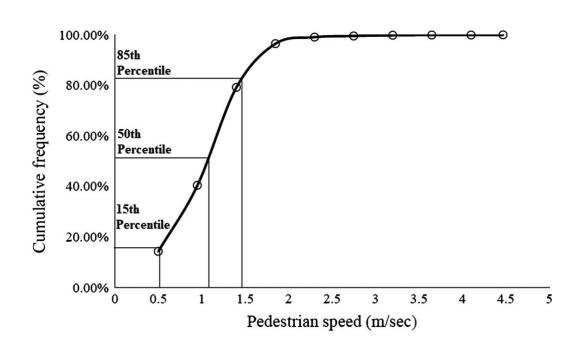
The study establishes a decision model of pedestrian crossingbasedonrisk-costandtime-utilityduringflashing green-countdown signal. The calculation methods of potentialanddirectriskineachdirectionoftheintersection areproposedaccordingtothetrafficoperationstatus and analyzedtherelationshipamongthearrivaltime,remaining duration of flashing green signal and the actual crossing behaviors, pedestrians are divided into adventurous, ordinaryandconservativetypes[6] Inmetropolitancities where both must share a common area on the road, the interactionofpedestriansandright-turningautomobilesata signalised crossroads is a typical occurrence. Conflicts betweenpedestriansandvehiclesaregrowingasaresultof therapiddevelopmentofmotortrafficinemergingnations like India [14]. The role of impact factors on pedestrian crossingdecision-makingisexaminedinlightofthemodel's findings.Afterthat,adviceisprovidedonthreefrontsroad facility setting, pedestrian traffic management, and safety education initiatives to lower the number of pedestrian violationsandimprovethepedestriantrafficenvironment [25]
Fig -4: Cumulativepercentagedistributionofpedestrian speed[14]
Delay is a function of a number of factors, including geometry, signal timings, and approach volumes. Some of these factors, particularly, peak hour volume, can be considered to be random variable, and therefore the distribution of intersection delay is a function of the distributionoftheserandomfactors[12] Intersectionthatis the vehicle together and steering is the key to urban transport,whosecomplextrafficfeaturesmakeiteasytobe continued confusion and traffic accidents with multiple pointsandreducetheabilityoftheroadnetwork.Itbecomes bottleneck in the entire city roads [16] The queue length wasdetermineddirectlyfromthefield,andthedelaywas calculatedusingSimpson'sone-thirdformulabasedonthe queue length of a cycle. It gives the distance between the lengthofthequeueandthetimeofasinglecycle,showing the overall delay of the cycle. The proposed model, HCM method,Webster'sdelaymodel,modified Webster'sdelay model,andprobabilisticdelaymodelresultswerecompared to the field delay. It was found that the suggested model producesthebestoutcomes [26].Thecollectionofqueues estimating models created in this work provides highway builders with a useful tool for calculating the correct link lengths for both through and left-turn movements in CFI [27].
The vehicle conflict values calculated by the improved model are the unbiased estimations of observed conflict values.Themodelalsodescribeswelltheevolutiontrendof trafficconflictquantitiesaccordingtotrafficvolumesatan unsignalizedintersection[28]. VISSIMsimulationsoftware, createsatrafficsimulationmodeloftheintersection,looks optimised signal timing scheme for the intersections and laneimprovementprogramme Resultsshowedthatthetwo types of channelization proposed in this paper performed better than the currently popular design [19]. Enhancing travelefficiencyforleft-turnmovementswasimportantas
International Research Journal of Engineering and Technology (IRJET) e-ISSN: 2395-0056
Volume: 09 Issue: 09 | Sep 2022 www.irjet.net p-ISSN: 2395-0072
the urban road network developed. Engineers may find additionalusefulreferencesfromthispaper[20].
This paper presents conclusions drawn after having a thoroughstudy-
1. The PCU of a vehicle is a complex parameter and dependsonallfactorsinfluencingthebehaviorofa vehicleinthetrafficstream.Thisprovidesthethe concepttotake the differentvehicles intoa single unit.
2. The design of the intersection should be done considering proper sight distance, lane widening, channelizing,properradiusofturningofvehiclesso thatvehiclecanstopbeforecollisioninanykindof situation.
3. Themodelindicatesthataplatooninamixedtraffic condition, after crossing the stop line of an upstream signal, gets completely dispersed at a distanceof450m.Therefore,iftheupstreamsignal is located within 450 m from the downstream signal,denseormoderatelydenseplatoonwill be witnessed, thereby reducing the vehicular delay [26].
4. Capacity of a two-lane road under mixed traffic conditions has already been a challenge to traffic engineers. It is due to variation in vehicular interactionatdifferentlevelsoftrafficmix.Speedof astreamofcarsreducesasanothertypeofvehicle is introduced in the stream. The amount of reduction in speed depends upon the type and proportionofthesecondcategoryofvehicleandthe totaltrafficvolume.Thecapacityofatwo-laneroad decreasesastheproportionof3-wheeler,tractor,or heavyvehiclesincreasesinthetrafficstream.[29]
5. Whenpedestriancannotcrossthestreetcompletely duetothewidthofstreet,itisnecessarytohavea pedestrian safety island. It is also advised to have pedestriansafetyislandwhentherearemorethan5 entranceorexitlanes.
6. The lowest level of delays for each traveler by dynamically altering green splits of signal timing plans designed for individual intersections in the network hour-by-hour in response to varying vehicle and pedestrian traffic entering the intersections.
7. The driver’s eye location is relatively close to the intersection and requires a smaller sight triangle clearfromobstruction.Thedriver’sdecisionpoint beginsatsomepointbetween4.4mand5.4mfrom
themajorroad’sintersectionedge,giventhevehicle stoplocationbehindthestoplineandthedistanceof thedriver’seyefromthefrontofthevehicle.Thegap timeacceptanceis0.5slessthanforyield-controlled intersections,resultinginashorterlegdistanceof thesighttrianglealongthemajorroad.
8. Thesimulationresultsshowthatthedesignsystem givesbetterclearancetovehicles,emergencytransit andalsotopedestriansinalltrafficflowconditions throughouttheday.Thissystemcanberealizedand implemented on any major traffic intersection to address all types of movements and enhance the trafficas well as pedestrian handlingcapability of theintersection.
9. Thenumberoflanechangesisincreasedwithtraffic volume to a certain extent, but as further traffic volumeincreased,thenumberoflanechangesare decreased. When traffic volume reaches capacity, thenumberoflanechanges are stagnated.Thisis becauseofnotenoughfreespaceavailableforthe movement of vehicles. The frequency of lane changesincreasesasthenumberoflanesaddedto thelaneincreases,yetthecapacityofonelaneper lanereducesasthenumberoflanesincreases.[31]
10. 10.Whenapproachinganintersectioncontrolledby ayieldsign,thedriverrequiresacertaindistanceto observeapotentialconflictingvehicleandtoslowor stop before entering the intersection, and this distance forms a large area that needs to be clear fromobstruction.
11. Traffic signals are one of the most effective and flexibleactivecontroloftrafficthatiswidelyusedin severalcitiesworldwidetoensuresafeandorderly trafficflow;theconflictsarisingfrommovementsof traffic in different directions is solved using time sharingprinciple[35].
12. Thetrafficguidesignplaysanimportantroleinthe traffic sign system. However, in the junction area betweenhighwayandurbanroad,thedriveroften takesthewrongwayduetothedifferentlayoutof thesignage[36]
13. Theseverityofconflictsvariedsignificantlywiththe pedestrians’ interactions with different vehicle types.Themaximumnumberofconflictsoccurred withLMVssuchascars,SUVs,andlightcommercial vans.Theseverityofconflictswasalsohigherwith LMV-related conflicts. The lowest severity was observedwithheavyvehiclesbecauseoftheirlower speedsatintersectionsandtheyieldingbehaviorof pedestrians after perceiving such large vehicles [14]
International Research Journal of Engineering and Technology (IRJET) e-ISSN: 2395-0056
Volume: 09 Issue: 09 | Sep 2022 www.irjet.net p-ISSN: 2395-0072
14. At signalized intersections, LOS is an operational conditionindexinfluencednotonlybytrafficflow, but also by geometric design features and signal timing. That is, a given traffic flow may be associatedwithdifferentintersectioncapacitiesdue to differing intersection configurations and signal timings.CorrelationsbetweenLOSandtrafficflow weretestedbeforedevelopingthemodels[37]
[1]A.Saha,S.Chandra,andI.Ghosh,“Assessmentoflevelof serviceforurbansignalizedintersectionsinIndia,” Curr Sci, vol. 117, no. 9, pp. 1516–1521, 2019, doi: 10.18520/cs/v117/i9/1516-1521.
[2]A.AgrawalandR.Paulus,“SmartIntersectionDesignfor Traffic,PedestrianandEmergencyTransitClearanceusing FuzzyInferenceSystem,” International Journal of Advanced Computer Science and Applications,vol.12,no.3,pp.516–522,2021,doi:10.14569/IJACSA.2021.0120362.
[3]M.W.Khattak,A.Pirdavani,P.deWinne,T.Brijs,andH. de Backer, “Examining the Effects of Geometric Features, TrafficControl,andTrafficVolumeonCrashFrequency at UrbanIntersections.”
[4]D.Singh,T.Ameen,andA.Ahmad,“Analysisofdelayand queuelength variationat three-legsignalized intersection under mixed traffic condition,” Innovative Infrastructure Solutions,vol.6,no.2,Jun.2021,doi:10.1007/s41062-02100493-1.
[5]M.Terraza,J.Zhang,andZ.Li,“INTERSECTIONSIGNAL TIMINGOPTIMISATIONFORANURBANSTREETNETWORK
TOMINIMISETRAFFICDELAYS,” Promet - Traffic - Traffico, vol. 33, no. 4, pp. 579–592, Aug. 2021, doi: 10.7307/ptt.v33i4.3694.
[6] X. Long, M. Zhou, H. Zhao, and Y. Song, “Pedestrian crossingdecisionduringflashinggreen-countdownsignalfor urban signalized intersection,” Journal of Transportation Safety and Security, 2021, doi: 10.1080/19439962.2021.1949415.
[7] S. R. Bonela and B. R. Kadali, “Review of traffic safety evaluation at T-intersections using surrogate safety measuresindevelopingcountriescontext,” IATSS Research ElsevierB.V.,2022.doi:10.1016/j.iatssr.2022.03.001.
[8]O.Kilani,M.Gouda,J.Weiß,andK.El-Basyouny,“Safety assessmentofurbanintersectionsightdistanceusingmobile lidardata,” Sustainability (Switzerland),vol.13,no.16,Aug. 2021,doi:10.3390/su13169259.
[9]J.E.HummerandA.MehraraMolan,“ComparingtheNew Double Contraflow Intersection to Conventional and
AlternativeIntersections,” JTranspEngASyst,vol.148,no.3, Mar.2022,doi:10.1061/jtepbs.0000642.
[10] Y. Wang, “Potential Traffic Conflict Prediction Model ConsideringInteractionofConflictSpotsatanUnsignalized Intersection.”
[11]X.Xu,H.Teng,V.Kwigizile,andE.Mulokozi,“Modeling Signalized-lntersectionSafetywithCornerClearance,”2014, doi:10.106l/(ASCE)TE.1943-5436.0000636.
[12] R. Noroozi and B. Hellinga, “Distribution of delay in signalizedintersections:Day-to-dayvariabilityinpeak-hour volumes,” J Transp Eng,vol.138,no.9,pp.1123–1132,Sep. 2012,doi:10.1061/(ASCE)TE.1943-5436.0000423.
[13]G.G.Keila,R.DerrickK.,andC.María,“ModelingUrban Road Scenarios to Evaluate Intersection Visibility,” Sustainability (Switzerland), vol. 14, no. 1, Jan. 2022, doi: 10.3390/su14010354.
[14]A.Kumar,M.Paul,andI.Ghosh,“AnalysisofPedestrian Conflict with Right-Turning Vehicles at Signalized IntersectionsinIndia,” J Transp Eng A Syst,vol.145,no. 6, Jun.2019,doi:10.1061/jtepbs.0000239.
15] Y.-N. Song, J.-J. Wang, and X.-Q. Long, “Analysis and ModelingofPedestrianCrossingBehavioratIntersections.”
[16] F. Shenghai and L. Ling, “A TRAFFIC CAPACITY IMPROVEMENT EXAMPLE OF URBAN ROAD INTERSECTION,”2011.
[17]A.Saha,S.Chandra,andI.Ghosh,“DelayatSignalized IntersectionsunderMixedTrafficConditions,” JTranspEngA Syst,vol.143,no.8,Aug.2017,doi:10.1061/jtepbs.0000070.
[18] X. Yang, G.-L. Chang, S. Rahwanji, and Y. Lu, “Development of Planning-Stage Models for Analyzing Continuous Flow Intersections,” 2013, doi: 10.1061/(ASCE)TE.1943-5436.
[19]J.Zhao,Y.Xue,Q.Wu,C.Zhou,andC.Wen,“Optimization Analysis of Urban Road Intersection Based on VISSIM Simulation.”
[20]J.Rong,M.-J.Wang,M.Gong,andJ.-M.Ma,“Comparative StudyofChannelizationDesignsforIntersectionWidening TransitionZones,”2010.
[21]A.Saha,S.Chandra,andI.Ghosh,“DelayatSignalized IntersectionsunderMixedTrafficConditions,” JTranspEngA Syst,vol.143,no.8,Aug.2017,doi:10.1061/jtepbs.0000070.
[22] A. Saha, S. Chandra, and I. Ghosh, “Saturation flow estimation at signalized intersections under mixed traffic conditions,”in WIT Transactions on the Built Environment, 2018,vol.176,pp.387–396.doi:10.2495/UT170331.
2022, IRJET | Impact Factor value: 7.529 | ISO 9001:2008 Certified Journal |
International Research Journal of Engineering and Technology (IRJET) e-ISSN: 2395-0056 Volume: 09 Issue: 09 | Sep 2022 www.irjet.net p-ISSN: 2395-0072
[23] J. Li, X. Wang, R. Yu, and P. J. Tremont, “Relationship between Level of Service and Traffic Safety at Signalized Intersections: Grouped Random Parameter Method,” J Transp Eng A Syst, vol. 144, no. 6, Jun. 2018, doi: 10.1061/jtepbs.0000142.
[24] H. Chen, L. Wang, and J. Zhou, “Research on Traffic Design and Safety Decision of the Intersection Based on MixedTraffic,”2011.
[25] Y.-N. Song, J.-J. Wang, and X.-Q. Long, “Analysis and ModelingofPedestrianCrossingBehavioratIntersections.”
[26] A. Saha, S. Chandra, and I. Ghosh, “Modeling Platoon Dispersion at Signalized Intersections in Mixed Traffic Scenario,” Arab J Sci Eng,vol.44,no.5,pp.4829–4838,May 2019,doi:10.1007/s13369-018-3568-5.
[27]M.Liu,G.Lu,Y.Li,andG.Student,“TheImpactAnalysis ofIntersectionSightDistanceonVehicleSpeed,”2010.
[28] X. Wang, K. Xie, S. M. Asce, M. Abdel-Aty, ; Xiaohong Chen,andP.J.Tremont,“SystematicApproachtoHazardousIntersection Identification and Countermeasure Development,”2014,doi:10.1061/(ASCE)TE.1943.
[29] P. Pratim Dey, S. Chandra, and S. Gangopadhyay, “Simulationofmixedtrafficflowontwo-laneroads,” JTransp Eng, vol. 134, no. 9, pp. 361–369, Sep. 2008, doi: 10.1061/(ASCE)0733-947X(2008)134:9(361).
[30] A. Mehar, S. C. 2, and S. Velmurugan, “Speed and AccelerationCharacteristicsofDifferentTypesofVehicleson Multi-Lane Highways Curb side bus stop View project OperationalperformanceMeasureforintercityroadsView projectSpeedandAccelerationCharacteristicsofDifferent Types of Vehicles on Multi-Lane Highways”, [Online]. Available: https://www.researchgate.net/publication/281893422
[31] S. Srikanth and A. Mehar, “DEVELOPMENT OF LANE CHANGE MODELS THROUGH MICROSCOPIC SIMULATION UNDERMIXEDTRAFFIC,” J Teknol,vol.84,no.4,pp.21–27, Jul.2022,doi:10.11113/jurnalteknologi.v84.18074.
[32]J.JithenderandA.Mehar,“EstimationofQueueLength at Signalized Intersection Under Non-Lane Based Traffic Conditions,” Periodica Polytechnica Transportation Engineering,Aug.2022,doi:10.3311/pptr.17454.
[33]S.Ramireddy,V.Ala,K.V.R.Ravishankar,andA.Mehar, “Acceleration and Deceleration Rates of Various Vehicle Categories at Signalized Intersections in Mixed Traffic Conditions,” Periodica Polytechnica Transportation Engineering, vol. 49, no. 4, pp. 324–332, Dec. 2021, doi: 10.3311/PPTR.16796.
[34] S. Biswas, B. Singh, and A. Saha, “ASSESSMENT OF LEVEL-OF-SERVICEONURBANARTERIALS:ACASESTUDY INKOLKATAMETROPOLIS,” INTERNATIONALJOURNALFOR TRAFFIC AND TRANSPORT ENGINEERING,vol.6,no.3,pp. 303–312,Sep.2016,doi:10.7708/ijtte.2016.6(3).06.
[35]O.O.Adeleke,K.A.Adeogun,andS.S.Kolo,“DESIGNOF A TRAFFIC SIGNALISATION SCHEME AT OLA-OLU INTERSECTION,ILORIN,NIGERIA,” MalaysianJournalofCivil Engineering, vol. 32, no. 2, Jul. 2020, doi: 10.11113/mjce.v32n2.639.
[36]Y.-F.Chen,X.-H.Zhao,andX.-L.Yao,“UtilityEvaluation of Intersection Area of Highway and Urban Road Traffic GuideSignBasedonDrivingSimulationExperiment.”
[37] W. Tan, Z.-C. Li, and Z. Tan, “Modeling the Effects of SpeedLimit,Acceleration,andDecelerationonOverallDelay andTrafficEmissionataSignalizedIntersection,” J Transp Eng A Syst, vol. 143, no. 12, Dec. 2017, doi: 10.1061/jtepbs.0000101.
2022, IRJET | Impact Factor value: 7.529 | ISO 9001:2008 Certified Journal