International Research Journal of Engineering and Technology (IRJET) e-ISSN: 2395-0056

Volume: 09 Issue: 09 | Sep 2022 www.irjet.net p-ISSN: 2395-0072
International Research Journal of Engineering and Technology (IRJET) e-ISSN: 2395-0056
Volume: 09 Issue: 09 | Sep 2022 www.irjet.net p-ISSN: 2395-0072
1Post Graduate student, Structural Engineering, Bapuji Institute of Engineering and Technology, Davangere, Karnataka, India
2Assistant Professor, Structural Engineering, Bapuji Institute of Engineering and Technology, Davangere, Karnataka, India ***
Abstract - According to seismic records, there is an increase in the need for earthquake-resistant buildings, which can be met by providing shear wall, X bracing or Fluid viscous dampers. Due to wind, earthquake and additional forces, lateral forces generated in the wall’s plane. In R.C.C building without shear wall, bracing and FVD the displacement can be seen more.so by placing shear wall, X bracing and Fluid viscous dampers at the properpositionitresiststhelateralloadsandprovidesthe stiffnessto thestructure Theanalysisis bycarried out of R.C.Cbuildingwith placing shear wall,X bracing and fluid viscous dampers at corners of the building by using responsespectrumanalysisinETABSsoftware.
Key Words: Lateral forces, shear wall, X bracing, Fluid viscous dampers, Response spectrum analysis.
Reinforced concrete is widely used in building industry. Hence every civil engineering programmer must have basic understanding of the fundamentals of reinforced concrete.
In order to provide adequate support, the building and to withstand the natural disaster like earthquake many research and analysis has been carried out. The study of seismic behavior of a structure is been checked by using importantcriteriaandthathasbeencarriedoutnumerous investigations and that analysis mainly depend upon elasticandnaturalbehaviorofthestructure.Thetorsional drift displacement and extra force which are acting over the period of time to the structure. The structure can withstandmainlydependuponthecenterofmassandalso considering center of rigidity and considering its figure it explains kind of seismic behavior that the structure is goingtowithstand.
The reinforced concrete (RC) structure which have plate like RC walls are called as shear walls in more to slab, column and beam. These walls are constructed at foundation level and spread continuous throughout the building height. The thickness of a shear wall can be
minimum of 150mm to maximum of 400mm in high rise buildings. The shear walls are constructed along length andwidthofastructure.
In India the RCC structures with the provision of bracing system is very rare in feature. This feature is very much desirable where the construction carried out in seismic areas.Byprovidingbracing systemtothestructure,itcan reduceoreliminatetheeffectofearthquake.
Fluid viscous dampers are also referred as the hydraulic device that when stroked it dissipates the energy placed on the structure by seismic action. To reduce the seismic damages also to improve its performance of a building many creative ideas of earthquake designing are carried out using proper demonstrating of structure with new techniques. Fluid viscous dampers (FVD) are used to examine the response of an RCC structure when they are affected to lateral loads and to resist the lates and to absorbtheenergyFVDareused.
Mr. K Lovaraju et .al (2015) investigated the non-linear analysis of frame to identify effective position of an shear wall in an multistory structure. Four model of an eightstory building were subjected to an earthquake load, and ETABSwasusedtolocateshearwallsatvariouslocations throughout the seismic zones. It was concluded that installing shear wall in an appropriate position is more relevant if base shear and displacement also lessen earthquakerelateddisplacement.
Chandurkar and pajgade (2013) investigated that changing position of shear wall will influence the fascination of powers so that wall should must be put in legitimate position. Concluded that in case the measurement of shear wall are huge the major sum level drive are taken by shear wall conjointly giving the shear wall at appropriate position it can decrease the displacementofanstructureduetoseismictremor.
International Research Journal of Engineering and Technology (IRJET) e-ISSN: 2395-0056
Volume: 09 Issue: 09 | Sep 2022 www.irjet.net p-ISSN: 2395-0072
S Amir and H Jiaxin(2014) investigated the use of viscous dampers under seismic and wind loads, finding that they greatly reduces the energy loss and reduces the vibration in most structure.it is described how a damping systemneedanon-linearcharacteristicsinordertolessen vibration.
Tejas D Joshi (2013) investigatedhighrisesteelstructure bracing system. For the purpose of the analysis, he considered G+15 story building that used a variety of bracing systems, including X bracing, double X bracing, single diagonal bracing and V bracing. according to the study braced building offer a higher level of displacement reduction than unbraced ones. When compared to unbraced building structures, storied drifting braced buildingcanchange.
D.k. Paul (2012) proposed a realistic implementation on an earthquake-resistant building in order to withstand nonlinear lateral seismic stresses.in order to enhance performance, retrofitting is used, in which chevron bracing and an aluminum shear links as a beam are installed. It is found that by using the shear link, the building becomes are more responsive and capable of sustaininglateralstresses.
1. Comparing the seismic behaviour of a structure with andwithoutashearwall,fluidviscousdampers,anda bracingsystemistheprimarygoalofthisstudy.
2. To analyse the displacement changes in the structure byprovidingdifferentshearparameters.
3. To investigate the seismic properties using the response spectrum approach for the identical structurewithandwithoutashearwall,Xbracingand FVD.
4. To study the efficiency of shear parameters by followingpointofview:
a) Maximumdisplacement
b) shear
c) Combinedstress
5. To determine which structure gives superior results byplacingshearparameters.
The analysis was conducted utilizing the software ETABS for the analysis purpose in order to discover the fundamentalelementslikedisplacement,Drift,StoryShear and Story Stiffness. For the analysis Response Spectrum methodisadopted.
Response spectrum analysis is a nonlinear dynamic staticalanalysistechniquethatrepresentingthemaximum seismic response of an elastic structure by evaluating the data from each natural mode of vibration. It is one of the best methodologies to determine the particular mode of vibration for 85% for the base reaction and 90% for response reduction factor under highest standard so response spectrum analysis is highly permitted under the method and known as sum of root of sum of square and other method which is popularly used is complete quadraticcombinationtogettheaccuratevalue.
Table1:Buildingdimension
Sl. No Name of the model Description Height, m
1. Model 1 RCC structure 30
2. Model 2 Structure with shear wall 30
3. Model 3 Structure with FVD 30
4. Model 4 Structure with X bracing 30
4.2 Material property which is used in this model are following;
Gradeofconcrete=M35
Gradeofsteel=Fe550
Geometry of model
Depthandwidthofbeam=460x600mm
Depthandwidthofcolumn=600x600mm
Slabthickness=200mm
Shearwallthickness=200mm
Floorheight=3m
MultiStorybuildingtotalheight=30m
4.3 Load consideration:
1. Dead load is permanent load which cannot vary, which is constant load which include the beam, column and slab weight. This dead load assigned according to codal provisionasperIS875-Part1(1987).
2022, IRJET | Impact Factor value: 7.529 | ISO 9001:2008 Certified
International Research Journal of Engineering and Technology (IRJET) e-ISSN: 2395-0056
Volume: 09 Issue: 09 | Sep 2022 www.irjet.net p-ISSN: 2395-0072
2. Live load is the load. Load is not a permanent load. Whichislikeatemporaryloadwhichloadisanytimeadd or remove from any situation. This live load is also assigned according to codal provision as per IS 875Part2(1987).
3. Earthquake Load (EL) Which is also called as dynamic loadthisloadissudden in natureandcaused vibrationto the building. Agitation is created in building which is caused by the earthquake. The earthquake or horizontal load is assigned according to as per the IS 18932002(Part1).
Thedetailstobeconsideredforearthquakeloadis
•Zonefactortakeinto=0.16
•Importancefactorconsider=1.5
•Responsereductionfactorinthisallmodels=3
•Conditionofsoil=Medium
•Dampingpercentage=5%
Load combinations:
1.5(DL+LL)
1.2(DL+LL±EL) 1.5(DL±EL)
0.9DL±1.5EL
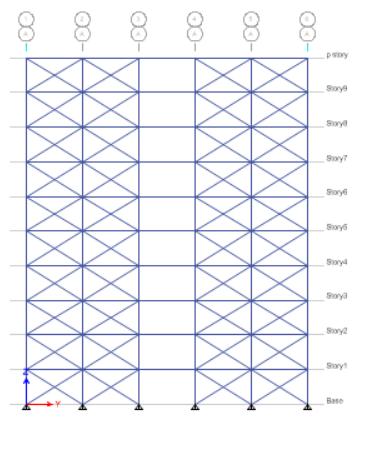
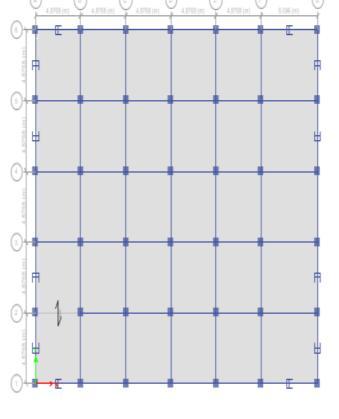
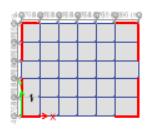
4.4 Modelling and analysis
MODEL 1
MODEL 2
MODEL 3
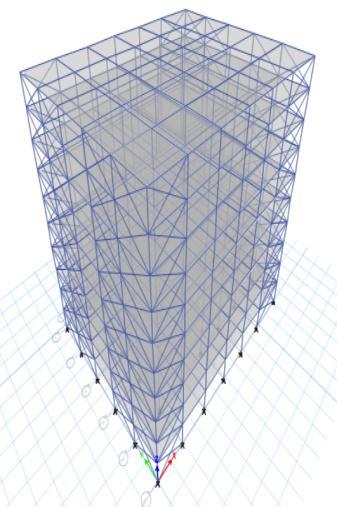
Model 2: plan and 3D view
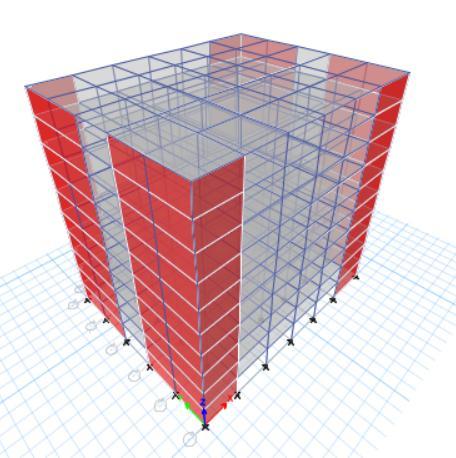
MODEL 4
Model 3: plan and 3D view
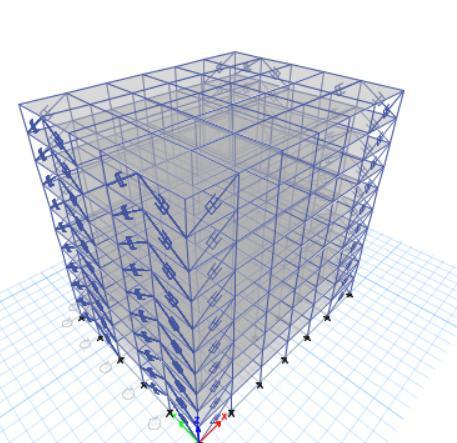
Model 4: plan and 3D view
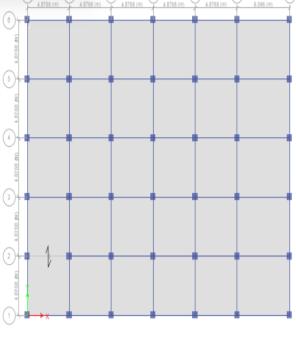
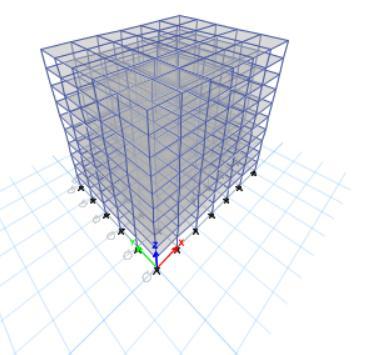
Model 1: plan and 3D view
2022, IRJET | Impact Factor value: 7.529 | ISO 9001:2008 Certified
0 5
International Research Journal of Engineering and Technology (IRJET) e-ISSN: 2395-0056
Volume: 09 Issue: 09 | Sep 2022 www.irjet.net p-ISSN: 2395-0072
1. Inthepresentstudythefinalcomparisonismade for multistorey building with and without shear wall, X bracing and fluid viscous dampers placing atthecorner.
2. By comparing multistorey building with and without shear parameters the displacement reduces by placing shear parameters at corner position.
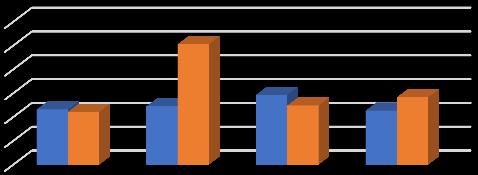
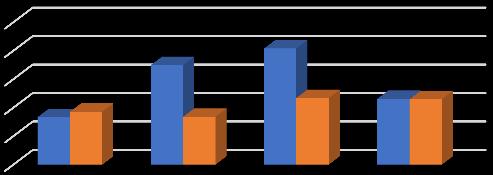
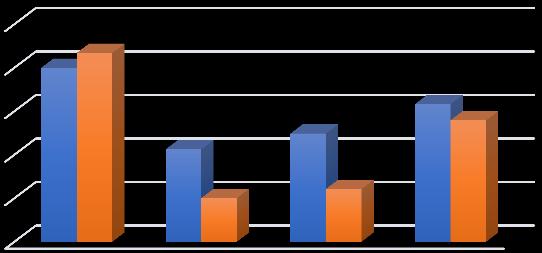
3. By considering the results displacement reduces more by placing shear wall at corners than the placingXbracingandFluidviscousdampers.
4. By placing the structure with shear wall, bracing and fluid viscous it can reduce structural damage due to the earthquake and resist the lateral force comparedtonormalRCCstructure.
5. We can conclude that among the four models by placingtheshearwallatthecornersgivesthebest results considering displacement get highly reduced and also story drift reduces gives more stiffness to the structure compared to x bracing andfluidviscousdampers.
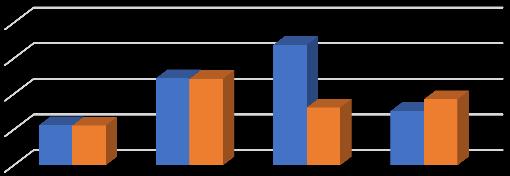
6. By considering displacement and stiffness values fluid viscous dampers shows the good results it canbeconsideredforthesecondchoice.
1 IS 1893 (Part 1): 2002 Indian Standard Criteria for Earthquake Resistant Design of Structures, Part 1 GeneralProvisionsandBuildings,(FifthRevision).
2 IS 456: 2000 Indian Standard Plain and Reinforced Concrete±CodeofPractice(FourthRevision)
International Research Journal of Engineering and Technology (IRJET) e-ISSN: 2395-0056
Volume: 09 Issue: 09 | Sep 2022 www.irjet.net p-ISSN: 2395-0072
3 Mr. K. LovaRaju, Dr. K. V. G. D. Balaji. 2015. Effective location of shear wall on performance of building frame subjected to earthquake load. International Advanced Research Journal in Science, Engineering andTechnology,2(1):33–36.
4 Anil Baral and Dr. SK. Yajdani. 2015. Seismic Analysis of RC Framed Building for Different Position of Shear wall.IJIRSET,4(5):3346–3353.
5 Z.A. Siddiqi, Rashid Hameed, Usman Akmal, “Comparison of Different Bracing Systems for Tall Buildings”Int.Jr.Engr.&Appl.Sci.Vol.14,Jan.,2014.
6 G.F. Dargush, M.L. Green and Y. Wang, “Evolutionary Aseismic Design And Retrofit Of Passively Damped Irregular Structures” 13th World Conference on EarthquakeEngineering.
7 Adithya. M, Swathi rani K.S, Shruthi H K, Dr. Ramesh B.R, “StudyonEffectiveBracingSystemsforHighRise Steel Structures”, SSRG International Journal of Civil Engineering(SSRG-IJCE)volume2Issue2February2015.
8 AnitaTippanagoudar,DrJGKoriandDrDKKulkarni, “Performance analysis of high rise building with viscous Damper”, International journal of Advanced technology & Engineering Research, ISSN No: 22503536,Volume5,Issue4,July2015.
2022, IRJET | Impact Factor value: 7.529 | ISO 9001:2008 Certified Journal