International Research Journal of Engineering and Technology (IRJET) e-ISSN: 2395-0056 Volume: 09 Issue: 09 | Sep 2022 www.irjet.net p-ISSN: 2395-0072

International Research Journal of Engineering and Technology (IRJET) e-ISSN: 2395-0056 Volume: 09 Issue: 09 | Sep 2022 www.irjet.net p-ISSN: 2395-0072
Njoku, M.C.1, Gaven, D.V.2, Azodoh, K.A.3 , Emeh G.C.4, Agulonu, C.C.5 and Ikegbula, S.O.6
1,2,3,4,5,6 Department of Mechanical Engineering, Federal Polytechnic Nekede, P.M.B. 1036 Owerri, Imo-State, Nigeria. ***
Abstract – Serpentine thermosyphon flat plate solar water heater has been designed, constructed from locally available material and its performance evaluation carried out under the metrological conditions of Owerri, Nigeria. Construction of the serpentine thermosyphon flat plate consist of copper tube and elbows used in formation of serpentine shape piping system attached to a black painted aluminum sheet that act as absorber plate. Clear white edge glass material and wood chips are used as glassing and insulator materials, respectively. The solar water heater was tested in October and November, 2021 at Federal Polytechnic Nekede Owerri. Result presented in this paper shows that the solar water heater is capable of generation of 28.5 o C change in water temperature between outlet and inlet of the serpentine solar water heater. Instantaneous thermal efficiency estimated for the solar water heater range between 13.94 and 51.1 % at various mass flow rate and insolation level.
Keywords: mass flow rate, serpentine, solar energy, test rig, water heater
Itisnowuniversallyacceptedthatfossilfuelsarefiniteandit is only a matter of time before their reserves become exhausted[1].Mostcountriesoftheworldstill depend on convectionalenergytomeettheirenergydemands[2].The problemwithoverdependenceonthisformofenergyisthat it is rapidly depleting. Furthermore, the greenhouse gas it produceshasbecomeathreattolifeonearth[3].Increased dependence on convectional energy has no doubt been of benefitatlargetomostcountriesbyprovidingemployment, developmentofinfrastructures,opportunitiesforstrategic alliance among counties and primary source of income. Industrialandeconomicdevelopmentwhichhavebeenmade possiblethroughtheuseof convectional energyresources havebroughtaboutsignificantenvironmentaldegradation and climate change with severe impact on human and ecosystem. The world oil crisis in the 1970s and climate shiftsnoticedbyWorldMeteorologicalOrganization(WMO) in the 1980s have stimulated a global action on the environment. To this effect, so many research works are
being carried out to replace or augment the use of convectional energy resources with renewable energy resources,suchassolarenergy,windenergy,biomass,etc.
Solar energy has been described as the most promising energyofthefuture[4].Itistheenergytransmittedfromthe suninformofelectromagneticradiationwhichrequiresno mediumforitstransmission.Theearthreceivesabouttwo hundredbillionmegawatts(200x109MW)ofthetotalsolar radiationoutput[5].Thisformofenergyisfinite,abundant, cheapandenvironmentallyfriendly.
A common utilization of solar energy is in solar thermal application. In solar thermal application, solar energy is directlyconvertedintoheatenergywhichisusedforheating andcoolingpurposes.However,foreffectiveconversionof solarenergyintoheat energy,solarthermal collectors are required. Solar thermal collector is an assemblage of differentrelatedpartsaimedatcollectionofsolarradiation andconveysthethermalenergytoareceivingmedium.Solar water heater is one of the oldest types of solar thermal collector.Reviewofdifferentconfiguration,performanceand economicconsiderationsof solarwaterheatershavebeen carriedoutbyrefs[6],[7],[8],[9]and[10]
Atsteadystatecondition,instantaneoususefulenergygain offlatplatesolarthermalcollectorisgivenas[11]
Where isusefulenergygain, iscollectorheatremoval factor, iscollectorarea, isincidentsolarradiationon thecollector, istransmittance-absorptanceproduct, is overall heat transfer coefficient, and are inlet fluid temperatureandambientairtemperature,respectively.
Transmittance-absorptance product for most practical collectorisgivenas[11]
International Research Journal of Engineering and Technology (IRJET) e-ISSN: 2395-0056
Volume: 09 Issue: 09 | Sep 2022 www.irjet.net p-ISSN: 2395-0072
(2)
Approximately,transmittance ofglassmaterialisgiven as[11]
(3)
Where representsBouguer’slawabsorptionof transmittanceofglass,givenas[11]
(4)
Where and areextinctioncoefficientandthicknessof glass, respectively. The value of varies from 4m-1 for waterwhiteglass,whichappearwhitewhenviewedonthe edgeto32m-1forhighironoxideglassthatappeargreenish whenviewfromtheedge.Inthisstudyawaterwhiteglassis used,hence, 4m-1.
For a given number of glasses transmittance of reflectionofradiationbyglazingmaterialisgivenas[11]


(5)
Where isreflectionofbeam,diffuseandground-reflected components of solar radiation estimated from Fresnel equation,givenas[11]
(6) and (7)
Therefractedangle ofincidentbeam,diffuseandground reflectedradiationareobtainedfromsneil’slawas[11]
(8)
Where isreflectiveindexofglasswhichisequalto1.526. Thus,angleofincidentbeamradiationisestimatedfrom[11]


(9)
Where islatitudeofstudylocation, ishourangleand is angleofdeclination.
While, incident angles for diffuse and ground-reflected radiationaregivenas[12] (10) and (11)
Where iscollectortiltangle
Solar radiation absorptance of glazing material is given as [11]
(12)
Overallheattransfercoefficient iseffectivecombination ofalllossesoutofthecollectoranditisgivenas[11]
(13)
Where istopheatlosscoefficient, isbottomheatloss coefficient, isedgelosscoefficientandassumedtobe negligibleinthiswork.
Topheatlosscoefficientofflatplatesolarcollectorisgiven as[11] (14) Where (15) (16) (17) (18)



Where isnumberofglasscover, iscollectortiltangle (degree), isemittanceofglass=0.88[13], isemittance

International Research Journal of Engineering and Technology (IRJET) e-ISSN: 2395-0056
Volume: 09 Issue: 09 | Sep 2022 www.irjet.net p-ISSN: 2395-0072
ofabsorberplate=0.90[13], ismeanplatetemperature (K), iswindtransfercoefficient(W/m2OC)
Bottomheatlosscoefficientofaflatplatecollectorisgivenas (19)





Where is thermal conductivity of insulator material, isthicknessoftheinsulationmaterialatbottomof thesolarcollector
Collectorheatremovalfactor forserpentineflatplate collectorisgivenas[14]
(20) Where (21) (22) (23) (24) (25) (26) And (27) (28) (29)
Where is mass flow rate of working fluid, is specific heat capacity of fluid, is absorber plate thermal conductivity, is resistance between plate and tube, is distancebetweentube, isbondconductance, isoutside tubediameter, isinsidetubediameter, isabsorberplate thicknessand isfluidtotubeheattransfercoefficient.
Foracylinderwithlengthverylargecomparedtodiameter at steady state. Fluid to tube heat transfer coefficient is estimatedfrom[13].




(30)
Where and areinnerandouterradiusofcoppertube, respectivelyand islengthofserpentinetube
Hence,thermalefficiencyofsolarwaterisgivenas[11]
(31)
Owerri is a city in south-east of Nigeria with two major climatic conditions namely rainy and dry seasons. The averagemonthlyinsolationlevelinOwerrirangesbetween 13.02 and 16.16 MJm-2day-1 [15] with the least occurring duringthewetseason.Sincethesolardryerisexpectedto operateunderallweatherconditions,itisbesttochooseas designmonththatwithlowestaveragemonthlyinsolation level.FromRef[15],itisthemonthofJulywitha valueof 13.02 MJm-2day-1. Thus, in this study, July is used as the designmonth.
Theserpentinethermosyphonflatplatesolarwaterheateris constructedfromlocallyavailablematerialswithinOwerri.A cleartransparentglassof0.003mthicknessand108m2area is used as cover material. Aluminum sheet of 0.5mm and 102.60 m2 in thickness and area, respectively, is used as absorber plate. Uppers surface of the absorber plate that faces the sun is painted black as to increase its ability for absorptionofsolarheatenergytrappedbyglassingmaterial.
Twotypesofcoppertubesareused;
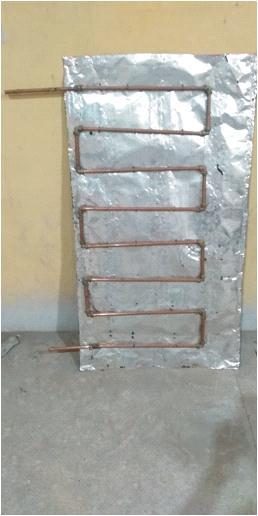
i. Non insulated copper tube of inner diameter of 0.143m and outer diameter 0.15m is used to form a serpentine shape. To form serpentine shaped piping, the coppertubeiscut into two different lengths of 0.53m and 0.19m.Thesetwolengthsofcoppertubearejoinedtogether usingcopper elbows.Topreventleakage,pipe-elbow-pipe jointsareproperlysealedusingTeflontapeandsealant.At intervals, the serpentine shaped copper tube piping is attachedtotheunpaintedsurfaceoftheabsorberplateusing thin copper wires as shown in Fig 1a. This is to aid the serpentine copper tube to have good contact with the aluminumsheet.Thereby,resultinginasituationwherethe coppertubeandaluminumsheetactsasheatexchangerto theworkingfluidwhenexposedtoincidentsolarradiation.
International Research Journal of Engineering and Technology (IRJET) e-ISSN: 2395-0056
Volume: 09 Issue: 09 | Sep 2022 www.irjet.net p-ISSN: 2395-0072
ii. Euro tube BS 2871–1057, diameter 0.15 x 0.5mm insulated copper tube is used to supply a lagged hot waterstoragetankplacedatthesamelevelwiththehot waterpointendofthesolarwaterheater.Thereasonfor
theuseofinsulatedcoppertubeistopreventheatloss fromhotwatertosurroundingasitflowsfromthesolar collectortohotwaterstoragetank.
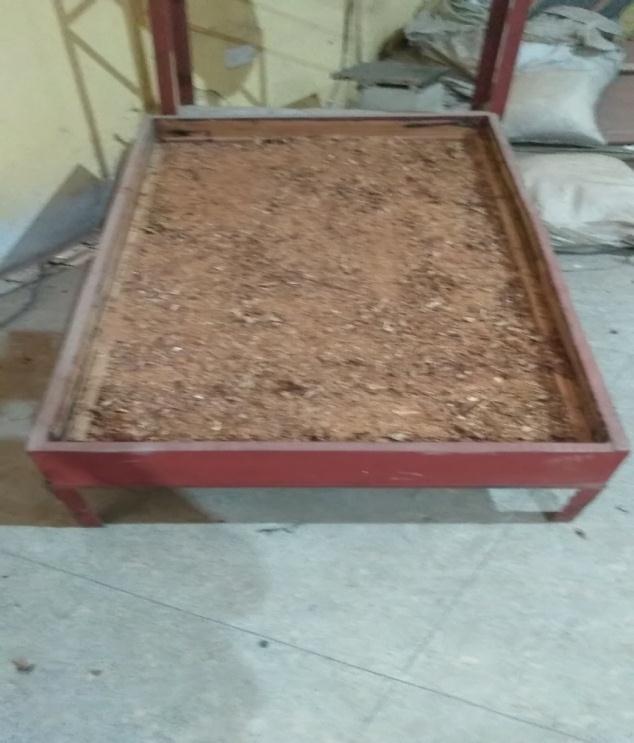
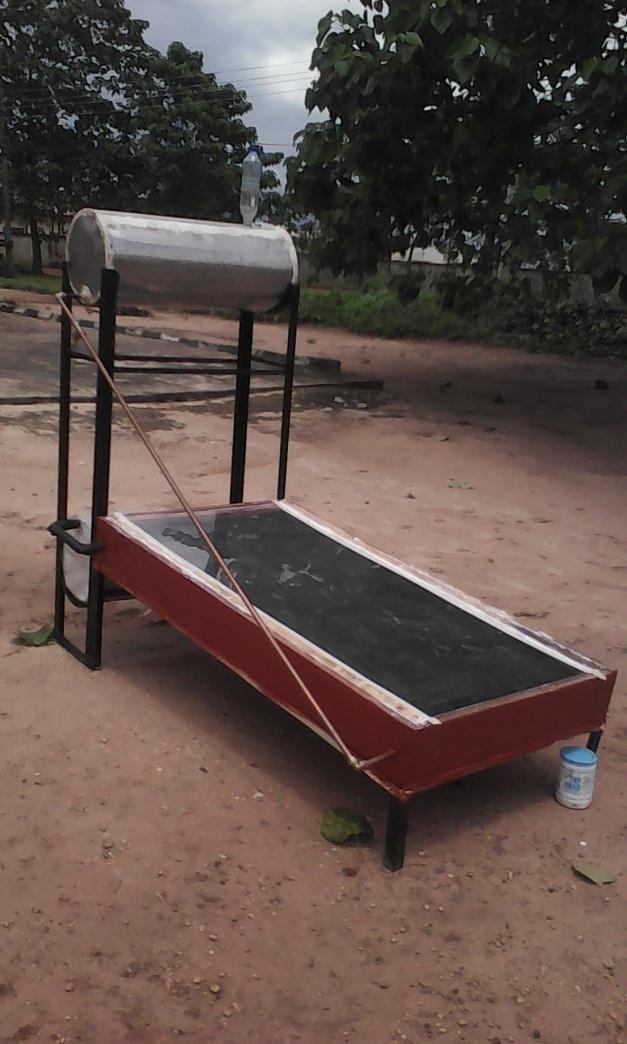
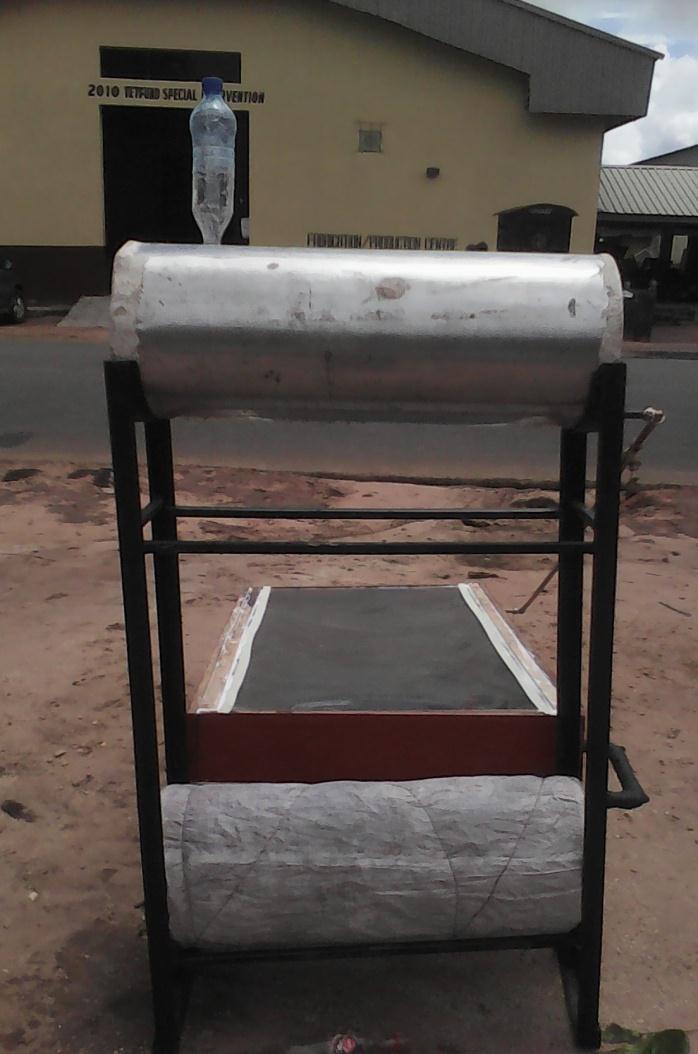
Topreventedgeandbottomheatlosses,woodchipsareused asinsulationmaterialasshowninFig.1b.Awoodenframeis used to house the transparent glass, serpentine shaped copper tube that is bounded to absorber plate and wood chip.Thetransparentglassingmaterialisplaced0.04mfrom absorberplate.Edgesoftransparentcovertowoodenframe are sealed with glue as to prevent heat loss. Two 30 liters tanksareconstructedfromstainlesssteelsheetandusedas cold and hot water storage tanks. Hot water tank storage tankislaggedastopreventheatlossfromhotwaterstored inside it. The cold water tank is placed above the wooden frame.Thisisnecessaryastoallowflowofwaterthroughthe serpentinecoppertubeandhencetohotwaterstoragetank. Angleironof0.01mthicknessisusedtoconstructtheframe onwhichthewoodframeandthehotandcoldwatertanks areplace.Thepartofangleironframeonwhichthewooden frameisplacedistiltedtolatitudeofstudylocation(latitude = 15o). This is necessary as to enhance incident solar radiation on the collector. Side and back view of the serpentinethermosyphonsolarwaterheaterareshownin Fig.2
© 2022, IRJET | Impact Factor value: 7.529 | ISO 9001:2008 Certified Journal | Page1211
International Research Journal of Engineering and Technology (IRJET) e-ISSN: 2395-0056
Volume: 09 Issue: 09 | Sep 2022 www.irjet.net p-ISSN: 2395-0072
Fig. 2 sideandbackviewoftheserpentinesolarwaterheater.
Theserpentinethermosyphonflatplatesolarwaterheater was tested in September and October 2021 under the metrological condition of Federal Polytechnic Nekede, Owerri,ImoState,Nigeria.Itwasoperatedonmassflowrate of0.002kg/sinSeptemberandmassflowrateof0.001kg/s and 0.003 kg/s in November. These mass flow rates are capable of generating a minimum daily hot demand of 20 liters per day [16]. During experimental rig set up, the followingparametersweremeasured:ambienttemperature, temperatureofstoragewatertank,inletwatertemperature and outlet water temperature and insolation. Data were collectedatintervalsofthirtyminutesfrom8.00amto5.00 pmeachday.AtypeKthermocoupleinsulatedwithTeflon andmetalgauzewirewithmaximuminsulationtemperature of 260 oC and probe accuracy of ± 2.2 oC or ± 0.75 % of reading from 0 oC to 800 oC was connected to a digital thermometer that has a measurement range of -50 oC to 1300 oCandahighresolutionof0.1 oCandaccuracyof18 oC to 28 oC. Insolation for the period during rig set up was measured using daystar solar meter which uses a polycrystalline silicon PV cell as sensor. The solar meter providesanaccuratereadingof3%from0.0to1200watts andhasaresolutionof1W/m2
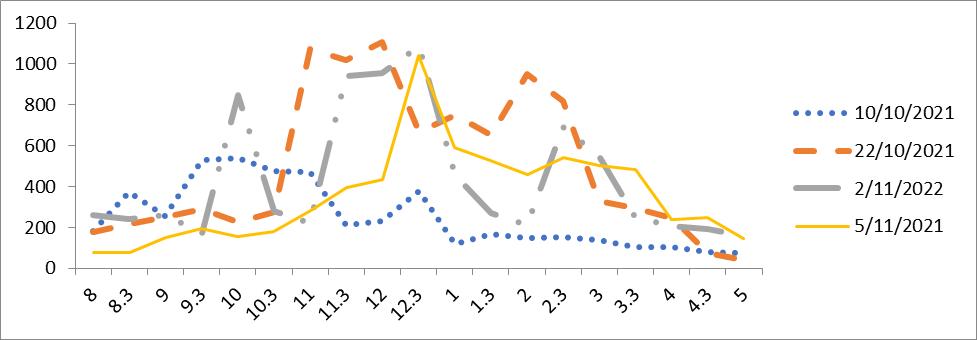
Theserpentineflatplatesolarwaterheaterwasoperatedon 10/10/2021and22/10/2021atamassflowrateof0.002 kg/s.While,on2/11/2022and5/11/2021itwasoperated onmassflowrateof0.003and0.001kg/s,respectively.Fig. 3 present insolation level for some days during which the testwascarriedout.ItisobservedfromFig3,thatondays 10/10/2021and22/10/2021insolationleveldiffers.Days 10/10/2021and22/10/2021maybesaidtobesunnyand overcast,respectively.Ambienttemperaturefor10/10/2021 and22/10/2021arealsoseentoexhibitsimilarlinepattern asshowninFig.4likethoseof Fig3.
International Research Journal of Engineering and Technology (IRJET) e-ISSN: 2395-0056
Volume: 09 Issue: 09 | Sep 2022 www.irjet.net p-ISSN: 2395-0072
Time (min)
Fig. 3 insolationlevelsforsomedays
OC
Time (min)
Figure 4 ambienttemperaturesforsomedays
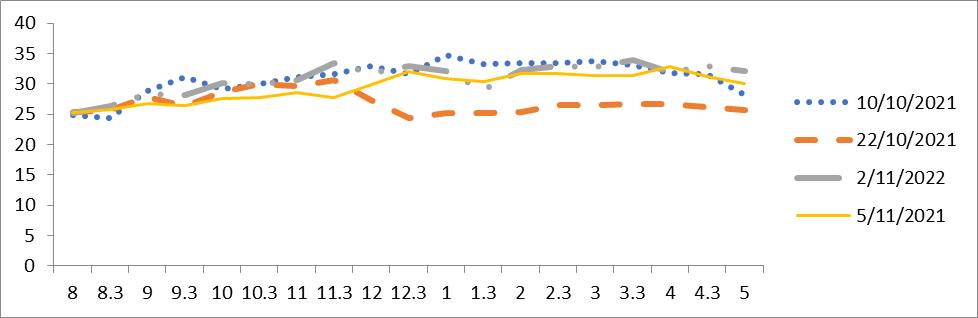
This reveal that as time of the day varies, magnitude of insolation level and ambient temperature fluctuates. Furthermore,itisobservedthatbetweenthehoursof10:30 am–2:30pminsolationlevelrecordedforeachdayishigher comparetothoseof8:00–9:30amand3:00–5:00pm.This revealspossibilityofharvestofmoresolarradiationbetween thehoursof10:30am–2:30pmthananyotherperiodofthe day.Thus,solarwaterheatersareexpectedtoperformmore effectivelyduringthisperiod.
2022, IRJET | Impact Factor value: 7.529 | ISO 9001:2008 Certified Journal
International Research Journal of Engineering and Technology (IRJET) e-ISSN: 2395-0056
Volume: 09 Issue: 09 | Sep 2022 www.irjet.net p-ISSN: 2395-0072
Fig 5 temperaturevariationsbetweeninletwaterandcoldwaterstoragetank
Temperaturevariationbetweeninletwaterandcoldwater storagetankispresentedinFig5.Itisobservedthat water in cold water storage tank increased in temperature as it flow through the copper tube that supply water into the serpentine thermosyphon solar water heater. Measured temperature variation ranged between 0.1 - 3.9 oC. This couldhavebeenpossibleconsideringthefactthatcoldwater storagetankandsupplycoppertubeisnotlagged.Thisalso revealsthatbynotinsulatingcoldwaterstoragetanksand coldwatersupplypipingsystemofsolarwaterheatersthere is possibility of gaining relatively increase in fluid temperature.
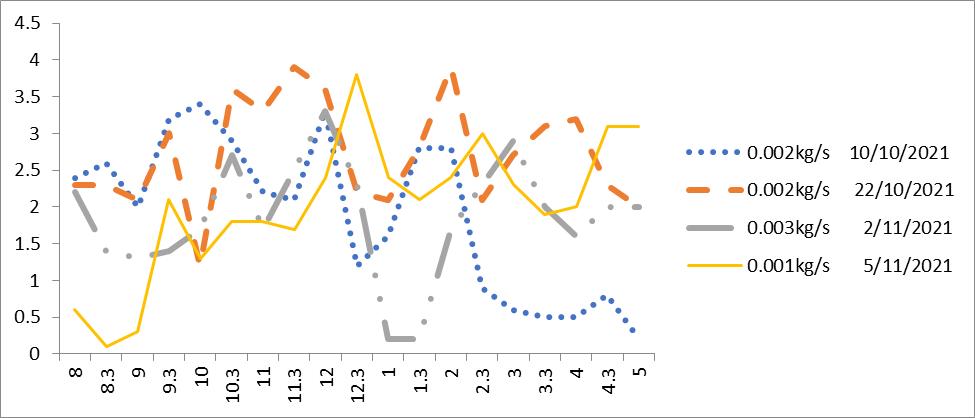
Variationintemperaturebetweenoutletandinletwateris presented in Fig 6. Fluctuation in curve patterns of Fig 6 shows that the serpentine flat plate thermosyphon solar waterheaterrespondedtochangeininsolationlevel.Forthe entiremassflowrateanappreciableincreaseintemperature isobservedtooccurbetween10amto2.30pmcomparedto other period of the day. During this period in Fig 3, it is observedthatinsolationlevelfortheentiredayishigh.Thus, this reveals possibility of the serpentine flat plate thermosyphonsolarwaterheateryieldingmorehotwater during this period. From Fig 6, it is observed that on 10/10/2021and22/10/2021duringwhichtheserpentine flatplatesolarwaterheaterwasoperatedonthesamemass flow rate of 0.002 kg/s on different level of insolation. Temperaturevariationbetweentheoutletandinletwateris observed to be higher on 22/10/2021, a day with higher insolation value than that of 10/10/2021. On days with relativelysimilarhighinsolationvaluesanddifferentmass flow rate, it is observed that mass flow rate of 0.003 kg/s
producedtheleastvaluesofhotwatertemperaturevariation between outlet and inlet. This shows that the solar water heateriscapableofproducingmorehotwaterondayswith highorlowinsolationwhenoperatedatlowmassflowrate. Wateroutletandinlettemperaturevariationduringwhich theserpentineflatplatethermosyphonsolarwaterheater wastestedrangedfrom7.8–28.5 oC.
International Research Journal of Engineering and Technology (IRJET) e-ISSN: 2395-0056
Volume: 09 Issue: 09 | Sep 2022 www.irjet.net p-ISSN: 2395-0072
Time (min)
Fig 6 temperaturevariationsbetweenoutletandinletwater
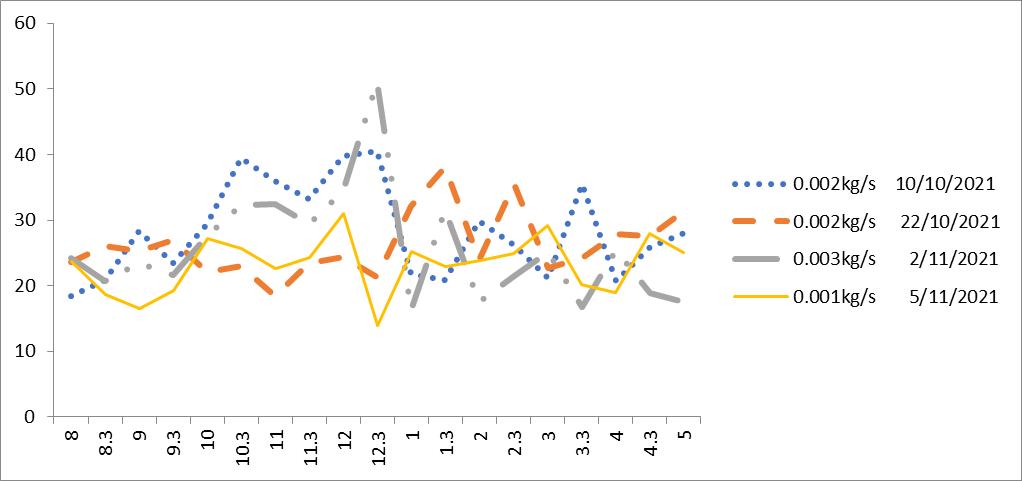
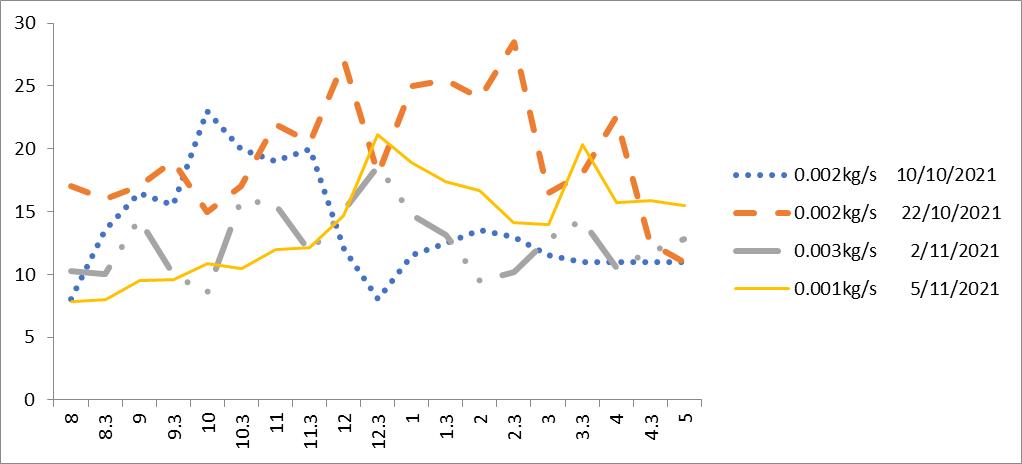
Fig7presentsinstantaneousthermalefficiencyofthesolar waterheaterforthetesteddays.Variationincurvesreveals thatefficiencyof the solar waterheater variesthroughout the test period. Efficiency estimated for the solar water heaterduringthetestperiodrangesbetween13.98and51.1 %.Operating the solarwaterheater on massflow rates of
0.002, 0.003 and 0.001 kg/s yield maximum efficiency of 38.03,51.1and30.92%,respectively,ondayswithrelatively similar insolation (22/10/2021, 2/11/2021 and 5/11/2021).
Time (min)
Fig 7 instantaneousthermalefficiency FPN/hNDe/180114869
International Research Journal of Engineering and Technology (IRJET) e-ISSN: 2395-0056
Volume: 09 Issue: 09 | Sep 2022 www.irjet.net p-ISSN: 2395-0072
5.0 Conclusion
The performance evaluation of a serpentine flat plate thermosyphonsolarwaterheaterhasbeencarriedout.It is constructed from readily available materials within Owerri,ImoState.Itwasobservedthat
i. The solar water heater responded to change in insolation level and it is capable of generating hot waterwithintherangeof7.8-28.5oCdependingonthe levelofinsolation
ii. Operationofthesolarwaterheateronalowmassflow rate(0.001and0.002kg/s)ondayswithhighorlow valuesofinsolationiscapableofproductionofhigher valueofhotwatertemperature.
iii. Maximuminstantaneousthermalefficiencyachievedby thesolarwaterunderthemeteorologicalconditionof Owerriatmassflowrateof0.002,0.003and0.001kg/s are38.03,51.1and30.92%,respectively.
[1] Sambo, A. S. (2005): Renewable Energy for Rural
Development: The Nigeria Perspective. ISESCO ScienceandTechnologyVision,1:12-22
[2] Ogueke, N.V., Njoku M.C. and Anyanwu E.E. (2009) Design, Construction and Testing of a Cylindrical SolarwaterHeater.InternationalJournalofEnergy foraCleanEnvironment10(1-4),57-72
[3]RobertL.Hirch(2007):TheMotherofAllEnergyCrises. Power Business and Technology for the Global IndustryMagazineVol151
[4] Lunder P.J. (1980): Solar Thermal Engineering, Space HeatingandHotWaterSystem.JohnWileyandSons In.NY.
[5]AndersonB.andMichaelR.(1983): The Solar Home Book Chesire Books.HarrisvilleNH.USA
[6]Ogueke,N.V.,Anyanwu,E.E.andEkechukwu,O.V.(2009) A Review of Solar Water Heating Systems. J. RenewableSustainableEnergy,AmericanInstitute ofPhysics,043106,pp1-21
[7] Jouhri, M. and Dhakar, P.S. (2019) A Review Study on SolarWaterHeatingSystems.JETIR,6(6),222-224
[8]Vengadesan,E.andSenthilR.(2020)AReviewonrecent Development of Thermal Performance Enhancement Methods of Flat Plate Solar Water Heater.SolarEnergy206,935-961
[9] Jamar, A., Majid, Z.A.A., Azmi, W.H., Norhafana, M. and Razak, A.A. (2016) A Review of Water Heating SystemforSolarEnergyApplications.Int.Commun. Heat Mass Transf. dx.doi,org/10.1016/j.icheatmasstransfer.2016.05.0 28
[10] Zara, S.G., Hafezi, R., Alipour, M., Tabar, R.P. and Stewart,R.A.(2021)ResidentialSolarWaterHeater Adoption Behaviour: A Review of Economic and TechnicalPredictorsandTheirCorrelationwiththe Adoption Decision. MDPI, doi.org/10.3390/en14206630
[11] Duffie, J. A. and Beckman, W. A. (2013). Solar Engineering of Thermal Processes.JohnWiley&Son Inc.43-133
[12] Bramdemuehi, M.J. and Beckman, W.A. (1980) TransmissionofDiffuseRadiationthroughCPCand FlatPlateCollectorGlazing.SolarEnergy,24,511
[13]Incopera,F.P.andDeWitt,D.P.(2006) Fundamental of Heat and Mass Transfer.JohnWileyandSonInc.
[14] Zhang, He-Fei and Lavan, Z. (1985) Thermal PerformanceofaSerpentineAbsorberPlate.Solar Energy,34,175-177
[15]Anyanwu,E.E.andOteh,U.U.(2003).AnalysisofSolar RadiationMeasurementsatOwerri,Nigeria.African JournalSci.4(1),893-906
[16] Nieuwoudt, M.N. and Mathews, E.H. (2005) A mobile SolarWaterHeaterforRuralHousinginSouthern Africa,Build.Environ.40,1217-1234