International Research Journal of Engineering and Technology (IRJET) e-ISSN: 2395-0056

Volume: 09 Issue: 09 | Sep 2022 www.irjet.net p-ISSN: 2395-0072
International Research Journal of Engineering and Technology (IRJET) e-ISSN: 2395-0056
Volume: 09 Issue: 09 | Sep 2022 www.irjet.net p-ISSN: 2395-0072
1 P.G Student, Department of Environmental Engineering, Bapuji Institute of Engineering and Technology, Davanagere, Karnataka, India
2Principal, Bapuji Institute of Engineering and Technology, Davanagere, Karnataka, India ***
Abstract- Generally, a huge amount of wastewater is generated from dairy industry. By treating dairy effluent at the end, sludge is produced which can be used as manure for agriculture purpose. Formation of sludge in effluent of dairy industry is mainly formed due to coagulation-flocculation process, they generally use chemical-coagulants in this process, which produces more sludge and are toxic in nature. When these toxic sludges are used in agriculture it may deplete the quality of crops.Hencetoovercometheseproblems a plant-based bio-flocculants can be derived and used as an alternate for artificial-coagulants.Whichareeconomical,nontoxic and biodegradable in nature. We have been selected tamarind seed and aloe vera as natural plant-based coagulants for treating of dairy effluent. Physio-chemical parameters of dairy effluent were carried out and later treated with these bio-flocculants.Mainly,optimumdosagesof tamarind seed powder and aloeveraleafpowerwereobtained by jar test. Optimum dosage of tamarind seed powder is 120 mg/l and aloe vera leaf powder are 100 mg/l. Tamarind seed powder showed more efficiency in treatingBODabout88.64% when compared to aloe vera leaf powder which is of 87.44%. Aloe vera leaf powder has showed great efficiency in treating COD and turbidity attained 88.44% and 87% respectively, compared to tamarind seed powder COD and turbidity is 86.89% and 63% of reduction respectively. For more effectiveness dosages aloe vera leaf powder can be increased in treating of dairy wastewater.
Key Words: Coagulation/flocculation process, Jar test, plant-based bio-flocculants, Tamarind seed, Aloe vera.
Indiaisalargestmilkproducingcountryintheworld,which isabout22%oftotalworld’sproduction.Dairyindustryis lookingforwardtoincreaseitsactivitiesupto9-11percent inyear2021-2022.Asper2022,India’sproductionis203.5 MMT. Per capita consumption of milk is 406 g/day as per 2019-2020.Around80millionpeopleofIndiadependsupon dairyfarmingfortheirincome.
Pollution caused by industry is a significant concern throughouttheworld.Amongalltheindustrialactivitiesthe foodsectorplaysamajorroleinthehighestconsumptionof wateranditisoneofthesubstantialproducersofeffluent per unit of mass production (Ashish Tikariha and
OmprakashSahu2014).Dairyindustryisthemainexample ofthissector.Dairyindustryisoneoftheconsiderablefood production industries in India, out of all countries India ranks first maximum milk producing country. The characteristics of dairy industry wastewater involves Temperature, PH, Color, BOD, COD, DO, Dissolved solids, Suspended solids, Sulphate, Chlorides, Oil and Grease. It dependsmainlyonthequantityofmilkclarifiedandtypeof the mass of product produced (Bharati S. Shete and N. P. Shinkar2013)
Thecoagulation/flocculationprocedurearepartofthewater and wastewater treatment process (L Muruganandam et al.,2017).Mainpurposeofthisprocessistoclearthewater or dividing the suspended particles by wastewater. Coagulation is explained as destabilization method of colloidal matter using amalgamate for treatment of water and wastewater. Flocculation is a technique of ease for collection,andisaccomplishedbylargermolecularweight amalgamation(SetyoBudiKurnaiwanetal.,2021)
Bio-flocculants/bio-coagulants are considered more environmentfriendlyandusefulasasubstitutetoreducethe riskthattakesplaceinenvironment.Usingchemical-based flocculant/coagulantarenotgoodforenvironmentandnot good for human health for consumption purpose (NandagopanSetal.,2021).Tomaintainsafetyforhuman healthandenvironmentusingbio-flocculant/bio-coagulant is important, and at the same time cost effective and are easilyavailable(NandagopanSetal.,2021).
Bio-coagulants/flocculantsaredevelopedfromseedsand vegetables this are used for the wastewater treatment purpose. Examples for plant-based bio-flocculants are as follows aloe vera (leaf), fruit peels, fenugreek (mucilage), guargum,hibiscus,tamarind(seed),dates,oilnutgum,okra, jackfruitseedanddrumsticketc.,Inthisstudytamarindseed andaloeverahasbeenusedasaplant-basedbio-flocculants.
1. To collect and characterize the dairy industry waste water.
International Research Journal of Engineering and Technology (IRJET) e-ISSN: 2395-0056
Volume: 09 Issue: 09 | Sep 2022 www.irjet.net p-ISSN: 2395-0072
2. Tousetamarindseedandaloeveraasaplant-basedbioflocculants,asanalternativetochemicalcoagulants.
3. Extraction and preparation of plant-based bioflocculants.
4. Totreatthecollectedsamplebytamarindseedandaloe vera.
5. To find out the optimum dosage of plant-based bioflocculants.
6. To examine the coagulation/flocculation efficiency of tamarindseedandaloeveraintreatingofdairyeffluent.
7. Todiscussonthecost-effectiveandsuitabilityofplantbased bio-flocculants in the treatment of dairy wastewater.
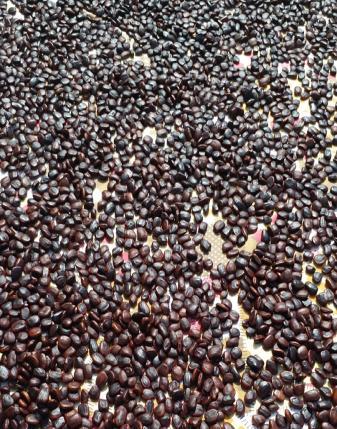
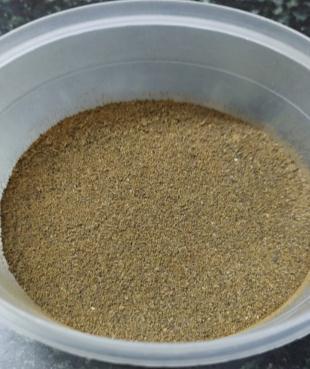
Tamarind seed is used as a bio-flocculant in this study. Around1kgoftamarindseedwaspurchasedinlocalmarket ofdavanagerecity.Tamarindseedswerewashedproperlyin tap water to remove dirt and sun dried for 2-3 days to removemoisturecontentpresentinit.Andthensun-dried seeds were finely grinded to make powder and sieved against4.75mmsieveandthentamarindpowerisstoredin air tight container. Dilution of tamarind seed powder was made by using o.1g of tamarind seed powder in 100ml of distilled water. Likewise, further different dilutions were madefromtamarindseedpowdertouseasabio-flocculant inthepresentwork(ShivamB.MagarandM.VJadhav2018).
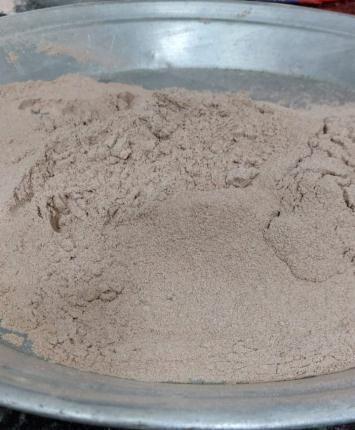
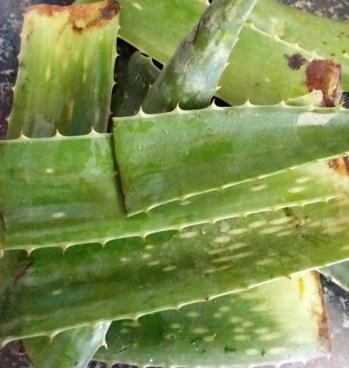
Davanagerecity.Thealoeveraleaveswerewashedproperly intapwatertoremovedirt.Andwholeleaveswerecutinto smallpieceswithoutremovinganypartofit.Andthenkept inhotairovenin105℃for24hrs.Andthenfinelygrindedto make aloe vera powder and sieved against 4.75mm sieve, then aloe vera powder was stored in air tight container. Dilutionwasdonewith0.1gofaloeverapowderin100mlof distilled water (Akhila Jinna et al.,2019) Further the differentdilutionsweremadefromaloeverapowderasper requirementofprojectwork.
Aloeveraleavesareusedasaplant-basedbio-flocculantsin thisstudy.Aloeveraleaveswascollectedfromsomeareain
In this the sample taken is dairy wastewater is collected. Grabsamplingisinvolvedforthecollectionofthesample. The sample is collected from equalizer tank where all processofdairywastewaterisstoredinthattank.20litres ofsampleweretaken,sampleistakenataparticularspace and time. Sampling tool depends upon the type of the sample. Here 20 litres are used for collection of samples. Safetymeasuresdependsuponthetypeofthesample.For hazardous waste safety measures must be taken for collectionofwastewatersaspertheguidelines.Heregloves andfacemaskwereusedtocollectthesample(AmirAdul Azeezetal.,2020)
Theinitialparametersoftherawwatersamplehavebeen carried out to determine the initial characteristics of wastewaterandmentioneditasbeforetreatment.Theinitial parameters like PH, turbidity, chlorides, calcium, TS, TDS, BODandCODarestudied
Table 1: Initial parameters of raw sample
International Research Journal of Engineering and Technology (IRJET) e-ISSN: 2395-0056
Volume: 09 Issue: 09 | Sep 2022 www.irjet.net p-ISSN: 2395-0072
TDS 3880mg/l BOD 2890.02mg/l
COD 1,32,000mg/l
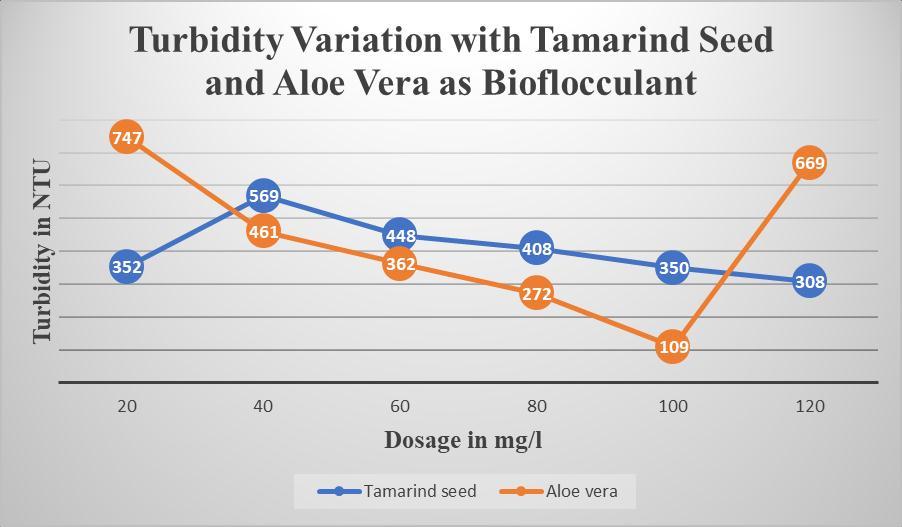
Coagulation/flocculationprocessiscarriedoutinlaboratory byjartestforbothtamarindseedandaloeveraasnatural coagulantsintreatingofdairyeffluent.Turbiditytestisdone foreverydosage.Theoptimumdosageoftamarindseedis 120 mg/l and aloe vera is 100 mg/l in treatment of dairy wastewater in this particular study. Optimum dosage is consideredcorrespondingtothelowestresidualturbidity. Furtherexperimentswereconductedusingoptimumdosage ascoagulantdosage.
Sl.No. Characteristics Tamarind seed Aloe vera 1
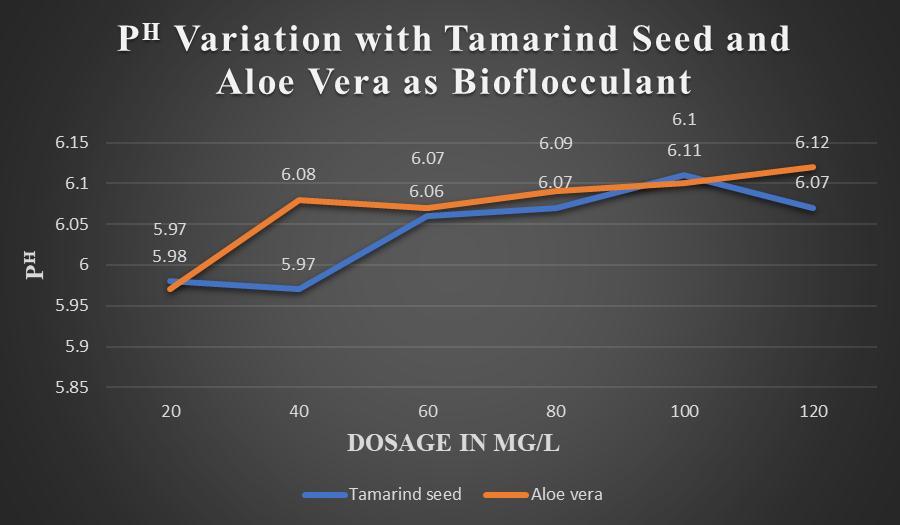
PH 6.07 6.10 2
Turbidity 308NTU 109NTU 3 Chlorides 242mg/l 202mg/l 4 Calcium 60.8mg/l 102.4mg/l 5 TS 2800mg/l 2400mg/l 6 TDS 2400mg/l 2088mg/l 7 BOD 328.07 mg/l 362.97 mg/l 8 COD 17300mg/l 15250 mg/l
Chart-1: PH Variation
Chart-2: Turbidity Variation
Inthispresentwork,tamarindseedandaloeverahavebeen usedasplant-derivedbio-flocculantsandtheirefficiencyhas beenanalyzedfortreatmentofdairyeffluent.Fromabove results we can conclude that optimum dosage of using tamarindseedpowderwasfoundtobe120mg/landaloe vera leaf powder is about 100 mg/l. From the examined results,themaximumpercentagereductionefficiency,when comparedbetweentamarindseedandaloeveraitwasfound that tamarind seed was more effective in treating dairy wastewaterparameterslikealkalinity,calciumandBODand in aloe vera the most effective parameters were acidity, chloridesandCOD.
In this study turbidity removal efficiency using tamarind seedpowderisshownas63%andwhileusingaloeveraleaf powderisshown87%.Hence,aloeveraismoreefficientin removing turbidity compared to tamarind seed. In BOD removal efficiency the tamarind seed powder achieved 88.64%whilealoeveraleafpowderachieved87.44%.Hence tamarindseedishighlyeffectiveinremovingBODcompared to aloe vera. In cod removal efficiency the tamarind seed powderobtained86.89%andwhilealoeverahasobtained 88.44%. Hence aloe vera has great efficiency in removing BOD.Aloeveracanbeusedasaneffectivecoagulantindairy wastewater treatment mainly for COD and for turbidity removal
[1]AkhilaJinna,AnuMR,NijeshKrishnan,VyshnavySanal, Litty Das (2019) “Comparative study of efficiency of local plantsinwatertreatment”.Internationalresearchjournalof engineeringandtechnology,vol06,issue04,pp4046-4052.
International Research Journal of Engineering and Technology (IRJET) e-ISSN: 2395-0056 Volume: 09 Issue: 09 | Sep 2022 www.irjet.net p-ISSN: 2395-0072
[2] Aliyu Isa, Maina Mohammed Idris, Haruna Karamba, RabiaAyoubi(2018)“Tamarindusindica–Areviewpaper on efficacy of tamarind plant in water treatment and purification”. International journal of scientific and engineeringresearch,vol9,issue10,pp2024-2034.
[3]AmareTirunehAdugnaandNahomMankirGebresilasie (2018)“Aloesteudnerigel asnatural flocculantfortextile wastewatertreatment”.Waterpracticeandtechnology,vol 13,no3,pp495-504.
[4] Amir Abdul Azeez, Asna K.A, Aneesha, Christy George, RanjithaN(2020)“Useofplant-basedcoagulantsforwater treatment”.Vol6,issue3,pp231-242.
[5]AnujSandK.Mophin-Kani(2016)“Exploringtheuseof organicpeelandneemleafpowderasalternativecoagulant intreatmentofdairywastewater”.Internationaljournalof scienceandengineeringresearch,vol7,issue4,pp238-244.
[6]AnuSundaresanandAnuN(2016)“Feasibilityofnatural coagulant for the treatment of dairy wastewater”. International journal of science and engineering research, vol7,issue4,pp245-249.
[7] Asish Tikariha and Omprakash Sahu (2014) “Study of characteristicsandtreatmentofdairyindustrywastewater”. Journalofappliedandenvironmentalmicrobiology,vol2,no. 1,pp16-22.
[8] Azmi Ahmad, Siti Rozaimah Sheikh Abdullah, Hassimi Abu Hasan, Ahmad Razi Othman, Nur Izzati Ismail (2021) “Potential of local plant leaves as natural coagulant for turbidity removal”. Environmental science and pollution research.
[9] Aziz H.A., Yii Y.C., Syed Zainal S.F.F. and Akinbile C.O. (2018)“Effectofusingtamarindusindicaseedsasanatural coagulant aid in landfill leachate treatment”. Global NEST journal,vol20,no2,pp373-380.
[10] Bharati S. Shete and N. P. Shinkar (2013) “Dairy industrywastewatersources,Characteristicsanditseffect on environment”. International journal of current engineeringandtechnology,Vol3,no5,pp1611-1615
[11]DhanushPatelHG,MrsVeenaDV(2019)“Treatmentof dairyindustrywastewaterusingtamarindousindicaseedas anadsorbent”.Internationalresearchjournalofengineering andtechnology,vol06,issue07,pp1600-1603.
[12]GulmireAmrutaandG.R.Munavalli(2017)“Useofaloe vera as coagulant aid in turbidity removal”. International journalofengineeringresearchandtechnology,vol10,no1, pp314-317.
[13]HiteshS.Patil,SanketA.Shinde,GaneshA.Raut,Nilesh p.Nawale,Pro.AshishHakke,Prof.ManojDeosarkar(2020) “Use of aloe-vera gel as natural coagulant in treatment of
drinkingwater”.Internationaljournalofadvancescientific researchandengineeringtrends,vol5,issue9,pp81-89.
[14]JibrinNdejikoMohammedandWanRosmizaZanaWan Dagang (2020) “Implications for industrial application of bioflocculant demand alternatives to conventional media: wasteasasubstitute”.Waterscienceandtechnology.
[15]JuduthEmiliahChristySS,AnantharajR,AmbedkarB andDhanalakshmiJ.(2017)“Treatmentofsyntheticturbid water using natural tamarind seeds at atmospheric conditions”.Researchjournalofpharmaceutical,biological andchemicalsciences,pp352-359.
[16]LMuruganandam,MPSaravanakumar,Amarjitjena, Sudiv Gulla and Bhagesh Godhwani (2017) “Treatment of waste water by coagulation and flocculation using biomaterials”. IOP Conf. Series: Materials science and engineering263032006.
[17] Mayowa O. Agunbiade, Carolina H. Pohll, Anofi O.T. Ashafa(2016)“Areviewoftheapplicationofbioflocculants inwastewatertreatment”.Pol.J.Environ.Stud,vol25,no4, pp1381-1389.
[18]MegharajA,Dr.DPNagarajappa,Dr.P.ShivaKeshava Kumar,SreekanthN(2020)“Treatmentofdairywastewater usingnaturaladsorbents”.Internationalresearchjournalof engineeringandtechnology,vol07,issue08,pp3521-3525.
[19] Nandagopan S, Nongki Perme, Sruthy A R, Yugma V, Prof. Jency Nadayil (2021) “Waste water treatment using natural coagulants”. International research journal of engineeringandtechnology,vol08,issue07,pp590-592.
[20]NAZainolandNurNasuhaMohdFadli(2020)“Surface water treatment using tamarind seed as coagulants via coagulation process”. IOP conference series: Materials scienceandengineering8640123172.
[21]NilanjanaDas,NupurOjhaandSanjeebKumarMandal (2021) “Wastewater treatment using plant-derived bioflocculants: green chemistry approach for safe environment”.Waterscienceandtechnology,pp1797-1812.
[22]NorSuhailiBintiMohamadZin,WanNurhazirahBinti Kamaruzaman,ChiaSoiLee(2016)“Studytheeffectiveness of biocoagulant between aloevera (L.). Burm. F and okra mucilageincoagulationandflocculationtreatment”.pp3438.
[23]PremkumarR,S.Rajesh,PrasannaVenkadeshM(2021) “Feasibility study on application of natural coagulants”. Journalofphysics:Conferenceseries2070012186.
[24] Prof. T D Raju, Asst Prof. Ahana K Reji, Naji Raheem, Sruthi Sasikumar, Veena Vikraman, Shimil C P, Sneha K M (2018)“Roleofmoringaoleiferaandtamarindseedinwater
2022, IRJET | Impact Factor value: 7.529 | ISO 9001:2008 Certified Journal | Page1164
International Research Journal of Engineering and Technology (IRJET) e-ISSN: 2395-0056
Volume: 09 Issue: 09 | Sep 2022 www.irjet.net p-ISSN: 2395-0072
treatment”. International journal of engineering research andtechnology,vol7,issue04,pp454-462.
[25] Reena Abraham, Harsha P (2019) “Efficiency of tamarindandpapayaseedpowderasnaturalcoagulants”. International research journal of engineering and technology,vol06,issue04,pp4849-4853.
[26]RohitGupta(2020)“Performanceevaluationofeffluent treatment plant of dairy plant”. Journal of emerging technologies and innovative research, vol 7, issue 11, pp 613-619.
[27] Ronke Ruth Ayangunna, Saidat Olanipekun Giwa, Abdulwahab Giwa (2016) “Coagulation-flocculation treatment of industrial wastewater using tamarind seed powder”.Internationaljournalofchemtechresearch,vol9, no5,pp771-780.
[28] Saidat Olanipekun Giwa, Danladi Yakubu SAID, MustaphaDanladiIBRAHIMandAbdulwahabGIWA(2017) “Textile wastewater treatment using Sodom apple (Calotropisprocera)-aidedtamarindseedasacoagulant”. Internationaljournalofengineeringresearchinafrica,vol 32,pp76-85.
[29]SetyoBudiKurniawan,MuhammadFauzulImron,Che Engku Noramalina Che Engku Chik, Amina Adedoja Owodunni (2021) “What compound inside biocoagulants/bioflocculantsiscontributingthemosttothe coagulationandflocculationprocesses?”.Articleinscienceof thetotalenvironment.
[30]ShivamB.Magar,Dr.M.VJadhav(2018)“Useofherbal coagulantsfortreatmentofdairywastewater”.International journalforresearchtrendsandinnovation,vol3,issue12, pp24-33.
[31] Upendra Kumar, Kanchan Nahar, Ajay Singh Thakur (2022) “Sustainable treatment of water and wastewater using natural plant-based coagulants: A Review”. International journal of engineering research and technology,vol11,issue05,pp650-656.
[32]WanNurhazirahBintiKamaruzaman,NorSuhailiBinti Mohamad zin (2016) “Study effectiveness of biocoagulant between aloevera (L.). Burn.F and tetragonus pad in coagulationandflocculationtreatment”.
2022, IRJET | Impact Factor value: 7.529 | ISO 9001:2008 Certified Journal |