International Research Journal of Engineering and Technology (IRJET)
e-ISSN: 2395-0056
Volume: 09 Issue: 09 | Sep 2022
p-ISSN: 2395-0072
www.irjet.net
Damper Systems for Reinforced Concrete Structures V. RaviKumar1, T. Raghavendra2 1Post
Graduate Student, RV College of Engineering, Bengaluru-59, Bengaluru, Karnataka, India 2Associate Professor, RV College of Engineering, Bengaluru-59, Karnataka, India ---------------------------------------------------------------------***--------------------------------------------------------------------For dampers provided at top storey resulting in faster Abstract - Dampers are the members provided to reduce dissipation in oscillations.
oscillation which develops due to excitation. In this paper different types of dampers are presented. This paper reviews experimental studies carried out on structures provided with tuned liquid damper (TLD). The literature review suggests that for effective damping, damper may be provided at top storey resulting in faster dissipation of oscillations.
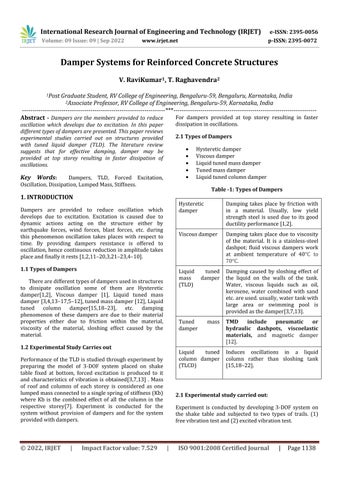
2.1 Types of Dampers
Key Words:
Dampers, TLD, Forced Excitation, Oscillation, Dissipation, Lumped Mass, Stiffness.
Table -1: Types of Dampers
1. INTRODUCTION Dampers are provided to reduce oscillation which develops due to excitation. Excitation is caused due to dynamic actions acting on the structure either by earthquake forces, wind forces, blast forces, etc. during this phenomenon oscillation takes places with respect to time. By providing dampers resistance is offered to oscillation, hence continuous reduction in amplitude takes place and finally it rests [1,2,11–20,3,21–23,4–10]. 1.1 Types of Dampers There are different types of dampers used in structures to dissipate oscillation some of them are Hysteretic damper[1,2], Viscous damper [1], Liquid tuned mass damper [3,4,13–17,5–12], tuned mass damper [12], Liquid tuned column damper[15,18–23], etc. damping phenomenon of these dampers are due to their material properties either due to friction within the material, viscosity of the material, sloshing effect caused by the material.
Performance of the TLD is studied through experiment by preparing the model of 3-DOF system placed on shake table fixed at bottom, forced excitation is produced to it and characteristics of vibration is obtained[3,7,13] . Mass of roof and columns of each storey is considered as one lumped mass connected to a single spring of stiffness (Kb) where Kb is the combined effect of all the column in the respective storey[7]. Experiment is conducted for the system without provision of dampers and for the system provided with dampers.
|
Impact Factor value: 7.529
Hysteretic damper
Damping takes place by friction with in a material. Usually, low yield strength steel is used due to its good ductility performance [1,2].
Viscous damper
Damping takes place due to viscosity of the material. It is a stainless-steel dashpot; fluid viscous dampers work at ambient temperature of 40°C to 70°C.
Liquid mass (TLD)
tuned damper
Damping caused by sloshing effect of the liquid on the walls of the tank. Water, viscous liquids such as oil, kerosene, water combined with sand etc. are used. usually, water tank with large area or swimming pool is provided as the damper[3,7,13].
mass
TMD include pneumatic or hydraulic dashpots, viscoelastic materials, and magnetic damper [12].
Liquid tuned column damper (TLCD)
Induces oscillations in a liquid column rather than sloshing tank [15,18–22].
Tuned damper
1.2 Experimental Study Carries out
© 2022, IRJET
Hysteretic damper Viscous damper Liquid tuned mass damper Tuned mass damper Liquid tuned column damper
2.1 Experimental study carried out: Experiment is conducted by developing 3-DOF system on the shake table and subjected to two types of trails. (1) free vibration test and (2) excited vibration test.
|
ISO 9001:2008 Certified Journal
|
Page 1138