International Research Journal of Engineering and Technology (IRJET) e-ISSN: 2395-0056

Volume: 09 Issue: 09 | Sep 2022 www.irjet.net p-ISSN: 2395-0072
International Research Journal of Engineering and Technology (IRJET) e-ISSN: 2395-0056
Volume: 09 Issue: 09 | Sep 2022 www.irjet.net p-ISSN: 2395-0072
1Department of Environmental Engineering, Bapuji Institute of Engineering and Technology, Davanagere, Karnataka, India
2Assistant professor, Department of Environmental Engineering, Bapuji Institute of Engineering and Technology, Davanagere, Karnataka, India ***
Abstract – The huge concentrations of the heavy metals present in Electroplating industry waste water enters food chain by getting accumulated in various living components. The traditional methods that are currently in usage involves lot of processes and highly non-economical. Phytoremediation emerged as a cost effective, efficient and green technology to remediate these heavy metals. In this study two free floating aquatic plants Water lettuce and Duck weed are investigated for their potential to absorb heavy metals from electroplating industry waste water. These plants are grown in waste water samples for the period of 20 days and Heavy metal concentration in the water sample is analyzed for every 4 days until 20 days. Finally the comparison is made between these two plants for removal of Cd and Ni from waste water. The Duck weed plants showed better absorption towards Cd and Ni than Water lettuce plants. The removal efficiency varied from 70-80 percentage by both the plant species.
Key Words: Bio-absorption process, Atomic Absorption Spectrophotometer(AAS),Phytoremediation,Waterlettuce, Duckweed,HeavymetalToxicity,Cadmium(Cd),Nickel(Ni).
The rapid growth in industrial sector made a safe waste water disposal as major environmental issue. Due to dischargeofuntreatedwastewaterintonaturalecosystem, the surrounding environment is polluted. Electroplating techniqueisemployed inmetal finishingindustrieswhich giverisetowastewaterwithlotofhazardouscomponents and heavy metals (L. Suseela et al.,2021). There are many heavymetalswhichexhibitdifferentcharacteristics,someof them are categorized as precedence pollutants which are highly toxic in nature and engages into the food chain throughplantsandanimals(UzmaMajeedetal.,2014).These heavy metals adversely affect the soil environment by altering the soil composition, granular size and microbial activity. They cause chlorosis, stunted growth, yield decrement,metabolicdisordersinplantswith depression, insomnia, fatigue, sensory damage, irritability and gastric disordersinvariousanimalsandhumans.Aquaticecosystem balanceisseverelyimpactedbytheseheavymetals which leadstobiomagnificationandbio-accumulationindifferent aquaticspecies(VinodKumaretal.,2019).Hencetreatment
ofwastewaterisconsideredasgoodpracticetoovercome scarcityofwaterandreducethedamagetoenvironment.But theconventionalmethodsthatarebeingusedarecostlyand ineffective. The use of easy, economical and efficient technique to remediate heavy metals from waste water is necessary.
Itisagreentechnology,wherethetoxicheavymetalsare convertedintonon-toxicorlesstoxicformbyvariousplant species(ShahabaldinRezaniaetal.,2016).Itincludesvarious mechanisms such as Rhizofiltration, Phytoextraction, Phytodegradation, Rhizodegradation, Phytostabilization, Phytovolatilization,Hydrauliccontroletc.,(MonikaYadavet al.,2021). Bio-absorption is a mechanism where the heavy metals and other pollutants are absorbed by plants roots, tissues and shoot areas. The plants that are used for this process should be able to uptake large amount of both inorganicandorganicpollutantswithfastgrowingabilityand shouldshowlesstoxicity(RashaHMahmoudetal.,2017). Hencechoosingofplantsplaysaveryimportantroleinthis technique.
FreeFloatingaquaticplantspossessbettercapabilityto eliminate heavy metal from waste water as they are fast growingwithhighabsorbingpotential.Activetransportof pollutants occurs via roots to shoot system. Passive transport occurs during direct contact of plant parts with polluted water (Shafaqat Ali et al.,2020). Water lettuce ( Pistia stratiotes L)andDuckweed(Lemna minor L)arethe most commonly seen aquatic weeds which absorb heavy metals at a faster rate and exhibit less metal toxicity (SangeetaAnandetal.,2016).Waterlettuceconsistsofpale greenleaveswith3-4inchwideand2-3incheslongandalso withwhitishhairylowerpart.Ithasleavesfloatingonwater and a well-developed root system hanging beneath the water.Duckweedplantsaretinywith0.5to1inchoverall heightand1-2cmlightgreenleaves.Theseplantspropagate vegetatively and can be easily harvested if the absorbed heavy metals are to be extracted ( Dana A. Mohammed Barznji,2015).
International Research Journal of Engineering and Technology (IRJET) e-ISSN: 2395-0056
Volume: 09 Issue: 09 | Sep 2022 www.irjet.net p-ISSN: 2395-0072
A CETPlocatedat12.84210N, 77.67960Ecoordinates near Electroniccity,Bengaluru,whichreceiveswastewaterfrom surroundingElectroplatingindustrieswasapproachedand wastewatersamplewascollectedfromitsinlettank
The plant samples (Duck weed and Water lettuce ) were collected from a lake situated at 12.77690N, 77.66080E coordinatesnearHennagaravillage,Bengaluru.Theseplants werewashedintapwatertoremovedustanddirtparticles and then grown in tap water for 7 days and 50% diluted electroplating industry waste water for other 7 days to acclimatethemtowastewater.After14dayshealthyplants areselectedforfurtherprocess.
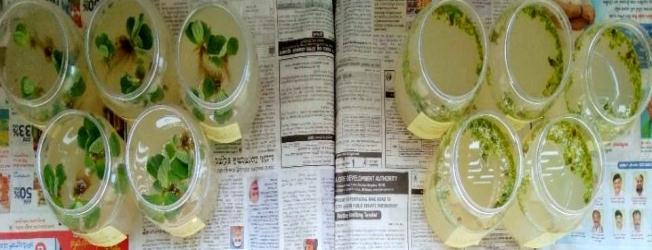
Thecollected wastewatersamplewasfilledin10different 1litrecapacityplasticcontainersinwhichtheWaterlettuce andDuckweedplantsaregrown.Initiallyabout10gramsof plantsspeciesareintroducedineachcontainerandallowed togrow.Plantsusesallthenutrientsinthewastewaterand developdaybyday.Thewatersampleswereanalyzedat4,8, 12,16,20daysforCdandNiconcentrations.1containerwith waterlettuceplantsand1withDuckweedplantsareused duringeveryanalysis.After20thdaytheabsorptionefficiency ofboththeplantsarecompared.
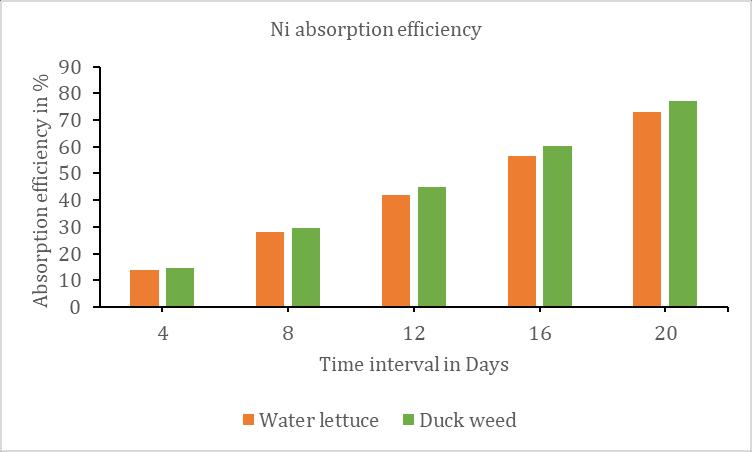
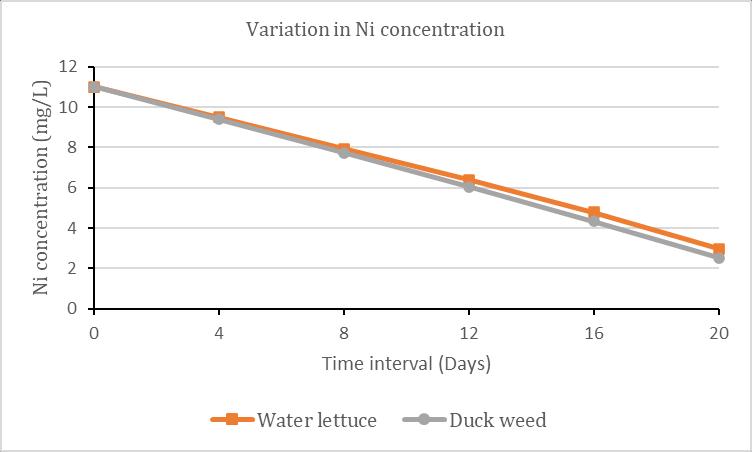
The initial Cd and Ni concentrations in the waste water sample was found to be 7.80 mg/L and 11.0 mg/L respectively. After 20 days the concentration of Cd was reducedto2.06mg/Land1.49mg/LbyWaterlettuceand Duckweedplantsrespectively.Waterlettuceplantsreduced Nicontentto2.98mg/LandDuckweedplantsreduceditto 2.53mg/L.
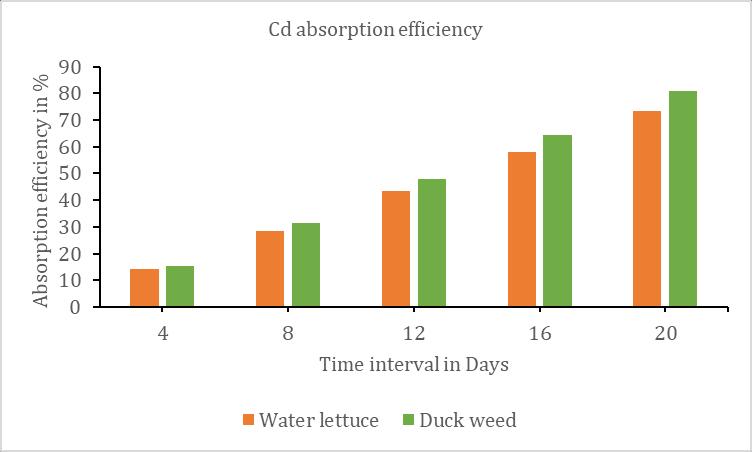
TheDuckweedplantsshowedbetterabsorptionefficiency forbothCdandNielementsoverWaterlettuceplants.Duck weedplantsabsorbedabout80.89%ofCdand77.00%ofNi. TheabsorptionefficiencyofWaterlettuceplantswasfound tobe73.50%and72.90%towardsCdandNirespectively. Theresultsobtainedduringtheanalysison4,8,12,16,20 daysareshowninthebelowtablesandcharts.
Table -1: Variationinheavymetalconcentrationdueto Waterlettuceplants
Sl.No Time interval (days)
Parameters Cd (mg/L) Ni (mg/L)
1. 0 7.80 11.00 2. 4 6.70 9.48 3. 8 5.57 7.92 4. 12 4.42 6.39 5. 16 3.26 4.79 6. 20 2.06 2.98
Table -2: Changesinheavymetalconcentrationdueto Duckweedplantseffect
ThetwoheavymetalsCdandNi wereanalyzedin Atomic Absorption Spectrophotometer (AAS) model AA-6880 through “WizAArd” software. Cadmium is analyzed at 228.8nmandNickel at 232.0nm wavelengths. Slit widthis adjustedaspertherequirementsfordifferentelements.
Sl.No Time interval (days)
Parameters Cd (mg/L) Ni (mg/L)
1. 0 7.80 11.00
2. 4 6.60 9.40 3. 8 5.35 7.73 4. 12 4.07 6.05 5. 16 2.79 4.35 6. 20 1.49 2.53
International Research Journal of Engineering and Technology (IRJET) e-ISSN: 2395-0056
Volume: 09 Issue: 09 | Sep 2022 www.irjet.net p-ISSN: 2395-0072
Table -3: AbsorptionpotentialofWaterlettuceplants
Sl.No Time interval (days)
Absorption efficiency (%) Cd Ni
1. 4 14.10 13.80 2. 8 28.58 28.00 3. 12 43.33 41.90 4. 16 58.20 56.45 5. 20 73.50 72.90
Table -4: AbsorptionpotentialofDuckweedplants
Sl.No Time interval (days)
Absorption efficiency (%) Cd Ni
1. 4 15.38 14.54 2. 8 31.41 29.72 3. 12 47.82 45.00 4. 16 64.23 60.45 5. 20 80.89 77.00
Chart -3:Cdabsorptionefficiency versesTime
Chart -1:CdconcentrationversusTimeinterval
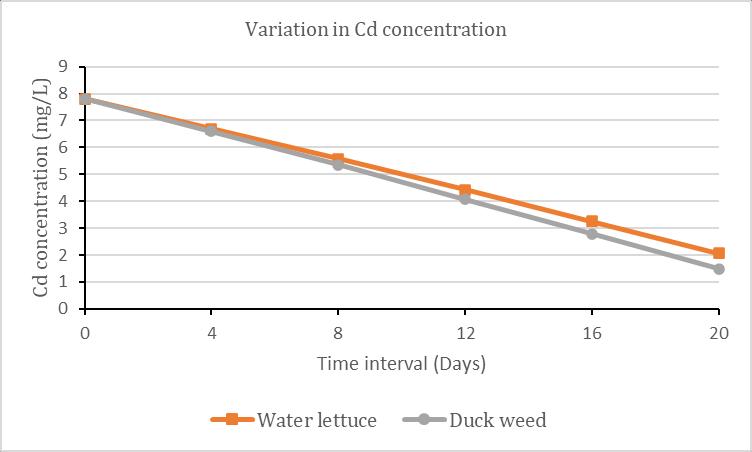
Chart -4:NiabsorptionefficiencyversusTime
Aclear-cut ideaaboutheavymetaltoxicityandcosteffective witheasilyapproachablemethodforheavymetalreduction is obtained by this study. Both the Duck weed and Water lettuce plants showed best absorption on 20th day. The concentration of the heavy metals are highly reduced by DuckweedplantswhencomparedtoWaterlettuceplants The absorbed heavy metals can be easily extracted by harvestingtheplantpartswithverylessefforts.Thismethod canbeeasilyadoptedinvariousindustrieswhichcouldnot affordforcostlyconventionaltreatmentmethods.
[1] Arisekar Ulaganathan, Jeya Shakila Robinson, Shalini Rajendran, Jeyasekaran Geevaretnam, Sundhar Shanmugam, Arumugam Natarajan, Almansour AbdulrahmanI,PerumalKarthikeyan.‘Potentiallytoxic elements contamination and its removal by aquatic weedsintheriverinesystem:Acomparativeapproach.’ EnvironmentalResearch,ElsevierPublications,pp1-10, 2021
International Research Journal of Engineering and Technology (IRJET) e-ISSN: 2395-0056
Volume: 09 Issue: 09 | Sep 2022 www.irjet.net p-ISSN: 2395-0072
[2] BhupinderDhir,P.Sharmila,PardhaSaradhi.‘Potential ofaquaticmacrophytesforremovingcontaminantsfrom the environment.’ Environmental science and Technology, Taylor & Francis publications, Vol 39, pp754-781,2009
[3] DanaA.MohammedBarznji.‘Potentialofsomeaquatic plantsforremovalofarsenicfromwastewaterbygreen technology.’Limnol.Rev,Vol15,pp15-20,2015
[4] Ekta Chaudhary, Praveen Sharma. ‘Chromium and cadmiumremovalfromwastewaterusingduckweedLemna gibba L.andultrastructuraldeformationdueto metal toxicity.’ International Journal of Phytoremediation, Taylor and Francis publications, pp1-9,2019.
[5] Esra Ucuncu, Evren Tunca, Seyda Fikirdesici, Ahmet Altindag.‘DecreaseandincreaseprofileofCu,CrandPb during stable phase of removal by Duckweed (Lemna Minor L.).’ International Journal of Phytoremediation, TaylorandFrancispublications, pp1-10,2012
[6] Goswami, Majumder. ‘ Potential of Lemna minor in Ni and Cr removal from aqueous solution.’ Pollution, Vol 1(4),pp373-385,2015.
[7] HesamKamyab,ShahabaldinRezania,ShazwinMatTaib, Mohd Fadhil Md Din, Farrah Aini Dahalan ‘Comprehensive review on phytotechnology: Heavy metalsremovalbydiverseaquaticplantsspeciesfrom waste water.’ Journal of Hazardous Materials, pp587-599,2016
[8] Isiuku Beniah Obinna , Enyoh Christian Ebere. ‘Phytoremediationofpollutedwaterbodieswithaquatic plants: Recent progress on heavy metal and organic pollutants.’ Environmental Chemistry Journal, pp1-38,2019.
[9] JameelM.Dhabab.‘RemovalofFe(II),Cu(II),Zn(II)and Pb(II) ions from aqueous solutions by duckweed.’ JournalofOceanographyandMarineScience,Vol2(1), pp17-22,2011
[10] KuokHoDanielTang,SooHooiAwa,TonyHadibarata ‘Phytoremediationofcopper-contaminatedwaterwith Pistia stratiotes insurfaceanddistilledwater.’WaterAir SoilPollut,Springerpublications, pp1-16,2020.
[11] Lanka suseela, M. Swarupa Rani, Kota Ashok Kumar ‘Physico-ChemicalandHeavyMetalAnalysisofEffluent WastewaterfromRoldGoldJewelleryIndustriesandto Review on Its Safe Disposal Using Phytoremediation ApproachwithSpecialEmphasison Hydrilla Verticillata, anAquaticPlant.’SpringerNatureSingaporePteLtd,pp 243-252,2021
[12] LindaB.L.Lim,NamalPriyantha,ChinMeiChai,Diyanah Matassan, Hei Ing Chieng, M.R.R. Kooh. ‘Adsorption behavior of methyl violet 2B using duckweed: Equilibrium and kinetic study.’ Arabian Journal for ScienceandEngineering,SpringerPublications,Vol39, Issue9,pp6757-6765,2014
[13] LouisLandesman,CliffordFedler,RunbinDuan.‘Plant nutrient phytoremediation using duckweed.’ Springer publications,pp341-354,2011
[14] MadhumitaDas,P.S.Bramhanand,K.Laxminarayana,S. RoyChowdhury.‘Effectivenessofcommonmacrophytes for phytoremediation of hexavalent Cr prevalent in chromite mining areas.’ International Journal of Phytoremediation,TaylorandFrancispublications,pp 1-10,2021.
[15] MahamadiC.‘Waterhyacinthasabiosorbent:Areview.’ African Journal of Environmental Science and Technology,Vol5(13),pp1137-1145,2011
[16] Mahmoud Saleh Al-Khafaji, Faris H. Al-Ani, Alaa F. Ibrahim.‘Removalofsomeheavymetalsfromindustrial wastewater by Lemmna minor.’ KSCE Journal of Civil Engineering,Springerpublications,pp1-6,2017.
[17] MaryLissyPN,Dr.G.Madhu.‘RemovalofHeavyMetals fromWasteWaterUsingWaterHyacinth.’ACEEEInt.J. on Transportation and Urban Development, Vol 01, pp48-52,2011
[18] Mehmet Borga Ergonul, Danial Nassouhi , Sibel Atasagun.‘Modelingofthebioaccumulativeefficiencyof Pistia stratiotes exposedtoPb,CdandPb+Cdmixtures in nutrient-poor media.’ International Journal of Phytoremediation, Taylor and Francis publications, pp1-10,2019.
[19] Monika Yadav, Gurudatta Singh, R.N. Jadeja ‘Phytoremediation for Heavy Metal Removal.’ John Wiley&Sonspublications,pp1-23,2021
[20] Muhammad Nasiruddin khan, Saba Fazal-ur-Rehman, AghaArslanWasim,SumaiaraNaz.‘Assessmentofheavy metals in rice using atomic absorption spectrophotometry-Astudyofdifferentricevarietiesin Pakistan.’Pak.J.Anal.Environ.Chem,Vol20,pp67-74, 2019.
[21] Muhammad Tariq Javed, Kashif Tanwir, Muhammad Sohail Akram, Muhammad Shahid, Nabeel Khan Niazi, SylviaLindberg.‘Phytoremediationofcadmiumpolluted water/sedimentbyaquaticmacrophytes:RoleofPlantinducedpHchanges.’CadmiumtoxicityandTolerancein Plants,pp1-37,2019
2022, IRJET | Impact Factor value: 7.529 | ISO 9001:2008 Certified Journal |
International Research Journal of Engineering and Technology (IRJET) e-ISSN: 2395-0056
Volume: 09 Issue: 09 | Sep 2022 www.irjet.net p-ISSN: 2395-0072
[22] N. Khellaf, M. Zerdaoui. ‘Growth, photosynthesis and respiratory response to copper in Lemmna minor: A potential use of duckweed in biomonitoring.’ Iran. J. EnvironHealth.Sci.Eng,Vol7,pp299-306,2010
[23] NabilaKhellaf,MostefaZerdaoui.‘Phytoaccumulationof zincbytheaquaticplant, Lemna gibba L.’Bioresource technology,pp6137-6140,2009
[24] NurulAinJamion,FaizIddenShahIsmail,NurSalwani AbWahid,NurSofiahAbuKassim.‘Apreliminarystudy ofpotentialaquaticmacrophytesinphytoremediationof leadintheMuarriver.’MalaysianJournalofChemistry, Vol23(2),pp152-164,2021.
[25] Patricia Miretzky, Andrea Saralegui, Alicia Fernandez Cirelli.‘Aquaticmacrophytespotentialforsimultaneous removal of heavy metals (Buenos Aires, Argentina).’ Chemosphere, Elsevier publications, pp 997-1005, 2004
[26] Rasha H. Mahmoud and Amal Hassanein Mohammed Hamza. ‘Phytoremediation Application: Plants as Biosorbent for Metal Removal in Soil and Water.’ SpringerPublications,pp405-422,2017.
[27] Ritusmita Goswami, Bhabani Devi and Kali Prasad Sarma.‘Comparativestudyonaccumulationofcadmium in three aquatic plants.’ Journal of Environmental Research and Development, Vol 4 (2), pp 359-364, 2009
[28] Sangeeta Anand, Sushil Kumar Bharti, Dhananjay Kumar, Narendra kumar. ‘Phytoremediation of flash light manufacturing effluent through aquatic macrophytes.’ International Journal of Science, TechnologyandSociety,Vol2,pp24-30,2016.
[29] ShafaqatAli,ZohaibAbbas,MuhammadRizwan,Ihsan Elahi Zaheer, Ilkay Yavas, Adln Unay, Mohamed M Abdel-DAIM, May Bin-Jumah, Mirza Hasanuzzaman, DimitrisKalderis.‘ApplicationofFloatingAquaticPlants inPhytoremediationofHeavyMetalsPollutedWater:A Review.’Sustainability,pp1-33,2020
[30] Siti Hanna Binti Elias. ‘Phytoremediation system for treating metals in ceramic industry waste water.’ UniversitiTeknologiMalaysia,pp1-42,2015.
[31] SultanaParven,AparajitaDe,AbhikGupta.‘CuandPb accumulation and removal from aqueous medium by Enydra Fluctuans DC.(Asteraceae) - A medicinal plant withpotentialforphytoremediation.’ResearchSquare ,pp1-17,2021
[32] Suresh Kumar & Surinder Deswal ‘Phytoremediation capabilitiesofSalvinia molesta,waterhyacinth,water lettuceandduckweedtoreducephosphorusinricemill
wastewater.’InternationalJournalofPhytoremediation, TaylorandFrancispublications,pp1-14,2020.
[33] Suresh Huma Bokhari, Muhammad Mahmood-UlHassan,MunirAhmad.‘PhytoextractionofNi,PbandCd by duckweeds.’ International Journal of Phytoremediation, Taylor and Francis publications, pp1-9,2019
[34] UgyaA.Y,-Hua,X-Ma,J.‘Phytoremediationasatoolfor theremediation of waste water resultingfrom dyeing activities.’AppliedEcologyandEnvironmentalResearch, Vol17(2),pp3723-3735,2019.
[35] Uzma Majeed, Iftikhar Ahmad, Mahmoodul Hassan, Ashiq Mohammad. ‘Phytoremediation potential of Aquatic Plants for Heavy Metals Contaminated IndustrialEffluent.’EuropeanAcademicResearch,Vol2, pp7983-7968,2014
[36] VinodkumarandPiyushKumar.‘Areviewonfeasibility of phytoremediation technology for heavy metals removal.’ Archives of Agriculture and Environmental Science,Vol4(3), pp326-341,2019
[37] Zohaib Abbas, Fariha Arooj, Shafaqat Ali, Ihsan Elahi Zaheer, Muhammad Rizwan, Muhammad Ahsan Riaz ‘Phytoremediation of landfill leachate waste contaminants through floating bed technique using WaterhyacinthandWaterlettuce.’InternationalJournal of Phytoremediation, Taylor and Francis publications, pp1-13,2019
2022, IRJET | Impact Factor value: 7.529 | ISO 9001:2008 Certified Journal