International Research Journal of Engineering and Technology (IRJET) e-ISSN:2395-0056

Volume: 09 Issue: 09 | Sep 2022 www.irjet.net p-ISSN:2395-0072
International Research Journal of Engineering and Technology (IRJET) e-ISSN:2395-0056
Volume: 09 Issue: 09 | Sep 2022 www.irjet.net p-ISSN:2395-0072
Islamic Azad University Tehran North Branch, Iran ***
Inthelastdecade,organizationalperformancehasbeenasuitabletoolforthepathologyoftheorganizationand,consequently, performance improvement at various organizational levels has been considered by researchers and executives, because measuring, monitoring and evaluating performance focused on the goals and missions of the organization. Scientifically in a changingenvironment,itisnecessaryfororganizationstosurviveandcontinuetosurvive.
Thepurposeof thepresent studyistoinvestigate the effectoforganizational resiliencedimensionsofstart-up businessesin themarketontheirfinancialperformance.Thisresearchisappliedintermsofdevelopmentalpurposeanddescriptive-survey in terms of nature and method. The statistical population of the research consists of all managers and experts of creative companies in Tehran, whose number according to the latest statistics of the "Ecological Development Program of Creative Companies" is248,including foreach companyatleast 2managersand experts Thestatistical populationwasequal to496. Sampling is simple random and the sample size is 220. The data collection tool was a standard questionnaire with 17 questionsandstructuraltransactionmodelingwithPlssoftwarewasusedtotestthehypotheses.
The resultsshowedthat plannedresiliencehasa positiveeffect onadaptive resilienceof 62%.Adaptive resiliencealsohas a positive effect on financial performance of 71%, but planned resilience does not have a positive impact on financial performance.Thismeansthattheimpactofplannedresilienceonfinancialperformanceisthroughadaptiveresilience
Keywords: Adaptiveresilience,Plannedresilience,Organizationalfinancialperformance,Startups.
Inthelastdecade,organizationalperformancehasbeenasuitabletoolforthepathologyoftheorganizationand,consequently, performance improvement at various organizational levels has been considered by researchers and executives, because measuring, monitoring and evaluating performance focused on the goals and missions of the organization. Scientifically in a changing environment, it is necessary for organizations to survive and continue their survival (Rastegar et al., 2020). In the meantime, performance improvement is very important, especially in times of crisis (Kim, 2020). In very volatile and uncertain times, organizations need to develop resilience capacity in crises and changes that enable them to cope effectively with unexpected events, escape crises, and even ensure future success (Hosseini et al., 2020). Although academic interest in organizationalresiliencehassteadilyincreasedinrecentyears,thereislittleconsensusonthetruemeaningofresilience and howitiscreated.Moreknowledgeisneededespeciallyabouttheorganizationalcapabilitiesthatmakeupresilienceaswellas theconditionsfortheirdevelopment(Duchek,2020:1).Resilience,meanwhile,differsfromrelatedstructuressuchasagility or strength. Although flexibility as the ability to quicklyadapt to environmental changes and agility as the "ability to quickly identify opportunities, change direction, and avoid collisions" have some elements in common with resilience, the specific emphasis of resilience structures is different. While flexibility and agility are essential to deal with day-to-day problems and change, resilience involves an aspect of adaptation (Madani & Jackson, 2009) and allows organizations to emerge stronger than before the crisis. This characteristic distinguishes resilience from agility and defines it as the ability of a system to maintainperformancedespitedisturbances(LengNickHalletal.,2011).
Organizationalresiliencehastwodimensions:plannedandadaptive(Leeetal.,2013).Plannedresilienceusuallyoccursbefore a disaster occurs, while adaptive resilience usually occurs after a disaster and requires leadership, external communication, internal collaboration, the ability to learn from past experiences, and employee well-being (Nilakant et al., 2014). While
International Research Journal of Engineering and Technology (IRJET) e-ISSN:2395-0056
Volume: 09 Issue: 09 | Sep 2022 www.irjet.net p-ISSN:2395-0072
previousstudieshaveshownthatpost-disasterrecoverystrategiesaffect businessperformance(CoreyandDitch,2011),the impact of organizational resilience on business performance among start-ups has not been studied. In particular, post-crisis financial performance is affected by many factors, including pre-crisis planning, company size, and operations (Nakanishi et al., 2014). Also, subjective criteria of business performance are highly correlated with objective criteria (Wage and Badie, 2016). Therefore, this study examines the relationship between planned resilience and adaptation to the financial performance ofstartupsandstart-ups.Doesthesizeof thecompany and the operationsdepartmentaffectthis relationship? Lackofrecoveryplanscanimpairadaptiveresilience(Alexander,2013).
Crisis planning can facilitate the resilience of organizational infrastructure, thus helping planned resilience (Faulkner and Vikulov, 2014). However, research reveals complexities between the relationship between planned and adaptive resilience. Summers(2009)foundthatcrisisplanningdidnothaveasignificanteffectonorganizationalresilience.DalziellandMcManus (2014)suggestthatplanningfacilitatesonlypartialor post-disasterorganizationalrecovery.Therefore,organizationsshould focus on creating adaptive flexibility rather than step-by-step plans (Summers, 2009). Orchiston et al. (2016) found strong evidence from the two dimensions of "collaboration and innovation" and "planning and culture" that have different relationships with planned and adaptive resilience. Nevertheless, the importance of effective planning for emergency issues, problemsolving,buildingexternallinks,andeffectivedecisionmakingasa teamhasbeenhighlighted(Orchistonetal.,2016). Thesepracticescanpositivelyaffectbusinessperformance(Prayagetal.,2018).
Today, start-ups face a variety of challenges related to the market, audience, employment, product, capital and customer service, and there is no simple way to solve them (Sayahpour et al., 138). Entrepreneurs with high resilience do not carry problemswiththemselves,butratherfocusontheirlong-termmission.Inthemeantime,itisveryimportanttopayattention tovariousorganizationalresiliencestrategies,especiallyforsmallandsmallbusinesses(Aldinatoetal.,2021).Inthisregard, themainquestionofthisresearchiswhatistheimpactoforganizationaldimensionsofstart-upbusinessesinthemarketon theirfinancialperformance?
Aresilientorganizationcanbeviewedfromtwoperspectives.Oneisthatresilientorganizationisanorganizationthathas the abilitytorebuilditselffromuncertainties,stresses,andscarcityofresourcesandenvironmentalthreats(Balu,2001;Duttonet al.,2002;Gittelletal.,2006).Thisperspectiveisapsychologicalperspectivethatemphasizesonincreasingthepsychological capacity of the organization to deal with threats, crises and challenges. On the other hand, he believes that organizational resilience refers to the development and creation of new organizational capabilities and capabilities to create new organizational opportunities in the environment (Koutu, 2002; Freeman et al., 2004; Jamrog et al., 2006). This is a strategic visionthatemphasizesincreasingthestrategiccapacityoftheorganizationtoovercomeenvironmentalchallenges.
Butwhatiscertainisthatresilientorganizationswillhavebettercompetitiveadvantagesinthemarket,soorganizationstryto prioritizetheirresilienceandallocateresourcestoit(Peyghamietal.,2016:14;Deloitte,2021:6)
SutcliffandVogus(2013)believethatresilientorganizationshavetheabilitytoalignthemselvesstrategicallyandstrategically with their challenging environment. These organizations can also improve during the challenges by creating and improving their strategic resilience capacity, because they face and overcome these challenges and obstacles, and thus the ability to changeandimprove. Theyaddthemselves.Thisin fact demonstratestheirstrategic resilience, whichis the abilityto change directionincriticalsituations(lackofbudget,lackofresources)and thelikeresilienceandresilienceintheenvironmentand updating and strengthening resources to find new opportunities. It creates potential threats from the environment and transformsthemintoopportunities,althoughsometimesachievingtheseopportunitiesrequiresmajororganizationalchanges (Kim,2016:32).Atpresent,Covid-19hashadasignificantimpactonthedisruptionoftheglobaleconomy,includingforstartups.Itencouragesentrepreneurstopursueaprocessofcontinuousinnovationtobecomemoreempoweredandtocontinueto innovateinordertomaintainthefutureoftheirbusiness(Aldinatoetal.,2021).
International Research Journal of Engineering and Technology (IRJET) e-ISSN:2395-0056
Volume: 09 Issue: 09 | Sep 2022 www.irjet.net p-ISSN:2395-0072
Varioustheorieshavebeenproposedaboutorganizationalperformance.Organizationalperformancereferstohowmissions, organizational tasks, and results are performed. In another definition, organizational performance includes achieving or exceeding organizational and social goals and fulfilling the responsibilities of the organization (De Carvalho et al., 2016). In fact, organizational performance refers to the ability of an organization to achieve the set goals to maintain profit, have a competitiveadvantage,increasemarketshareandmaintainlong-termsurvival,basedontheuseofapplicableorganizational strategies(Benzingetal.,2009).Organizationalperformanceisintroducedasanindicatorthatmeasureshowanorganization achieves its goals. Performance can be defined and evaluated based on goal achievement, cost-effectiveness or efficiency, scarceresourceacquisition,environmentaladaptability,stakeholderandstakeholdersatisfaction,andinternalprocessessuch asorganizationallearning,employeemorale,andorganizationalculture(KarpakandTopcu,2010).
Researchers believe that resilience draws attention to the ability of a system to return to its pre-crisis state as quickly as possible. This implies a focus on performance efficiency and helps the organization focus on its adaptive capacity and bring dynamismandcapacitydevelopmenttocopewithnewsituations(Al-Shehietal.,2018).Resilienceasafunctionalfeatureofa systemcontributestotheperformanceofthatsystem,andcompaniesthatwanttoinvestinmoreresilience needtoevaluate their performance to see the differences in pursuing resilient strategies, including resilience. Planned collection, to be specified. Of course, the complexity is in defining a criterion for analyzing and measuring the resilience of organizations and the relationship with their financial performance due to the diversity of domains and objectives (Balugani et al., 2020). Paradkar et al. (2015) also believe that due to the resilience of start-up businesses, access to different types of success resourcesisprovidedintheearlystagesofdevelopmentandcapabilities-basedresources,especiallydynamiccapabilities,will be realized in them. In the beginning, alliances with partners are especially important, so the ability to form unions is a key capability for successful adaptive resilience of these companies, and they must use their available resources to attract good partners in order to access the necessary complementary resources. Finally, Zand Hesami and Bayat (2016) also found that resilientbusinessmodelsarethekeytothesuccessofstartupsandtheirperformance.

Basedontheliteratureandreviewedbackground,theconceptualmodeloftheresearchcanbedevelopedasFigure1:



planned resilience
financial performance
adaptive resilience
This research is development-applied in terms of purpose, because it is in the field of examining the impact of resilience dimensions of startups on improving their financial performance, which in the theoretical part to explain its various dimensions and in the operational part to provide practical and executive solutions. For start-ups that are the focus of this study.Ontheotherhand,thisresearchisdescriptive-surveyintermsofnatureandmethod.Thestatisticalpopulationofthis study consists of all managers and experts of creative companies in Tehran, the number of which according to the latest
International Research Journal of Engineering and Technology (IRJET) e-ISSN:2395-0056
Volume: 09 Issue: 09 | Sep 2022 www.irjet.net p-ISSN:2395-0072
statisticsofthe"EcologicalDevelopmentProgramofCreativeCompanies"is 248.Accordingtothelatestreport,thereare248 creative companies, which with the inclusion of at least 2 managers and experts in each company, the statistical population wasequalto496.Sampling wassimplerandom.Todeterminethesamplesize,CharlesCochran'sformulahasbeenusedand based on this formula, the sample size for the community of 496 companies is equal to 216 people, of which 220 questionnaireshavebeendistributedtoensureasufficientnumberofreturnquestionnairesinthestatisticalsample. Data collectiontoolwasa standardquestionnairewith 14questions.Inordertomeasurethevalidityofthe questionnairein this study, content validity and construct validity have been used. To assess the content validity, the questions have been adaptedfromreliablesourcesandthenprovidedtoprofessorsandexperts,andthenumberofquestionsandtheircontenthas beenapproved.Confirmation,constructvalidityused.Cronbach'salphacoefficienthasbeenusedforreliability.
Inordertoanalyzethedataobtainedfromthequestionnaires,firstinthedescriptiveanalysissection,thestatisticalsampleof theresearchwasreviewed.TheresultsofthesecalculationsaregiveninTables1:
Demographic Variable Frequency Percentage gender female 164 36 Male 220 64 Education BA/BS 135 37.1 MA/MS 165 42.9 PhD 104 19.9
Also, the results of measuring the reliability of variables as well as their central descriptive statistics (mean) and dispersion (standarddeviation)aregiveninTable2:
Key Variables Cronbach's alpha calculated mean Standard deviation
Planned Resilience 0.791 3.80 0.97 Adaptive Resilience 0.780 3.45 0.89 Financial Performance 0.839 4.12 0.61
Ascanbeseen,basedontheresultsofTable2,mostofthestatisticalsamplestudiedhadamaster'sdegree.Also,thereliability obtainedforalleightmainvariableswasacceptableabove0.70,whichindicatesthereliabilityofthequestionnairequestions. On the other hand, descriptive statistics show that in terms of central statistics, the average of all 5 variables was above the mean (3) and below the allowable standard deviation (1), and therefore their mean and standard deviation are within the allowablerange.
Inthissection,Kolmogorov-Smirnovtestisusedtodeterminethetypeofdatadistributionasnormalorabnormal,andbased onthat,becausethesigvalueofthetestforallvariablesislessthan0.05,thenullhypothesisiszero.Basedonthenormality, thedistributionofquantitativeresearchvariableswasnotconfirmed(P<0.05),inotherwords,thedistributionofall quantitativeresearchvariablesisabnormal.
International Research Journal of Engineering and Technology (IRJET) e-ISSN:2395-0056
Volume: 09 Issue: 09 | Sep 2022 www.irjet.net p-ISSN:2395-0072
BasedontheresultsofKolmogorf-Smirnovtestanddeterminingtheabnormalityofthestatisticalpopulationdistribution,to testthemodelofthisresearch,dataanalysisbystructuralequationmodelingbasedonvariancewithSmartPLSsoftwarewas used
5.3.1
Table 2 shows the divergent and convergent validity statistics for the validity and reliability of the research measurement model:
Index/variable cp AVE α
Planned resilience 0.944 0.770 0.925
Adaptive resilience 0.868 0.569 0.810 Financial performance 0.894 0.680 0.841
5.3.2
Co-occurrence between multiple variables occurs when there is a large correlation (greater than 0.9) between multiple variablesthatresultsinredundantinformation.Thisrepetitionofinformationreducesthepredictivepowerofeachindividual independent variable (Field, 2009; Pallant, 2007). Table 4 shows the results of the correlation coefficients between the researchvariables.
Variable 1 2 3
PlannedResilience 0.877 AdaptiveResilience 0.621 0.754 FinancialPerformance 0.384 0.675 0.824
InTable5,thecross-sectionalloadsoftheitemsontheresearchstructuresarereported.
ObviousVariable Factorload
CriterionLimit Result 1 0.904 Over0.7
FactorConfirmed 2 0.844 Over0.7 FactorConfirmed 3 0.899 Over0.7 FactorConfirmed 4 0.868 Over0.7 FactorConfirmed 5 0.870 Over0.7 FactorConfirmed 6 0.734 Over0.7 FactorConfirmed 7 0.775 Over0.7 FactorConfirmed 8 0.790 Over0.7 FactorConfirmed 9 0.812 Over0.7 FactorConfirmed 10 0.784 Over0.7 FactorConfirmed
International Research Journal of Engineering and Technology (IRJET) e-ISSN:2395-0056
Volume: 09 Issue: 09 | Sep 2022 www.irjet.net p-ISSN:2395-0072
11 0.740
Over0.7 FactorConfirmed 12 0.875 Over0.7 FactorConfirmed 13 0.845 Over0.7 FactorConfirmed 14 0.841 Over0.7 FactorConfirmed
AccordingtoTable5,therootmeansquareoftheextractedvarianceofallresearchvariablesisgreaterthantheircorrelation with other variables. Therefore, the criterion for examining the divergent validity of research variables is established. In addition, numbers below the diameter of the correlation matrix have been reported to investigate the relationship between thevariables.Ascanbeseen,thecorrelationcoefficientofallvariableswitheachotherispositiveandsignificant.
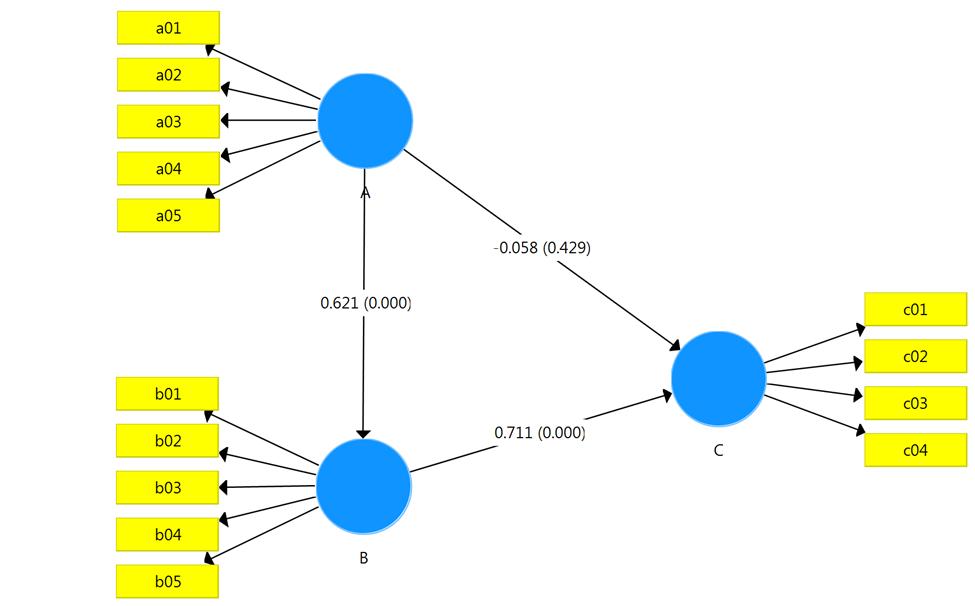
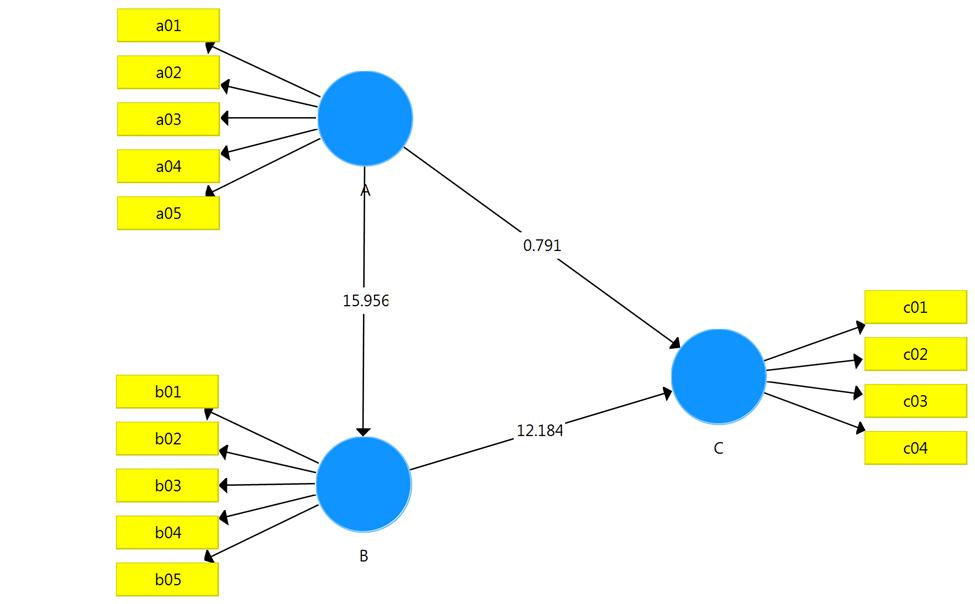
Theproposedconceptualmodelisexaminedthroughthestructuralequationmodelingmethodandaccordingtotheresearch hypothesesmentionedinthetheoreticalframework,thepartialleastsquaresmethodisusedtoestimatethemodel.InFigures 3 and 2, the tested model shows the relationship between research variables. According to this figure, the effect of numbers insidethecircleofvarianceareexplained.Theresultsareasfollows:
International Research Journal of Engineering and Technology (IRJET) e-ISSN:2395-0056
InTable6,theestimationofpathcoefficientsandexplainedvarianceofresearchvariablesandtheresultoftestingresearch hypothesesarereported.
Hypothesis β یهرامآ یت MeaningfulnessStatistics Results
1 Planned resilience has positive effect on adaptive resilience 15.956 0.621 0.000 H confirmed
2 Planned resilience has positive effect on financial performance 0.791 0.058 0.429 H confirmed
3 adaptive resilience has positive effect on financial performance 12.184 0.711 0.000 H rejected
As can be seen in Table 7, the values of the coefficients of determination for the latent variables of the model express the degree of influence of the dependent variables on the independent variable. In fact, from the values in the table above, the inference of 0.385 from the structural changes of adaptive resilience and 0.458 from the structural changes of financial performanceisexplainedbythestructureenteringthem,ietheindependentvariableofplannedresilience.TheGOFindexis alsoabovethecriterionof0.3andisacceptable
Resilience, which means the ability and capacity of an organization to face crises and challenges, and the ability to return to normalbusinessconditions,isaveryimportantfeaturethatorganizationsmustbeequippedforthesurvivalandcontinuityof their business. However, concern is not limited to catastrophes; There are also small deviations and uncertainties that challenge organizations (Ran et al., 2011). Various pieces of evidence indicate the limitless nature of disorders (Smith and Fischbacher,2009).Inthisregard,Alexanderetal.(2014)Acknowledgethattherearevariousbusinessesthatdonothavethe abilitytomanagevulnerabilities;Insuchawaythatinthefaceofenvironmentalunrest,theymaybeeliminatedortakenover bypowerfulorganizations
This study was conducted in line with the aim of "examining the impact of organizational resilience dimensions of start-up businessesinthemarketontheirfinancialperformance"andtheresultsshowedthatplannedresiliencehasa positive effect
Volume: 09 Issue: 09 | Sep 2022 www.irjet.net p-ISSN:2395-0072 © 2022, IRJET | Impact Factor value: 7.529 | ISO 9001:2008 Certified Journal | Page840
International Research Journal of Engineering and Technology (IRJET) e-ISSN:2395-0056
Volume: 09 Issue: 09 | Sep 2022 www.irjet.net p-ISSN:2395-0072
on adaptive resilience of 62%. Adaptive resilience also has a positive effect on financial performance of 71%, but planned resilience does not have a positive impact on financial performance. This means that the impact of planned resilience on financialperformanceisthroughadaptiveresilience.
TheresultsofthisstudyareinlinewiththeresultsofresearchsuchastheresearchofAl-Shahietal.(2018)whobelievethat resiliencedrawsattentiontotheabilityofasystemtoreturntoitspre-crisisstateinthefastestpossibletime. Thisimpliesa focusonperformanceefficiencyandhelpstheorganizationtofocusonitsadaptivecapacityandbringdynamismandcapacity development to copewith new situations,aswell asthe researchofBalogani et al.(2020)whofound thatAsa performance feature of a system, it contributes to the performance of that system, and companies that want to invest in more resilience needtoevaluatetheirperformancesothatdifferencesinthepursuitofresilience strategies,includingprogramresilience.Be specified; Finally, the research of Paradkar et al. (2015) showed that due to the resilience of start-up businesses, access to different types of success sources is provided in the early stages of development and capability-based resources, especially dynamic capabilities, will be realized in them. And their resilience is increased and thus leads to their success and performance,isconsistent.
Therefore,inlinewiththeobtainedresults,itisrecommended thatthemanagersanddecisionmakersofcreativecompanies bemoreawareofthesituationofmanagingrestrictivebarriersintheenvironmentinwhichtheyoperate.Andbyidentifying potentialeventsandexaminingtheirconsequences,theycanbeawareoftheamountofresourcesavailabletotheorganization inthefaceofcrisisandtheywouldbeawareoftheorganization'sobligationstoallstakeholders. theycanalsofindtheability to identify and manage their key vulnerabilities like the points that cause irreparable damage to the business by losing or damagingit,anddosobymodifyingthebusinessmodelandincreasingemployeeempowerment. meanwhile,therewouldbe anincreasein thecapacityforculturaladaptationanddynamismoftheirbusinessbyrelyingontheremovalofstructuraland culturalbarrierstobusiness.Also,managersofsmallandmediumcompaniesshouldalwaysseektodevelopanddiscovernew marketsbyeffectivelyadvertisingproductsandusingnewmarketingmethodsinordertoincreasetheirflexibilityintheface of rapid environmental changes. Finally, it is recommended that managers of these businesses carefully examine the capabilities of their employees and accurately describe and discuss them for themselves and them. Freely share information withemployeesandtheirsubordinates,especiallyintimesofcrisis,andexpresstheirideasandthoughtsclearlytoothers, and finally pay attention to organizational structural factors such as organizational structure, organizational strategy, explicit targeting,creatingfeedbacksystems.Topmanagementsupport,employeefreedomofaction,humanresourcesystem,flexible structure,etc.,allaffecttheimprovementoforganizationalresilienceprocesses.Themanagersofthesecompanies areadvised to pay special attention to improving these structural structures and strengthening them in their human resource managementprograms.
This research has been conducted cross-sectionally and perhaps its results as a longitudinal research can provide other generalizableresults.Also,duetothecoronaepidemic,moreaccesstomorestartupcompanieswasnotprovidedinorderto providemoregeneralizableresults.
Inthisregard,futureresearchersarealsosuggestedtodothisresearchagainduringlongitudinalresearchandalsotoexamine the mediating variables in the effects of organizational resilience dimensions on financial performance (such as type of business plan, level of organizational innovation, The role of dynamic capabilities, etc.) and finally test this model in other statisticalcommunitiesandotherstart-upbusinesses.
Aldianto, L., Anggadwita, G., Permatasari, A., Mirzanti, I. R., & Williamson, I. O. (2021). Toward a Business Resilience FrameworkforStartups. Sustainability, 13(6),3132.
Aleksandar Aleksi, Miladin Stefanovi, Slavko Arsovski, Danijela Tadi, (2014). An Assessment of Organizational Resilience Potential in SMEs of the Process Industry, A Fuzzy Approach", Journal of Loss Prevention in the Process Industries,26;1238-1245.
International Research Journal of Engineering and Technology (IRJET) e-ISSN:2395-0056
Volume: 09 Issue: 09 | Sep 2022 www.irjet.net p-ISSN:2395-0072
Alexander,D.(2013).Anevaluationofmedium-termrecoveryprocessesafterthe6April2009earthquakeinL’Aquila, CentralItaly.EnvironmentalHazards,12(1),60–73.
Alshehhi, A., Nobanee, H., & Khare, N. (2018). The impact of sustainability practices on corporate financial performance:Literaturetrendsandfutureresearchpotential. Sustainability, 10(2),494.
Balu,R.(2001).Howtobouncebackfromsetbacks.FastCompany,45,148−156
Dalziell, E. P., & McManus, S. T. (2004, December 6–8). Resilience, vulnerability, and adaptive capacity: Implications forsystemperformance.PresentedattheInternationalForumforEngineeringDecisionMaking,Stoos,Switzerland
De Carvalho, A. O., Ribeiro, I., Cirani, C. B. S., & Cintra, R. F. (2016). Organizational resilience: A comparative study betweeninnovativeandnon-innovativecompaniesbasedonthefinancialperformanceanalysis. International Journal of Innovation, 4(1),58-69.
Dutton,J.E.,Frost,P.J.,Worline,M.C.,Lilius,J.M.,&Kanov,J.M.(2002).Leadingintimesoftrauma. HarvardBusiness Review,80(1),54−61.
Faulkner,B.,&Vikulov,S.(2001).Katherine,washedoutoneday,backontrackthenext:Apost-mortemofatourism disaster.TourismManagement,22(4),331–344.
Gittell, J. H., Cameron, K., Lim, S., & Rivas, V. (2006). Relationships, layoffs, and organizational resilience: Airline industryresponsestoSeptember11th.JournalofAppliedBehavioralScience,42(3),300−330.
Kim, Y. (2020). Organizational resilience and employee work-role performance after a crisis situation: exploring the effectsoforganizationalresilienceoninternalcrisiscommunication. Journal of Public Relations Research, 32(1-2),4775.
Nakanishi,H.,Black,J.,&Matsuo,K.(2014).Disasterresilienceintransportation:Japanearthquakeandtsunami2011. InternationalJournalofDisasterResilienceintheBuiltEnvironment,5(4),341–361.
Nilakant, V., Walker, B., van Heugen, K., Baird, R., & De Vries, H. (2014). Research note: Conceptualizing adaptive resilienceusinggroundedtheory.NewZealandJournalofEmploymentRelations,39(1),79.
Orchiston,C.(2013).Tourismbusinesspreparedness,resilienceanddisasterplanninginaregionofhighseismicrisk: ThecaseoftheSouthernAlps,NewZealand.CurrentIssuesinTourism,16(5),477–494.
Ran Bhamra, Samir Dani & Kevin Burnard. (2011). Resilience: the Concept, a Literature Review and Future Directions",Int.J.ProductionResearch,49(18),5375-9
Smith, D., & Fischbacher, M. (2009). The changing nature of risk and risk management: The challenge of borders, uncertaintyandresilience. Risk management, 11(1),1-12.
Somers, S. (2009). Measuring resilience potential: An adaptive strategy for organizational crisis planning. Journal of ContingenciesandCrisisManagement,17(1),12–23
Vij, S., & Bedi, H. S. (2016). Are subjective business performance measures justified? International Journal of ProductivityandPerformanceManagement,65(5),603–621
ZandHesami,H.,&Bayat,N.(2016).ChoicetheBusinessModelforKnowledge-BasedCompaniesLocatedinIncubator Center. Journal of Development & Evolution Mnagement, 1395(26),59-69.