Benefits of Ultra low Loss Fiber in Submarine Transmission

Page 1

International Research Journal of Engineering and Technology (IRJET)

e-ISSN: 2395-0056

Volume: 09 Issue: 09 | Sep 2022

p-ISSN: 2395-0072

www.irjet.net

Benefits of Ultra low Loss Fiber in Submarine Transmission (Review Article) Pradeep Kumar Sharma1, a *,Ashutosh Kumar Singh2,b,Manisha Yadav3,c,Sanjay Chauhan4,d 1Student

Mtech2nd year, Department of Electronics and Communication, IET, Dr. Rammanohar Lohia Avadh University Ayodhya, Uttar Pradesh, India 2Associate Professor, Department of Electronics and Communication, IET, Dr. Rammanohar Lohia Avadh University Ayodhya, Uttar Pradesh, India 3Assiatant Professor, Department of Electronics and Communication, IET, Dr. Rammanohar Lohia Avadh University Ayodhya, Uttar Pradesh, India 4Assiatant Professor, Department of Electronics and Communication, IET, Dr. Rammanohar Lohia Avadh University Ayodhya, Uttar Pradesh, India

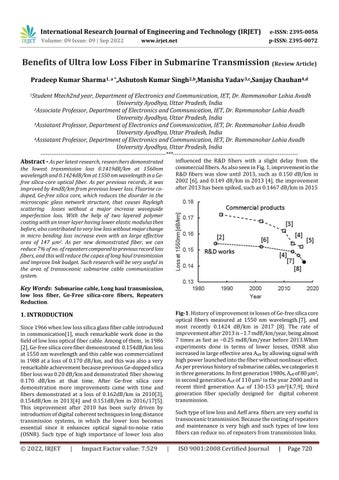
---------------------------------------------------------------------***--------------------------------------------------------------------influenced the R&D fibers with a slight delay from the commercial fibers. As also seen in Fig. 1, improvement in the the lowest transmission loss 0.1419dB/km at 1560nm R&D fibers was slow until 2013, such as 0.150 dB/km in wavelength and 0.1424dB/km at 1550 nm wavelength in a Ge2002 [6], and 0.149 dB/km in 2013 [4], the improvement free silica-core optical fiber. As per previous records, it was after 2013 has been spiked, such as 0.1467 dB/km in 2015 improved by 4mdB/km from previous lower loss. Fluorine codoped, Ge-free silica core, which reduces the disorder in the microscopic glass network structure, that causes Rayleigh scattering losses without a major increase waveguide imperfection loss. With the help of two layered polymer coating with an inner layer having lower elastic modulus then before, also contributed to very low loss without major change in micro bending loss increase even with an large effective area of 147 µm2. As per new demonstrated fiber, we can reduce 7% of no. of repeaters compared to previous record loss fibers, and this will reduce the capex of long haul transmission and improve link budget. Such research will be very useful in the area of transoceanic submarine cable communication system.

Abstract - As per latest research, researchers demonstrated

Key Words: Submarine cable, Long haul transmission,

low loss fiber, Ge-Free silica-core fibers, Repeaters Reduction. Fig-1. History of improvement in losses of Ge-free silica core optical fibers measured at 1550 nm wavelength.[7], and most recently 0.1424 dB/km in 2017 [8]. The rate of improvement after 2013 is −1.7 mdB/km/year, being almost 7 times as fast as −0.25 mdB/km/year before 2013.When experiments done in terms of lower losses, OSNR also increased in large effective area Aeff by allowing signal with high power launched into the fiber without nonlinear effect. As per previous history of submarine cables, we categories it in three generations. In first generation 1980s, Aeff of 80 μm2, in second generation Aeff of 110 μm2 in the year 2000 and in recent third generation Aeff of 130-153 μm2[4,7,9], third generation fiber specially designed for digital coherent transmission.

1. INTRODUCTION Since 1966 when low loss silica glass fiber cable introduced in communication[1], much remarkable work done in the field of low loss optical fiber cable. Among of them, in 1986 [2], Ge-free silica core fiber demonstrated 0.154dB/km loss at 1550 nm wavelength and this cable was commercialized in 1988 at a loss of 0.170 dB/km, and this was also a very remarkable achievement because previous Ge-dopped silica fiber loss was 0.20 dB/km and demonstrated fiber showing 0.170 dB/km at that time. After Ge-free silica core demonstration more improvements came with time and fibers demonstrated at a loss of 0.162dB/km in 2010[3], 0.154dB/km in 2013[4] and 0.151dB/km in 2016/17[5]. This improvement after 2010 has been surly driven by introduction of digital coherent techniques in long distance transmission systems, in which the lower loss becomes essential since it enhances optical signal-to-noise ratio (OSNR). Such type of high importance of lower loss also

© 2022, IRJET

|

Impact Factor value: 7.529

Such type of low loss and Aeff area fibers are very useful in transoceanic transmission. Because the costing of repeaters and maintenance is very high and such types of low loss fibers can reduce no. of repeaters from transmission links.

|

ISO 9001:2008 Certified Journal

|

Page 720


Turn static files into dynamic content formats.
Create a flipbook
Benefits of Ultra low Loss Fiber in Submarine Transmission by IRJET Journal - Issuu