International Research Journal of Engineering and Technology (IRJET) e-ISSN: 2395-0056

Volume: 09 Issue: 09 | Sep 2022 www.irjet.net p-ISSN: 2395-0072
International Research Journal of Engineering and Technology (IRJET) e-ISSN: 2395-0056
Volume: 09 Issue: 09 | Sep 2022 www.irjet.net p-ISSN: 2395-0072
1M. Tech Power System Scholar Dept. of Electrical & Electronics, Shri Vaishnav Vidyapeeth Vishwavidyalaya Indore (M.P.) India. 2Assistant Professor Dept. of Electrical & Electronics, Shri Vaishnav Vidyapeeth Vishwavidyalaya Indore (M.P.) India. ***
Abstract - The energy gap in a power system network may be filled by distributed solar generation. The system's power flow is altered by its high penetration, which also results in significant voltage and frequency fluctuations. Storage is crucial in addressing the solar systems' problems with unpredictability and uncertainty. Electric vehicles (EVs) are applied in this research as a Demand Side Management (DSM) strategy to lessen the impact of solar fluctuations. Three factors State of Charge (SoC), PV output power, and system voltage control how an EV battery behaves whenactingas a load or source. Using MATLAB/Simulink, various scenarios have been examined on a 2 MW distributed solar generation system integrated with an IEEE-33 bus radial network. The findings demonstrate that by using EVs as a DSM tool, the over/under voltage problems are minimizedandexcess energy generated is successfully utilized.
Usingthistechnique,EVscanfunctionasaload,adistributed energyprovider,oragridnetworkenergystorage.TheEVs canbechargedandthusoperateasaloadduringtimesof highgenerationandlowdemandbecausethegenerationand consumptionmustalwaysbalanceforastablepowergrid. Thissavedenergycanbeusedfortransportationlateronor asasourceofelectricityduringperiodsofhighdemandand lowproduction[3].
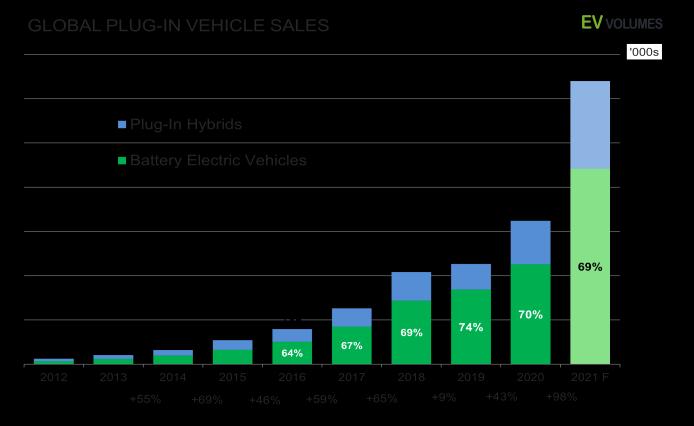
Duetothegrowingconcernsaboutglobalwarmingandthe fact that transportation is the major source of pollution, clean energy production and electric vehicles (EVs) have caught the interest of numerous sectors and consumers worldwide.AsstatedbytheInternalEconomicDevelopment Council(IEDC),thetransportationsectoruses70%oftheoil usedintheUSA.Duetotheirmassivepopulations,Chinaand India have a growing demand for passenger automobiles, andby2050,theworldmayhave1.5billioncars.Asaresult, itisexpectedthattheneedforoilwouldlikewiserisemore intheyearstocome. Themanufactureanduseofbatteryelectric vehicles and plug-in hybrid-electric vehicles have increasedtremendouslyinrecentyearsdueto theirclean operationandindependenceonoil,and by2027they will accountfor45%ofthemarketforlightvehiclesworldwide as Shown in Fig.-1[1]. Tesla automobile company ranked No.1byselling9,36,172unitofEV’sin2021[2].Thebenefits of EV’s are listed as 5 C’s – Clean, Convenient, Clever, Connected, Cost Effective. Other than this EV can play importantroleinVehicletoGridtechnology.
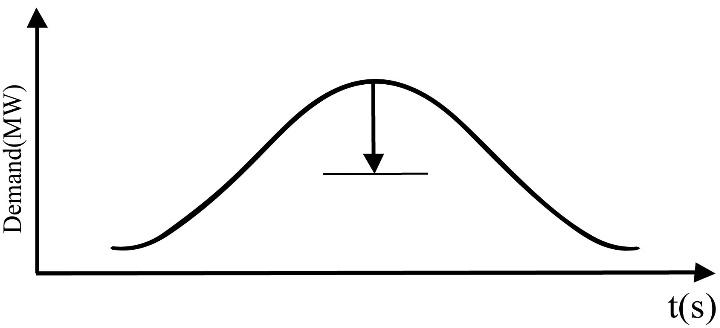
Thesolargenerationsystemshaveahighlevelofpenetration inthedistributionnetworkduetotheirhighpotential.Many Americanbusinesses,includingEnergies,BorregoSolar,and GodfreyHoffman,arenowputtingsolarsystemsinparking lots to maximize available space [4] However, due to the uncertain and variable character of distributed solar generation,thehigherpenetrationlevelofdistributedsolar generation reshapes the power flow of the distribution systemandcancauseabruptswingsinsystemvoltagesand frequency [5]. By installing EV charging stations in PV parkinglots,EVscanactasa peak-shavingorvalley-filling tooltoimprovethestabilityofthesystem.AstheEVmarket hasdevelopedtothepointwheretheycanplayasignificant roleasaDemandSideManagement(DSM)tooltomitigate these fluctuations in the system. In this paper, a control algorithmforpeakshavingandvalleyfillinginaVehicleto GridoperationforDSMisproposed.Tomanagethebehavior oftheEVstooperateasaloadorasource,manyparameters
International Research Journal of Engineering and Technology (IRJET) e-ISSN: 2395-0056
Volume: 09 Issue: 09 | Sep 2022 www.irjet.net p-ISSN: 2395-0072
havebeenemployed,includingtheStateofCharge(SoC)of thebattery,PVoutputpower,andsystemvoltages.
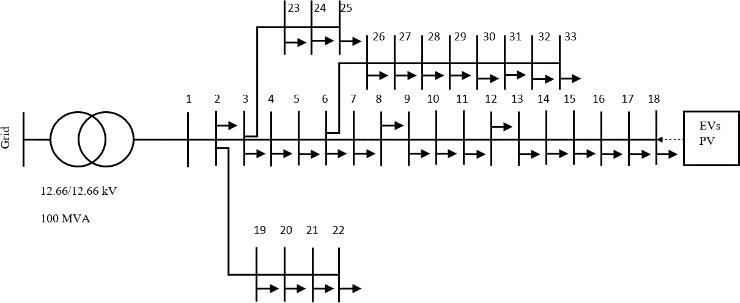
In this work, an IEEE-33 bus radial system, a 12.66 kV mediumvoltagedistributionsystem,hasbeenemployed.A 100MWtransformerconnectsthedistributionnetworktothe grid.Thesystemincludes20PVpanels,eachwitha100kW capacity, anda 2018 Tesla model S-100D with a 100-kWh capacityhasbeenemployedasanEV.AggregatedEVshavea 0.5MWhcapacity,whichisusedasaDSMtool. TypicalSLD ofIEEE-33BusSystemisshowninFig.2.
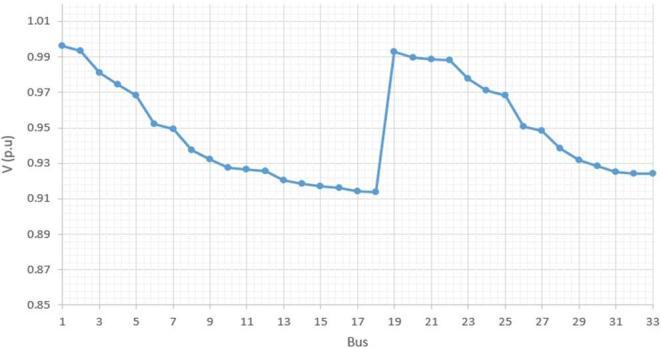
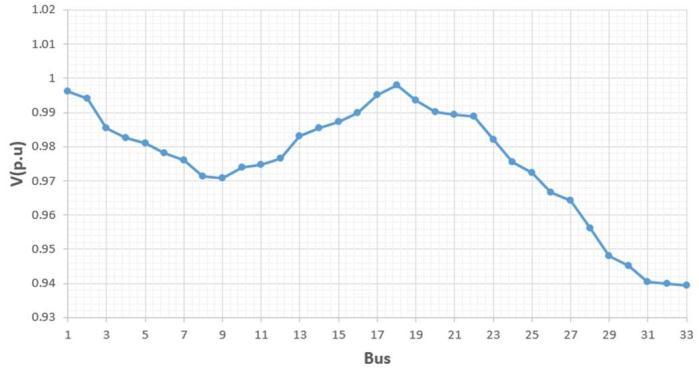
Accordingtothesimulationfindingsforthenetworkwithout PVandEVs,bus-18isthecrucialbuswiththelowestvoltage, asshowninFig3.Asaresult,thePVandEVarecombinedat bus-18foradditionalsimulations.
SoC
Fig.-4illustratesthevalleyfillingphenomenongraphically As shown in Fig.-5, this method has been managed by the SoCoftheEVsandbusvoltage/powerfromthePV There aretwoprerequisitesforthisoperation:
BusVoltage>1(p.u.)
SoCofEV’sBatteries<95%
B Voltage >Limit OR PV Power>Limit
Power from PV Bus Voltage SoC < Limit
Disconnect EV’s Disconnect EV’s Valley Filling EV’s will act as a load
Thebus voltageswill risein highgeneration/lowdemand scenarios.The bus with whichthePVhasbeenintegrated willprovidethecontrollerwithdataonaconstantbasis.If thebusvoltageishigherthanthenominalvaluei.e.,1(p.u.), ThecontrollercheckstheSoCofthecombinedEVbatteries, and if the second condition is also met, the EVs are then configured tooperate asa loadandstore the extra power producedbythePV.
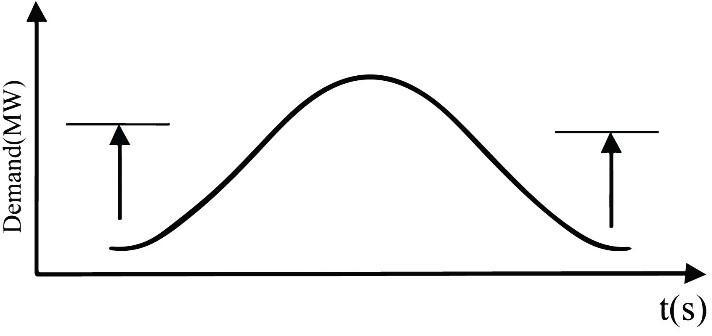
ThepeakshavingmechanismisshowninFig.6 Thenexttwo prerequisitesneedtobemetforthisoperationtobecarried outasshowninFig.7
International Research Journal of Engineering and Technology (IRJET) e-ISSN: 2395-0056
Volume: 09 Issue: 09 | Sep 2022 www.irjet.net p-ISSN: 2395-0072
BusVoltage<0.97(p.u)
SoCofEVsBatteries>50%
The bus voltages will decrease in situations with low generation and strong demand. The controller will once morechecktheSoCoftheEVbatterieswhenthevoltagedips belowthethresholdof5%ofnominalvoltage,or0.9(p.u).If thesecondconditionisconfirmed,theEVswillnowbemade toworkasasourceandwillsupplypowertothesystem.The SoC'supperandlowerlimitswon'tbeexceededinorderto protectthebattery'shealthandsafety.
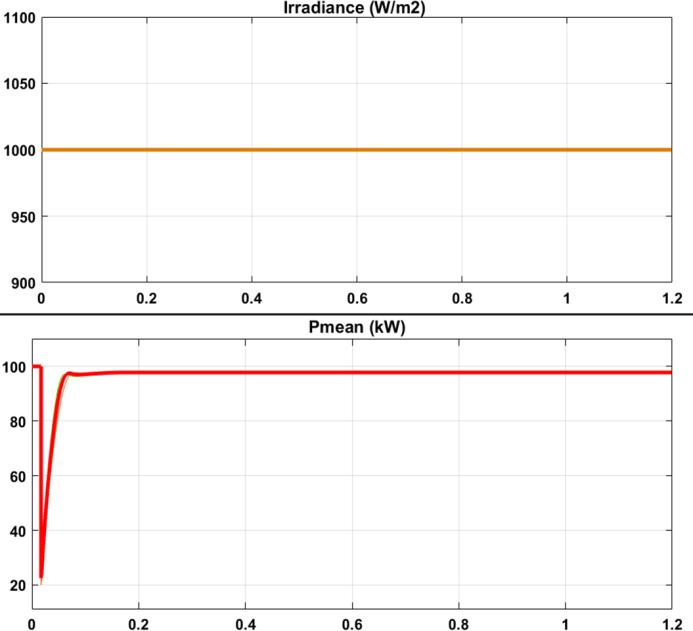
20PVpanels,eachwitha100-kWcapacity,wereemployed for the simulation. Since an average day's irradiance is between 700 and 800 Wm2, a single PV panel typically produces70to80kWofpoweratirradiancelevelsbelow 1000Wm2 .Asaresult,whenthePVpanelsareexposedto fullirradiance,thesystemmaygetoverwhelmed.AnEVis incorporatedintothesystemtosupportPVpenetrationin ordertosolvethisissue.Foursituationshavethereforebeen addressedinrelationtothelevelsofPVgenerationwithand withoutEVs.
EachPVpanelisproducingaround100kWofpowerwhen theirradiationis1000Wm2asshowninFig.8
The effect of an increasing voltage profile is particularly notable because the PV is connected to the feeder's important bus 18, which is at the feeder's end. Therefore, nearthefeederend,thebusvoltageisunabletomaintainthe permitted voltage limit shown in simulation result Fig. 9 Additionally,thesimulation findingsdemonstratethatthe system'sheadterminalbusvoltagesarelowerthanitsend busvoltagesduetothehighpowerfromthePV,whichcould leadtoissueswiththesystem'spowerflow.Insteadofbeing unidirectional, the power flow is now bidirectional. As a result, changes in the power's direction and magnitude resultinoscillationsinthesystem'ssteadystatevoltage.
International Research Journal of Engineering and Technology (IRJET) e-ISSN: 2395-0056
Volume: 09 Issue: 09 | Sep 2022 www.irjet.net p-ISSN: 2395-0072
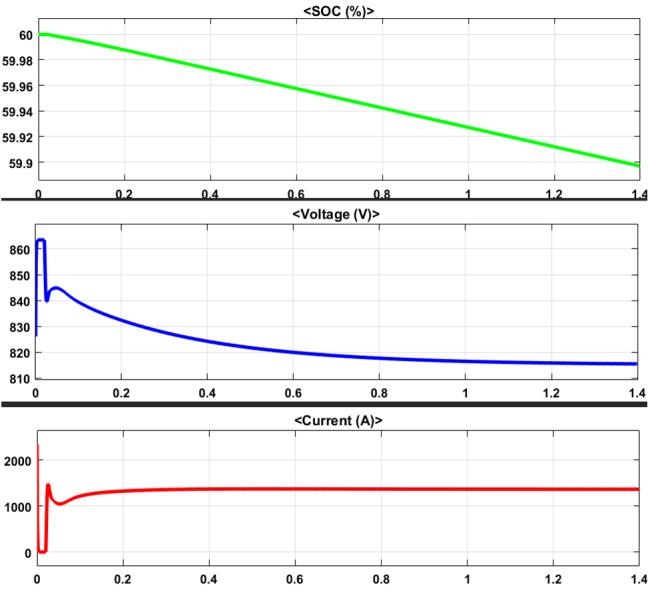
Inthisinstance,EVsareincorporatedintothesystemand used as DSM tools to fix the overvoltage issue. Due to the high-poweroutputofthePV,theEVswilloperateasaload andstoreanyexcesspowerproduced. Asaresult,theSoC and voltage of the EV batteries are gradually raised. The presence of a negative current indicates that current is enteringthebatteriesshowninFig.10
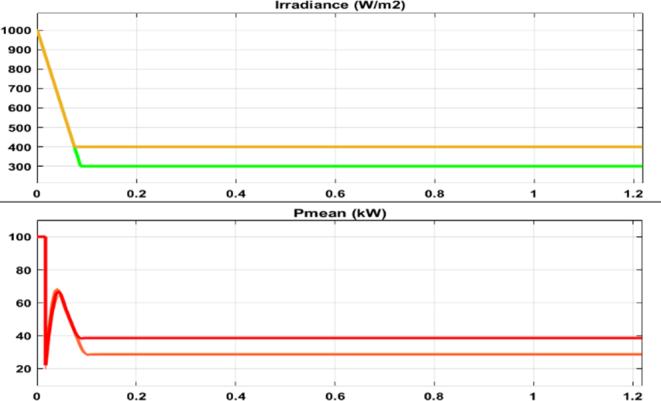
PVisintermittentandchangeablebynature,justlikeany otherrenewableenergysource,andisgreatlyinfluencedby theweather.ThePVpanels'solarirradiationissettoalow levelinthisinstancetorepresentshade.ThepowerfromPV is low because of lower solar irradiance because the PV's production is directly tied to solar irradiance shown in Fig.12
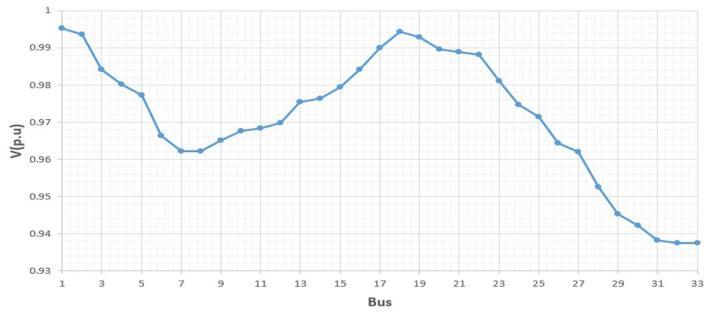
The integration of renewable power in low and mediumvoltagedistributionnetworksisencouragedbythe rising demand for electricity and some environmental restrictions.Asdiscussedearlier,theunpredictablenatureof these energy sources may cause severe problem in the system,especiallyifthereisnobackupsourceavailable.In this case the voltages of the end feeder bus drop to unacceptablelimitsduetolessgenerationfromPVshownin Fig.13.
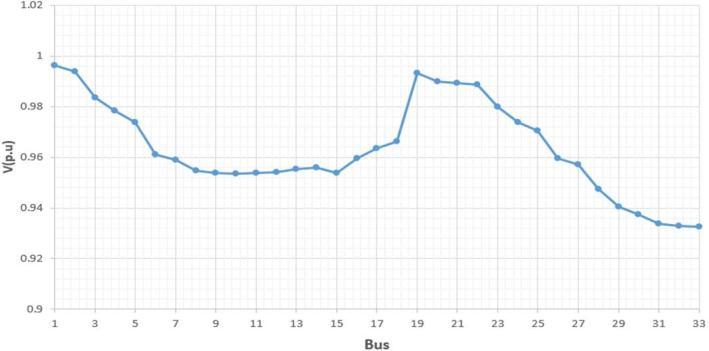
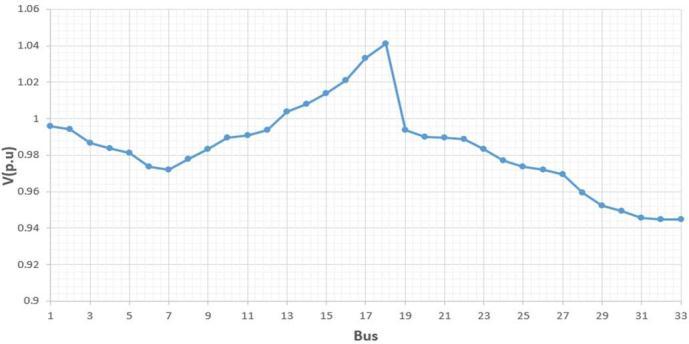
The end line bus voltage will remain within the allowable limitasaresultoftheEVs'employmentasavalleyfillingtool forDSMshowninFig.11.Thesimulationresultsdemonstrate that, in a system with a high penetration of renewable energy,EVscanplayasignificantroleinsystemstability.
2.4
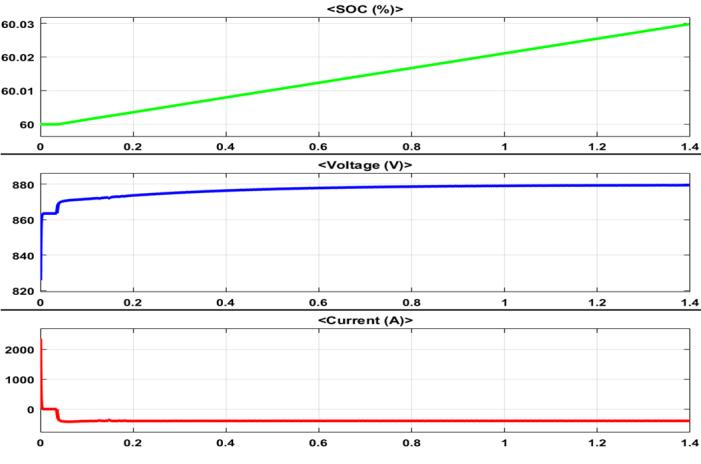
In this condition, EVs are added to the system while PV generationislowandthefeederendbusvoltagedeclinesas aresult.Inordertoreducethesevoltagestoasafelevel,the controllerisnowoperatingtheEVsasasource.WhenEVs operate as a source, the system receives an injection of
International Research Journal of Engineering and Technology (IRJET) e-ISSN: 2395-0056
Volume: 09 Issue: 09 | Sep 2022 www.irjet.net p-ISSN: 2395-0072
current,whichlowersthevoltageandSoCoftheEVbatteries showninsimulationresultsFig.14
loads. In order to support the intermittent and variable characterofPV,thisresearchsuggestshowtheycanbeused asasourceforpeakshavingandasaloadforvalleyfilling. The operation of peak shaving and valley filling control algorithms is explored. Using the valley filling control technique, the end line bus voltages exceed the allowable voltagelimitswhenthepowerfromPVincreases.Byusing EVsasasource,peakshavingcontrolisusedtoreturnthe voltagestoacceptableranges.Theendlinebusvoltages,on theotherhand,tendtodropwhenPVgenerationdeclines, whichiscounteredbyemployingEVsasasourceforpeak shaving.
[1] ByRolandIrleEV-Volumes.com.
[2] MathildeCarlierStatista.com
[3] HassanButtandSyedAliAbbasKazmi‘IntegrationofEV asSmartLoad’conf.paperNov.2018
-14:
Thecontrollerbeginsfeedingpowerfromthebatterytothe systemaftertheEVsareintegrated,actingasapeakshaving toolforDSM.Tocompensateforthevoltageloss,powerfrom theEVbatteriesisaddedtothePVpower. Asa result,the bus voltages are raised to an appropriate level shown in simulationresultsFig.15.Thehighpenetrationofrenewable energysourcesisthusmadepossiblewithouttheneedfor backup reserves, and the installation costs of renewable resourcescanbereduced,ifthenumberofEVsisraisedin thefutureanddistributedacrossthenetwork.
[4] A. Alghamdi, A. Bahaj, and Y. Wu, “Assessment of Large-Scale Photovoltaic Power Generation from Carport Canopies,” Energies,vol. 10, no. 5, p. 686, 2017.
[5] A.Y.SaberandG.K.Venayagamoorthy,“Resource schedulingunderuncertaintyinasmartgridwith renewablesandplug-invehicles,” IEEE Syst. J.,vol.6, no.1,pp.103–109,2012.
Kaleem Khan Mansoori1
ScholarM.TechPowerSystem Department of Electrical & Electronics
Shri Vaishnav Vidyapeeth Vishwavidyalaya,IndoreM.P.
Anil Kumar Jain2


AssistantProfessor Department of Electrical & Electronics
Fig -15:LowPVGeneration&BusVolagewithEV
Improvementsintheregulationofcharginganddischarging ofEVsarerequiredinordertofullyutilizethemforsystem stabilityinresponsetotheongoingexponentialincreaseof global sales and the anticipated penetration of EVs. Using V2Gtechnology,EVscanbemadetofunctionasintelligent
Shri Vaishnav Vidyapeeth Vishwavidyalaya,IndoreM.P.
2022, IRJET | Impact Factor value: 7.529 | ISO 9001:2008 Certified Journal |