International Research Journal of Engineering and Technology (IRJET) e-ISSN: 2395-0056

Volume: 09 Issue: 09 | Sep 2022 www.irjet.net p-ISSN: 2395-0072
International Research Journal of Engineering and Technology (IRJET) e-ISSN: 2395-0056
Volume: 09 Issue: 09 | Sep 2022 www.irjet.net p-ISSN: 2395-0072
Dept. Of E&I Engineering, OUTR, BBSR, Odisha, India Assistance Professor, Dept. Of E&I Engineering, OUTR, BBSR, Odisha, India Professor, Dept. Of E&I Engineering, OUTR, BBSR, Odisha, India ***
Abstract - Wirelessinformationandpowertransfersystem isanencouragingresulttoenhancelinglifeandtonereliant wirelessnetwork.ThebatterylifecapacityislimitedinIoT devices such as mobile devices as a guaranteed solution simultaneous wireless information and power transfer is introduced can transfer information and power simultaneously by capturing the powers from the radio frequencyformobiledevices.Theninthispaper,ourmain focus is to maximize the sum of the entire device to the device under a mobile network by maximizing the power and resource allocation based on a nonlinear EH scheme. Theninthispaper,ourmainfocusistomaximizethesumof the entire device to device under a mobile network by maximizingthepower and resource allocation based ona nonlinear EH scheme. Here we firstly model a clusteringbasedPSOalgorithmtodifferentiatethedevicetodevicelink inaSimultaneouswirelessinformationandpowertransfer enableenergyharvestgroupandnonenergyharvestgrope whichcan’tsatisfytheenergyharvestcircuitsensitiveand use two layer energy efficiency iterative algorithm which willmaximizethedevicetodevicepowertransmissionand thePSpowersplittingratiotooptimizetheenergyefficiency of all the Simultaneous wireless information and power transferenableddevicetodevicelinksandcellularuserlink. Thetwo-layerenergyefficiencyiterativealgorithmhastwo typeoneisinnerloopiterativealgorithmwherewecovert theconvex maximization problem foroptimizingthetotal energyharvestpowerandotheroneisouterloopiterative algorithmonthisalgorithmwelistoutthepreferenceforthe devicetodevicelinkandcellularlink.Thenweusedoneto one constraint stable matching algorithm to optimize the sum of all Energy efficiency of the Simultaneous wireless information and power transfer to enable the device to device link by maximizing the spectrum resource sharing betweenalldevicetodevicelinksandcellularlinks.Byusing an iterative power control algorithm and one to one matching algorithm, the non energy harvest sum rate can increase. The simulation result shows that our proposed algorithm gives much high energy efficiency than the existingone.
Key Words: MATLAB,D2D,Energyeffectiveness,Matching proposition,Powercontrol,Resourceallocation,Underlay, simultaneouswirelessinformationandpowertransfer.
With the rapid growth of device to device communication system,nowadayourrequirementistoincreasethedata rate.Theremanytechniquearethere,likewifi,Zigbeewhich are support IoT[5]. And most of them are worked in unlicensed band that means we cannot promise on the qualityofservice.oneoftheadvantageincellularnetworkis itgivesdirectcommunicationwitheachotherwithouthelp of BS[8]byreusetheresourceallocationofcellularnetwork whichimprovetheenergyefficiencyof network.Butthere willbeimproveselfinterferenceduringdatatransmission and reception between the cellular user and the device to device user, which we have to minimize by using correct resourceallocationmode.InthispaperwedevelopRF-EG (radio frequency-energy harvest) where the receiver harvests the energy from the radio frequency signal [7] Simultaneousinformationandpowertransmissionisoneof the best technique which can harvest energy and also transfer the information to the receiver. Energy harvest techniqueisdividedintotwotypesthatarepowersplitting modeandtimeswitchingmode [3].SWIPTcanoperate in shorter distance because it is depends upon the received power and throughput to activate the energy harvest technique. There has been many work have assumed a simple linear energy harvest model, where the harvested energybythereceiverislinearproportionaltothereceive power, but due to some non linear element like diode, capacitor, inductors in practice energy cannot harvest linearly.
In this paper our main focus is to optimize the energy efficiencyofalldevicetodeviceunderlaidcellularnetwork
D2D communication is the encouraging technology in 5G network [4].5G comes a lots of devices which generating dataanditisdifficulttomanagingthedataatasingleBS.In device to device communication two user communicate directlywithouthelpofbasestation[8 ].Communication technologyprovidesD2Dforthe5Gtocommunicatedevices witheachotherwithoutsharingtheinfrastructureorpartial sharing thereof. There are common technologies for D2D available for wireless transmission for example Bluetooth
International Research Journal of Engineering and Technology (IRJET) e-ISSN: 2395-0056
Volume: 09 Issue: 09 | Sep 2022 www.irjet.net p-ISSN: 2395-0072
and Wi-Fi Direct, but they are short-range and therefore mosttechnologiescannotdirectlycommunicatebetweenthe twodevicestoachievetheperceivedconnectionof5G.There must be a change in the basic structure of the existing networks.
Moderncellularnetworkismainlydividedintotwo types,firstoniscalledMicrocell tier,Devicetier.Thecell layercontainsalargenumberofbasestation(BS)attached to the device as it is known in conventional cell systems. WhilethedevicelayercontainsD2Dconnections.ifoneof the device is connected to another device through base station then it is operating is micro cell mode. And if one deviceisconnectedto other device without BSordirectly thenitisindevicemode.
Itextensionofwirelesspowertransfer(WPT),knownfrom contactless smart phone charging. Beside wireless power transferinSWIPTdatacantransmitsimultaneouslyviathe samemagneticorelectricfield[6],wherereceiverharvest energyandprocesstheinformationsimultaneously.SWIPT givesspectrumefficiencytothesystemassamebandwidth is used for power and information transfer. In wireless communicationinterferenceisamajorissuewhichwehave to address and reduce. In cooperative communication, for relayinformationrelaynodeneedsenergy,soEHisoneof thetechniqueoftheenergyproblemattherelaynode[10]. Hencefirstharvestenergybyrelaynodeandthenusethis harvest energy for relaying purpose. Wireless communicationwithSWIPT,batterthequalityofserviceof thesystembygivingEE andspectrumefficiency,cancelling nearfareffect,increasingthecoverageareaandimproving channelcapacity.
There are two protocols in SWIPT based wireless communicationandthesesprotocolsdefinedhowrelaynode harvestenergyandprocessinformationsimultaneously.
First,wesettheenergyharvestsensitivity(minimum energyrequiredforactivatingtheenergyharvesttechnique) [9].WeproposeaClusteringbasedPSOalgorithmtoverify the device-to-device link can operate in SWIPT enable EH technique where circuit sensitivity and depth required throughputbuildonPSOalgorithm.Weusedtheconstraint matchalgorithmtooptimizethesumofallEnergyefficiency of the SWIPT to enable the D2D link by maximizing the spectrum resource sharing between all D2D link and CUE links.Inthe matchingalgorithm,thepartnermatchinglink listforCEUusersandtheD2Duseriscreated basedonthe solution of per device-to-device link energy efficiency
optimizationproblem,whichwillmaximizethetransmission poweroftheD2DlinkandPSrateaccordingtothepiecewise linearenergyharvestmodel.
By the power control, iterative algorithm, and matching algorithm,the energy efficiencyofthenon energyharvest modelcanbemaximized.
Input: Output: Initialize: 3. do 4. k do 5. Obtain ,obtain 6. or 7. 8. 9. 10. 11. 12. 13. , 14. 15.












Inpre matchingalgorithm wedivide device todevicelink into two part, one is part is for SWIPT enabled device to device link which harvest the energy (activate energyharvestcircuitsensitivity)andanothergroup is for non EH D2D link. Were we have taken a partner selection set for each D2D link and we initialize as Whencellularuserk'sreusingresourceblock(smallestunit ofresourceassignedtoasingleuser)andsendingmaximum power D2D link cannot fulfill the energy harvest circuit sensitivity or the device to device throughput requirement, the cellular user is deleted from the partner selectionset [1].
Initialize:


Initialize: position X
Initialize: velocity V
International Research Journal of Engineering and Technology (IRJET) e-ISSN: 2395-0056
Volume: 09 Issue: 09 | Sep 2022 www.irjet.net p-ISSN: 2395-0072
6. 7. 8. TheenergyefficiencyofSWIPTenabledthedevicetodevise alinkthisalgorithmconsiststhree-steptomaximizetheEE. Thefirststepistomaximizethenumberofsegmentsthat belongs to, which denoted by . We solve the maximization problem in by solving P3 and we found maximum power allocation and resource allocation and determine the correspondingenergyefficiency.
Require:
PSOisapossibleoptimizationapproachthatisbasedona population known as the swarm [2] that is made up of particlesthatgoingtogetherinsuchasearchspacetofind themaximumsolution.Eachparticleholdstheobjectstobe optimized,anditspositionismodifiedbetweeniterationsto get the best local and global positions. The global best position is where a particle has achieved the population's highestreturns,whereasthelocalbestpositioniswherethe particle has achieved its own highest thus far. The power splittingratiowasdesignedtobeafixednumberin[3]anda restricted value in obviating the possibility of tuning it to improvetheenergyefficiency ofaSWIPT-enableddevice.As aresult,itisnotoptimizedforincreasingtheEEofaSWIPTenabled D2D under laid network. Our major goal in this method is to divide into two groups. One is for energy harvesting,whiletheotherisfornon-energyharvesting.This method'smainpurposeistosplitintotwogroups.Thefirst isforenergyharvesting,andthesecondisfornon-energy harvesting.














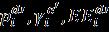









InAlgorithm3,weuseaninnerloopiterativestrategytofind theoptimalvalueof , ,and onthejthsegmentof thelinearpiecewiseenergyharvest model,foreachSWIPT-




International Research Journal of Engineering and Technology (IRJET) e-ISSN: 2395-0056
Volume: 09 Issue: 09 | Sep 2022 www.irjet.net p-ISSN: 2395-0072

enabled device to device link t signifies the number of iterationstepsinAlgorithm3,while representthehighest numberof iterationsallowed.Theiterationstopswhenthe value of the acquired EE is smaller than the value of the obtainedenergyefficiencyintheprecedingstep,ψorwhen isreached.






Input: Output: Initialize: 1.While do 2. do 3. do 4. a cellular user received only a one request by device to device links and current has not even onepartner then cellularuserandD2Dlinkare matched 5. 6.end if 7. cellular receiver gets another request by D2D link 8.then cellularuserwillcheck 9. devicetodeviceconnection or isnolonger preferred 10. Then Cellularuser will thenmatchwithD2D link or 11. Thecomplementdevice-to-deviceconnectionis removedfrom andthemismatcheddevice todevicelinkgetsgroupedinto 12. 13. OtherchoicesexistforbothD2Dconnections. 14. then Cellularuserkwillsupplementwithmuch more preferred options. Device-to-device communicationbasedon k,thematchingD2D connection is deleted from and the mismatched device-to-device link is grouped into 15. 16. 17. 18.
InthisalgorithmusedthatthealltheSWIPTenableD2Dlink havetofindtherepartner.FirsttheentireD2Dlinkwillstart proposing to the entire cellular user for matching. If the cellularuseronlygetsonerequestfromthedevicetodevice link andpresentlyhavenoactivepartner,thencellularuser andD2Duser arematched.Ifcellularusergetsadifferent requestfromdevicetodevicelink thencellularuser will analysis the maximum preference between and . If D2Dlink or ,hasnolongermatchingthencellularuser wouldconnectwithaD2Dlink,thematcheddevicetodevice link and willbedeletedfromthelistandthelinkwhichis unmatchedwilladdedtothe Ifbothdevicetodevice linkhavemorepreferencematchingthencellularuser will connectwiththemostfavoreddevice-to-devicelinkbased on the highest preferred then the matched device to device link will delete from and the link which is unique will added to the In each loop, a device to device link will delete from If cellular network matchedwithD2Dlinkthenitwillremovefrom All device to device links remove from their most preferred cellularuserfromthechoicelistattheendofeachloop.In thefollowingloop,allunmatchedcellularusersaregathered in
Simulationparameters Values
CellradiusR 300m
NumberofD2DlinksN 10to20

NumberofCUEsM 10to60
Device to device communication distance ranger
10to60
Pathlossexponent 3
Receiverpower [ , ] [10,56368,240.07,200]uw
Coefficient[ ] [0,0.3899,06967,0.1427]
Intercept[ ] [0, -1.6613,19.1737,108.2778]


Maximum harvestable power 250uw
Max transmission power foeanyuser 24dBm
International Research Journal of Engineering and Technology (IRJET) e-ISSN: 2395-0056
Volume: 09 Issue: 09 | Sep 2022 www.irjet.net p-ISSN: 2395-0072
Cellular transmission power 24dBm
Noisepower -100dBm
Circuit power consumption 20dBm
Throughput requirement forD2Dlink 2bit/s/Hz
Throughput requirement forcellularlink 1bit/s/Hz
Simulation Result
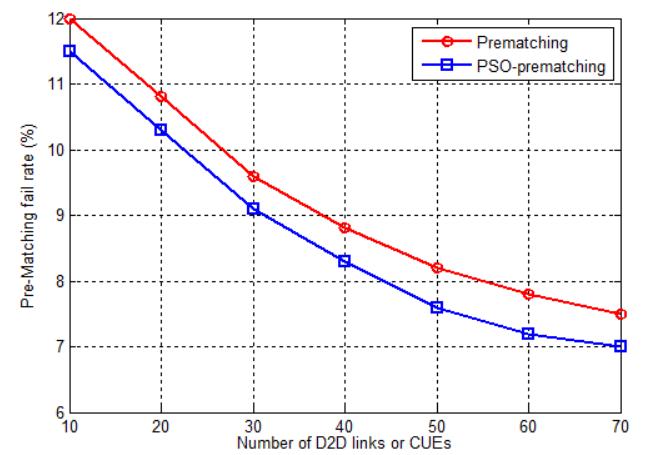
Fig-2:PMFRversusthedistanceofD2Dlinkorcellular user

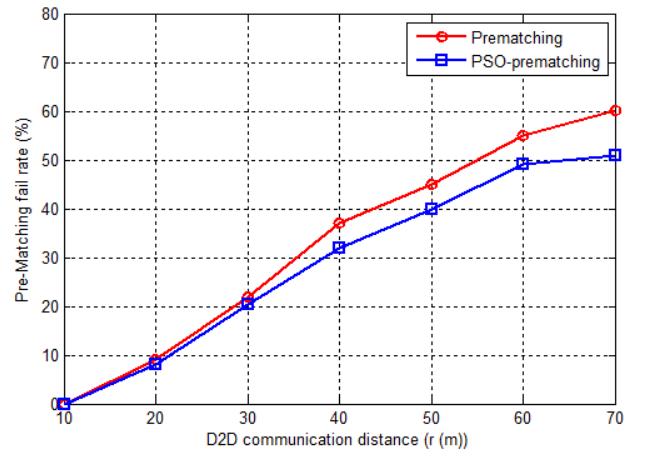


Fig-1:PMFRvs thenumberofD2Dlinksorcellularusers basedonprematchingfailrateandnumberofD2Dlinksor cellularusers.

Thepowersplitting(PS)ratiowasconsideredtobealimited valuein[1]andafixedvalueinlosingoutonthepossibility toadjustitforincreasingtheenergyefficiencyofaSWIPTenabled device to device underlay system. By using PSO algorithm the pre-matching fail rate is reduce to 11.5% (whileinprematchingalgorithmthePMFRis12%)when thenumberofD2Dorcellularuserincreasesfrom10to70.
Fig2showsprematchingfailurerateincreasesfrom1%to 52%withlargedevice-to-devicecommunicationdistances rangingfrom10to70m.Whenthedistanceofthedeviceto device communicationimproves,the device todevicelink needs to increase the transmission power to get energy harvestconstraints,aftertherequiredtransmissionexceeds maximum power then, the device-to-device link cannot performSWIPTwhichwillincreasethenonenergyharvest device-to-devicelink,andwegethigherprematchingrate. InthePSOalgorithm,thepercentageofprematchingfailrate getsdecreaseswhileincreasingthenumberofD2Duser,as comparedtoprematchingalgorithm.Inprematchingthereis a restriction to select the energy harvest group and non energy harvest but in the PSO algorithm, we set all the receivesignalstoabitstreamthatisonly0and1,forthat we have taken an objective function. PSO will take informationaccordingtothebitstreamifthebitstreamis greaterthan0.5thenitwillberemovedfromtheselection matchinggroup andgroupedasanonharvestD2Dlink elseitwillharvesttheenergydenotedas
International Research Journal of Engineering and Technology (IRJET) e-ISSN: 2395-0056
Volume: 09 Issue: 09 | Sep 2022 www.irjet.net p-ISSN: 2395-0072
WeoptimizedthetotalEEoftheentiredevicetodevicelink inthispaperthroughmaximizingtheassignmentofavailable spectrumandtransmissionpowerinSWIPTenableddevice to device links. We propose the PSO algorithm device to deviceconnectionintoSWIPTenabledEHbandandnon-EH band.ForoptimizingthesumenergyefficiencyofallSWIPT device-to-devicelinksweusestablematchingalgorithm.The sumenergy efficiencyofthe non-energyharvestdeviceto device link is maximized. The PSO algorithm reduces the prematchingfailrate.Thisimprovestheenergyefficiencyof devicetodeviceconnections.
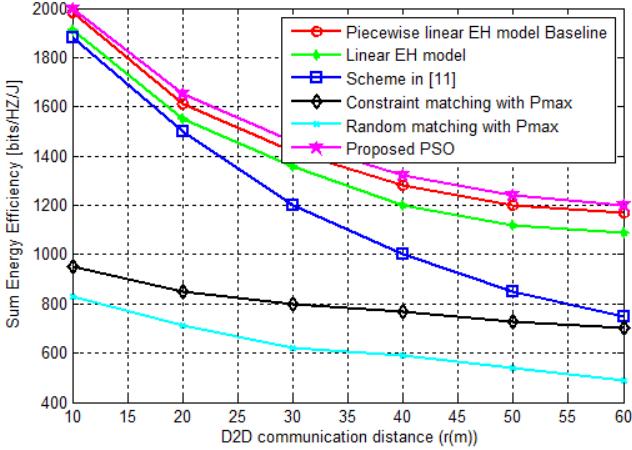
Fig-3:Sumenergyefficiencyversusdistanceofdeviceto devicelinkorCellularusersusingPSOalgorithm
Fig3showsthesumenergyefficiencyversusdistanceofthe D2D communication, in the paper, our main motive is to maximize the sum rate, we use a PSO-based algorithm instead ofpre matchingalgorithmandweanalyzethat by usingthePSOalgorithmthe sumenergyisincreasedwith increasingdistance
[1] H.Yang,Y.Ye,X.ChuandM.Dong,"ResourceandPower Allocation in SWIPT-Enabled Device-to-Device Communications Based on a Nonlinear Energy Harvesting Model," in IEEE Internet of Things Journal, vol. 7, no. 11, pp. 10813-10825, Nov. 2020, doi: 10.1109/JIOT.2020.2988512.
[2] García,CarlaE.,MarioR.Camana,andInsooKoo."LowComplexityPSO-BasedResourceAllocationSchemefor Cooperative Non-Linear SWIPT-Enabled NOMA." IEEE Access 10(2022):34207-34220.
[3] Perera,T.D.P.,&Jayakody,D.N.K.(2018).Analysisof time-switching and power-splitting protocols in wireless-powered cooperative communication system.PhysicalCommunication,31,141-151.
[4] Amanuel, S. V. A., & Ameen, S. Y. A. (2021). Device-todevicecommunicationfor5Gsecurity:areview. Journal ofInformationTechnologyandInformatics, 1(1),26-31.
[5] R.Q.HuandY.Qian,"Anenergyefficientandspectrum efficientwirelessheterogeneousnetworkframeworkfor 5Gsystems,"in IEEECommunicationsMagazine,vol.52, no. 5, pp. 94-101, May 2014, doi: 10.1109/MCOM.2014.6815898.
[6] Garg, P. (2022). A Survey on Energy Harvested CooperativeCommunicationsystem.
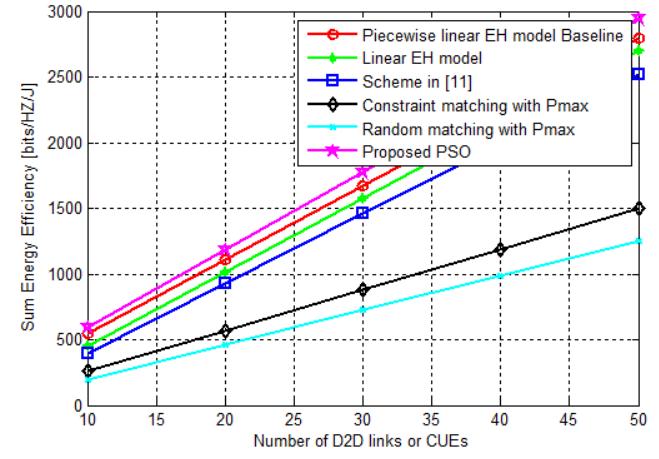
Fig-4:SumenergyefficiencyversusthenumberofD2D linkorCellularusersusingPSOalgorithm
Fig4showsthesumenergyefficiencyversusdistanceofthe D2Dcommunication.Hereweanalyzethat,byusingthePSO algorithm the sum energy is increased with increasing of numberofD2Dlinkorcellularlink.
[7] Z.Zhou,C.Gao,C.Xu,T.Chen,D.ZhangandS.Mumtaz, "Energy-Efficient Stable Matching for Resource AllocationinEnergyHarvesting-BasedDevice-to-Device Communications," inIEEE Access, vol. 5, pp. 1518415196,2017,doi:10.1109/ACCESS.2017.2678508.
[8] J.Iqbal,M.A.Iqbal,A.Ahmad,M.Khan,A.QamarandK. Han,"ComparisonofSpectralEfficiencyTechniquesin Device-to-Device Communication for 5G," inIEEE
International Research Journal of Engineering and Technology (IRJET) e-ISSN: 2395-0056
Access, vol. 7, pp. 57440-57449, 2019, doi: 10.1109/ACCESS.2019.2914486.
[9] Boshkovska, E., Morsi, R., Ng, D. W. K., & Schober, R. (2016,May).PowerallocationandschedulingforSWIPT systems with non-linear energy harvesting model. In 2016 IEEE International Conference on Communications(ICC) (pp.1-6).IEEE.
[10] T. D. Ponnimbaduge Perera, D. N. K. Jayakody, S. K. Sharma,S.ChatzinotasandJ.Li,"SimultaneousWireless Information and Power Transfer (SWIPT): Recent Advances and Future Challenges," inIEEE CommunicationsSurveys&Tutorials,vol.20,no.1,pp. 264-302, Firstquarter 2018, doi: 10.1109/COMST.2017.2783901.
Volume: 09 Issue: 09 | Sep 2022 www.irjet.net p-ISSN: 2395-0072 © 2022, IRJET | Impact Factor value: 7.529 | ISO 9001:2008 Certified Journal | Page643