International Research Journal of Engineering and Technology (IRJET) e-ISSN: 2395-0056

Volume: 09 Issue: 08 | Aug 2022 www.irjet.net p-ISSN: 2395-0072
International Research Journal of Engineering and Technology (IRJET) e-ISSN: 2395-0056
Volume: 09 Issue: 08 | Aug 2022 www.irjet.net p-ISSN: 2395-0072
1B.Tech Student, Department of Civil Engineering, Toms College Of Engineering, Kerala, India
2B.Tech Student, Department of Civil Engineering, Toms College Of Engineering, Kerala, India
3Assistant Professor, Department of Civil Engineering, Toms College Of Engineering, Kerala, India ***
Abstract - In India, a major portion of total land area is covered by clayey soil and is of expansive soil. Soil Stabilization is one of the promising techniques used to improve the geotechnical properties of soil and has become major practice in construction engineering. This project aims to conduct a study to check the improvements in properties of expansive soil by adding glass fiber and epoxy resin. By varying percentage of resin and fiber the soil parameters such as liquid limit, plastic limit, maximum dry density and CBR may be studied. Finally it can be said that stabilization of expansive soil using fiber and resin is an effective method.
Key Words: Soilstabilization,Epoxyresin,glassfiber, MaximumDryDensity,Reinforcement.
Engineering properties of soils play vital role in civil engineering construction works in road work, foundations, embankments and dams, to mention but a few. In such situations the practice is to modify the soil properties by blending with different foreign materials, anditisgenerallyknownasSoilStabilization.Therefore,it is imperative to carry out tests on soil upon which foundation or superstructure is to be erected, prior to construction. Invariably, the outcome will determine soil suitability as construction material. Marginal and weak soils, including soft clays, black cotton soil, organic deposits, and loose sand, are often unsuitable for constructionduetotheirpoorengineeringproperties.
Expansive soil experiences volume change due to alteration in moisture content. In monsoon seasons, soils absorb water, swells, become soft and capacity to bear water is reduced. In drier seasons, these soils shrink or reduce in volume due to evaporation of water and they become harder. Due to its peculiar characteristic of high plasticity, excessive swelling, shrinkage and low strength whenwet,thesoilisregardedunsuitableforconstruction. Kumarakom soils are soft highly organic clay or silt deposits with higher compressibility and lower strength characteristicsfound inKottayamdistrict inKerala, India.
Here we study the effect of glass fiber and Epoxy resin inclusion on Engineering properties of clayey soil. The mixing of randomly oriented glass fiber and Epoxy to soil samplemaybeconsideredsameasotheradmixturesused
to stabilize soil. Glass fiber is one such fiber having a durable, inert nature possessing high tensile and compressive strength. It is extremely strong and robust material. Glass fibers are among the most versatile industrial materials known today. Epoxy is now used globally as a construction material. The aim of the research was to ascertain glass fiber and Epoxy performance as a stabilizer by measuring its effects on expansivesoilanddetermineappropriatequantitiesofthe glass fiber and Epoxy required for adequate stabilization oftheexpansivesoil.
Mohamed Ezzat Al-Atroush [2021] This paper introduced a novel application of the closed- cell, onecomponent epoxy resin (HPUF) to be used as a swelling soil stabilizer. Based on the results of the experimental study it was concluded that HPUF could competently reduce both the swelling potential and the shrinkage cracking of the reactive expansive soil, even after several wet-shrinkcycles.
Ahmed S. Abdulrasoo [2021] This paper has presented analternativenovelmaterialforimprovingthecollapsible soilbehavior.Accordingtotheobtainedresults,fillingthe collapsible soil’s pores with PF resin improves its behaviourundersaturationandloading.Theresultsofthe direct shear tests indicate that the PF liquid affects the shear strength parameters of the gypseous soil by increasingtheapparent cohesionandtheangleofinternal frictionrelativelydecreased.
E. R. Sujatha [2020] Glass fiber reinforcement has beneficially modified the geotechnical properties of the soil, particularly its UCS and CBR values that reflects its suitability for use as subgrade reinforcement. The type of glass fiber and the glass fiber content, both influence the properties of the reinforced soil. The liquid limit of the reinforced soil increased by 16% in case of ARGFRS ( Alkali Resistant Glass Fiber Reinforced Subgrade) and 26.3%forE-GFRS(E-GlassFiberReinforcedSubgrade)at the maximum investigated percentage of fiber addition (i.e) 1%. UCS of the soil improved by 60% and 48% for ARGFRS and E-GFRS respectively at a fiber content of 0.75%. CBR value of glass fiber reinforced soil increased bynearly52%at0.2%ARglassfiberadditionand48%at 0.5%Eglassfiberaddition.
International Research Journal of Engineering and Technology (IRJET) e-ISSN: 2395-0056
Volume: 09 Issue: 08 | Aug 2022 www.irjet.net p-ISSN: 2395-0072
Samer Rabab’ah [2020] Thedataandresultsobtainedin thisresearchworkshowthattheadditionofGlassfiberto expansive soil has a considerable effect on their UCS (Unconfined Compressive Strength), indirect tensile strength, and free swell. This increase in the strength of the soil and the reduction in the swelling tendency was proportionallydependentonthepercentofusedfiber..By improving the strength and stiffness of subgrade soil, the useofglassfiberinexpansivesubgradereinforcementcan result in a significant reduction in the design thickness of pavement.
Gbenga Matthew Ayininuola [2018] The study revealed thatadditionofglassfiberintothetwolateriticsoilsledto increaseinsoil California bearing ratioandmaximum dry density. Performance of Glass Fiber as a stabilizer was evaluated by measuring its effect on soil through a comparison of the properties of the soil with and without theadditionoftheglassfiber.TheCBRvalueofsoilsample AJwithouttheadditionofglassfiberwas51.0%.Theglass fibershadoptimumeffect onthesoilsbetween1.2%and 1.6% of soil samples. When optimum value of glass fiber was exceeded, the excess formed spongy spot in the soil matricesthat constitutedaweakportion.
Above literature reviews indicate that the addition of various percentage of glass fiber and epoxy resin increasingthestrengthofthesoil.Howeverthecombined effectofbothepoxyresinandglassfiberonthesoilsample was not explored in any of the literatures. So our present study is to find a working ratio for both the epoxy resin and glass fiber for our soil sample, with the aim of improvingsoilcharacteristics.
Soil is collected from Kumarakom, Kerala ,India. KumarakomispartofKottayam,(10km).Thecomposition of Kumarakom clay reveals a unique combination of various minerals with considerable organic content. The annual normal rainfall over Kumarakom region is 1100 mm. Itisidentifiedasclayeysoil.Thetopsoilwasremoved manuallytoadepthofabout1.5mbeforesubsoilsamples werecollected.Thesubsoilsamplesisthenair-dried,stock piled separately andcovered with polythenematerialsto prevent moisture ingression. Properties of clay samples aregiveninTable:1
Glass fiber are manufactured in various compositions by changing the amount of raw materials like sand for silica, clayforalumina,calcitefor calciumoxide,andcolemanite for boron oxide. Glass fiber is made by blending raw
materials,meltingtheminathree-stagefurnaceextruding the molten glass through a bushing in the bottom of the forehearth, cooling the filaments with water and then applying a chemical size. The filaments then are gathered andwoundintoapackage.PropertiesaregiveninTable:2.
Epoxyresinsareliquidcompoundthat whencured,forms a hard,composite material. Itisstrongadhesive with high compatibility with other materials. It is resistant to heat and doesn’t react withother chemicals. Araldite LY 556 epoxyandAradurHY951hardnerwereused.AralditeLY 556is medium viscosity, unmodified liquid epoxy resin based on Bisphenol-A, Aradur HY 951 is a low viscosity, unmodified, aliphatic polyamine. Properties are given in Table:3.
Table -1: Propertiesofcollectedclaysample.
Properties Values
Specificgravity 2.3
Percentageofclay 52 Percentageofsand 38 Percentageofsilt 10 Liquidlimit 64% Plasticlimit 47% Shrinkagelimit 6% Plasticityindex 17% Toughnessindex 11% Maximumdrydensity 1.45g/cc Optimummoisturecontent 30% CaliforniaBearingRatio 2.01%
Table -2: Propertiesofcollectedglassfiber
Fiber Properties Size 12mm Toxiccontent Nil
Strength&stiffness High Brittleness Less Material Alkaliresistant Shape Straight Chemicalresistance High
International Research Journal of Engineering and Technology (IRJET) e-ISSN: 2395-0056
Volume: 09 Issue: 08 | Aug 2022 www.irjet.net p-ISSN: 2395-0072
Adhesionproperty Good
Compressivestrength High
Compatibility High
Tensilestrength High
Corrosionresistance High
Heatresistance High Shrinkage Low
Standard Proctor test was performed to determine the moisture content-dry unit weight relationship according to ASTM D- 698-91. In the proctor test, the soil was compactedinthemoldthathasavolumeof944cm3.The diameter of the mold is 101.6 mm. The soil was mixed with varying amounts of water and then compacted in three equal layers by a hammer that delivers 25 blows to each layer using an automatic dynamic compacter with a hammer is dropping from a height that produce a compactive effort. The compaction test has been performed on soils with different fiber contents (0.5,0.6,0.7,0.8 %), resin contents(0.5,0.6,0.7,0.8 %), both fiberandresin(0.6%)ofdrymass.
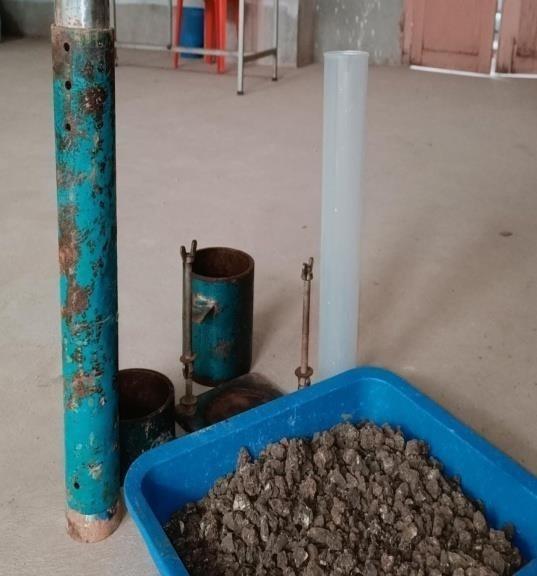
soil. It is measured by the pressure required to penetrate asoilsamplewithaplungerofstandardareawhichisthen divided by the pressure required to achieve an equal amount of penetration on a standard crushed rock material. For the test, mix proportions used for the compaction test were used again, dry soil was mixed thoroughly with calculated quantity of water to obtain moist soil as per the required moisture percentage obtained from the compaction test. The soil was compacted in a CBR moulds, each in 3layers and of 56 blows at each layer using the standard rammer. The top surface was scraped and levelled after compacting the third layer. The loading was applied at the rate of 1.25 mm/min. 0.5, 1.0, 1.5, 2.0, 2.5, 3.0, 4.0, 5.0, 7.5, 10.0 and 12.5. The CBR test has been performed on soils with different fiber contents (0.5,0.6,0.7,0.8 %), resin contents(0.5,0.6,0.7,0.8 %), both fiber and resin (0.6%) of drymass.
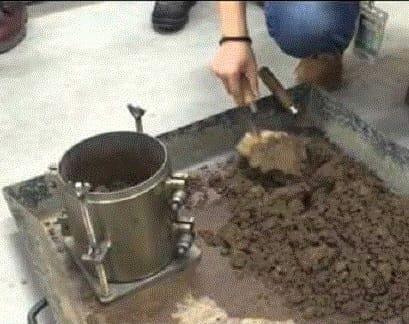
Fig -2:CBRapparatus
The CBR is a measure of resistance of a material to penetration of standard plunger under controlled density and moisture conditions. The test is performed on a disturbedsoilorundisturbedsoilofsoakedandunsoaked
48
International Research Journal of Engineering and Technology (IRJET) e-ISSN: 2395-0056
Volume: 09 Issue: 08 | Aug 2022 www.irjet.net p-ISSN: 2395-0072
Chart -1:Variationofliquidlimitvaluebyaddingvarying percentageoffiber
Limit
Plastic Limit x-axis
Chart -2:Variationofplasticlimit valuebyaddingvarying percentageoffiber
Table -5: Drydensityofclaywithfiber
Percentage of fiber (%) Dry density (g/cc) 0.5 1.66 0.6 1.67 0.7 1.66 0.8 1.64
1.67
1.66
1.65
1.64
1.63
1.68 0.5 0.6 0.7 0.8
1.62
Chart -3:Variationofdrydensityvaluebyaddingvarying percentageoffiber
5.1.3 CBR VALUE
Table-6: CBRvalueofclaywithfiber
Percentage of fiber (%) CBR value (%) 0.5 4.8 0.6 5.9 0.7 5.6 0.8 5.2
Dry Density x-axis 0 1 2 3 4 5 6 7 0.5 0.6 0.7 0.8
CBR VALUE x-axis
Chart -4:VariationofCBRvaluebyaddingvarying percentageoffiber
International Research Journal of Engineering and Technology (IRJET) e-ISSN: 2395-0056
Volume: 09 Issue: 08 | Aug 2022 www.irjet.net p-ISSN: 2395-0072
5.2.1 ATTERBERG’S LIMITS
Table -6: Atterberg’slimitsofclaywithresin
Percentage of fiber (%) Liquid limit (%) Plastic limit (%) 0.5 58 45 0.6 63 49 0.7 54 47 0.8 50 45
0 10 20 30 40 50 60 70 0.5 0.6 0.7 0.8
limit
5.2.2
Table -7: Drydensityvalueofclaywithresin
Percentage of resin (%) Dry density (g/cc) 0.5 1.609 0.6 1.64 0.7 1.44 0.8 1.367
1.2 1.25 1.3 1.35 1.4 1.45 1.5 1.55 1.6 1.65 1.7 0.5 0.6 0.7 0.8
Dry density x-axis
Chart -5:Variationofliquidlimitvaluebyaddingvarying percentageofresin
limit
Plastic limit x-axis
Chart -6:Variationofplasticlimitvaluebyaddingvarying percentageofresin
Chart -7:Variationofdrydensityvaluebyaddingvarying percentageofresin
5.2.3 CBR VALUE
Table -8: CBRvalueofclaywithresin
Percentage of resin (%) CBR value (%) 0.5 5.1 0.6 6.2 0.7 5.8 0.8 5.2
International Research Journal of Engineering and Technology (IRJET) e-ISSN: 2395-0056
Volume: 09 Issue: 08 | Aug 2022 www.irjet.net p-ISSN: 2395-0072
Chart -8:VariationofCBRvaluebyaddingvarying percentageofresin
Sincetheoptimumratioofbothglassfiberandepoxyresin was found to be 0.6% for the clay sample, so here used thatratioand the result given in the Table-7.
Table -7: Propertiesofclaywith0.6%bothfiberandresin
1. Al-Atroush, M.E.; Sebaey, T.A. Stabilization of expansive soil using hydrophobic epoxy resin: A review.Transp.Geotech.(2021)
2. Kumar,andA.K.Singh,“Stabilizationofsoilusing cement kiln dust,” International Journal of Innovative Research in Science, Engineering and Technology, (2020)
3. A.A.Al-Rawas,R.Taha,J.D.Nelson,T.B.Al-Shab,H. Al-Siyabi, A comparative evaluation of various additives used in the stabilization of expansive soils,Geotech.Test.J. 25(2019)
4. Baruah,H.(2015).Effectofglassfiberonredsoil. International Journal of Advanced Technology in EngineeringandScience, (2018)
5. Ikizler, S.B.; Aytekin, M.; Nas, E. Laboratory study of expanded polystyrene (EPS) georesin used withexpansivesoils. Geotext. Geomembr. (2018)
6. M. Mirzababaei, A. Arulrajah, S. Horpibulsuk, A. Soltani, N. Khayat, Stabilization of softclay using short fibers and poly vinyl alcohol, Geotext. Geomembr.46(2017)
7. N.C. Consoli, M. Bellaver Corte, L. Festugato, Key parameterfortensileandcompressivestrengthof fiber-reinforcedsoil–limemixtures, Geosynth. Int. 19(2015)
8. N.C.Consoli,P.D.M. Prietto, L.A.Ulbrich,Influence offiberandcementadditiononbehaviorof sandy soil,J.Geotech. Geoenviron. Eng.124(2012)
Thisstudyresultsthattheeffectofaddingepoxyresinand glass fiber on behavior of clayey soil. Based on result presented in this paper the following conclusions are drawn:
Liquidlimitofclayeysoilincreaseswithresinand fiber(0.6%).
9. N.C.Consoli,J.P.Montardo,M.Donato,P.D.Prietto, Effect of material properties on the behavior of sand cement fiber composites, Proc. Inst. Civ. Eng.-Gr.Improv.8(2012)
10. Reddy, N.G.; Tahasildar, J.; Rao, B.H. Evaluating the influence of additives on swelling characteristics of expansive soils. Int. J.Geosynth. GroundEng.(2008)
Plasticlimitofclayeysoilincreaseswithresinand fibercontent(0.6%).
Maximumdrydensityofclayeysoilwithresinand fibercontent(0.6%).
California bearing ratio values with resin and fibercontent(0.6%).
Factor value: 7.529 | ISO 9001:2008 Certified Journal |