Cloud Computing Task Scheduling Algorithm Based on Modified Genetic Algorithm

Page 1

International Research Journal of Engineering and Technology (IRJET)

e-ISSN: 2395-0056

Volume: 09 Issue: 08 | Aug 2022

p-ISSN: 2395-0072

www.irjet.net

Cloud Computing Task Scheduling Algorithm Based on Modified Genetic Algorithm Ms. Manorma Kori 1, Mr. Rajneesh Pachouri2, Mr. Anurag Jain3 M.Tech Research Scholar Department of Computer Science Engineering AIST, Sagar Assistant Professor, Department of Computer Science Engineering AIST, Sagar Assistant Professor, Department of Computer Science Engineering AIST, Sagar ---------------------------------------------------------------------***---------------------------------------------------------------------

Abstract - The design of cloud computing allows for

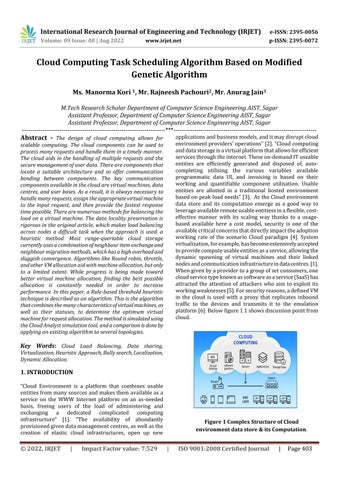
applications and business models, and it may disrupt cloud environment providers' operations” [2]. “Cloud computing and data storage is a virtual platform that allows for efficient services through the internet. These on-demand IT useable entities are efficiently generated and disposed of, autocompleting utilising the various variables available programmatic data UI, and invoicing is based on their working and quantifiable component utilisation. Usable entities are allotted in a traditional hosted environment based on peak load needs” [3]. As the Cloud environment data store and its computation emerge as a good way to leverage available remote usable entitiess in a flexible, costeffective manner with its scaling way thanks to a usagebased available here a cost model, security is one of the available critical concerns that directly impact the adoption working rate of the scenario Cloud paradigm [4]. System virtualization, for example, has become extensively accepted to provide compute usable entities as a service, allowing the dynamic spawning of virtual machines and their linked nodes and communication infrastructure in data centres. [1]. When given by a provider to a group of set consumers, one cloud service type known as software as a service (SaaS) has attracted the attention of attackers who aim to exploit its working weaknesses [5]. For security reasons, a defined VM in the cloud is used with a proxy that replicates inbound traffic to the devices and transmits it to the emulation platform [6]. Below figure 1.1 shows discussion point from cloud.

scalable computing. The cloud components can be used to process many requests and handle them in a timely manner. The cloud aids in the handling of multiple requests and the secure management of user data. There are components that locate a suitable architecture and so offer communication bonding between components. The key communication components available in the cloud are virtual machines, data centres, and user bases. As a result, it is always necessary to handle many requests, assign the appropriate virtual machine to the input request, and then provide the fastest response time possible. There are numerous methods for balancing the load on a virtual machine. The data locality preservation is rigorous in the original article, which makes load balancing across nodes a difficult task when the approach is used. a heuristic method. Most range-queriable cloud storage currently uses a combination of neighbour item exchange and neighbour migration methods, which has a high overhead and sluggish convergence. Algorithms like Round robin, throttle, and other VM allocation aid with machine allocation, but only to a limited extent. While progress is being made toward better virtual machine allocation, finding the best possible allocation is constantly needed in order to increase performance. In this paper, a Rule-based threshold heuristic technique is described as an algorithm. This is the algorithm that combines the many characteristics of virtual machines, as well as their statuses, to determine the optimum virtual machine for request allocation. The method is simulated using the Cloud Analyst simulation tool, and a comparison is done by applying an existing algorithm to several topologies.

Key Words: Cloud Load Balancing, Data sharing,

Virtualization, Heuristic Approach, Bully search, Localization, Dynamic Allocation.

1. INTRODUCTION “Cloud Environment is a platform that combines usable entities from many sources and makes them available as a service on the WWW Internet platform on an as-needed basis, freeing users of the load of administering and exchanging a dedicated complicated computing infrastructure” [1]. “The availability of abundantly provisioned given data management centres, as well as the creation of elastic cloud infrastructures, open up new

© 2022, IRJET

|

Impact Factor value: 7.529

Figure 1 Complex Structure of Cloud environment data store & its Computation.

|

ISO 9001:2008 Certified Journal

|

Page 403


Turn static files into dynamic content formats.
Create a flipbook
Cloud Computing Task Scheduling Algorithm Based on Modified Genetic Algorithm by IRJET Journal - Issuu