International Research Journal of Engineering and Technology (IRJET) e-ISSN: 2395-0056

Volume: 09 Issue: 08 | Aug 2022 www.irjet.net p-ISSN: 2395-0072
International Research Journal of Engineering and Technology (IRJET) e-ISSN: 2395-0056
Volume: 09 Issue: 08 | Aug 2022 www.irjet.net p-ISSN: 2395-0072
Anjali Yadav1, Ganesh Jaiswal2
1M.Tech Student, Institute of Engineering and Technology, I.E.T-LUCKNOW
2Assitant Professor, Institute of Engineering and Technology, I.E.T-LUCKNOW ***
Abstract - The performance of a multi-story framed buildingduringsturdyearthquakemotionsdependsonthe distribution of mass, stiffness, and strength in both the horizontal and vertical planes of the building. Many structuresinthemodernerafeatureoddelevationandplan arrangements. These structures are more vulnerable to earthquake forces. The more significant elements that reduce a structure's seismic behavior are structural imperfections. Reduced base shear, which attracted fewer seismicforces,wasmostlycausedbytheeffectofdiaphragm openings just on the seismic response of multi-story buildings.Thestructurecanbenefitfromefficientstrength& serviceability thanks to the placement of apertures. It is importanttodeterminehowwellthestructurescansurvive disasters. Gaps in the floors are common for a variety of reasons, including stairs, illumination, and architectural purposes. These openings in the diaphragms result in tensionsatthejointswherethebuildingelementsterminate. Discontinuousdiaphragmsaremadewithoutconsideringthe effectsofgapsandareassumedtobeadequate.Inthiswork, an effort has been made to determine the differences between the seismic responses of two buildings with and without irregularities. Using E.TABS 2017 software, the seismicresponseofanexistingbuildinghavingdiaphragm irregularitywillbecomparedtoabuildingwithdiaphragm discontinuityinthecurrentstudy.Therehasbeenalinear dynamicanalysisdone.Forthemodalbaseshear,storydrift, stiffness,anddisplacementtheresultsoftwobuildingshave beencompared.
Key Words: geometrical irregularity, ETABS 2017, Responsespectrumanalysis,Regularbuilding
Thebehaviorofthebuildingissignificantlyinfluencedbythe structural configuration or placement of structural components.Buildingswithastraightforwardandconsistent layout have been demonstrated to sustain less damage in previousearthquakes.Inertiaforcesarecreatedinabuilding when it is subjected to a seismic dynamic stress, and they concentrate at the building's Centre of mass [1]. A place knownastheCentreofstiffnessofthebuildingiswherethe lateral resisting pressures of vertical structural elements, suchascolumnsandshearwalls,resisttheseismic inertia forces. The building will become eccentric if the Centre of
mass and the Centre of stiffness are not in alignment. A building develops eccentricity due to its atypical configuration, which causes torsion in the structure [2]. A building develops eccentricity due to its atypical configuration, which causes torsion in the structure. The torsionthatcausesabuildingtobedamagedissignificantly influencedbythelocation,size,theorientationofstructural members[3]
In vertical or horizontal planes, regular buildings don't have any noticeable discontinuities in mass, stiffness, or strength. Contrarily, irregular structures have these discontinuitiesthatconcentratestressesanddeformitiesin theareaofthediscontinuity[4].Thiscouldcausestructural componentstofailattheirjointsandcausethestructureto collapse.Verticalirregularityistheunequaldistributionof stiffness,mass,&geometryalongthelengthofthebuilding, while horizontal irregularity is the discontinuity in the building's plan. Usually, the buildings have these imperfections for both aesthetic and practical reasons [5] The position, kind, and degree of abnormalities presentin that mostly determine the size of the building's response. Buildings'performanceundertheeffectofseismicloadcould beensuredifallthesefactorsarewiselytakenintoaccount throughoutthedesignprocess[6].
A multi-story building is one that has more than four levelsandcanhaveuptotwelveormore.Intownsandcities withahigherpopulationdensity,multi-storybuildingsare frequently found. Engineering can do very little to protect peopleandpropertyfromearthquakes,whicharethemost destructiveandunpredictableofall-naturaldisasters.There are a number of regulations that have been updated frequently on this subject. Stiffness, appropriate lateral strength,ductility,simpleandregularconfigurations, andotherelementsallaffecthowabuildingrespondstoan earthquake[7].
Incomparisontoirregularstructures,buildingswithregular geometryandevenlydistributedmassandstiffnessinplan andelevationsustainsubstantiallylessdamage.Themodern generation's needs and demands, however, as well as the expandingpopulation,haveforcedarchitectsandengineers to build irregular arrangements. Because of this, understandingtheroleofbuildingconfigurationshasbecome oneofthemainproblemsinearthquakeengineering[8]
International Research Journal of Engineering and Technology (IRJET) e-ISSN: 2395-0056
Volume: 09 Issue: 08 | Aug 2022 www.irjet.net p-ISSN: 2395-0072
Definition of Irregularity in IS 1893, An irregular distribution of their mass, strength, and rigidity along the heightofthebuildingmaybethecauseoftheirregularitiesin the building structures. The design and analysis are more difficult when certain buildings are built in high seismic zones.Theaimofthispapertostudytheseismicbehaviorof g+8multistoreyverticalirregularbuildinginseismiczoneIV under medium soil conditions using ETABS [9]. Vertical Irregularitiesdefineasthelateralforceresistingsystemina storey has a horizontal dimension that is more than 150 percentlargerthanthatofthestoreydirectlybelow.Vertical Geometric Irregularity is thus thought to apply to the construction.Herewehadtostudytheparameterslikestorey drift,displacement,overturningmoment[10].
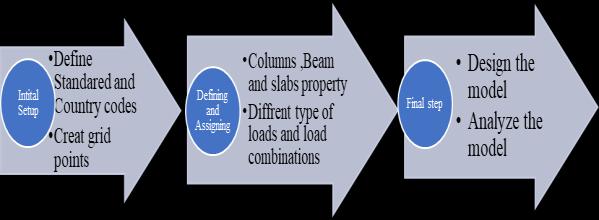
AG+8structureisbuiltinETABSv16withastoreysheightof 3m,astructurelengthof25.6minonedirectionand14.3min the other, and member sizes that vary depending on design specifications.Tofinishthemodelandanalysis,takethefollowing actions:
DESCRIPTION(G+8)StoreyResidentialbuildingsituatedinZoneIVis consideredfortheanalysisandtheirgeometricparameters aregivenintable
(IS-1893:2016 PART-1)-
MODEL PARAMETERSFordeadloads,wegetIS875Part1,forliveloads,IS875 part2,andseismicanalysisiscarriedoutinaccordancewith the2016editionofIS1893part1.
S. N Parameters
Dimension 1 Modeltype 3D 2 PlanDimension 25.6*14.3m(X*Y) 3 Noofstories G+8 4 FloortoFloorheight 3m 5 TotalHeightofbuilding 24m 6 SlabThickness 150mm 7 Columnsize 350*350mm 8 Irregular building Column size 300*300 9 Beamsize 300*400mm 10 Gradeofconcrete(slab) M30 11 Grade of concrete (column, Beam) M30 12 Rebar Fe415 13 EarthquakeZone 1V
S. No Material Grade
1. Concrete(beam,slab) M30 2. Concrete(Column) M30 3. Rebar FE415
EarthquakeZone IV
Zonefactor(Z) 0.24(Table3,clause6.4.2) 3. DampingRatio 5%(clause7.2.4) 4. ImportantFactor 1.2(Table8,clause7.2.3) 5. Typeofsoil Mediumsoil(clause6.4.2.1) 6. ResponseReduction Factor 5 (SMRF) (Table-9, clause 7.2.6) 1. Liveload 3.5KN/m2 asperIS875PartII 2. Earthquakeload asperIS1893:2016Part-I 3. Deadload 4.75kN/m
International Research Journal of Engineering and Technology (IRJET) e-ISSN: 2395-0056
2395-0072
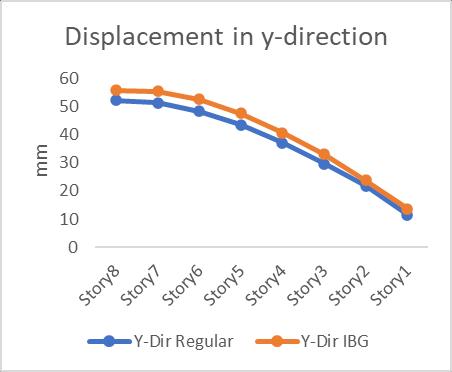
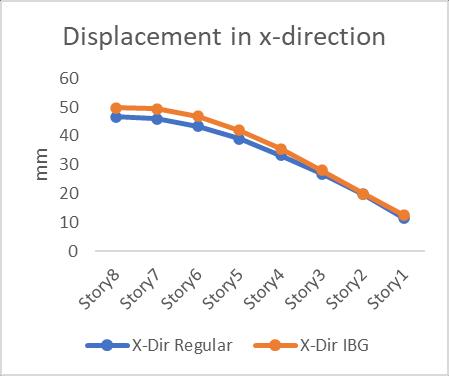
The graph shows, the displacement of building with geometricalirregularityhasmoredisplacementinbothX andYDirectionwhichisapproximately7%morethanthe regularRCCbuilding. 4.2 STOREY DRIFT:
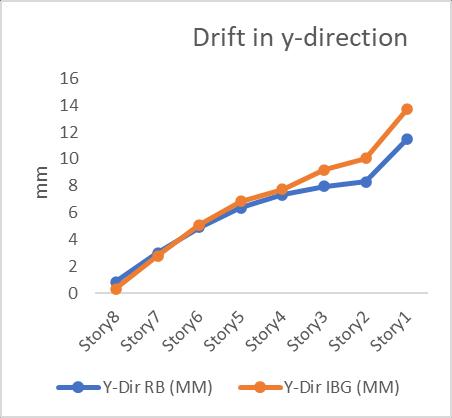
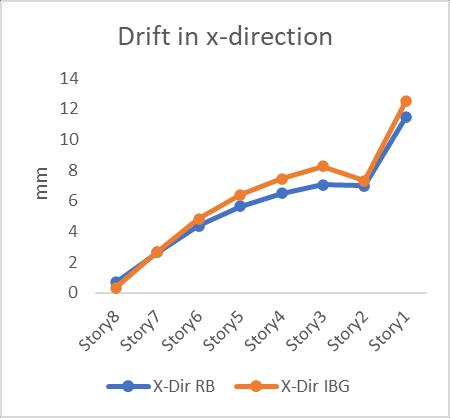
ThegraphshowsthedriftinregularRCCbuildingislessthan thestorydriftinbuildingwithgeometricalirregularityinall story in x- direction and the max story drift in regular Buildingis8%lessthanthemaxdriftinIBGbuildingwhere asiny-directionthestorydriftinbuildingwithgeometrical irregularityisobservelessthantheregularbuildingin7th storyduetogeometricalirregularitywhichisapproximately 7% less than the regular building but both are within permissiblelimitsandthemaxstorydriftiny-directionin regular building is approximately 16.36% less than the Geometricalirregularbuilding.
International Research Journal of Engineering and Technology (IRJET) e-ISSN: 2395-0056
Volume: 09 Issue: 08 | Aug 2022 www.irjet.net p-ISSN: 2395-0072
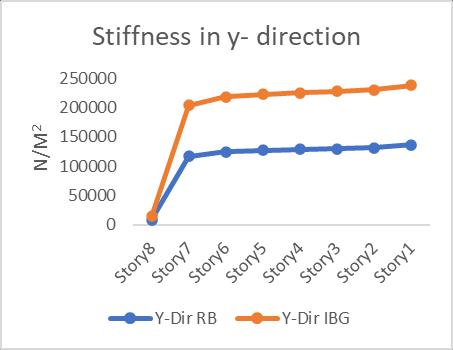
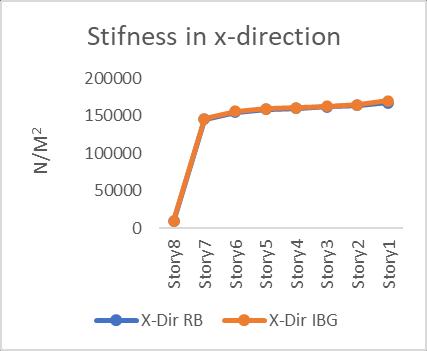
The graph shows, the stiffness of building with geometrical irregularityhasalmost samestiffnessin Xdirection as it is in regular building. In Y-direction maximumstorystiffnessofGeometricalirregularbuilding is approximately 42% more than the regular RCC buildings
4.5
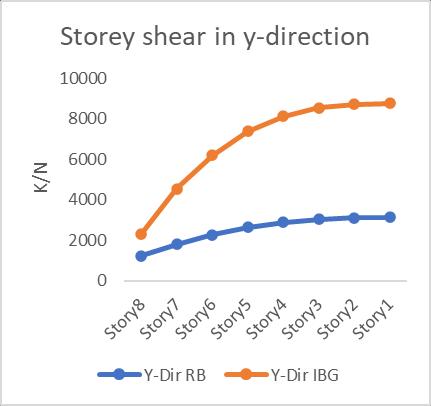
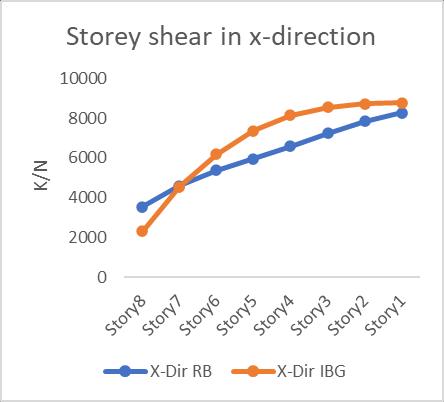
The graph shows, the storey shear of building with geometricalirregularityhasmoreinX-directionandless inY-direction andmaximumstoreyshearofgeometrical irregularbuildingisapproximately6%moreinx-direction and 64% more in y- direction than the regular RCC buildings.
5.CONCLUSION:
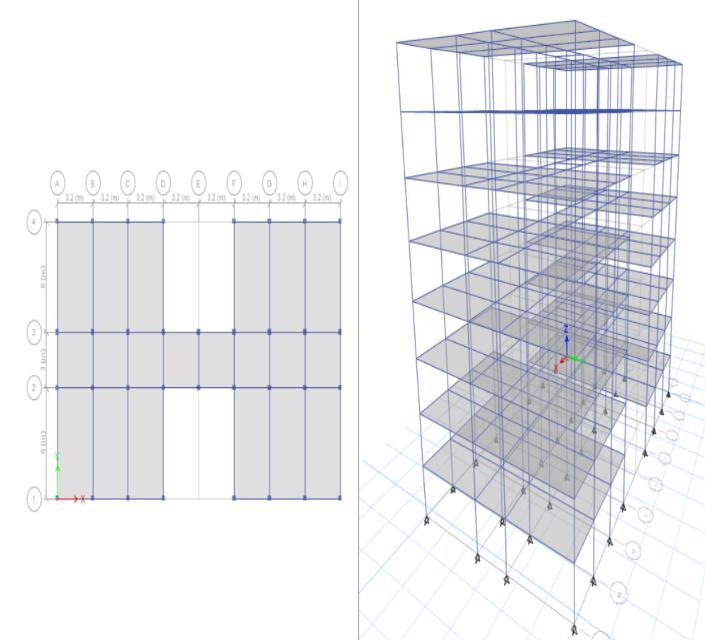
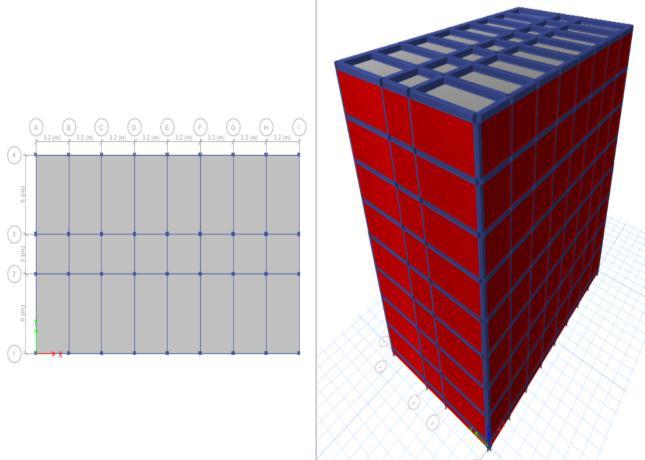
Thepurposeofthisstudywastoanalyzeandcomparethe seismic performance of the G+8 Story H Shape irregular buildings for different models at varying location. THE RESPONSESPECTRUMmethodwasused,andresultswere foundintermsofbaseshear,storydisplacement,storydrift, story stiffness and maximum story drift. The results of analysisforthemodelsfollowingconclusionscanbedrawn. ThemaximumvaluesofSTOREYDRIFTofModel2observed inxandy-directionareapproximately7%&16.34%more than the values observed in Model 1 in the respective direction. Similarly the maximum values of STIFFNESS of Model 2 observed in y-directions is approximately 42 percent more than the values observed in Model 1 in the respectivedirection..Inthisstudymaximumvalueofbase shear is observed in Model 1(REGULAR) building and minimumvalueisseeninModel2(IRREGGULAR).Thevalue ofbaseshearinModel1buildingismorethanModel2.The story displacement remains constant but with increase geometricalirregularityinstoryheightofbuildingthereis an exponential rise in top most storey which is approximately 7% more than the regular building The maximumvalueofstorydisplacementobservedattopmost storyofbuildingforboththemodelsincreasesgraduallyand exponentially.Henceitisconcludedthat regularbuilding performbestwhenitissubjectedtoseismicloading.
[1] A.Ahirwal,K.Gupta,andV.Singh,“Effectofirregular planonseismicvulnerabilityofreinforcedconcrete buildings,” AIP Conf. Proc.,vol.2158,no.September, 2019,doi:10.1063/1.5127136.
International Research Journal of Engineering and Technology (IRJET) e-ISSN: 2395-0056
Volume: 09 Issue: 08 | Aug 2022 www.irjet.net p-ISSN: 2395-0072
[2] D.RanaandJ.Raheem,“SeismicAnalysisofRegular & Vertical Geometric Irregular RCC Framed Building,” Int. Res. J. Eng. Technol., pp. 1396–1401, 2015,[Online].Available:www.irjet.net
[3] Zabihullah, P. Singh, and M. Z. Aryan, “Effect of (Vertical & horizontal) geometric irregularities on theseismicresponseofRCstructures,” Int. J. Emerg. Technol.,vol.11,no.3,pp.965–974,2020.
[4] H. S. Lee and D. W. Ko, “Seismic response characteristicsofhigh-riseRCwallbuildingshaving differentirregularitiesinlowerstories,” Eng. Struct., vol. 29, no. 11, pp. 3149–3167, 2007, doi: 10.1016/j.engstruct.2007.02.014.
[5] M.Surana,Y.Singh,andD.H.Lang,“Fragilityanalysis of hillside buildings designed for modern seismic designcodes,” Struct. Des. Tall Spec. Build.,vol.27,no. 14,pp.1–13,2018,doi:10.1002/tal.1500.
[6]. “_Case_Study11.Pdf.”
[7] A.G.Soni,D.G.Agrawal,andA.M.Pande,“Effectof IrregularitiesinBuildingsandtheirConsequences,” Int. J. Mod. Trends Eng. Res. ( IJMTER ),vol.2,no.4, pp.14–22,2015.
[8] K. Ghimire and H. Chaulagain, “Common irregularitiesanditseffectsonreinforcedconcrete buildingresponse,” Struct. Mech. Eng. Constr. Build., vol.17,no.1,pp.63–73,2021,doi:10.22363/18155235-2021-17-1-63-73.
[9] D. M. N. R. D. Mr. Pathan Irfan Khan, “Seismic Analysis of Multistoried Rcc Building Due To Mass Irregularity,” Ijedr 2016,vol.4,no.March2016,pp. 214–220,2016.
[10] P. Sarkar, A. M. Prasad, and D. Menon, “Vertical geometricirregularityinsteppedbuildingframes,” Eng. Struct.,vol.32,no.8,pp.2175–2182,2010,doi: 10.1016/j.engstruct.2010.03.020.