International Research Journal of Engineering and Technology (IRJET) e-ISSN: 2395-0056

Volume: 09 Issue: 07 | July 2022 www.irjet.net p-ISSN: 2395-0072
International Research Journal of Engineering and Technology (IRJET) e-ISSN: 2395-0056
Volume: 09 Issue: 07 | July 2022 www.irjet.net p-ISSN: 2395-0072
1MTech Student, Institute of Engineering and Technology, I.E.T-LUCKNOW
2Assitant Professor, Institute of Engineering and Technology, I.E.T-LUCKNOW ***
Abstract - Many modifications have been made to enhancetheperformanceofhigh-risebuildingsinseismic activity prone areas based on previous studies and technology developments. This paper examines the performance of RCCmass irregular buildings in zone IV withmediumsoilusingcode1893-2016(part1),because irregularity has been shown to reduce the seismic performance of structures. Practically all multistory buildingsmustbeassessedasthree-dimensionalsystems accordingtothecurrenteditionoftheIS:1893-2016.This isbecausebuildingstypicallycontainirregularityintheir plans, elevations, or both. In efficient design and construction methods for multistory buildings, particularlyin Peninsular India, resultinirregularity in the buildings' elevation and layout. The performance assessmentofanirregularworkiscoveredinthisMass irregularity in the RC Building. The current study attemptstoassesstheimpactofheavymassatfloorlevels 2,5,andhighertoinvestigatethemanyfactors,including Base Shear, Stiffness, Story Displacement, and Story Drifts,oftheG+8building.
Key words:Irregularbuilding,massirregularity,E-Tabs 2017.
The distribution of stiffness, mass, plan, strength, and severalotherabnormalitiesinthestructure'sverticaland horizontaldirectionsallaffecthowthestructurebehaves duringearthquakes.Thedamagetobuildingsinthepast showed that irregularity was a primary cause of those structures' downfall [1]. A period of intense earth trembling.Whenastructureexperiencesanearthquake, horizontalforcesareproduced.Throughoutthestructure, whichcausedinertiaforcestoactviathebuilding'sCentre ofmass.variousforcesverticalwallsandcolumnsresist theseforces,andasaresult,theseforcesimpactthrough suchalocationknownastheCentreofthestiffness[2]
Forastructuretofunctionwellagainstseismicstresses,it needs to have enough lateral strength, a straightforward, regular shape, and enough stiffness and ductility. In comparison to structures with irregular shape, buildings withbasicgeometryandevenlydistributedmassorstiffness inelevationandplanarelessvulnerable[3].Therearemany irregular architectural structures. Some were originally intended to be this way, while others happened to be by
accident. For instance, during the construction process, structuresmaybeinconsistentorevenmistaken,butmany othersmaybecomeinconsistentduringthecourseoftheir lifetimeowingtodamage,restoration,orchangeinusage[4]. Cityordinancesforceverticalinconsistenciesinstructures, and structural designers must account for earthquake response.Thekeyverticalirregularitiesthattheresearchers have focused on are discontinuities in stiffness, mass, verticalgeometry,in-planediscontinuity,andcapacity.The asymmetrical plan forms, re-entrants' corners, diaphragm discontinuity, and torsional abnormalities are primarily responsibleforthehorizontalirregularities[5]
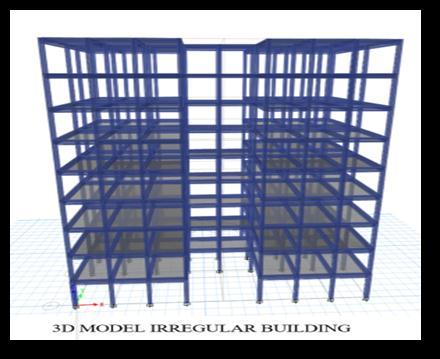
Inthepresentperiod,irregularconstructionsareregularly constructedinnearlyeverynation,includingNepal.Because of its usage in both functional and aesthetically pleasing design, irregular structure is becoming more and more commoninmulti-storybuildings.Additionally,inanurban region having closely spaced tall buildings, this land restrictionistheprimaryreasonforprovidingappropriate sunshineandventilationforthelowerstory.Fundamental period,baseshear,andmostcruciallystressconcentration or ductility demand are located in the structure from the perspectiveofseismicsafety[6].Therefore,comparedwith vertically irregular structures, geometrical regular shape structures with homogeneous mass and stiffness function wellduringanearthquake [7].Inordertodothis,thebay wasremovedatvariousfloorlevelsandthecolumnswere removed at various portions, creating anomalies in geometry, mass, and stiffness, respectively. For this paper seismicbehaviorofRegularandmassirregularg+8multistorybuildingistakenandanalysestheStorydisplacement, baseshear,Stiffnessandstorydrift.Withthehelpof ETABS toanalysesthedynamicallylinearresponsespectrumofaG+8 multi-storystructure'sseismic performanceunderlateraland gravityload[8]
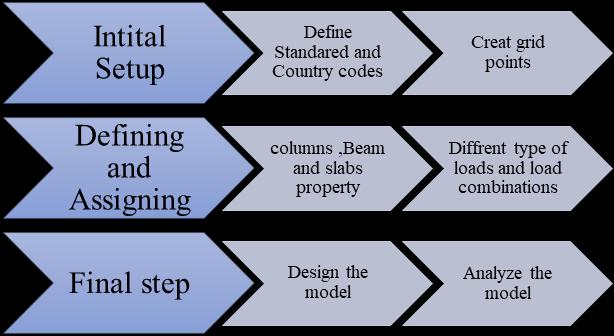
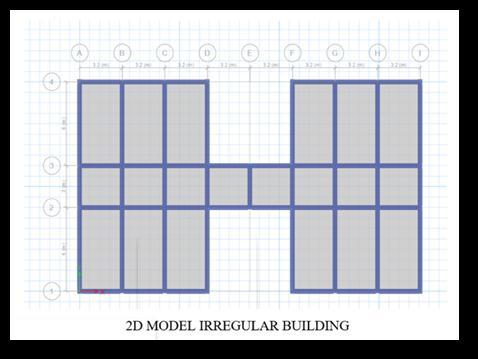
In accordance with design requirements, a G+8 structure is createdinETABSv16withsuchastoryheightof3meters,a buildinglengthof25.6mforonesideand14.3minanother,and elementsizesthatvary.Followthesestepstocompletethemodel andanalysis:
International Research Journal of Engineering and Technology (IRJET) e-ISSN: 2395-0056
Volume: 09 Issue: 07 | July 2022 www.irjet.net p-ISSN: 2395-0072
3.4 BUILDING PARAMETERS-
S.No Parameters Dimension 1 Modeltype 3D 2 PlanDimension 25.6*14.3 m(X*Y)
Fig3.1:Methodologysteps
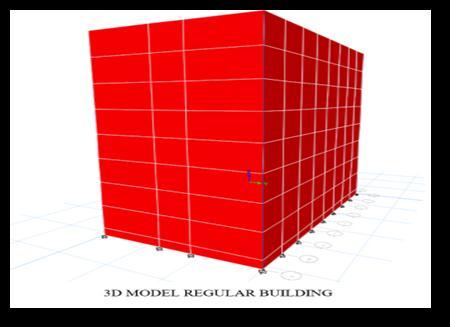
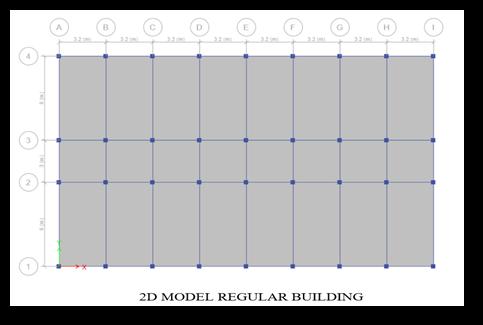
For the analysis, a (G+8) Floor Residential Building in Zone IV is taken into consideration, and its geometric specificationsareprovidedinthetable.
S. No Material Grade 1. Concrete(beam,slab) M30 2. Concrete(Column) M30 3. Rebar FE415 3.2. SEISMIC DATA (IS-1893:2016 PART-1)1. Earthquake Zone IV 2. Zonefactor(Z) 0.24(Table3, clause6.4.2) 3. DampingRatio 5%(clause7.2.4) 4. Important Factor 1.2(Table8,clause 7.2.3) 5. Typeofsoil Mediumsoil(clause 6.4.2.1) 6. Response Reduction Factor 5(SMRF)(Table-9, clause7.2.6)
3.3 LOADING DATA Fordeadloads,wegetIS875Part1,forliveloads,IS875 part2,andseismicanalysisiscarriedoutinaccordancewith the2016editionofIS1893part
Table 3.1 Load data
Noofstories G+8 4 FloortoFloor height 3m 5 TotalHeightof building 24m 6 SlabThickness 150mm 7 Columnsize 350*350 mm 8 Beamsize 300*400 mm 9 Gradeofconcrete (slab) M30 10 Gradeofconcrete (Column,Beam) M30 11 Rebar Fe415 12 EarthquakeZone 1V
1
International Research Journal of Engineering and Technology (IRJET) e-ISSN: 2395-0056
Volume: 09 Issue: 07 | July 2022 www.irjet.net p-ISSN: 2395-0072
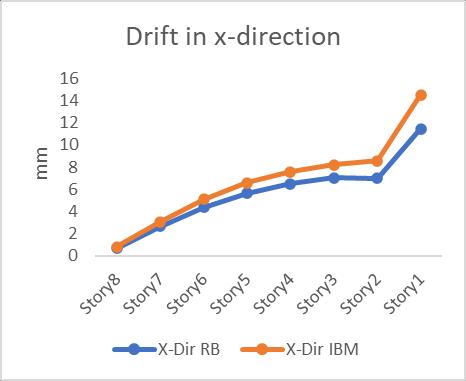
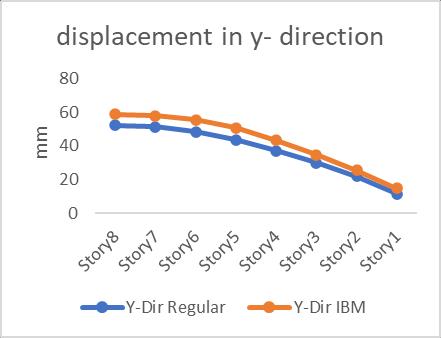
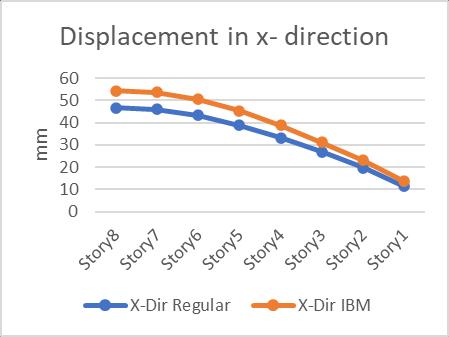
Inthis resultsection wewill usetheabbreviationIBMfor “building with mass irregularity” and RB for “Regular building”forconvenience.
4.1 STORY DISPLACEMENT
The graph shows, the displacement of building with massirregularityhaslesserdisplacementinbothXandY Direction which is approximately 33.34% less than the regularRCCbuilding
4.2 STORY DRIFT
International Research Journal of Engineering and Technology (IRJET) e-ISSN: 2395-0056
Volume: 09 Issue: 07 | July 2022 www.irjet.net p-ISSN: 2395-0072
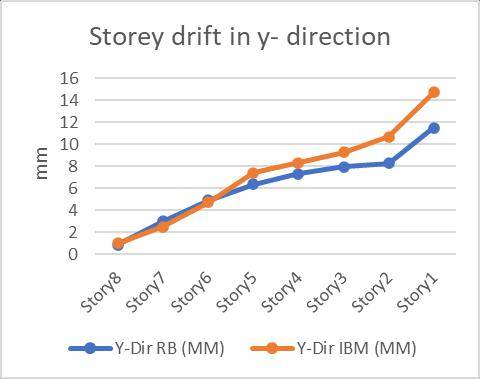
ThegraphshowsthedriftinregularRCCbuildingislessthan thestorydriftinbuildingwithmassirregularityinallstory inx-directionandthemaxstorydriftinregularBuildingis 24.04%lessthanthemaxdriftinIBMbuildingwhereasinydirectionthestorydriftinbuildingwithmassirregularityis observe less than the regular building in 7th story due to massirregularitywhichisapproximately16.75%lessthan theregularbuildingbutbotharewithinpermissiblelimits andthemaxstorydriftiny-directioninregularbuildingis approximately22%lessthantheMassirregularbuilding.
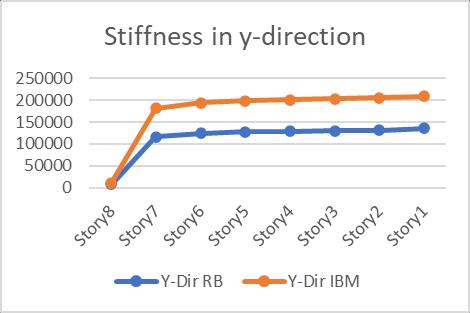
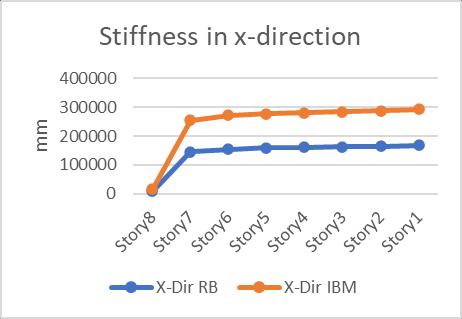
The graph shows, the stiffness of building with mass irregularityhasmore stiffnessinbothXand Ydirection andmaximumstorystiffnessofMassirregularbuildingis approximately 42.85% in x-direction and 35% in ydirectionmorethantheregularRCCbuildings
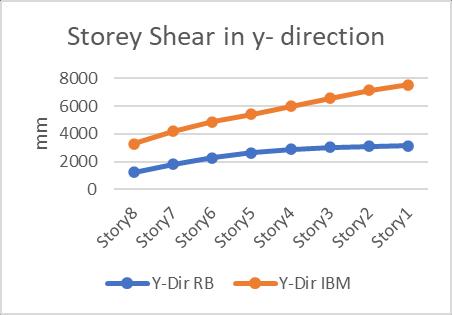
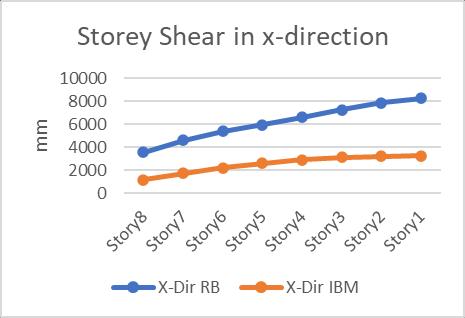
The graph shows, the storey shear of building with massirregularityhaslessinX- directionandmoreinYdirection and maximum storey shear of Mass irregular building is approximately 60.7% less in x-direction and 58.35% more in y- direction less than the regular RCC buildings.
Thepurposeofthisstudywastoanalyzeandcomparethe seismic performance of the G+8 Story H Shape irregular buildings for different models at varying location. THE RESPONSESPECTRUMmethodwasused,andresultswere foundintermsofbaseshear,storydisplacement,storydrift, story stiffness and maximum story drift. The results of analysisforthemodelsfollowingconclusionscanbedrawn. ThemaximumvaluesofSTOREYDRIFTofModel2observed in x and y-direction are approximately 24% & 22% more than the values observed in Model 1 in the respective direction. Similarly the maximum values of STIFFNESS of Model2observedinbothdirectionsare approximately13 percent more than the values observed in Model 1 in the respective direction. In this study maximum value of base shear is observed in Model 1(REGULAR) building and minimumvalueisseeninModel2(IRREGGULAR).Thevalue
International Research Journal of Engineering and Technology (IRJET) e-ISSN: 2395-0056
Volume: 09 Issue: 07 | July 2022 www.irjet.net p-ISSN: 2395-0072
ofbaseshearinModel1buildingismorethanModel2.The storydisplacementremainsconstantbutwithincreasemass irregularityinstoryheightofbuildingthereisanexponential rise in top most storey which is approximately 33% more than the regular building The maximum value of story displacementobservedattopmoststoryofbuildingforboth themodelsincreasesgraduallyandexponentially.Henceitis concludedthat regularbuildingperformbestwhenitis subjectedtoseismicloading.
[1] H. S. Lee and D. W. Ko, “Seismic response characteristicsofhigh-riseRCwallbuildingshaving differentirregularitiesinlowerstories,” Eng. Struct., vol. 29, no. 11, pp. 3149–3167, 2007, doi: 10.1016/j.engstruct.2007.02.014.
[2] M.Surana,Y.Singh,andD.H.Lang,“Fragilityanalysis of hillside buildings designed for modern seismic designcodes,” Struct. Des. Tall Spec. Build.,vol.27,no. 14,pp.1–13,2018,doi:10.1002/tal.1500.
[3]. “_Case_Study11.Pdf.”
[4] A.G.Soni,D.G.Agrawal,andA.M.Pande,“Effectof IrregularitiesinBuildingsandtheirConsequences,” Int. J. Mod. Trends Eng. Res. ( IJMTER ),vol.2,no.4, pp.14–22,2015.
[5] K. Ghimire and H. Chaulagain, “Common irregularitiesanditseffectsonreinforcedconcrete buildingresponse,” Struct. Mech. Eng. Constr. Build., vol.17,no.1,pp.63–73,2021,doi:10.22363/18155235-2021-17-1-63-73.
[6] D. M. N. R. D. Mr. Pathan Irfan Khan, “Seismic Analysis of Multistoried Rcc Building Due To Mass Irregularity,” Ijedr 2016,vol.4,no.March2016,pp. 214–220,2016.
[7] Zabihullah, P. Singh, and M. Z. Aryan, “Effect of (Vertical & horizontal) geometric irregularities on theseismicresponseofRCstructures,” Int. J. Emerg. Technol.,vol.11,no.3,pp.965–974,2020.
[8] P. Sarkar, A. M. Prasad, and D. Menon, “Vertical geometricirregularityinsteppedbuildingframes,” Eng. Struct.,vol.32,no.8,pp.2175–2182,2010,doi: 10.1016/j.engstruct.2010.03.020.
2022, IRJET | Impact Factor value: 7.529 | ISO 9001:2008 Certified Journal