International Research Journal of Engineering and Technology (IRJET) e-ISSN:2395-0056

Volume: 09 Issue: 08 | Aug 2022 www.irjet.net p-ISSN:2395-0072
EFFECT OF PARTIAL REPLACEMENT OF CEMENT BY EGGSHELL POWDER AND COARSE AGGREGATE BY CERAMIC TILE WASTE IN CONCRETE
Mr. Ali Mohd1, Mr. Sourabh Lalotra2
1Student-M. Tech-Structural Engineering, Sri Sai College of Engineering & Technology, Badhani, Pathankot, India
2Assistant Professor, Department of Civil Engineering, Sri Sai College of Engineering & Technology, Badhani***
Abstract: The main objective of this research is to determine the workability, compressive strength, split tensile strength, and flexure strength of concrete prepared by using ceramic tile waste and eggshell powder. On the basis of previous researches which has been done we make a comparison of strength properties of concrete made with replacement and conventional concrete. Cement is replaced by eggshell powder in the following percentages 4%, 8%, 12%, 16%,20%,24% and coarse aggregate is replaced by ceramic tile waste in the following percentages 7%, 14%, 21%, 28%, 35%, 42%. The graded of concrete used for this research work is M30. Different specimens of the material are tested for strength. The result shows that concrete workability is fine and within limits after replacing cement with eggshell powder and coarse aggregate by ceramic tile waste. However, workability gets reduced at higher replacement of materials. The strength parameters such as compressive strength, flexural strength, and split tensile strength also increase and show an optimum value at 12% cement replacement and 21% replacement of coarse aggregate by eggshell powder and ceramic tile waste, respectively. Test results are satisfactory up to 16% and 28% replacement of ESP and CTW resp. After this, there is a decrease in the strength of concrete. So, after this research work, we are able to find out that the replacement can be done to this extent but there may be chances of higher percentage ofreplacement by doing further investigations.
Keywords-Eggshell Powder, Ceramic Tile Waste, Compressive Strength, Flexural Strength, Split Tensile Strength.
1.INTRODUCTION
Any construction activity requires several materials such as steel, bricks, concrete, wood etc. However, concrete is the main material required in construction industry.Concreteitselfismadeupofdifferentconstituent materials such as cement, coarse and fine aggregates, water etc. concrete is considered as the backbone of the construction industry. It is because most of the constructions uses concrete as compared to the other materials.Sinceconcreteismadeupofdifferentmaterials, so its strength, adaptability and suitability depend upon thepropertiesofmaterialsfromwhichitismade.Cement is considered as the main component in concrete as it
binds the other materials in the concrete. Maximum volume of concrete is occupied by the aggregates i.e. (7580 %). Coarse aggregates provide strength to the concrete and fine aggregates acts as filler material. It is estimated that concrete consumption on earth is in the order of 11.5 billion tons per year. Also, the waste disposal is the major problem nowadays. Various wastes have been generated daily on a large scale by different industries as well as by othersourcesandthereisnoproperwayofdisposingsuch wastes. Accumulation of these wastes is increasing day by dayandsuchaccumulationofwastes posesa seriosthreat tooursocietyaswellastoourenvironment.So,itisavery goodideaifweareabletousesuchwastesinaproductive way which are otherwise dangerous for our environment. To use such wastes in a productive way we have to study about the properties of different wastes separately and their composition also so that we can utilize different wastes according to their potential and in the right place wherewecangetmaximumbenefitofsuchwastesbecause different wastes generating from different locations have differentpropertiesaswellasdifferentuses.
1.1 Eggshell Powder (ESP)
Among the different wastes eggshell is also one of the wastes. India is third largest egg producer in the world. Every day egg company in the world process nearly one million eggs. If it is to be estimated, about 10,000 tons of eggshellshavetobewillingeachyear.Mostoftheeggshell waste is put out in the landfill without any pretreatment because it is useless and, in many countries, requires pretreatment before dumping.Eggshell wastealsoattracts verminduetothemembraneattachedtoit.So,itisathreat to the environment and human health. The utilization of this waste will lead to a sustainable environment. Also, utilizing eggshell powder in place of cement will reduce carbondioxide emissionsduringtheproductionofcement and decrease air pollution. This will lead to the economic growth and development of countries. Eggshell waste evolves from poultry farms, restaurants, and hotels where there is the consumption of eggs. Eggshells are rich in calcium and have the same limestone composition as cement. Researchers have reported that eggshell mainly contains calcium in the form of Calcium Carbonate (90%) and the remaining masses contain Phosphorus, Magnesium, traces of sodium, zinc, manganese, iron, and
© 2022, IRJET | Impact Factor value: 7.529 | ISO 9001:2008 Certified Journal | Page265
International Research Journal of Engineering and Technology (IRJET) e-ISSN:2395-0056
Volume: 09 Issue: 08 | Aug 2022 www.irjet.net p-ISSN:2395-0072
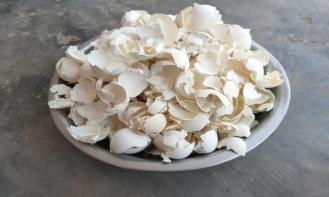
copper. The research done so far suggests that eggshell powdershowsthebindingpropertyofthecement.So,the need arises for the bioconversion of waste into usable energy. Eggshell powder is also a cheap alternative material in place of cement which can reduce the overall cost of construction and impact on the environment to a largeextent.TheEggshellPowderisshowninFig.1.
1.2 Ceramic Tile Waste
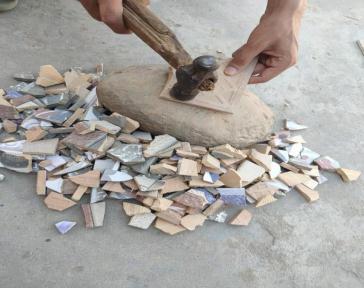
Ceramic tile waste is the waste of tiles generated from ceramic industry as well as from construction sites because most of the tiles get wasted during construction. ceramic tile waste is the waste which is produced on a large scale as compared to other wastes that are being used in replacement. India ranked third in the production of tiles. Ceramic wastes are created in different forms someofwhichareproducedincompaniesduringandafter production process due to errors in construction, human activities and also inappropriate raw materials. Some others are produced in transportation and distribution processandfinallythemostbulkofthemarecreatedasa result of destroying constructions. It is predicted that about 30 % of daily production of ceramic materials in India gets converted into wastage and this amount of wastagereachestomilliontonsperyear.Thiswasteisnot recycled in any form at present. Therefore, they cause environmentalanddisposalproblems.So,itisagoodidea to use this waste in the place of coarse aggregates in concrete so that on one hand our natural resources get saved and the disposal problem of this waste also get solved.Ceramicwasteisdurable,hardandhighlyresistant to different attacks of environment. Ceramic waste consistsof15to45%ofsand,30to50%ofclay,10to13 % of limestone, and 5 to 30 % of granite. Ceramic tile wasteisawastematerialwhichisgeneratedataveryfast rate so it is a very good step to use it as a useful material but with proper care and handling. In this research work ceramictilewastewascollectedfromvariousconstruction sites and also from tile stores and this tile waste was convertedintorequiredsizei.e.,intherangeof10-20mm by manual hammering. Flaky aggregates were removed. The properties of the concrete made with ceramic waste are well within the range of the values of concrete made withvirginaggregates.CeramicTileWasteisshowninthe Fig.2.
2. OBJECTIVE
a. To perform the following test and to compare the results with and without replacement of eggshell powderandceramictilewaste
CompressiveStrengthTest.
FlexuralStrengthTest. SplitTensileStrengthTest.
b. To reduce the overall environmental effects of concrete production using eggshell powder and ceramictilewasteaspartialreplacement.
c. Workabilityofconcrete.
3. LITERATURE REVIEW
Kamran Basit et al. (2019): This paper studies the variousstrengthparametersofconcretemadewithvarying proportionsofeggshellpowderviz0%,5%,10%,15%and 20% as replacement of cement and concluded that the higheststrengthisachievedat10%replacementofcement with ESP. Also concluded that split elastic qualities of ESP cements were practically similar to traditional cement up to15%ESPreplacement.Theworkabilitycharacteristicsof the concrete with varying ratio of ESP were also studied throughslumpconetest.
Bikash Subedi et al. (2020): In this study the physical characteristics of ceramic tile aggregates are measured. They are used in concrete as the substitute for the coarse aggregates with 0%, 5%, 10% ,15%, 20%, 25%, 30% and 35% substitution. The optimum percentage is 10% for 7 days compressive strength and 25% for 28 days compressivestrength.Withtheadditionoftileaggregatein the making of concrete split tensile strength was also increased.
Fig-1 Eggshells Fig-2 CeramicTileWasteInternational Research Journal of Engineering and Technology (IRJET) e-ISSN:2395-0056 Volume: 09 Issue: 08 | Aug 2022 www.irjet.net p-ISSN:2395-0072
4. MATERIAL AND PROPERTIES
4.1 Cement
Cement is a binding material used in the preparation of concrete. It binds the coarse aggregates and fine aggregateswiththehelpofwateranditalsofillsthevoids intheconcrete.ThenameordinaryPortlandcement(OPC) is reserved for a cement which is an extremely finely grounded product obtained by burning calcareous and argillaceous raw materials at high temperature. Cement used in this study is OPC 43 grade cement conforming to IS: 8112 throughout the work. The relevant lab has providedinformationonthecement'sphysicalqualities
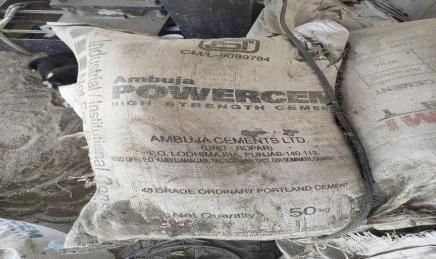
Fig.4-FineAggregate
4.3 Coarse Aggregate
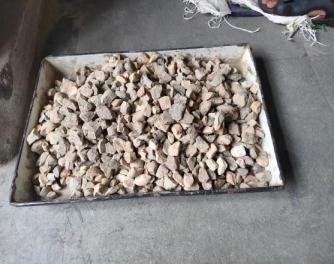
Aggregate which has a size larger than 4.75 mm or which retrained on 4.75 mm IS Sieve are known as Coarse aggregate. Coarse aggregates must be tough, pristine,anddevoidofanychemicalcoatingofclayand dust on the surface in order to make a decent concrete mix Coarse aggregates used in this research were locally available crushed aggregates of size 20mm and 10mm in the proportion of 60 and 40 respectively. Grading of coarse aggregate was done according to IS: 383-2016. Detailed sieve analysis of coarse aggregates shown in Table 3.5. Specific gravity and water absorption of coarse aggregates were determined according to IS: 2380 (Part 3) of 1963. The concerned labprovidedthepropertiesofcoarseaggregate.
4.2 Fine Aggregate
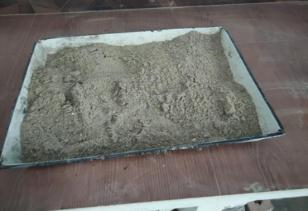
Fine aggregate consists of crushed sand particles or natural river sand passing through a 4.75mm sieve. In general, river sand is used as a fine aggregate having a particle size of 0.07mm. Fine aggregates used in this research was locally available sand from Akhnoor in district Jammu. Sieve analysis was done to determine the sandzoneasperIS:383-1970.Physicalpropertiesofsand like fineness modulus, specific gravity was determined. The physical properties of sand were provided by the concerned lab. It conforms to IS 383 1970 comes under zoneII.
4.4
Fig.5
-CoarseAggregate
Eggshell Powder (ESP)
Eggshellwasteevolvesfrompoultryfarms,restaurants, and hotels where eggs are consumed. Instead of damping, it can be used as supplementary material in place of cement. Eggshells are rich in calcium and have the same limestone composition as cement. Eggshells were collected, cleaned, dried and then converted into fine powder to useas a supplementary material with cement.
Table 2: Chemical Composition of Eggshell Powder
Fig-3 43GradeOPCCement Table 1 Properties of CementInternational Research Journal of Engineering and Technology (IRJET) e-ISSN:2395-0056
Volume: 09 Issue: 08 | Aug 2022 www.irjet.net p-ISSN:2395-0072
5. METHODOLOGY
Fe2O3 41 003
MgO 2.2 0.01 K2O 04Na2O 04 015 SO3 22 062
4.5 Ceramic Tile Waste (CTW)
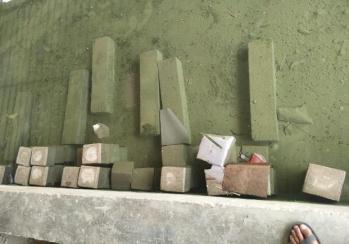
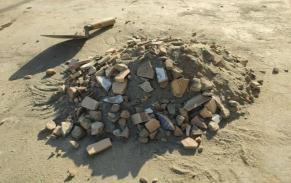
It is predicted that about 30 % of daily production of ceramicmaterialsinIndiagetsconvertedintowastageand this amount of wastage reaches to million tons per year. Therefore, they cause environmental and disposal problems.So,itisagoodideatousethiswasteintheplace of coarse aggregates in concrete so that on one hand our natural resources get saved and the disposal problem of this waste also get solved. Ceramic tile waste is a waste material which is generated at a very fast rate so it is a very good step to use it as a useful material but with proper care and handling. In this research work ceramic tile waste was collected from various construction sites andalsofromtilestoresandthistilewastewasconverted intorequiredsizei.e.,intherangeof10-20mmbymanual hammering. Flaky aggregates were removed. The properties of the concrete made with ceramic waste are well within the range of the valuesofconcrete made with virginaggregates.
Table 3: Chemical Composition of Ceramic Waste
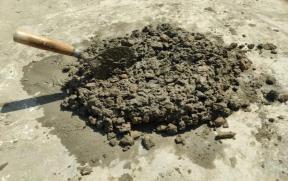
5.1 Batching: Different constituents of concrete are collected and weighed appropriately. The materials to be replaced are also measured and there is proper mixing of materials.Thewater isaddedproperlyto preparea better mixandafterpreparingthemix,themixture istransferred torespectivemoulds.
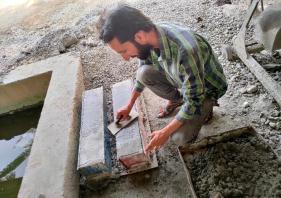
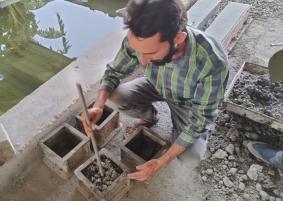
Fig.6- MixingofMaterial
5.2 Casting: Theworkabilitytestisperformedforeachmix via slump cone test before transferring the concrete into moulds. The moulds are properly oiled or greased. Concrete is transferred into the moulds along with proper compaction.Afterfillingthemould,thetopofthemouldis properlylevelledandtheextramaterialisremovedoff.
Fig.7- Castingofspecimens
5.3 Curing: Afterthepreparationofmould,itisallowedto setfor24hours.After24hours,mouldsareopenedandthe specimensareplacedinawatertankforcuringfor28days. The specimens must be marked for identification so that theremustnotbeanyerror.Curingofspecimenswasdone inportablewaterwhichisfreefromallkindsofimpurities otherwise it will affect the concrete strength. The specimens must be dried before putting under testing machine.
4.6 Water
Water is to be considered as the main constituents in the production of concrete. The normal portable tap water mustbeusedintheproductionofconcrete.Waterwhichis to be use in the research work should be free from all kinds of impurities. The ph. of the water should be in desiredrange.Potablewaterwasusedinthisresearchfor mix as well as for curing specifications conforming to IS 456-2000.
Fig.8- Curing
International Research Journal of Engineering and Technology (IRJET) e-ISSN:2395-0056
Volume: 09 Issue: 08 | Aug 2022 www.irjet.net p-ISSN:2395-0072
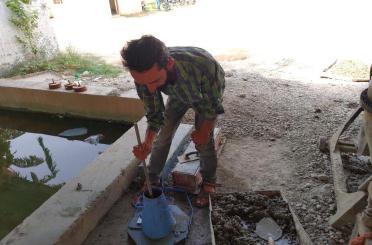
5.4 Slump cone test: Concreteslumptestisperformedon freshly mixed concrete to determine the workability or consistencyofconcretemix.Concreteslumptestiscarried out from batch to batch to check the uniform quality of concrete during construction. In our project, we performed slump cone test for every set of specimens to check the uniformity and workability of the mix. The apparatus of slump cone test cone test consists of a frustum cone of 20 cm dia at top and 10 cm at bottom. Heightofconeis30cm.Italsoconsistsofatampingrodof length 600mm and dia 16mm, base plate and measuring scale.
size 150mm x 150mm x 700mm. For testing, the beam is placed longitudinally in the steel rollers. Apparatus consists of: tamping rod of 600mm length and 16mm dia, weighingbalance,abeammould.
Fig.9- SlumpTest
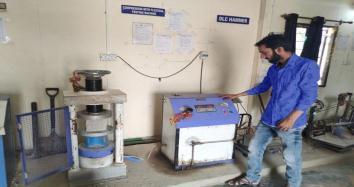
5.5 Compressive Strength Test: Compressive strength test provides the characteristic strength of concrete. Compressive strength of concrete depends upon many factors such as water-cement ratio, material quality and quality control during production of concrete etc. Compressivestrengthtestisgenerallyperformedoncubes ofconcreteofsize15cmx15cmx15cmor10cmx10cmx 10cm.Inthisproject,weusecubesofsize15cmx15cmx 15cm for compressive strength test. The compressive strength test is performed in compression testing machine.
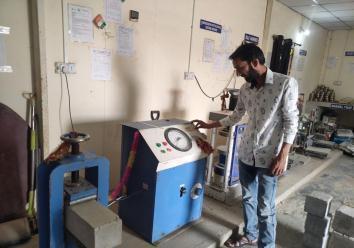
Fig.10- CompressionTest
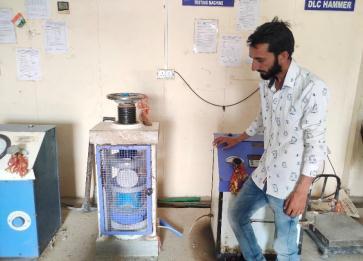
5.6 Flexural Strength Test: Flexural strengthofconcrete is the ability of concrete beam or slab to resist failure in bending. Many structural components such as beams and slabs are subjected to flexing or bending and it is necessary that such components should be able to resist bending or tensile forces. For performing the flexural strength test, we use specimen in the form of a beam of
Fig.11- FlexuralStrengthTest
5.7 Split Tensile Strength Test: Thesplittensilestrength test is an indirect tensile test generally used to determine the tensile strength of concrete. It is known that the concrete is good in compression but weak in tension, so cracks develop when tensile forces exceed the tensile strength of concrete. This test can be performed on UTM. Apparatus consists of: tamping rod of length 600mm and dia 16 mm, weighing balance, cylindrical mould of size 150mmx300mm.
Fig.12-SplitTensileStrengthTest
6. RESULT AND DISCUSSION
6.1 Concrete Mix Design
Based on trial mixes for different proportions of ingredients, the final design mix was prepared for M30 grade of concreteas per IS 10262:2009. The concrete mix proportion and w/cratio was considered as 0.43 and with varying percent of eggshell powder and ceramic tile waste and design was done. The different specimens as per the requirement for test were casted. The specimens were tested after 7,14 and 28 days of curing. In each category thespecimenstobetestedandaveragevalueisreportedin theformofgraphs.
6.2 Compression Test
Thetotalof63cubeswastestedat7days,14days,28days Thevalueofeachtestisprovidedinthetablebelow:
International Research Journal of Engineering and Technology (IRJET) e-ISSN:2395-0056
Table-8:CompressiveStrengthResults
Mix Specimen Details
Compressive Strength (N/mm2) 7 Days 14 Days 28 Days
M0 ConventionConcrete 25.04 34.99 39.44
M1 4%ESP+7%CTW 2607 3524 4046
M2 8%ESP+14%CTW 2712 3615 4218
M3 12%ESP+21%CTW 2724 3839 4358
M4 16%ESP+28%CTW 2610 3653 4228
M5 20%ESP+35%CTW 2453 3397 3717
M6 24%ESP+42%CTW 2274 3251 3668
Compressivestrength
0 10 20 30 40 50 M0 M1 M2 M3 M4 M5 M6
Days
6.3 Flexural Strength
Results including the flexural strength (for fractured samples) and the yield strength (samples that did not fracture). The test results conducted for 7,14 and 28 days aretabulatedbelow.
Table-9:FlexuralStrengthResults
Mix Specimen Details
Flexural Strength (N/mm2)
7 Days 14 Days 28 Days
M0 ConventionConcrete 3.05 3.85 3.84
M1 4%ESP+7%CTW 3.09 3.87 3.95
M2 8%ESP+14%CTW 3.15 3.93 4.06
M3 12%ESP+21%CTW 3.36 4.28 4.36
M4 16%ESP+28%CTW 3.07 3.86 3.92
M5 20%ESP+35%CTW 2.37 3.26 3.60
M6 24%ESP+42%CTW 2.24 2.95 3.39
© 2022,
IRJET | Impact Factor value: 7.529
C o m p r e ss i v e s t r e n g t h in N / mm 2
FlexuralStrength 7 Days 14 Days 28 Dyas
Graph 2 -FlexuralStrengthResults
6.4
Split Tensile Strength
A standard test cylinder of concrete specimen is placed horizontally between the loading surfaces of compression testing machine. The compression load is applied diametrically and uniformly along the length of cylinder until the failure of the cylinder along the vertical diameter. The test results conducted for7,14and 28 days aretabulatedbelow.
Table-10:SplitTensileStrengthResults
Mix Specimen Details
Split Tensile Strength (N/mm2)
7 Days 14 Days 28 Days
M0 ConventionConcrete 253 349 379
M1 4%ESP+7%CTW 2.53 3.52 3.82 M2 8%ESP+14%CTW 2.84 3.95 4.33 M3 12%ESP+21%CTW 246 358 402 M4 16%ESP+28%CTW 240 357 399
S p
Split Tensile Strength 7 Days 14 Days 28 Days
Graph 3-:SplitTensileStrengthResults
International Research Journal of Engineering and Technology (IRJET) e-ISSN:2395-0056
Volume: 09 Issue: 08 | Aug 2022 www.irjet.net p-ISSN:2395-0072
6.5 Slump Test
The results of the slump cone test performed on different mixesofM30gradeconcreteareshowninthetable:
Table-7:SlumptestResults
Mix Specimen Details Slump(mm)
M0 ConventionConcrete 84
M1 4%ESP+7%CTW 86
M2 8%ESP+14%CTW 83
M3 12%ESP+21%CTW 80
M4 16%ESP+28%CTW 79
M5 20%ESP+35%CTW 76
M6 24%ESP+42%CTW 72
90
85
80
75
70
65
Split Tensile Strength is maximum at 8% eggshell powder and 14% ceramic tile waste replacement.
8. REFERENCES
[1] KamranBasit,Nitish Kumar Sharma andBrij Kishor “Fractional substitute of cement with eggshell particles” International Journal of Innovative Technology and Exploring Engineering, vol-8, Issue9,July2019.
[2] Bikash Subedi, Dhurba Kumar Wagee and Keshav Basnet“Utilizationofcrushedceramictilewastes as partialreplacementofcoarseaggregateinconcrete” International Journal of Engineering Research and Technology,vol-9,Issue-7,July2020.
[3] Nikita Vaidya, Prof. M.P Bastwadkar “Experimental studyofpartialreplacementofcementwitheggshell powder in concrete” International Journal of Engineering Development and Research, vol-7, Issure-4,2019.
[4] A. Kanaka Ramya, A.V. Phani Manoj, G.T.N Veerendra, P.Kodanda Rama Rao “Strength and durability properties of concrete with partially replaced cement with eggshell powder and fine aggregates by quarry dust” International Journal of Innovative Technology and Exploring Engineering, vol-8,Issue-10,August2019.
M0 M1 M2 M3 M4 M5 M6
Slump (mm) Slump (mm)
Graph 4- Slumpconetest
7. CONCLUSION
Basedontheexperimentalinvestigationcarriedouton the strength behavior of Partial replacement of coarse aggregate with ceramic tile waste and cement with eggshellpowder,thefollowingconclusionsaredrawn:
Workability results show that if we replace cement with eggshell powder up to 8% and coarse aggregate with ceramic tile waste up to 14%, there isnosignificantdecreaseintheworkability.
Compressive Strength is maximum at12% eggshell powderand21%ceramictilewastereplacement.
Flexural Strength is maximum at 12% eggshell powderand21%ceramictilewastereplacement.
[5] Ashfaque Ahmed Jhatial, Samiullah Sohu, Muhammad Jaffar Memon, Nadeem-ul-Karim Bhatti and Darya Memon “Eggshell powder as partial cementreplacementanditseffectontheworkability andcompressivestrengthofconcrete”International Journal of Advanced and Applied Sciences, vol-6, Issue-9,July2019.
[6] Arun Kumar C, Shri Ruban D, Suresh Kumar P, Nagarajan N and Sudeendra B “Partial replacement ofESPforcementinconcrete”International Journal ofCreativeResearchThoughts,vol-6,Issue-1,2018.
[7] D. Rambabu, A. Varadevi Priya, M. Divya, K. Kiran and M. Anusha “A study on partial replacement of cementwitheggshellpowderinconcrete”Journalof EngineeringSciences,vol-12,Issue-7,July2021.
[8] MohammadAnsari M,DineshKumarM and Dr Vani G “Replacement of cement using eggshell powder” SSRG International Journal of civil Engineering, vol3,Issue-3,March2016.
[9] Afolayan J.O. “Experimental investigation of the effectofpartialreplacementofcementwitheggshell ash on the Rheological properties of concrete”
International Research Journal of Engineering and Technology (IRJET) e-ISSN:2395-0056
Volume: 09 Issue: 08 | Aug 2022 www.irjet.net p-ISSN:2395-0072
International Journal of Engineering and Applied Sciences,vol-4,Issue-12,December2017.
[10]Anand Parkash, Er. Rajinder Singh “Behavior of concrete containing eggshell powder as cement replacing material” International Journal of Latest ResearchinEngineeringandcomputing,vol-5,Issue4,July-August2017.
[11]Bandhavya G.B, Sandeep K and Bindushree G.B “an experimentalstudyonpartialreplacementofcement with eggshell powder in concrete” International Research Journal of Engineering and Technology, vol-4,Issue-6,June2017.
[12]Prof. Akshay B. Rahane, Vrushali S. Jagtap, Papiha R. Wade and Mohammad Ismail “To enhance the strengthofconcretebypartialreplacementofcoarse aggregate with tile waste” International Journal of Creative Research Thoughts, vol-9, Issue-5, May 2021.
[13]Madasu Venkata Vijaya Durga and K. Narasimha Reddy “A study on partial replacement of coarse aggregate by ceramic tile aggregate and fine aggregates by Marble Dust to improve concrete strength” International Journal of Research in Engineering,ScienceandManagementvol-2,Issue-8, August2019.
[14]Nishant Kumar and Aravind Sagar B “An experimentalstudyonutilizationofceramicwasteas a partial replacement of coarse aggregate in concrete” International Journal of Research in Engineering and Technology, vol-5, Issue-11, November2016.
[15]Adeware Sunday O, Gana A. James, Aremu charity O and chris C.K “Application of waste ceramic tile aggregates in concrete production” International Journal of Management Studies, Business and Entrepreneurship Research vol-4, Number I, March 2019.
[16]Achsah Elizbeth Jacob, Er. Akash Aggarwal and Yogendra Kumar Kushwaha “Utilization of ceramic waste as a replacement of aggregates and its effect on variation of expenditure” International Journal of EngineeringResearch,vol-5,Issue-3,June2017.