Subgrade Soil Stabilization using Fines obtained from Demolished Concrete Structures

Page 1

International Research Journal of Engineering and Technology (IRJET)

e-ISSN: 2395-0056

Volume: 09 Issue: 08 | Aug 2022

p-ISSN: 2395-0072

www.irjet.net

Subgrade Soil Stabilization using Fines obtained from Demolished Concrete Structures Vipul Kerni1, Vinod Kumar Sonthwal2, Ajay Kumar Duggal3, Jasvir S Rattan4 P.G. Student, Department of Civil Engineering, NITTTR, Chandigarh, India Professor, Department of Civil Engineering, NITTTR, Chandigarh, India 3 Associate Professor, Department of Civil Engineering, NITTTR, Chandigarh, India 4 Sr. Technical Assistant, Department of Civil Engineering, NITTTR, Chandigarh, India ---------------------------------------------------------------------***--------------------------------------------------------------------Abstract - Subgrade soil stabilization is one of the 2. MATERIAL USED 1

2 Associate

primary and major processes in the construction of any highway. The aim of this paper is to evaluate the utilization of fines (passing 1.18 mm IS sieve) obtained from demolished concrete structures in subgrade soil stabilization. The evaluation involved the determination of the California Bearing Ratio (CBR) value of the clay soil in its natural state as well as when mixed with different proportion of fines. Results showed that the CBR (both Unsoaked and Soaked) value of the clay soil is improved substantially by the addition of fines and the highest CBR value was achieved at 10% fines.

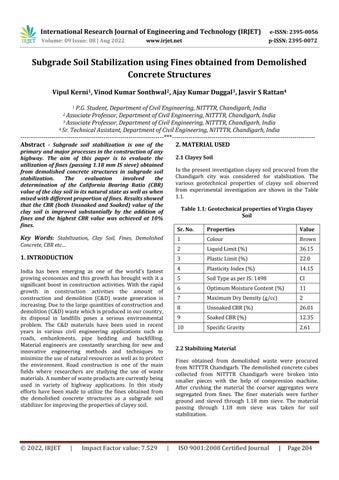
2.1 Clayey Soil In the present investigation clayey soil procured from the Chandigarh city was considered for stabilization. The various geotechnical properties of clayey soil observed from experimental investigation are shown in the Table 1.1. Table 1.1: Geotechnical properties of Virgin Clayey Soil

Key Words: Stabilization, Clay Soil, Fines, Demolished Concrete, CBR etc…

Sr. No.

Properties

Value

1

Colour

Brown

2

Liquid Limit (%)

36.15

1. INTRODUCTION

3

Plastic Limit (%)

22.0

India has been emerging as one of the world's fastest growing economies and this growth has brought with it a significant boost in construction activities. With the rapid growth in construction activities the amount of construction and demolition (C&D) waste generation is increasing. Due to the large quantities of construction and demolition (C&D) waste which is produced in our country, its disposal in landfills poses a serious environmental problem. The C&D materials have been used in recent years in various civil engineering applications such as roads, embankments, pipe bedding and backfilling. Material engineers are constantly searching for new and innovative engineering methods and techniques to minimize the use of natural resources as well as to protect the environment. Road construction is one of the main fields where researchers are studying the use of waste materials. A number of waste products are currently being used in variety of highway applications. In this study efforts have been made to utilize the fines obtained from the demolished concrete structures as a subgrade soil stabilizer for improving the properties of clayey soil.

4

Plasticity Index (%)

14.15

5

Soil Type as per IS: 1498

CI

6

Optimum Moisture Content (%)

11

7

Maximum Dry Density (g/cc)

2

8

Unsoaked CBR (%)

26.01

9

Soaked CBR (%)

12.35

10

Specific Gravity

2.61

© 2022, IRJET

|

Impact Factor value: 7.529

2.2 Stabilizing Material Fines obtained from demolished waste were procured from NITTTR Chandigarh. The demolished concrete cubes collected from NITTTR Chandigarh were broken into smaller pieces with the help of compression machine. After crushing the material the coarser aggregates were segregated from fines. The finer materials were further ground and sieved through 1.18 mm sieve. The material passing through 1.18 mm sieve was taken for soil stabilization.

|

ISO 9001:2008 Certified Journal

|

Page 204


Turn static files into dynamic content formats.
Create a flipbook