NOISE ABSORBING MATERIAL USING BIOPOLYMERS

Page 1

International Research Journal of Engineering and Technology (IRJET)

e-ISSN: 2395-0056

Volume: 09 Issue: 08 | August 2022

p-ISSN: 2395-0072

www.irjet.net

NOISE ABSORBING MATERIAL USING BIOPOLYMERS Md Seraj Uddin1, Rahul Sharma2 1Student,

Dept. of Civil Engineering ( M.Tech ), RadhaRaman Engineering College, Bhopal Professor, Dept. Of Civil Engineering, RadhaRaman Engineering College, Bhopal ---------------------------------------------------------------------***--------------------------------------------------------------------1.3 APPLICATION Abstract - Biopolymers reduce the demand for traditional, 2Assistant

organic, or propane nutrient products as a part of the "green" industry. As these biofibre and bilayer materials change, their ratios as well as their biological and mechanical characteristics are evaluated and quantified. The investigation is using agricultural garbage, which has intrinsic unpredictability. For frequencies between 0.30 and 3.0 KHz, ASTM E1050 (2012) criteria was used to calculate the rates of sound insulation. ASTM D412 investigated the vibrations of biopolymers and developed statistical measures for the mechanical and physical properties.

The bulk of functions are used in the automobile, food, textile, and construction industries today. Increasingly bioplastic products, including decorative panels, Eco-bricks, bio-shingles, and greenhouse substances, are being used in building materials. Examples include a coir fibre reshaped duffle bag made by Stemergy from composites reinforced and polypropylene to use adhesion reshaped nanofiber material.

2. METHODOLOGY

Reduced density, increased anechoic factor, decreased ultimate tensile strength (UTS) were among the correlations between material properties and increasing biofibre. Given that trade-offs among these traits are frequent, this innovation is crucial for maximising material selections when creating items.

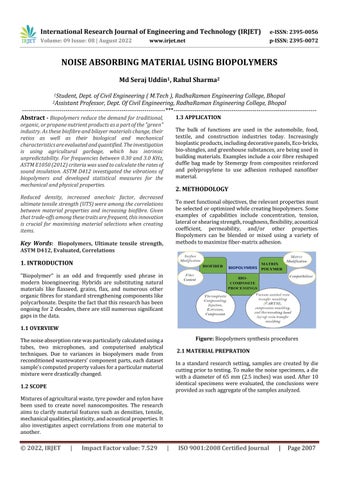
To meet functional objectives, the relevant properties must be selected or optimized while creating biopolymers. Some examples of capabilities include concentration, tension, lateral or shearing strength, roughness, flexibility, acoustical coefficient, permeability, and/or other properties. Biopolymers can be blended or mixed using a variety of methods to maximize fiber-matrix adhesion.

Key Words: Biopolymers, Ultimate tensile strength, ASTM D412, Evaluated, Correlations

1. INTRODUCTION "Biopolymer" is an odd and frequently used phrase in modern bioengineering. Hybrids are substituting natural materials like flaxseed, grains, flax, and numerous other organic fibres for standard strengthening components like polycarbonate. Despite the fact that this research has been ongoing for 2 decades, there are still numerous significant gaps in the data. 1.1 OVERVIEW Figure: Biopolymers synthesis procedures

The noise absorption rate was particularly calculated using a tubes, two microphones, and computerised analytical techniques. Due to variances in biopolymers made from reconditioned wastewaters' component parts, each dataset sample's computed property values for a particular material mixture were drastically changed.

2.1 MATERIAL PREPRATION In a standard research setting, samples are created by die cutting prior to testing. To make the noise specimens, a die with a diameter of 65 mm (2.5 inches) was used. After 10 identical specimens were evaluated, the conclusions were provided as such aggregate of the samples analyzed.

1.2 SCOPE Mixtures of agricultural waste, tyre powder and nylon have been used to create novel nanocomposites. The research aims to clarify material features such as densities, tensile, mechanical qualities, plasticity, and acoustical properties. It also investigates aspect correlations from one material to another.

© 2022, IRJET

|

Impact Factor value: 7.529

|

ISO 9001:2008 Certified Journal

|

Page 2007


Turn static files into dynamic content formats.
Create a flipbook
NOISE ABSORBING MATERIAL USING BIOPOLYMERS by IRJET Journal - Issuu