EXAMINING THE ACOUSTIC CHARACTERISTICS OF COMPOSITES MADE FROM WASTE STREAMS

Page 1

International Research Journal of Engineering and Technology (IRJET)

e-ISSN: 2395-0056

Volume: 09 Issue: 08 | August 2022

p-ISSN: 2395-0072

www.irjet.net

EXAMINING THE ACOUSTIC CHARACTERISTICS OF COMPOSITES MADE FROM WASTE STREAMS Md Seraj Uddin1, Rahul Sharma2 1Student,

Dept. of Civil Engineering ( M.Tech ), RadhaRaman Engineering College, Bhopal Professor, Dept. Of Civil Engineering, RadhaRaman Engineering College, Bhopal ---------------------------------------------------------------------***--------------------------------------------------------------------1.2 APPLICATION Abstract - The ASTM E1050 standard was being used to 2Assistant

determine coefficients of sound absorption at frequencies between 300 and 3000 Hz. Biocomposites lessen the need for conventional, synthetic, or gasoline-based carbon-based items. The compositions of such biofibre and layer materials are assessed and estimated as they change, as well as the physical and mechanical properties. These features were studied as a function of composition in order to develop a significant material from waste streams. The material strength previously obtained for the same biocomposites via ASTM D412 (1998) testing normal protocols were also linked to the acoustic features.

The majority of biocomposites meet the material needs of the construction, automotive, and packaging industries. They are lightweight, high-performing, and economical. More qualities, including acoustic dampening and moisture absorption, will also suit the design criteria for new innovations. The building sector is using more and more biocomposite goods, such as architectural panels, Eco-bricks, bio-shingles, and greenhouse materials. The architectural panel fibers offer an alternative to wainscoting made of wood, claims Stemergy.

Findings are important for optimising material choices when designing goods because compromises between these features are common. Following the interpretation of the findings, a quantitative link with density, highest tensile strength, ultimate tensile strength (UTS), and acoustical properties was discovered, along with other materials with improved characteristics. The dissertation created statistical formulas on mechanical and physical properties and examined the resonance frequencies of biocomposites.

2. METHODOLOGY To create biomaterial, crumbled tyres, crushed tyres, fiber crop waste, and resin were blended. Each group had a different weight proportion of each component. The samples were created using a Dake Press at 1.62 MPa (235 psi) pressure and 150-165°C for 20 minutes.

Key Words: Biocomposites, ASTM, Features, Strength, Tensile

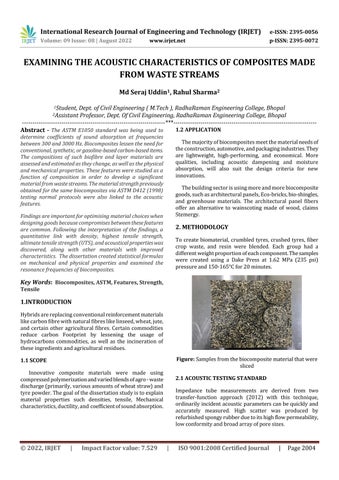
1.INTRODUCTION Hybrids are replacing conventional reinforcement materials like carbon fibre with natural fibres like linseed, wheat, jute, and certain other agricultural fibres. Certain commodities reduce carbon Footprint by lessening the usage of hydrocarbons commodities, as well as the incineration of these ingredients and agricultural residues. Figure: Samples from the biocomposite material that were sliced

1.1 SCOPE Innovative composite materials were made using compressed polymerization and varied blends of agro - waste discharge (primarily, various amounts of wheat straw) and tyre powder. The goal of the dissertation study is to explain material properties such densities, tensile, Mechanical characteristics, ductility, and coefficient of sound absorption.

© 2022, IRJET

|

Impact Factor value: 7.529

2.1 ACOUSTIC TESTING STANDARD Impedance tube measurements are derived from two transfer-function approach (2012) with this technique, ordinarily incident acoustic parameters can be quickly and accurately measured. High scatter was produced by refurbished spongy rubber due to its high flow permeability, low conformity and broad array of pore sizes.

|

ISO 9001:2008 Certified Journal

|

Page 2004


Turn static files into dynamic content formats.
Create a flipbook