International Research Journal of Engineering and Technology (IRJET) e-ISSN: 2395-0056

Volume: 09 Issue: 08 | Aug 2022 www.irjet.net p-ISSN: 2395-0072
International Research Journal of Engineering and Technology (IRJET) e-ISSN: 2395-0056
Volume: 09 Issue: 08 | Aug 2022 www.irjet.net p-ISSN: 2395-0072
1
G.H. Patel College of Engineering and Technology, Anand – 388120, India ***
Abstract - Given the age and continued deterioration of infrastructure, upgrading concrete structures has gained importance. Because of improved construction methods, the issue is worse. A structural engineer faces a dilemma when deciding whetherexpansionproceduresor materialsarebest for retrofitting a structure. Retrofitting is the science and technology of enhancing the performance of existing structures or structural components with new technologies, features,andcomponents.Areinforcedconcretestructurethat has already been built can be retrofitted by making repairs, rehabilitations,orstrengthening.Thecurrentarticleexplores the comprehensive study of retrofitting along with its classification. Moreover, the necessity and importance of the retrofitting accompanying the procedure of the same are explained. In addition, the various methodologies of retrofitting the retrofitting of reinforced concrete structures are explained in the present article.
Key Words: Retrofitting, Concrete Structure, Repair, Buildings,deterioration.
Inthecurrentsituation,concretestructuredeteriorationis aninternationalissue.Numerousfactorscontributetothis, including the occurrence of natural disasters like earthquakes,alackofawarenessofvariouscrucialstatutory requirementsinthefieldofbuilding,inadequateoversight, etc. These elements cause constructions to lack strength. Structure overloading can occasionally result in extreme deformationsandcorrosion,bothofwhichdemandtoday's attention. Today's building industry often calls for strengthening,retrofitting,andrepairworktocounteractall theseeffectsonreinforcedconcretestructures[1,2].
Allofthesepotentialwaystoproducedamagewillcallfora range of potential repair methods, from which the most efficient one will be selected in each specific situation. In somecircumstances, even recentlyconstructedstructures need to be repaired and strengthened in order to remove flawscausedbymistakesinthedesignorconstruction.Ithas alwaysbeenhighlydifficulttorepairaconcretestructureor one of its components, and effective solutions frequently required substantial work [3]. To deal with structural elements damaged by unexpected events like fire, earthquake, foundation movement, impact, and overload, specialized procedures of strengthening, stiffening, and repairarerequired[4].
Numerous existing bridges, industrial buildings, urban transportationhubs,marinestructures,andearth-retaining structures require maintenance or improvement. The reinforced concrete constructions must undergo some alterationsandadvancementsduringtheirservicelifefora varietyofreasons.Retrofittingorreplacementarethetwo optionsavailableinthissituation.Wholestructuresmustbe replaced,whichhasdrawbacksincludingexpensivelabour andmaterialprices.Therefore,ifpossibleandpractical,itis preferable to repair or update the structure rather than replacetheentirething[5].
Retrofittingistheprocessofgivinganythingacomponentor feature that was not included during manufacture or by addingsomethingthatwasnotpresentatthetimeoforiginal construction.Itfrequentlyreferstotheinstallationofnew buildingsystems,suchasheatingsystems,butitmayalso applytothefabricofabuilding,likeinstallingdoubleglazing or retrofitting insulation. Retrofitting RCC structural membersaredonetorestorethestrengthoftheweakened concreteelementstructure[6].Additionally,itaidsinhalting additional damage to concrete components. Errors in the design or subpar construction could be to blame for the concreteelement'slackofstrength.Anotherexplanationfor the decline can also exist, such as the aggressiveness of dangeroussubstances[7].
Dependingentirelyontheextentofthedamagecaused,the requiredcapacityofthestructuremayberestoredoncethe right method of retrofitting is applied and specified. Numerous methods, including external plate bonding, grouting,externalpost-tensioning,sectionenlargement,and fibre-reinforcedpolymercomposites,areemployedduring theretrofittingprocess[8].Whenstructuresandengineering projectsgetdamagedtothepointthattheycannotbeused forgeneral purposes,they mayrequirestrengthening and repair.Suchsituations.Theriskoflivesbeinglostaswellas any structural and content damage would be intolerable sincethestructurecannotsustainasubsequentsequenceof thesameactionorotherunintentionalactswithacceptable reliability.Retrofittingisastrengtheningmodificationthat canrestoreasuitablelevelofsafetyanddefenceagainstsuch acts[9].
Retrofitting is classified into two ways i.e., (1) Local Retrofitting and (2) Global Retrofitting. The seismic resistance of the structures is the focus of the global retrofittingtechnique.Shearstructureaddition,steelbracing
International Research Journal of Engineering and Technology (IRJET) e-ISSN: 2395-0056
Volume: 09 Issue: 08 | Aug 2022 www.irjet.net p-ISSN: 2395-0072
addition,infillstructureaddition,andfoundationisolation areallpartofit.Flatslabsorflatplatescanbeusedtoadd shearstructuresintoaconstruction.Withtheleastamount ofinterferencetothebuilding'sfunction,theycanbegivenin theouterframes[10].Alocalretrofittingtechniquefocuses on a member's seismic resistance. The local retrofit technique involves jacketing structural members, such as beams,columns,foundations,andbeam-columnjoints,with concrete, steel, or fibre-reinforced polymer. By adding a freshlayerofconcretewithlongitudinalreinforcementand evenlyspacedlinks,concretejacketingisaccomplished.The jacketimprovesthecolumn'sorthebeam'sflexuralstrength inbothdirections[11].
Retrofitting is now spreading uncontrollably over the globeasasubstantialportionofrecorded,public,andprivate noteworthydesignsgetoldandweakenwiththepassageof time.Retrofittingislikelythebestoptionforsecuringaweak structure against potential threats or other natural forces. Retrofitting is the process of adding new features to older structures, legacy structures, spans, and so forth [12]. Retrofittingreducesthepotentialforinjuryfromanexisting design during an impending seismic event. It is the modificationofcurrentdesignstomakethemmoreresistant to seismic activity, ground movement, and soil disappointmentproducedbyseismictremorsorothertypical cataclysms,suchastwisters,typhoons,andwindswithhigh velocity generated by tempest, blizzards, and hailstorms. Severaldesignshavehistorical,social,orpublicsignificance. Strength and resistivity are improved through retrofitting [13].
Astimegoeson,thestructureisimpactedbyavarietyof environmentalconditions.Themostharmful oftheseisan earthquake, which disrupts the interior structure of the building and gradually causes that structure to lose its strength and stability [14]. As a result, the building is rendereddangerousforusageinthefutureandcouldresult inasignificantloss.Theconcreteelementstructure'slevelof deteriorationisprogressingatanalarmingrate.Ithasbeen confirmedthatthereisahighprobabilityofconcreteelement deteriorationandreinforcementcorrosionevenwhenevery preciseconstructioncodeisfollowed[15].
One of the major factors that contribute to the deterioration of reinforced concrete components is steel corrosion, which may lead to cracking, a reduction in the reinforcement's useful area, spalling of the concrete's top layer,andevencollapse.Whendealingwithdamages,there aremanydifferentsituations[16].Ifabuilding,whetheritbe inthepublicorprivatesectors,suchasanofficeorahome, suffers severe structural damage. Civil engineers prefer to tear down and rebuild the structure [17]. However, dismantlingsignificantorhistoricallysignificantbuildingsis notanoption.Intheefforttomakebuildingsmoreefficient
andpractical,retrofittinghastakencentrestage.Byreducing fossil fuel waste, lowering operating costs and making structureseasiertomaintain,aswellashelpingtocombat helpless ventilation and moisture problems, the overall situation will be improved. Additionally, it can increase a building'srobustness,flexibility,andadaptability[18].
Theprimarygoalofretrofittingorrepairworkistoraise theload-bearingcapacity,boostthestructure'sperformance, or prolong its useful life. The sensible approach to any retrofittingoperationistotakeintoaccountboththeroot cause and the symptoms of the degradation. Without a thoroughgraspoftherootcausesoftheissues,fixingonly thesymptomscanresultinhiddenflawsbeingdiscovered beneaththefinishedproduct.Repairoftheretrofittingwork isbelievedtobesomethingthatshouldbeavoided,sothe followingactionsshouldbetaken[19-21].
Determine the performance criteria for the existing structure that has to be retrofitted and create a comprehensiveplanthatincludesinspection,technique selection,structuraldesign,andimplementationofthe retrofittingwork.
Examinethestructurethatneedstoberetrofitted.
Assess the structure's performance based on the inspection'sfindings,andmakesureitcomplieswiththe performancestandards.
Designoftheretrofittingstructureshouldbedoneifthe structuredoesnotmeetperformancestandardsandifit isdesirabletokeepusingthestructureaftertheretrofit.
Determine the materials to be utilized, the structural specifications, and the construction technique, then choosethebestretrofittingstrategy.
Analyzethestructure'sperformancefollowingtherefit andensurethatitsatisfiestheperformancestandards.
Implementtheretrofittingworkifitisassessedthatthe retrofittingstructurewillbeabletosatisfyperformance requirements using the chosen retrofitting and constructionmethods.
Concretejacketingisonetypeofretrofitforthebeams.To increase the flexural and/or shear capacity, extra longitudinalbarsandstirrupsmustbeaddedtogetherwith anadditionallayerofconcretearoundthecurrentbeam.The inquiry on reinforcing beams with bottom bars that are
2022, IRJET | Impact Factor value: 7.529 | ISO 9001:2008 Certified Journal | Page198
International Research Journal of Engineering and Technology (IRJET) e-ISSN: 2395-0056
Volume: 09 Issue: 08 | Aug 2022 www.irjet.net p-ISSN: 2395-0072
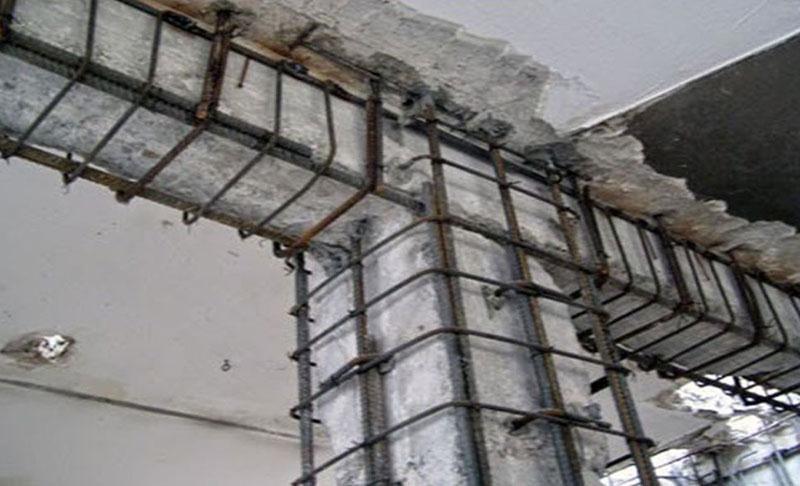
interrupted at joints is described in the current work. Concrete jacketing is required to increase bearing load capacity after a structural design revision or to restore structural design integrity following a structural member failure.Thismethodisappliedonverticalsurfaceslikewalls, columns,andothercombinationslikethebottomandsides ofbeams.Figure1demonstratestheconcretejacketing[22].
In the event of future seismic activity, A structure's susceptibilitytoharmisdecreasedbyretrofitting.Inorder tomeettherequirementsofthepresentcodalprovisionsfor seismicdesign,itseekstostrengthenastructure.Inrecent years,ithasbeendiscoveredthatseismicretrofitwithFRP materials has gained noticeably acceptance among the variousretrofittingmethods.FRPmaterialretrofitting isa technicallysoundandeconomicalrepairtechnologythatis currently widely employed as a seismic retrofitting approach.Theoptionsandproceduresusedinpracticefor wrapping the beam-column joints have been reviewed in this study. The breadth and applications of FRP materials likecarbonfibrereinforcedpolymer(CFRP)andglassfibre reinforced polymer are also summarized in this study (GFRP)[24,25].
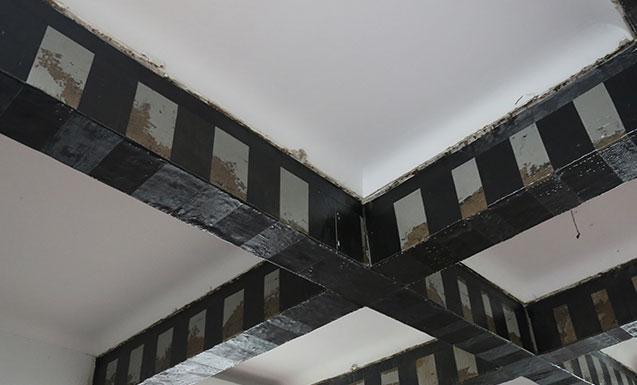
Manyconstructionsfoundinseismicallyactivezonesarenot able to withstand seismic waves, according to Indian Standard code requirements for earthquake concerns. Additionally,duetoinadequatedesign, poorconstruction, additionalloads,increasedperformancedemands,etc.,the seismicbehaviourofexistingstructuresisimpacted.Recent earthquakeshaverevealedthattheshearfailureofbeamcolumn joints is the main factor in the collapse of many moment-resisting frame buildings. Numerous research projects have been conducted to create various strengthening and restoration approaches to enhance the seismicperformanceofexistingstructures.Figure2depicts theCFRPjacketing[23].
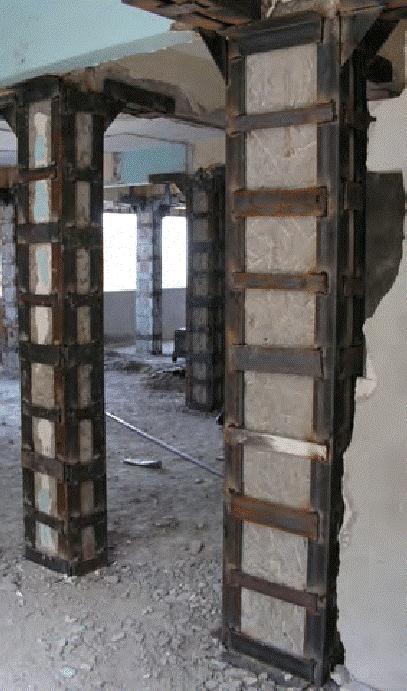
Increasesinbasicstrengthcapacitycanalsobeachieved bytheuseofsteeljacketing.Steeljacketingnotonlyoffers adequate confinement but also stops shell concrete deterioration,whichistheprimarycauseofbondfailureand longitudinal bar buckling. Steel jacketing is the process of coveringapartwithsteel platesandfillingthespacewith groutthatwon'tshrink.Itisaveryefficientwaytofixflaws like insufficient shear strength and poor longitudinal bar splicesatcrucialpoints.Butitcouldbeexpensive,andyou havetothinkabouthowfireresistantitis.Steelstripsand angles are the most widely utilized reinforcing method in reallife.Steeljacketingappearstobeusefulforretrofitting columnssinceithelpstorestorethestrength,ductility,and energy absorption capacity of columns. Additionally, the steeljacketcontributestothelap-splicedcolumn'sincreased flexural strength and ductile behaviour, improving the lateral performance of columns. Figure 3 shows the basic steeljacketingoftheconcretestructure[26].
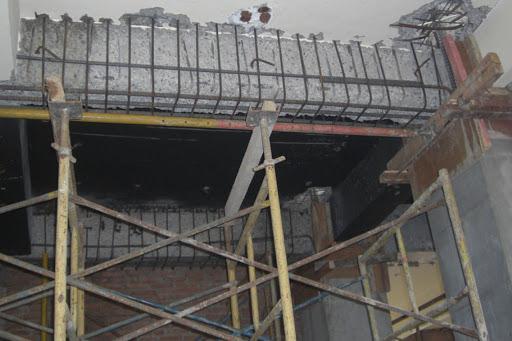
Figure4demonstratedthesteelcagingofthestructure.To improve the total energy dissipation potential and lateral stiffness, a strengthening technique using steel caging is
International Research Journal of Engineering and Technology (IRJET) e-ISSN: 2395-0056
Volume: 09 Issue: 08 | Aug 2022 www.irjet.net p-ISSN: 2395-0072
proposedtoraisethelateralstrengthofweakground-storey columns.Thiswillalsoimprovetheseismicperformanceof non-ductileopen-ground-storeyRCframes.Withtheaimof havingthestructuregenerateenoughflexuralstrengthand inelasticrotationatatargetyieldmechanismtosurvivethe likely seismic demand, a performance-based design methodologywasdeveloped[27].
experiment was to repair structurally flawed beams and makethemusablein bothflexureandshear.Additionally, theymakethemodificationssoordertoguaranteethatthe stiffness and strength values are higher than those of the control beam. Values for the parameters are higher than thoseforthecontrolbeams.Firstcrack,loaddeflection,and RCFS debonding were the metrics that this study's researchers discovered, along with patterns of fracture propagation.Toincreaseshearstrengthandstrengthenat the same time, they used shear straps. The test findings revealedthattheretrofittedRCFSbeamshavesignificantly higherstiffnessthanthecontrolbeams,andtheirdeflection issignificantlydecreasedearlyintheloadingcycle.Thereis ariseintheultimateloadsuponfailure.
In order to strengthen the reinforced concrete beam (RC) againstflexure,theauthor[30]investigatedthepotentialuse of externally bonded hybrid fibre reinforced polymer (HYFRP) with a combination of glass (GFRP) and carbon (CFRP)basedlaminates.Toevaluatetheflexurestrength,a totaloffivebeamswithcrosssectionsmeasuring150mmby 250mmby3000mmlongand2800mmsimplysupported spanwerecast.Fivebeamswereused,oneofwhichactedas areferencebeam.Theotherfourwerecomposedofhybrid FRPlaminates,withtheparametersmeasuredbeingstirrup spacing,HYFRPlaminatethickness,andcompositeratio.The testfindingsdemonstratedthattheRCbeamreinforcedwith hybrid fibre reinforced polymer (HYFRP) exhibited enhancedstrengthandcompositeactionupuntilfailure.
The author [28] carried out an experimental study by externallybondingGFRPsheetstotheRCbeamandtesting under the two-point static loading system. The study is basedontheflexuralbehaviourofRCbeamswrappedwith GFRPsheets.Sixreinforcedconcretebeamsweremadefor this, and it was found that all six of them had the same reinforcementdetailsandwereweakinflexuralloads.The bottom of the GFRP sheet wrapping in a 70% preloaded beamcanincreasetheflexuralcapacityofthebeamby14% (onultimateload)incomparison to the control beam,the researchersfound.Theyseparatedthreebeams,usedthree as control beams, and strengthened the other three using GFRPinthetensionzone.
Usingrubberizedfibresheetstestedundertwo-pointloads, the authors [29] undertook experimental work on the retrofitting of reinforced concrete beams. The goal of this
Theauthorconductedastudyonreinforcedconcretebeam failurebehaviourin2015[31].strengthenedwithabrandnew type of wire mesh-epoxy composite reinforcing material. Additionally, it was contrasted with an RC beam reinforced with a CFRP sheet (carbon fibre reinforced polymer).Thetestresultsrevealedthatusingawiremeshepoxycompositeimprovedthestiffness,yieldstrength,and first crack load of reinforced beams. In addition, using a hybridwiremesh-epoxy-carbonfibrecompositeresultedin better post-yield behaviour and reduced the risk of CFRP sheetscominglooseduringtheyieldingprocess.
According to a study [32], the flexural behaviour of reinforced concrete beams with multi-directional basalt fibre-reinforced polymer composites. By externally reinforcing the concrete beams, the research discusses an experimental behaviour of the basalt fibre reinforced polymercomposite.AtthebottomfaceoftheRCbeam,the BFRP composite is wrapped in one, two, three, and four layers. Based on the results of this experiment, the first fracture load is increased from 6.79 to 47.98 percent dependingontheincrement inlayers.The maximumload carrying capacity has also been raised from 5.66 to 20 percent.Thecrackspacinglikewisedecreasesasthenumber of layers rises. The majority of the reinforced beams in unidirectionalBFRPdisplayedcompressionandflexurecum crushingmodes.Thenumberoflayersisincreased,which
International Research Journal of Engineering and Technology (IRJET) e-ISSN: 2395-0056
Volume: 09 Issue: 08 | Aug 2022 www.irjet.net p-ISSN: 2395-0072
increasesthebeams'stiffness.Byexpandingthebasaltfibre layers,thecurvatureofstrengthenedbeamsisalsoreduced. The number of cracks increases while crack spacing decreasesduetoanincreaseinbasaltfibrelayers.
The study titled "Comparative evaluation of different retrofittingstrategies"isexaminedbytheauthor[33].Fora very long time, concrete has been a significant and productivematerialintheconstructionsector.Itisusedin the building industry in a wide variety of ways. From this experiment, all beams were retrofitted utilizing various procedures, including HFRC, FRC, SIFCON, SIMCON, and Ferrocement.Applymortartothefullbeamaftercovering the entire beam with SIMCON. Apply mortar- and slurryinfiltratedfibreconcrete(steelfibre)tothesurfaceofbeams. Thesameprocedurewillbeusedforpolypropylenefibre.In Ferrocementretrofitting,chickenmeshandweldedwireare utilizedtocoverthebeamsbeforethesurfacesarecovered with mortar. As a result, it can be said that the concrete beamretrofittedwithSIFCONyieldshigherflexuralstrength, withthepercentageintheflexuralstrengthascomparedto the beam without retrofitting being found to be 85.03 percent.TheconcretebeamretrofittedwithFerrocement alsoyieldshigherflexuralstrength.
RCbeamsretrofittedinflexureandshearbypre-tensioned steel ribbons were the subject of an experimental examinationbytheauthors[34].Accordingtothisinquiry, thepre-stressedstainlesssteelribbonservesasanauxiliary transversal reinforcement and encloses the structural element. Nine shear deficient beams and six flexural deficientbeamswerecastandtestedinthecurrentstudy.In thefirstgroup,fourbeamswereretrofittedwithtransversal ribbons and bottom stainless steel angles spaced at two different intervals, while in the second group, three specimens were retrofitted by wrapping the beam with ribbons, and the remaining three specimens were strengthened by perforating the beam beneath the slab height and by partially wrapping the beam by putting the ribbons through the hole. It was determined that the test resultsdemonstratedtheeffectivenessofthemethod.
Thestudy[35]investigatedtheuseofexternalbarsatthe soffit level to retrofit RC beams for flexural loads. In an experimentalinvestigation,theauthorssuggestedthatthe exteriorbarsberetainedatthebeamsection'ssoffitlevelto avoid the need for mechanical anchoring devices like deflectors and make the design more practical, straightforward, and efficient. The improved ductility decreased deflection and fracture width, and increased momentbearingcapacityofthecurrentmethodarefurther benefits. The inherent drawbacks of existing retrofitting techniques, such as section enlargement, bonded steel plating, external post-tensioning strengthening, and strengtheningwithFRPcompositesheets,includehighcoast, the need for sophisticated tools, an increase in sectional area,andsurfacepreparation.De-bondingfailures,a poor
cost-benefit ratio, costly maintenance, etc. The suggested methodofmaintainingreinforcementexternallyatthesoffit level has various benefits, including simple and quick execution,noinstallationdisruption,alowself-weightneed, andnodiscerniblereductioninheadroom[36].
For the purpose of finding more effective sustainable retrofitting approaches, new techniques are being developed.Themostpopularmethodsarethosethatwere juststated. The retrofitting ofa structureaffectshow that structure responds to risks other than those related to flooding,suchaswindhazards,andthearchitect,engineer, orcodeofficial mustbeawareofthis. Whenit ispossible, dangersshouldbeapproachedholistically.Theretrofitting processshouldtakeintoaccountbothflood-relatedandnonflood-relatedrisks,suchasearthquakeandwindforces,as well as water-borne ice and debris impact forces, erosion forces,andmudslideimpacts.Astructure'sabilitytoendure the several risks outlined above may be harmed by retrofitting it to simply withstand floodwater-generated stresses. As a result, it's crucial to use a multi-hazard strategywhilechoosingaretrofittingmethodanddesigning theproject.
[1] NationalInstituteofStatistics(ISTAT)16°Censimento Generale della Popolazione e delle Abitazioni.ISTAT; Rome,Italy:2021.(InItalian)
[2] Dall’AstaA.,LandolfoR.,SalvatoreW.EdificiMonopiano inAcciaioad UsoIndustriale.DarioFlaccovioEditore; Palermo,Italy:2022.(InItalian)
[3] CNR (Consiglio Nazionale delle Ricerche)CNR-UNI 10011: Steel Structure–Instruction for Design, Construction, Testing and Maintenance.UNI; Milano, Italy:1988.(InItalian)
[4] CS.LL.PP. (Consiglio Nazionale dei Lavori Pubblici)Criteri Generali per la Verifica di Sicurezza delle Costruzioni e Norme Tecniche per i Carichi ed i Sovraccarichi.Gazzetta Ufficiale della Repubblica Italiana, Italian Ministry for Infrastructures and Transportations;Rome,Italy:1982.(InItalian)
[5] CS.LL.PP.(ConsiglioNazionaledeiLavoriPubblici)Circ. 24/05/1982,n.22631:IstruzioniRelativeaiCarichi,ai Sovraccarichi ed ai Criteri Generali per la Verifica di Sicurezza delle Costruzioni.Gazzetta Ufficiale della RepubblicaItaliana,ItalianMinistryforInfrastructures andTransportations;Rome,Italy:1982.
[6] CS.LL.PP. (Consiglio Nazionale dei Lavori Pubblici)D.M.24/01/1986: Norme Tecniche per le
International Research Journal of Engineering and Technology (IRJET) e-ISSN: 2395-0056
Volume: 09 Issue: 08 | Aug 2022 www.irjet.net p-ISSN: 2395-0072
Costruzioni in Zone Sismichel.Gazzetta Ufficiale della RepubblicaItaliana,ItalianMinistryforInfrastructures andTransportations;Rome,Italy:1986.
[7] Cantisani G., Della Corte G. Modelling and Seismic Response Analysis of Non-residential Existing Steel Buildings in Italy.J. Earthq. Eng.2022 doi:10.1080/13632469.2022.2030438.
[8] Scozzese F., Terracciano G., Zona A., Della Corte G., Dall’AstaA.,LandolfoR.Modellingandseismicresponse analysisofItaliancode-conformingsingle-storeysteel buildings.J. Earthq. Eng.2018;22:2104–2133. doi:10.1080/13632469.2018.1528913.
[9] SimõesdaSilvaL.,SilvaL.C.,TankovaT.,CraveiroH.D., Simões R., Costa R., D’Aniello M., Landolfo R. Performance of modular hybrid cold-formed/tubular structural system.Structures.2021;30:1006–1019. doi:10.1016/j.istruc.2021.01.066.
[10] PoursadrollahA.,D’AnielloM.,DeMartinoA.,LandolfoR. Preliminarystudyontheseismicperformanceofhybrid steelstructureswithtrusslightweightgirdersandplugand-playconnections.Ing.Sismica.2020;37:102–114.
[11] FaggianoB.,FormisanoA.,D’AnielloM.,LandolfoR.Steel ConstructionsintheFrameworkoftheEmilia-Romagna Earthquake.Progett. Sismica.2012;3:189–200.(In Italian)
[12] Braga F., Gigliotti R., Monti G., Morelli F., Nuti C., Salvatore W., Vanzi I. Speedup of post earthquake community recovery: The case of precast industrial buildingsaftertheEmilia2012earthquake.Bull.Earthq. Eng.2014;12:2405–2418. doi:10.1007/s10518-0149583-3.
[13] Formisano A., Di Lorenzo G., Iannuzzi I., Landolfo R. Seismic Vulnerability and Fragility of Existing Italian Industrial Steel Buildings.Open Civ. Eng. J.2017;11:1122–1137. doi:10.2174/1874149501711011122.
[14] DiSarnoL.,FreddiF.,D’AnielloM.,KwonO.-S.,WuJ.-R., Gutiérrez-Urzúa F., Landolfo R., Park J., Palios X., Strepelias E. Assessment of existing steel frames: Numericalstudy,pseudo-dynamictestingandinfluence ofmasonryinfills.J.Constr.SteelRes.2021;185:106873. doi:10.1016/j.jcsr.2021.106873
[15] RomanoE.,CasciniL.,D’AnielloM.,PortioliF.,Landolfo R.Asimplifiedmulti-performanceapproachtolife-cycle assessmentofsteelstructures.Structures.2020;27:371–382.doi:10.1016/j.istruc.2020.05.053
[16] Kazantzi A.K., Vamvatsikos D. Seismic and Vibration Performance Rehabilitation for an Industrial Steel
Building.Pract. Period. Struct. Des. Constr.2020;25:05020001. doi:10.1061/(ASCE)SC.1943-5576.0000475.
[17] Di Sarno L., Elnashai A. Bracing systems for seismic retrofitting of steel frames.J. Constr. Steel Res.2009;65:452–465.doi:10.1016/j.jcsr.2008.02.013.
[18] Rinaldin G., Fasan M., Sancin L., Amadio C. On the behaviourofsteelCBFforindustrialbuildingssubjected toseismicsequences.Structures.2020;28:2175–2187. doi:10.1016/j.istruc.2020.10.050.
[19] Formisano A., Di Lorenzo G., Landolfo R. Seismic retrofittingofindustrialsteelbuildingshitbythe2012 Emilia-Romagna earthquake: A case study.AIP Conf. Proc.2019;2116:260021.doi:10.1063/1.5114272.
[20] Hirde S., Jagtap M. Retrofitting of Damaged Industrial Buildings.Int.J.Civ.Eng.Technol.2013;4:267–277.
[21] Bournas D.A., Negro P., Taucer F.F. Performance of industrial buildings during the Emilia earthquakes in Northern Italy and recommendations for their strengthening.Bull. Earthq. Eng.2013;12:2383–2404. doi:10.1007/s10518-013-9466-z.
[22] CEN (European Committee for Normalization)EN1993:1-1Eurocode3:DesignofSteel Structures–Part 1-1: General Rules and Rules for Buildings.CEN;Bruxelles,Belgium:2005.
[23] Xu Z.-D., Liao Y.X., Ge T., Xu C. Experimental and TheoreticalStudyofViscoelasticDamperswithDifferent Matrix Rubbers.J. Eng. Mech.2016;142:04016051. doi:10.1061/(ASCE)EM.1943-7889.0001101.
[24] Reitherman, Robert, Earthquakes and Engineers, InternationalHistory,Reston,VA,2012,ASCE,press,pp. 486-487.
[25] SilvaMAL,DedigamuwaKVandGamageJGPH2020 Performance of severly damaged reinforced concrete flatslab-columnconnectionsstrengthenedwithCFRP
[26] Suhreed Das, Farjana Akter, Farzana Rahman ChowdhuryandJobaidulAlamBoni2016Retrofittingof Flat Slab Building Members Undergone Damage by Earthquake Forces – Asian journal of innovative researchinscience,Engg.andTech.5
[27] Marco Valente 2012 Seismic rehabilitation of a threestoreyR/Cflat-slabprototypestructureusingdifferent techniques–Appliedmechanicsandmaterials7
[28] Xiangguo Wu, Shiyan Yu, Shicheng Xue, Thomas H.-K. Kang and Hyeon-Jong Hwang 2019 Punching shear strengthofUHPFRC-RCcompositeflatplates
2022, IRJET | Impact Factor value: 7.529 | ISO 9001:2008 Certified Journal | Page202
International Research Journal of Engineering and Technology (IRJET) e-ISSN: 2395-0056
Volume: 09 Issue: 08 | Aug 2022 www.irjet.net p-ISSN: 2395-0072
[29] Graziano Salvalai, Marta Maria Sesana and Giuliana Iannaccone2017Deeprenovationofmulti-storeymultiownerexistingresidentialbuildings:Apilotcasestudyin Italy
[30] Mary Beth D Hueste and Jong Wha-Bai 2006 Seismic retrofitofareinforcedconcreteflatslabstructure:PartI –Seismicperformanceevaluation
[31] Navarro M, Ivorra S and Varona F B 2020 Parametric finiteelementanalysisofpunchingshearbehhaviourof RCslabsreinforcedwithbolts
[32] Tartaglia R.,D’AnielloM.,LandolfoR.Theinfluenceof rib stiffeners on the response of extended end-plate joints.J. Constr. Steel Res.2018;148:669–690. doi:10.1016/j.jcsr.2018.06.025.
[33] 39.TartagliaR.,D’AnielloM.,RassatiG.A.,SwansonJ.A., LandolfoR.Fullstrengthextendedstiffenedend-plate joints: AISC vs recent European design criteria.Eng. Struct.2018;159:155–171. doi:10.1016/j.engstruct.2017.12.053.
[34] 40.Tartaglia R., Milone A., D’Aniello M., Landolfo R. Retrofit of non-code conforming moment resisting beam-to-column joints: A case study.J. Constr. Steel Res.2021;189:107095. doi:10.1016/j.jcsr.2021.107095.
[35] 41.Tartaglia R., D’Aniello M., Wald F. Behaviour of seismicallydamagedextendedstiffenedend-platejoints atelevatedtemperature.Eng.Struct.2021;247:113193. doi:10.1016/j.engstruct.2021.113193.
[36] 42.Dutta A., Dhar S., Acharyya S.K. Material characterizationofSS316inlow-cyclefatigueloading.J. Mater.Sci.2010;45:1782–1789.doi:10.1007/s10853009-4155-7.
2022, IRJET | Impact Factor value: 7.529 | ISO 9001:2008 Certified Journal