International Research Journal of Engineering and Technology (IRJET) e-ISSN: 2395-0056

International Research Journal of Engineering and Technology (IRJET) e-ISSN: 2395-0056
2
1
Abstract - In recent decades, the application of selfcompacting concrete (SCC) has emerging in construction structures because of its good abilities to improve durability anddecreasebleedingwithgoodbondingwithrebar.Besides, large amount of aggregates is required for the production of SCC. On the other hand, replacing natural aggregate in SCC with waste materials can led to discover ecological building materials. Walnut shell (WS) is one of the natural and agriculture waste materials which can be used as a substitutionofaggregateinSCC.Inthisresearch,WSwasused as a replacement of coarse aggregate and ground granular blast furnace slag (GGBFS) as mineral admixture for constructingSCCbyemployingvolumefractionsofWSis35%. The optimum percentage of GGBFS content is considered for the research. Fresh and hardened properties of SCC and lightweight self- compacting concrete (LWSCC) were investigated for the mix and control one. The results showed that all tested properties have satisfactory results of conventional SCC. However; the LWSCC can get at fraction volumeofWSequalandormorethan35%.Where,slumpflow diameter (SFD), compressive strengths and split tensile strength for flyash were 550 mm, 28 MPa and 2.4 MPa respectively achieved at 35% ratio of WS.
Key Words: Self-compactingconcrete,Walnutshell,Coarse aggregate,Mineraladmixture,Lightweightself-compacting concrete.
Theintroductionofnewmaterials,whichactasstructure massreductionandworkablematerialssuchaslightweight concrete (LWC) and self-compacting concrete (SCC) materials are one of the most recent technology in the modern construction industries. Lightweight selfcompactingconcrete(LWSCC)ispredictedtoproducehigh workabilitywhilenotsegregationandhighdurabilitywith reduced weight of SCC Light- weight aggregate (LWA) is generally used in the LWC construction and can be manufacturedbynaturallysourcedorartificiallyconstructed fromprocessingby-productsofsomeindustrialprocesses. Lightweight concrete has a low viscosity and large rate of flow which is very important for concrete pumping, particularly in multi-storey buildings. The success to
***
production of high quality LWSCC lies within the use and qualityofaggregates.
Walnutshell(WS)isoneofthenaturalandagriculturewaste materialswhichcanbeusedasasubstitutionofaggregatein SCC. The utilization of walnut shell aggregate with other quality additional cementing materials like GGBFS can providehighlyworkableanddurableLWSCC.Useofthese aggregates provides property to the sustainable development by protective energy increasing structural propertiesandincreasingtheservicelifetimeofstructural lightweightconcrete(LWC). Compactionisnormallydone with the help of vibrator during concreting and it raises concreting cost. In earnest quest for innovation in constructionindustryself-compactingconcrete(SCC)inlate 1980 s and is gradually gaining popularity. SCC have a propertytoflowundergravityandmorecompactlyfillthe complex space of formwork as well as the area congested with reinforcement. LWSCC is capable of filling up the formworkandencapsulatereinforcementbyitsself-weight withouttheneedforextracompactionorexternalvibration. It has better segregation resistance, high flowability and passingabilityatfreshstateaswellasbettermechanicaland durabilitypropertiesinthehardenedstate.
GGBSismainlyusedasapartialsubstituentforcementin concrete. When added as an admixture to concrete, its performancesasastabilizingagentandenhancethequality of concrete. In the production of ready-mixed concrete, a portion of the Portland cement component is replaced by GGBS, generally about 60-70%. It is resistant to sulfate attacks,chloride-relatedcorrosionandalkali-silicareaction. Itisoneofthegreenestconstructionmaterialsthatdoesnot manufacturesanywasteanditswaterdemandlowerby35%comparedtoOPC.
Table
Sl.No. Chemicalcomposition
PercentageContent
1 Silica(SiO2) 36.41
2 IronOxide(Fe2O3) 0.69
Volume: 09 Issue: 08 | Aug 2022 www.irjet.net p-ISSN: 2395-0072 © 2022, IRJET | Impact Factor value: 7.529 | ISO 9001:2008 Certified Journal | Page1841
P.G. Student, Structural Engineering, Universal Engineering college, Thrissur, Kerala Associate Professor, Civil Department, Universal Engineering college, Thrissur,KeralaInternational Research Journal of Engineering and Technology (IRJET) e-ISSN: 2395-0056
Volume: 09 Issue: 08 | Aug 2022 www.irjet.net p-ISSN: 2395-0072
3 Alumina(Al2O3) 10.39 4 CalciumOxide(CaO) 34.12 5 MagnesiumOxide(MgO) 8 6 TotalSulphur(SO3)7 PottassiumOxide(K2O) 0.97
Table -2: PhysicalPropertyofGGBFS[4]
Sl.No. PhysicalProperty TestResults 1 Colour Grey 2 SpecificGravity 2.3
Use of Ordinary Portland Cement (OPC) of Grade 53 accordingtoISspecificationsismadeinthisinvestigation. Table3providescement'scharacteristics.
Table-3: PropertiesofOPC53GradeCement
Properties Test Results TechnicalReference
SpecificGravity 3.12 IS4031(PART11):1988 Consistency(%) 30 IS4031(PART4):1988 Finenessof Cement(%) 4.7 IS4031(PART2):1996
InitialSetting Time(minutes) 78 IS4031(PART5):1988
For construction, manufactured sand (M-Sand) is an alternative for river sand. M-sand is a product made from hardgranitestonethat werecrushed. M-Sand isless than 4.75mminsize.Additionally,itisadust-freematerialthat pollutes very little. Table 4 lists the fine aggregate's characteristics.
Table-4:PropertiesofFineAggregate[25]
Properties Test Results
SpecificGravity 2.52
FinenessModulus 3.84
FreeSurfaceMoisture Nil
Aggregateswithaparticlesizemorethan4.75 mm,but typicallybetween10and40mminsizeisconsideredascoarse aggregate.Concretebenefitsfromcoarseaggregate'sstrength, toughness,andhardnessqualitiesaswellasitsresistanceto abrasion. The experimental study's coarse aggregate was 12.5mminsizeandconformedtoIS383:1970.Table5lists thecharacteristicsofcoarseaggregate.
Table-5: PropertiesofCoarseAggregate
Properties Test Results Technical Reference
SpecificGravity 2.69 IS2386(PART3):Clause2.4.2
FreeSurface Moisture Nil IS383(PART3):1970
Fineness Modulus 4.25 IS383(PART 3): 1970 table2
Walnutshellhasuniqueproperties,itisverydenseand takesyearsandyearstodecomposeorbreakdown.Itcanbe crushedandcouldbegroundintoseveralpiecesfromextra finetoextracourse.Duetotheexcessivehardnessofwalnut shell,walnutshellisusedasanabrasivethatisappliedto surfacepreparationoncementitioussurfacesincludingcastin-place concrete floors and walls, masonry walls, and shotcretesurfaces.Walnutshellisadequatelyhardnatural materialwhichcanbeusedascoarseaggregatepartiallyfor making lightweight concrete. However, its particle size, shapeandgradationwillaffectwork-abilityandstrengthof concrete.Moisturecontentandwaterabsorptionproperties willinfluenceshrinkageperformance.
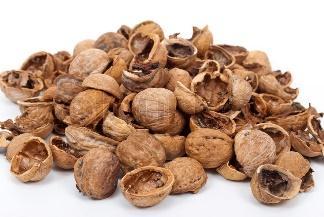
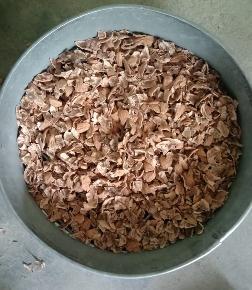
Table-6: PropertiesofWalnutShell[13]
SpecificGravity 0.96
WaterAbsorption 10%
Thickness 0.86–1.35
SizeOfAggregate 12.5mm
International Research Journal of Engineering and Technology (IRJET) e-ISSN: 2395-0056
Volume: 09 Issue: 08 | Aug 2022 www.irjet.net p-ISSN: 2395-0072
Waterisrequiredtowetthesurfaceofaggregatetodevelop adhesive quality as the cement paste binds quickly and satisfactorilytothewetsurfaceoftheaggregatesthandry surface. It is commonly accepted view that any portable water is suitable to be used in concrete making. It should haveinorganicsolidlessthan1000ppmandshouldbefree frominjuriousquantitiesofalkalies,acids,oils,salts,sugars, organicmaterials,vegetablegrowthorothersubstancethat canbedeleterioustobricks,stones,concreteorsteel.
“Amaterialotherthanwater,aggregates,hydrauliccement, andfiberreinforcement,usedasaningredientofconcreteor mortar, and added to the batch right away before or during itsmixing”isthedefinitionforadmixture. Chemical admixtures are used to upgrade the quality of concrete during mixing, transporting, placement and curing. MASTERRHEOBUILD 1126ND has a different chemical structurefromthetraditionalsuperplasticisers.Itconsists of a naphthalene formaldehyde polymer with long side chains. With this process, flowable concrete with reduced watercontentisobtained.
Aspect DarkBrownLiquid RelativeDensity 1.24±0.02at25 c pH ≥6
ChlorideIronContent ˂0.2%
Cubesofsize150mmx150mmx150mmwasusedforthe study. A total of 6 cubes and 3-cylinder specimen were casted.Thespecimenwastestedbytheoptimumcontentof GGBFS45%withoptimumcontentofwalnutshell35%in self-compacting concrete. And 6 cubes and 3-cylinder specimen were casted of conventional SCC. The mix were designedaccordingtoIS456:2000andthedetails.
Therequiredquantitiesofcement,fineaggregate,coarse aggregate,superplasticisers,mineraladmixtureandwater weretakenforcontrolspecimens,inadditiontothis,walnut shell were mixed with the ingredients. Concrete was prepared by machine mixing. Initially cement and fine aggregateweremixedindrystateuntilitisofevencolour throughoutandfreefromstreaksfollowedbytheadditionof walnutshellandthenmeasuredquantityofcoarseaggregate wasspreadout.Thewholemasswasmixedbymachineinan angleof45%.Three quarter ofthetotal quantityofwater wasaddedwhilethematerialswereturnedintowardsthe centrewithspades.Theremainingwaterwasaddedslowly when the whole mixture was turning over and over again until a uniform colour and consistency was obtained throughout.
Themouldwasmadereadiedbyapplyingoilinallcontact surfaces.Concretewasspreadonthemouldanduniformly spreadthemixonthemould.Theotherspecimenwascast by adding walnut shell of 35% to the concrete. Proper surfacefinishingwasprovided.Thespecimenwasremoved fromthemouldafter24hoursandkeptforcuring.After28 daysofcuring,specimenswerereadyfortesting.
Many different test methods have been introduced in attempts to characterise the properties of SCC. Similarly, thereisnosinglemethodhasbeenfoundwhichcharacterises alltherelevantworkabilityaspectssoeachmixdesignshould be tested by more than one test method for the different workabilityparameters.FortheinitialmixdesignofSCCall threeworkabilityparametersneedtobe evaluateto make surethatallaspectsarefulfilled.
Twotestmethodsaregenerallysufficienttomonitorthe qualitycontrolinsiteforproductionquality.Typicalthetest conductedareSlump-flowandV-funnelorSlump-flowandJring. Table-
International Research Journal of Engineering and Technology (IRJET) e-ISSN: 2395-0056
Volume: 09 Issue: 08 | Aug 2022 www.irjet.net p-ISSN: 2395-0072
Thepropertiesofhardenedconcrete,suchascompressive strength and split tensile strength of concrete mixes were determinedbycasting150x150x150mmcubespecimens, 150x300mmcylinderspecimensasperISspecifications.
The requirements are to be satisfied at the time of placingwhichmeansitinfreshstate. Likely changesin workability during transport of mix should be taken into account in production. EFNARC specifications provides typical acceptancecriteriaforSelf-compactingconcretewith amaximumaggregatesizeupto20mmareshowninTable9.
Table-9: AcceptanceCriteriaforSelf-CompactingConcrete [28]
Test Method Unit Typical Range of Value Minimum Maximum Slump-flowbyAbram’s cone mm 650.0 800
T50cmslumpflow sec 20.0 5 J-ring mm 6.0 10 V-funnel sec 0.0 12 V-funnelatT5minutes sec 0.8 ±3 L-box h2/h1 0.0 1 U-box h2-h1 (mm) 90.0 30 Fill-box % 0.0 100 GTMscreenstabilitytest Sec 0.0 15 Orimet Sec - 5
These typical requirements shown against each test method are based on modern knowledge and practice. Specialcareshouldbetakentoensurenosegregationforthe mix.
Table-10 TestResultsonFreshConcrete
Trial Mix Slump (mm) T50 cm (Sec) L - box
SCC1 480 37.00 0.4 SCC2 580 18.00 0.8 SCC3 600 6.18 0.9
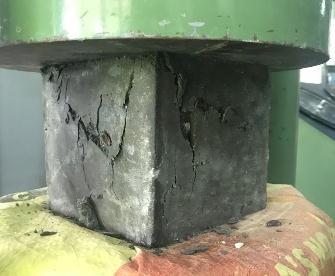
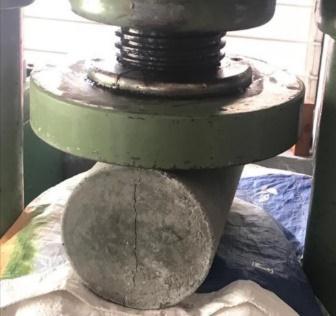
Thecompressivestrengthofconcreterepresentsoneof themostimportantfeaturesusedinthedesignrulesofthe concrete structures, and many of other mechanical characteristics and physical properties of concrete. The resultsaretabulatedforconventionalSCC inTable11.
Figure2CompressiveStrengthTestofSCCMixwith GGBFS
Table-11: TestResultsonConventionalSCCHardened Concrete
Sample Number Compressive Strength of Cube (N/mm2) Split Tensile Strength (N/mm2) 1 37.77 3.324 2 37.11 3.254 3 36.88 3.324 Average 37.25 3.333
Table-11: TestResultsonCompressiveStrengthofLWSCC CubeswithGGBFS
No. of Days Load (kN) Compressive Strength (N/mm2) Average Compressive Strength (N/mm2) 7 415 18.44 18.29 450 20.00 370 16.44 28 680 30.22 29.09 650 28.88 634 28.17
International Research Journal of Engineering and Technology (IRJET) e-ISSN: 2395-0056
Volume: 09 Issue: 08 | Aug 2022 www.irjet.net p-ISSN: 2395-0072
Theconcreteisweakintensionduetoitsbrittlenature andisnotexpectedtoresistthedirecttension.Theconcrete developscrackswhenitissubjectedtotensileforces.Thus,it isnecessarytodeterminethetensilestrengthofconcreteto determine the load at which the concrete members may producecrack.Tensilestrengthofconcreteismuchlowerto its compressivestrength. Itisapproximatethatthe tensile strength of concrete equals roughly about 10 % of compressivestrength.
Table-11: TestResultsonSplitTensileStrengthofLWSCC CubeswithGGBFS
No. of Days Load(kN)
Split Tensile Strength (N/mm2)
Figure3
The main aim was to study the properties of LWC using walnutshellascoarseaggregatewiththeconventionalselfcompacting concrete. From the studies we come to the followingconclusions:
The compressive strength test and split tensile strengthobtainedfromtheexperimentaltestwere notsatisfied.
IwishtothanktheManagement,PrincipalandHeadofCivil EngineeringDepartmentofUniversalEngineeringCollege, Thrissur, affiliated by Kerala Technological University for theirsupport.Thispaperisbasedontheworkcarriedoutby me (Anjana Pradeep), as part of my PG course, under the guidance of Mrs. Anima P. (Associate professor, Civil Department, Universal Engineering College, Thrissur, Kerala). I express my gratitude towards her for valuable guidance.
1. AnandDevB.G.andJayasreeS.(2017),“Effectof LightweightAggregateontheFlexuralBehaviourof SelfCompactingConcrete”, International Journal of ScientificandEngineeringResearch,Vol.7,Issue10, pp: 16 – 22
2. Arul sivanantham P. and Gokul R. (2018), “A ReviewonSelfCompactingConcrete”, International Journal of Chem Research,Vol.10,Issue11,pp: 62 –68
3. DominicStefanLawYimWan,FarhadAslaniand Guowei Ma (2018), “Lightweight Self-Compacting Concrete Incorporating Perlite, Scoria, and PolystyreneAggregates”, Journal of material in civil engineering, Vol. 8, Issue 30, pp: 1 –13
4. E. Guneyisi et. al, (2013), “Performance of Self Compacting Concrete (SCC) with High Volume Supplementary Cementitious Material (SCMs)”, Science Direct,pp:198–217
5. Idowu H. Adebakin, K. Gunasekaran and R. Annadurai (2018), “Mix Design and Rheological Properties of Self-Compacting Coconut Shell Aggregate Concrete”, Journal of Engineering and Applied Science,pp:465–1475
6. JingjunLi,EnjiaZhao,JiangangNiuandChaojun Wan,(2020),“Studyonmixturedesignmethodand mechanicalpropertiesofsteelfiberreinforcedselfcompactinglightweightaggregateconcrete”, Science Direct,pp:1–15
FromthestudyitshowsthatLWCrequireddensity below2000kg/m³andwiththerequiredstrength were 38 MPa and we obtained density as per the studyandbutstrengthobtainedwas28MPa.
7. K. J. H. Zhou and Ho and Su (2011), “Flexural Strength and Deformability Design of Reinforced Concrete Beams”, ScienceDirect,Vol.14,pp:1399–1407
Fromtheobtainedresults35%givestheeffective replacementofcoarseaggregatewithwalnutshell givessimilarstrengthofself-compactingconcrete.
8. K.S. Elango, D. Vivek, S. Anandaraj, R. Saravanakumar, J. Sanfeer and S. Saravanaganesh (2021), “Experimental study on self-compacting concrete using light weight aggregate”, Science Direct,Vol.14,pp:1–6
International Research Journal of Engineering and Technology (IRJET) e-ISSN: 2395-0056 Volume: 09 Issue: 08 | Aug 2022 www.irjet.net p-ISSN: 2395-0072
9. Mahmoud Khashaa Mohammed, Abdulkader IsmailAl-HadithiandMarwaH.Mohammed(2019), “Productionandoptimizationofeco-efficientselfcompactingconcreteSCCwithlimestoneandPET”, Science Direct,Vol.197,pp:734-746
10. Mohammed Sonebi and AmmarYahia (2020), “Mix Design Procedure, Tests and Standards”, Science Direct,pp:1-30
11. MojdehMehrinejadKhotbehsara,EhsanMohseni, TogayOzbakkalogluandMalekMohammadRanjbar (2017), “Durability Characteristics of SelfCompacting Concrete Incorporating Pumice and Metakaolin”, Journal of Materials in Civil Engineering,Vol. 11, Issue 29,pp:1-9
12. Mouhcine Ben Aicha (2020), “The Superplasticizer Effect on The Rheological and MechanicalPropertiesofSelfCompactingConcrete”, Science Direct,pp:315–331
13. Nahla Hilal, Taghreed Kh Mohammed Ali and Bassam A. Tayeh (2021), “Fresh and Hardened PropertiesofLightweightSelf-CompactingConcrete Containing Walnut Shells as Coarse Aggregate”, Science Direct,Vol.33,pp:364–372
14. Nahla Hilal, Taghreed Kh Mohammed Ali and Bassam A. Tayeh (2020), “Properties of environmental concrete that contains crushed walnutshellaspartialreplacementforaggregates”, Arabian Journal of Geosciences,pp:1–9
15. Paratibha Aggarwal (2008), “Self-Compacting Concrete – Procedure for Mix Design”, Leonardo Electronic Journal of Practices and Technologies”, Vol.12,pp:15–24
16. ParatibhaAggarwal,KiranDeviandBabitaSaini (2019), “Admixtures Used inSelf-Compacting Concrete:AReview”, Iranian Journal of Science and Technology, Transactions of Civil Engineering”,Vol. 8,Issue 30,pp:15–42
17. Peter A. Classie (2016), “Admixtures for Concrete” Science Direct,pp251–258
18. R.GopiandV.Revathi(2020),“Flexuralbehavior of self-compacting self-curing concrete with lightweightaggregates”, ScienceDirect”,Vol.12,pp: 1–7
19. Timothy Zhi Hong Ting, Muhammad Ekhlasur Rahman and Hieng Ho Lau (2020), “Sustainable lightweightself-compactingconcreteusingoilpalm shellandflyash”, Science Direct,Vol.12,pp:1–13
20. Weimin Cheng, Guoming Liu and Lianjun Chen (2017), “Pet Fiber Reinforced Wet-Mix Shotcrete withWalnutShellasReplacedAggregate”, Applied Science,Vol.7,Issue345pp:1–19
21. IS10262:2009[mixdesign]22.IS456-2000
22. IS4031-1988[Standardconsistencyofcement]
23. IS2720(PartIII)[Specificgravityofcement]
24. IS12269-1987 [Finenessofcement]
25. IS2386(Part-III)-1963[Fineaggregates]
26. IS383:1970[sieveanalysis]
27. IS2386(Part-III)-1970[coarseaggregate]
28. EFNARC-Specifications and Guidelines for SelfCompactingConcrete
2022, IRJET | Impact Factor value: 7.529 | ISO 9001:2008 Certified Journal |