International Research Journal of Engineering and Technology (IRJET) e-ISSN:2395-0056

Volume: 09 Issue: 08 | Aug 2022 www.irjet.net p-ISSN:2395-0072
International Research Journal of Engineering and Technology (IRJET) e-ISSN:2395-0056
Volume: 09 Issue: 08 | Aug 2022 www.irjet.net p-ISSN:2395-0072
1(PG student of Deogiri Institute of Engineering and management studies, Aurangabad), 2(Department of mechanical engineering, Aurangabad) ***
Heat generation in different industrial devices is very common problem. Fins are commonly used to dissipate heatbynaturalorforcedconvection.Finsareemployedon industrial devices such as heat exchanger, reciprocating compressor and engine, electric motor, transformer and many electronic devices. The material, dimensions and geometry of the fin is the challenging factor in today’s scenario, as optimum fin geometry can enhance heat transfer rate. It is observed that many manufacturers are using different fin geometry to increase the heat transfer rate such as rectangular, triangular fins with notches etc. Recently,theresearchhasbeencarriedoutonv-shapedfin array. The comparative study between rectangular fin arrayandv-shapedfinarrayshowsthatV-shapedfinarray has large improvement on heat transfer rate. The basic objective of this experiment is to generate the experimental data for the V-shaped fin array carrying a Naturalconvection.Hencetoanalyzetheheattransferrate fromthealuminumcastedv-shapedfinarraywithoutslots on notches and with slots on notes by providing angles to thebasicfinplate.
Keywords: Fin array, Natural convection, slots, experimentalstudy
Heat generation in industrial product is common problem in industry. This heat generation can effect on a performanceoftheproductandalsoontheefficiency.The system of the product may lead to failure if there is overheating of the product The heat transfer takes place bynaturalconvectionorforceconvection.Herpreferreda natural convection for heat transfer through fins as it is economicalandhasalessstudydata.Finsareemployedto dissipate heat at faster rate, but proper geometry, no. of fins,spacingbetweenfinandfinmaterialisabigtaskfora designer.Increasingthenumberoffinscanalsodecreases the rate of heat transfer. Therefore, the exact number of
finsisalsoaveryimportantfactor,asagreaternumberof fins may lead to the resistance to the flow of air. Natural convectionisa mechanismoratypeoftransportinwhich fluidmotionisgeneratedbygravitationalforce.Ingeneral, the heat transfer from heated surfaces are enhanced by increasing the coefficient of convection heat transfer between a heated surface and it’s ambient or by fins and fins array to increase the surface area of heat transfer or by both methods. The most commonly used fin array is rectangular fin array. Later on, triangular, vertical, diamond shaped fin array. Latest research is going on vshaped fin array. The researchers have also worked on Vshaped fin array with different manufacturing process of finarraysuchasv-shapedfinarraymanufacturedbyCNC, welding of fins on the flat plate, sticking the fins with the glueontheflatplate.Also,thedifferentmaterialisusedin manufacturing of the fins such as cast iron, aluminum, aluminumalloyetc.Inthepresentexperimentthefinsare manufactured in aluminum LM-16 material by sand casting method. The material selected is due to its higher thermal conductivity and material availability. The objective of the experiment is natural convection heat transfer through Aluminum casted V-shaped fin array withoutslotsandwithslotstothefins.
The experimental investigation is performed to check the natural convection heat through Aluminum casted Vshaped fin array without slots and with slots to the fins. The sand casted aluminum base plate is of dimension, height=390mm, width=200mm, thickness= 12mm. The testplateconsistsof20fins.2smallfins and18largefins. Other dimensions are length= 100mm, width= 20mm and thickness= 5mm. The angle of fin is 300 from horizontal planeofthefinplatewhenkeptvertical.
The electrical power is supplied to the heater whichmountedonthebacksideofthetestplate.Theexact
International Research Journal of Engineering and Technology (IRJET) e-ISSN:2395-0056
Volume: 09 Issue: 08 | Aug 2022 www.irjet.net p-ISSN:2395-0072
power supplied is measured by wattmeter. After steady state is reached the temperaturereadings were measured for the calculation. The flow chart of experimental procedure is shown in fig. which shows the steps how experiment is carried out. The power input supplied was 20W, 40W, 60W and 80W. The number of temperature readings measured on test plate were for 900 angles base temperature (tb)= 40; fin temperature (tf)= 40; slots temperature (ts)= 40; ambient temperature (ta)= 40. Similar procedure is done for the angle 600 and 300. For 600 the temperatures were measured and total number of readingsweretakenare:surfacetemperature(tb)=40;fin temperature (tf)= 40; slot temperature (ts)= 40; ambient temperature (ta)= 40. Similarly, for 300 angles the surface temperature (ts)= 40; fin temperature (tf)= 40; slot temperature (ts)=40; ambient temperature (ta)=40; This was the one part of the experiment whose surface plate having V-shaped inclined fins. But another readings were taken on the surface plate whose fins having a parallel 12mm distance slots on both sides of each fins. Similar procedure was done on another surface plate which contains slots. Readings were taken on the inclination of 900, 600 and 300. For each angle we have taken total number of readings: surface temperature (tb)= 40; fin temperature (tf)= 40; fin slots temperature (ts)= 40; ambient temperature (ta)= 40; So the total number of readingsforsurfaceplatewithoutslotsonfinarrayarefor surface plate (tb)= 120; fin temperature (tf)= 120; slots temperature (ts)= 120 and ambient temperature (ta)=120. Similarlythetotalnumberofreadingsforthesurfaceplate having a slots in fin array are: for surface plate (tb)= 120; fintemperature(tf)=120;slotstemperature(ts)=120and ambient temperature (ta)=120. After having all the readings we took average temperature readings for each factorandcalculationsaredoneforthefinarray.Thenthe graphs and excels are plotted and analyzed to calculate averageheattransfercoefficient,Nusseltnumber,Rayleigh number and Grashof number for both the surface plates without slots on fin and with slots on fins. Again the 12 mm slots are taken on the fin parallelly. Slots were made onthefinwiththehelpofmillingmachine.Andthenafter applying angles the same temperature readings were taken.Totalnumberofreadingsare:forsurfaceplate(tb)= 120;fintemperature(tf)=120;slotstemperature(ts)=120 and ambient temperature (ta)=120. Similarly, the total number of readings for the surface plate having a slots in fin array are: for surface plate (tb)= 120; fin temperature (tf)= 120; slots temperature (ts)= 120 and ambient temperature(ta)=120.
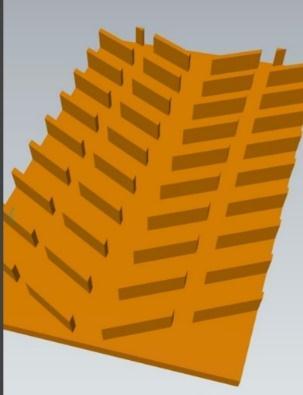
3. Photographic view of test plate
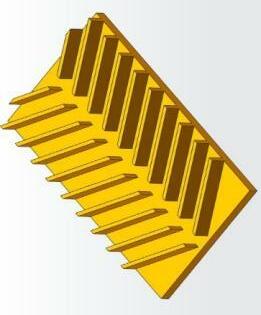
Fig3.1three-dimensionalviewoffinarraywithoutslotsin fin
Fig3.2three-dimensionalviewoffinarraywithslots
4. Results and discussion
Fig4.1thevaluesareofheattransfercoefficient(ha)at differentinclinations.
International Research Journal of Engineering and Technology (IRJET) e-ISSN:2395-0056
Volume: 09 Issue: 08 | Aug 2022 www.irjet.net p-ISSN:2395-0072
Fig4.2ValuesofAvg.HeatTransfercoefficientandAvg. NusseltNo.At20W
Fig4.5ValuesofAvg.HeatTransfercoefficientandAvg. NusseltNo.At80W
Fig4.3ValuesofAvg.HeatTransfercoefficientandAvg. NusseltNo.At40W
Fig4.4ValuesofAvg.HeatTransfercoefficientandAvg. NusseltNo.At60W
40
30
20
10
0 10 20 30 40 50 60 30 60 90 Ha Nu 0 10 20 30 40 50 60 70 30 60 90 Ha Nu 0
50 30 60 90 Ha Nu
40
30
20
10
0
Fig4.6ValuesforwithoutSlotsofAvg.NusseltNo.(Nu) AgainstDifferentInclinations
Fig4.7ValuesforwithoutSlotsofAvg.Heat transfer coefficient(Ha)AgainstDifferentInclinations
20
15
10
50 30 60 90 Ha Nu 0 10 20 30 40 50 60 70 30 60 90 20W 40W 60W 80W 0
25 30 60 90 20W 40W 60W 80W
5
International Research Journal of Engineering and Technology (IRJET) e-ISSN:2395-0056
Volume: 09 Issue: 08 | Aug 2022 www.irjet.net p-ISSN:2395-0072
Fig4.8thevaluesofheattransfercoefficient(ha)at differentinclinations
Fig4.11ValuesofAvg.HeatTransfercoefficientandAvg. NusseltNo.at60W
10
5
0
Fig4.9ValuesofAvg.HeatTransfercoefficientandAvg. NusseltNo.at20W
40
30
20
10
15 30 60 90 20W 40W 60W 80W 0
Fig4.12ValuesofAvg.HeatTransfercoefficientandAvg. NusseltNo.at80W
Fig4.10ValuesofAvg.HeatTransfercoefficientandAvg. NusseltNo.at40W
50
40
30
20
50 30 60 90 Ha Nu 0
0 10 20 30 40 50 60 70 30 60 90 Ha Nu 0 5 10 15 20 25 30 35 40 45 30 60 90 Ha Nu 0 10 20 30 40 50 60 70 30 60 90 20W 40W 80W 60W
60 30 60 90 Ha Nu © 2022, IRJET | Impact Factor value: 7.529 | ISO 9001:2008 Certified Journal | Page182
10
International Research Journal of Engineering and Technology (IRJET) e-ISSN:2395-0056
Volume: 09 Issue: 08 | Aug 2022 www.irjet.net p-ISSN:2395-0072
Fig4.14ValuesforwithSlotsofAvg.Heattransfer coefficient(Ha)AgainstDifferentInclinations
A. Withoutslots
1.Heattransfercoefficientincreasesat40Wat900 .
2.TheaverageHeattransferrategoesonincreasingat 20W,40W,60Wand80W.
3.TheaverageHeattransferrateishighat20Wand 60W.
4.TheaverageNusseltnumberincreasesat40W.
5.Heatlossislessascomparedtosurfaceplatewith slots.
B. Withslot
1.Heattransfercoefficientincreasesat60Wat900
2.TheaverageHeattransferrateincreasesat20W, 40Wand60W.
3.TheaverageHeattransferrateishigherat40W.
4.TheaverageNusseltnumberincreasesat20W,40W and80W
5.Heatlossismoreascomparedtowithoutslots surfaceplate.
1. Thepresentexperimentinvestigationiscarriedout on300,600,900 inclinations.Theinvestigationmay be extended to inclinations from 100 to 1800 with theintervalof100inclinations.
2. Same experiment can be carried out on force convection
1. A review on Heat Transfer from Different types of NotchFinArraysunderForcedConvectiontoincrease heat energy transfer Mr. Sandip .N. Mane Lecturer Mechanical Department. SBGI Miraj and Mr. Sachin.S.Mane Lecturer Automobile Department. PVPITBudhgoan.
2. Enhancementofnaturalconvectionheattransferfrom horizontal rectangular fin arrays with perforations in fin base* Guei-Jang Huang, Shwin-Chung Wong* , Chun-Pei Lin Department of Power Mechanical Engineering, National Tsing Hua University, Hsin-Chu 300,Taiwan,ROC
3. EXPERIMENTAL STUDY OF HEAT TRANSFER FROM PLATE FIN ARRAY IN MIXED CONVECTION MODE PravinKamblePGstudentShriTuljabhavaniCollegeof Engineering, Tuljapur,Maharashtra Prof. S.N.Doijode Head, MED Shri Tuljabhavani College of Engineering, Tuljapur,MaharashtraDr.Mrs.GeetaLathkarPrincipal MGM’sCollegeofEngineering,Nanded,Maharashtra.
4. Experimental Study of Forced- Convection from Horizontal Rectangular Fins Array into Air Duct Saad NajeebShehabDepartmentofMechanicalEngineering / College of Engineering/ Mustansiriyah University/ Baghdad Email: saadnajeeb16@ uomustansiriyah.edu.iq (Received 24 April 2018; accepted23July2018).
5. HEAT TRANSFER AND FRICTION CHARACTERISTICS OF AN ARRAY OF PERFORATED FINS UNDER LAMINAR FORCED CONVECTION A. Ahmadi Nadooshan1,*,Sh.Mohammadi1,M.Bayareh.
6. Numerical study on the mixed convection around inclined-pinfinsonaheatedplateinverticalchannels with various bypass ratios Jun Seok Lee, Man Yeong Ha, June Kee Min * School of Mechanical Engineering,
International Research Journal of Engineering and Technology (IRJET) e-ISSN:2395-0056
Volume: 09 Issue: 08 | Aug 2022 www.irjet.net p-ISSN:2395-0072
PusanNationalUniversity,2,Busandaehak-ro63beongil,Geumjeong-gu,Busan,46241,SouthKorea.
7. Theoritical Investigaion Of Convection Heat Transfer
In Vertical Tubes Ramesh Chandra Nayak* , Ashish Kumar Patra**, Sharmistha Jena*** * ( Department of MechanicalEngineering,SwamiVivekanandaSchoolof Engineering and Technology,BBSR, Odisha, India,Pin752054 **(Department of Electronics and Telecommunication Engineering, Swami Vivekananda School of Engineering and Technology,Bbsr,Odisha, India,Pin-752054 ***( Department of Computer Science and Engineering, Swami Vivekananda School ofEngineeringandTechnology,Bbsr,OdishaIndia,Pin752054 Corresponding Author: Ramesh Chandra Nayak.
8. Numerical study of mixed convection heat transfer of various fin arrangements in a horizontal channel MojtabaMokhtaria,⇑,M.BarzegarGerdroodbaryb,⇑, Rezvan Yeganeh c , K. Fallah d adepartment of Chemical & Petroleum Engineering, Sharif University of Technology, Tehran, Iran bdepartment of Mechanical Engineering, Babol Noshirvani University of Technology, Babol, Iran cdepartment of Chemical Engineering, Razi University, Kermanshah, Iran ddepartment of Mechanical Engineering, Islamic Azad University,SariBranch,Iran.
9. Enhancement of Natural convection heat transfer coefficient by using V-fin array Rameshwar B. Hagote, Sachin K. Dahake Student of mechanical Engg. Department, MET’s IOE, Adgaon, Nashik (Maharashtra,India).
10. Experimental Study of Forced- Convection from Horizontal Rectangular Fins Array into Air Duct Saad NajeebShehabDepartmentofMechanicalEngineering / College of Engineering/ Mustansiriyah University/ Baghdad Email: saadnajeeb16@ uomustansiriyah.edu.iq (Received 24 April 2018; accepted23July2018).
11. PREDICTION OF NATURAL CONVECTION FROM AN ARRAYOFHORIZONTALLINEHEATSOURCESINAL ARGE SPACE An-gui Li Dept. Of Environmental Engineering, Xi'an University of Architecture & Xi' an, Shaanxi,P.R.CHINA.
12. Forced Convection Heat Transfer Coefficient and Pressure Drop of Diamond-Shaped Fin-Array Shigeki
Hirasawa*, Atsushi Fujiwara, Tsuyoshi Kawanami, Katsuaki Shirai Department of Mechanical Engineering, Kobe University, Kobe, Japan Email: * hirasawa@kobe-u.ac.jpReceived25July2014;revised 25August2014;accepted2September2014.