International Research Journal of Engineering and Technology (IRJET) e-ISSN: 2395-0056

Volume: 09 Issue: 08 | Aug 2022 www.irjet.net p-ISSN: 2395-0072
International Research Journal of Engineering and Technology (IRJET) e-ISSN: 2395-0056
Volume: 09 Issue: 08 | Aug 2022 www.irjet.net p-ISSN: 2395-0072
Abstract- Concrete is a composite material consisting of cement, fine aggregate, and coarse aggregate, and demand for it is increasing due to construction practices at a large scale. As of now, we are able to use waste material such as fly ash in the manufacturing of cement, but fine aggregate and coarse aggregate are made available from natural resources and are getting depleted day after day. So, the need of an era is to find out some more waste material that can be used in place of these materials or can be replaced in a suitable amount. So, the material used for replacement in this research is washed bottom ash in place of sand and metakaolin powder in place of cement. The main objective of this research is to determine the workability, compressive strength, split tensile strength, and flexure strength of concrete prepared by using washed bottom ash and metakaolin powder. The test will be conducted to determine the compressive strength, split tensile strength, and flexure strength. Based on previous research, a comparison of strength and properties of concrete made with replacement compared to the standard concrete is made. Cement is replaced by metakaolin powder by 6%, 12%, 18%, 24%,30%, and natural sand is replaced by washed bottom ash by 9%, 18%, 27%, 36%, 45%. Based on the properties of the materials, the M35 grade of concrete mix is prepared. Different specimens of the material are tested for strength. The result shows that concrete workability is fine and within limits after replacing cement with metakaolin powder and natural sand by washed bottom ash. So, after this research work, we find out that the replacement can be done to some extent.
Keywords-Washed Bottom Ash, Metakaolin Powder, Compressive Strength, Flexural Strength, Split Tensile Strength.
Concrete consists of cement, fine aggregate, and coarseaggregateandplaysvitalrolesinconstructionwork today. Sand and cement are the prime material for the preparation of mortar and cement. Properties of material play a significant role in preparing a design mix. Sand in concreteoccupiesspacebetweenthecoarseaggregateand cement acts as a binding material between fine aggregate and coarse aggregate. About 80% of the total volume of
concrete consists of coarse aggregate and fine aggregate. Nowadays due to the construction boom demand for this material increasing day by day for construction activities worldwide, for rapid growth in infrastructure, consumptionofnaturalsandisincreasedwhichleadtothe continuous extraction of natural sand from the river bed. This extraction is causing severe damage to the natural resources,whichposesaseverethreattotheenvironment, such as loss of aquatic life, losing water retaining soil strata,causing bank slides, loss ofvegetationonthe banks ofrivers, andthesociety, etc.Duetotheseadverse effects, different states have imposed bans on the natural extraction of sand. Also, natural sand is very costly nowadays which makes the construction uneconomical so in this situation, the need arises to find some readily available alternative that can also reduce the cost of construction. The manufacturing of cement poses a severe threat to the environment. It is estimated that nearly 1 tonne of CO2 gas gets emitted during 1 tonneof Portland cement production. Since WBA is a waste product and metakaolin is cheaper than cement and also increases the strength of cement concrete. The use of these products in concrete makes the work economical and using these materials in the construction practices, the disposal problem of these materials can be reduced to a large extent.Theotherfactorthatcontributestotheiruseinthe concrete is their low cost. So, the use of these waste materials as an alternative material makes the project economical.
India produces approximately more than 100 million tonnes of coal ash annually. Coal-based thermal powerplantsallovertheworldfaceseriousproblemsof handling and disposal of the ash produced. The utilizationofflyashisabout30%asvariousengineering properties requirements that is for low technical applications such as in the construction of fills and embankments, backfills, pavement base and sub-base course.Washedbottomashisnearly20%oftheresidual material of coal combustion in a power plant, boiler, furnace, or incinerator. The portion of the ash that escapesthechimneyisreferredtoasflyash(80%),and the clinkers that fall under their weight in the bottom
Mr. Mohd Asif1, Mr. Sourabh Lalotra2International Research Journal of Engineering and Technology (IRJET) e-ISSN: 2395-0056
Volume: 09 Issue: 08 | Aug 2022 www.irjet.net p-ISSN: 2395-0072
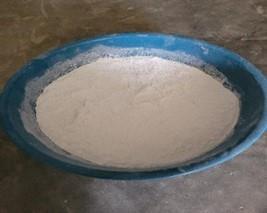
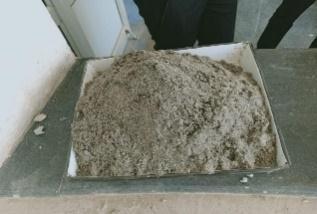
hopper is termed as bottom ash (20%) which is cooled bywaterwashingandistermedasWashedBottomAsh (WBA). India currently generates 100 million tonnes of coal ashannually,ofwhich15-20%isbottomash.Nonnatural lightweight aggregate builton bottom ashhasa lotofpromiseforusageinconstructionprojects.Bottom ash has shown to be a cheap material since it has benefits for constructability in addition to good engineering properties Bottom ash is a versatile materialthatcanbeusedinavarietyofcivilengineering projects that call for sand, gravel, or crushed stone The washed bottom ash in the form of fine aggregates is showninFig.1.
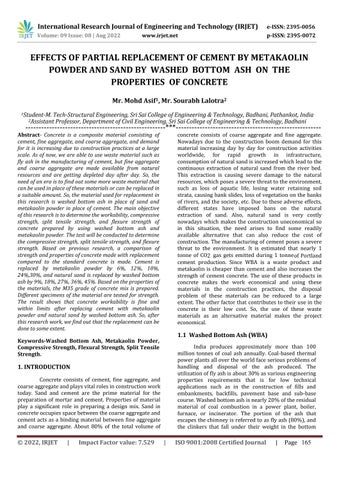
As a result, the concrete becomes more durable and its permeability is reduced. Now, when it is added to concrete,itwillfunctionasafiller,saturatingthespaces betweencementparticlesandmakingtheconcretemore impermeable.Itisneitheraby-productofindustrynora natural product it is obtained by calcination of pure kaoliniteorchinaclayatatemperatureof650to800⁰C. Once the burning process is completed is grinded properly to that particle size for which it is used and fulfillsthestrengthandpropertyparameterofcementin motarandconcrete. MetakaolinPowder isshowninthe Fig.2.
By using additives in place of cement, which increases CO2 emissions in the construction industry, these emissions are reduced. Cement can be replaced with metakaolin, also known as calcined kaolin, which is created via calcination. Due to their advantages for the economy and ecology, supplemental cementitious elementsareutilizedinconcreteallovertheworldand have received a lot of attention recently. The more popularSCMsaremineral admixturessuchflyash,rice husk ash, silica fume, etc. They aid in achieving increased efficiency and performance. One such unconventional substance that can be used to good effectintheconstructionsectorismetakaolin.
The most effective pozzolanic substance for use in concrete is metakaolin, a kind of pozzolan. It is created when china clay, a mineral called kaolin, is heated to a temperature between 600 and 800 ºC, making it a manufactured good intended for use as opposed to a byproduct. Its manufacturing process includes quality control, producing a material that is far less variable than industrial pozzolans, which are by-products. Metakaolin was successfully included into the concrete whenitwasfirstusedinthe1960stobuildanumberof significant dams in Brazil with the initial goal of preventing any harm brought on by the alkali-silica reaction.As withothermineral admixtures,metakaolin ismadeupofsilicaandaluminainanactiveform.When combinedwithcalciumhydroxideatroomtemperature, it forms calcium silicate hydrate (C-S-H)-gel, which raises the density and lowers the porosity of concrete.
Fig.-2: MetakaolinPowder
a. To perform the following test and to compare the results with and without replacement of washed bottomashandmetakaolinpowder CompressiveStrengthTest. FlexuralStrengthTest. SplitTensileStrengthTest.
b. To reduce the overall environmental effects of concreteproduction using washed bottom ash and metakaolinpowderaspartialreplacement.
c. Workabilityofconcrete.
Meghana. K et al. (2019): TheM30gradeofconcreteis used in this investigation for the experiment. 0 percent, 20%, 40%, 60%, 80%, and 100% of the bottom ash is added in place of the sand. The silica fume is added to replace 20% of the cement's weight in cement in a partial replacement. Additionally, the strength characteristicsofconcrete,includingitsimpact,flexural, shear,andtensilestrength,areinvestigated.
M. Narmatha, Dr. T.Felixkala (2016): This study aims to describe the effect of the replacement of metakaolin powder in cement. Metakaolin is a supplementary cementitious material for high- performance concrete. Properties of concrete with metakaolin are mostly preferred additives in high- performance concrete. The
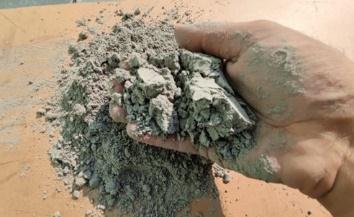 Fig.-1: WashedBottomAsh
International Research Journal of Engineering and Technology (IRJET) e-ISSN: 2395-0056
Volume: 09 Issue: 08 | Aug 2022 www.irjet.net p-ISSN: 2395-0072
replacement proportion of metakaolin to be used was 5%,10%,15%,and20%bytheweightofcement.
Whencombinedwithwatertocreatemortarorwhen combinedwithsand,gravel,andwatertocreateconcrete, cement is a dry, powdery material. It serves as a binder. Cementprovidessufficientstrengthonceithashardened. Lime is the main chemical component of cement. Depending on the demand and required strength, there are many different types of cement available on the market. The cement we'll use in this study is 43 Grade Ordinary Portland Cement that complies with IS: 8112 and goes by the brand name Ambuja Cement. The relevant lab has provided information on the cement's physicalqualities
Fig-3: 43GradeOPCCement
Table-1: PropertiesofCement
Fine aggregate consists of crushed sand particles or natural river sand passing through a 4.75mm sieve. In general, river sand is used as a fine aggregate having a particle size of 0.07mm. The extraction is done from rivers, lakes or seabed’s. Fine aggregate that was present at the site was extracted from Akhnoor Jammu. Sieve analysiswouldbedonetofindoutthezoneconformingIS: 383-1970. The physical properties of sand were provided bythe
concerned lab. It conforms to IS 383 1970 comes under zoneII.
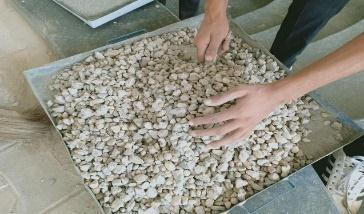
Aggregatewhichhasasize largerthan4.75mmor which retrained on 4.75 mm IS Sieve are known as Coarse aggregate. Coarse aggregates must be tough, pristine,anddevoidofanychemicalcoatingofclayand dustonthesurfaceinordertomakeadecentconcrete mix. Although there are many different ingredients or components used to make concrete mix, coarse aggregate is frequently used because it is one of the most important elements of concrete and takes up a significant amount of the mixture. The most important function of fine aggregate is to help with mixing consistency and workability. In this investigation, coarse materials with angular shapes from the neighborhood crusher are used. Grading of coarse aggregate was done according to IS:383-1970. Aggregates of Nominal size 20mm & 10mm to form a graded aggregate. The concerned lab provided the propertiesofcoarseaggregate.
Metakaolin is a highly pozzolanic material. It is one of the most widely used mineral admixtures these days. Concrete containing metakaolin as cement replacement uptosomepercentagehelpconcretetoobtainbothhigh performanceandeconomy. Itis neithera by-productof industry nor a natural product it is obtained by calcination of pure kaolinite or China clay at a temperatureof650to800⁰C.Oncethe burningprocess iscompletedisgrindedproperlytothatparticlesizefor which it is used and fulfills the strength and property parameterofcementinmotarandconcrete.Metakaolin, which contains silica and alumina in an active state, interacts with calcium hydroxide at room temperature to generate calcium silicate hydrate (C-S- H)-gel, increasingconcrete'sdensityandloweringitsporosity.
International Research Journal of Engineering and Technology (IRJET) e-ISSN: 2395-0056
Volume: 09 Issue: 08 | Aug 2022 www.irjet.net p-ISSN: 2395-0072
As a result, the concrete becomes more durable and its permeability is reduced. As a filler, it will now penetrate the spaces (voids) between cement particles when employed in concrete, making the concrete more impermeable. Metakaolin is its high reactivity with calcium hydroxide, Ca(OH)2, and its ability to accelerate cement hydration. Metakaolin is expected to be more significant due to its high concentration of silica and alumina. Specifically, the calcium to silicon (C/S) ratio of the produced calcium silica hydrates (C–S–H gel) is expectedtobehigherthanofotherSCM’s
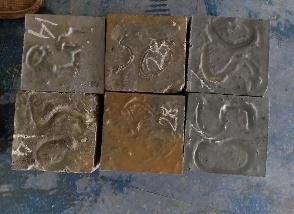
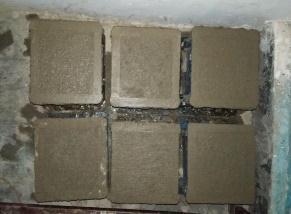
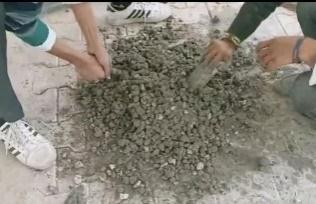
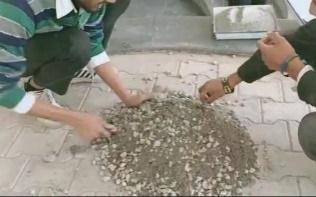
Table-2: ChemicalCompositionofMetakaolinPowder
Chemical Composition Cement (%) Metakaolin (%) SiO2 34 54.3 (Al2O3) 5.5 38.3 (CaO) 63 0.39 (Fe2O3) 4.4 4.28 (MgO) 1.26 0.08 (K2O) 0.48 0.5 (SO4) 1.92 0.22
Colour Grey OffWhite
Washed bottom ash is nearly 20% of the residual material of coal combustion in a power plant, boiler, furnace, or incinerator. The portion of the ash that escapes the chimney is referred to as fly ash (80%), and the clinkers that fall under their weight in the bottomhopperistermedasbottomash(20%) which is cooled by water washing and is termed as Washed Bottom Ash (WBA). The size of bottom ash ranges from fine sand to fine gravel and has a minimal amountofsiltandclay.Alargeportionof bottomash comprises fine particles. Coal bottom ash is generally fallinginawell-gradedsandgroup.
Table-3:ChemicalCompositionofWBA
Water is one of the main constituents in the production of concrete. The normal portable tap water must be used in the production of concrete. Water to be used must be free from impurities and unwanted particles. The ph of the water to be used must be in the desired range. Otherwise, the strengthofconcretecangetaffected.Thestrengthof concretecanalsogetaffectedbypollutedwater.
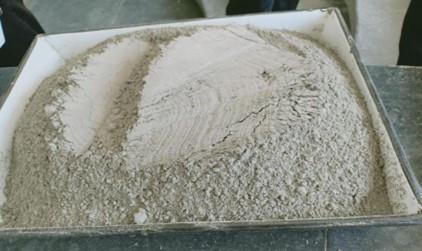
5.1 Batching: It's a technique for calculating and combining the necessary concrete components by weight and volume in accordance with the design mix. In most cases, volume is used. In batching, accuracyiscrucial.Insteadofusingvolumebatching, itispreferabletouseweightbatching.
Fig.-4:
5.2 Casting: Theworkabilityofmixtureistestedvia slump test and then placed in a mould. Before putting concrete mix in mould the mould is greased or appropriately oiled. After placing the mixture in the mould, it is adequately compacted. The exact process is carried on for all specimens to be tested. Threesamplesarepreparedforeachmix
Fig.-5: CastingofCube
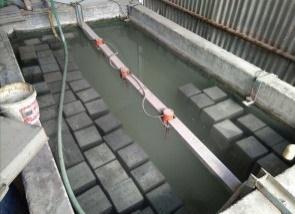
5.3 Curing: Before removing the mould, it is dried for 24 hours, and then specimens are placed in a water tank made to cure specimens. The specimens mustbemarkedforidentificationsothattheremust not be any error. The specimens are removed from the tank and dried before putting in the testing machine. The specimens are kept in the tank for 28 days.
e-ISSN: 2395-0056
Volume: 09 Issue: 08 | Aug 2022 www.irjet.net p-ISSN: 2395-0072
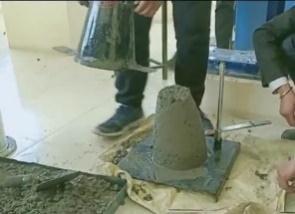
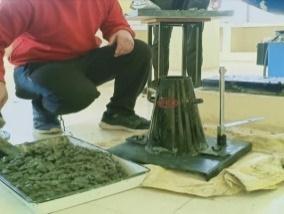
5.4 Slump cone test: The slump test of concrete is a laboratory or field test that is used to determine the workability of concrete. The slump test is simply a measure of the wetness or consistency of the mix. The equipment used to test the concrete slump is quite simple.Itconsistsofatampingrodoflength 600mmand dia. 16mm and a truncated cone that’s 300 mm tall, 100 mm in diameter at the top, and 200 mm in diameter at thebottom.
5.5 Compressive Strength Test: Compressive strength of the concrete is measured in UTM using mould that may be of cubical, trapezoidal, cylindrical in shape. Generally, cubical mould of size 150mm are used if the maximum nominal size of the aggregate is greater than 20mm and if it is less than 20m then mould of size 100mm can also be used. It is defined as the capacity of theconcretetoresisttheloadstendingtoreduceitssize. By this test characteristic compressive strength of concrete is determined. This test performed only in the lab.
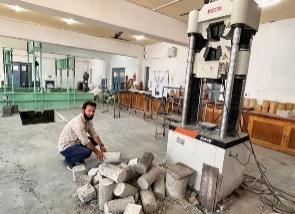
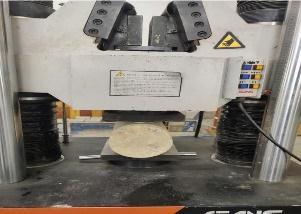
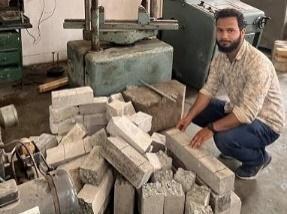
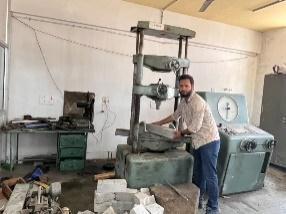
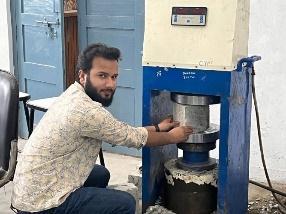
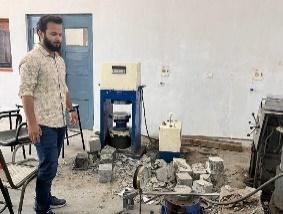
5.6 Flexural Strength Test: Flexural strengthisdefined as the capacity of the beam or slab to resist failure in bending.Flexuralstrengthofconcreteistestedindirectly by finding the modulus of rupture for which mould of size15cmx15cnx70cmisprepareif maximum nominal size of the aggregate is greater than 20mm and of size 10cm x 10cm x 50cm is prepare if the maximum size of theaggregateislessthan20mm.
5.7 Split Tensile Strength Test: Tensilestrengthof aconcertcanbetestedusingthesplittingcylindrical test, which consist of a cylindrical mould which is loaded horizontally in between the plates of universal testing machine The tensile strength of concrete significantly affects the cracking in the structure. As we know, the concrete is weak in tension,soconcretegenerally developscrackswhen tensile forces exceed the tensile strength of the concrete.Thistestcanbeperformedontheuniversal testing machine. The apparatus consists of: tamping rod of 600mm length and 16mm dia., a weighing balance, a cylinder of size 15 x 30cm, a testing machineandatrowel.
Based on trial mixes for different proportions of ingredients,thefinaldesignmixwaspreparedforM35 gradeofconcreteasperIS 10262:2009. Theconcrete mixproportionandw/cratiowasconsideredas0.44 and with varying percent of metakaolin powder and washed bottom ash and design was done. The different specimens as per the requirement for test were casted. The specimens were tested after 28 days of curing. In each category the specimens to be tested and average value is reported in the form of graphs.
Thetotal of54cubes was testedat7 days,14days,28 days The value of each test is provided in the table below:
Fig.-10:SplitTensileStrengthTest6.3
International Research Journal of Engineering and Technology (IRJET) e-ISSN: 2395-0056
Volume: 09 Issue: 08 | Aug 2022 www.irjet.net p-ISSN: 2395-0072
Table-4:CompressiveStrengthResults
Mix Specimen Details
Compressive Strength (N/mm2) 7 Days 14 Days 28 Days
M0 ConventionConcrete 2813 3836 4451
M1 6%MP+9%WBA 2867 3997 4663
M2 12%MP+18%WBA 2946 408 4763
M3 18%MP+27%WBA 3016 4154 4337
M4 24%MP+36%WBA 28.54 38.86 41.57
M5 30%MP+45%WBA 2751 3637 4414
Graph-2:FlexuralStrengthResults
A standard test cylinder of concrete specimenisplaced horizontally between theloading surfaces of compression testing machine. The compression load is applied diametrically and uniformly along the length of cylinder until the failure of the cylinder along the vertical diameter. Thetestresultsconductedfor28daysaretabulated below.
Table-6:SplitTensileStrengthResults
Split Tensile Strength (N/mm2)
Graph-1 :CompressiveStrengthResults
Results including the flexural strength (for fractured samples) and the yield strength (samples that did not fracture). The test results conducted for 28 days are tabulatedbelow.
Table-5:FlexuralStrengthResults
Mix Specimen Details
Flexural Strength (N/mm2)
7 Days 14 Days 28 Days
M0 ConventionConcrete 4.12 5.09 6.24
M1 6%MP+9%WBA 4.24 5.37 6.7
M2 12%MP+18%WBA 4.48 5.42 6.72
M3 18%MP+27%WBA 4.7 5.73 6.85
M4 24%MP+36%WBA 4.51 5.2 6.45
M5 30%MP+45%WBA 4.02 4.89 6.17
Mix Specimen Details
7 Days 14 Days 28 Days
M0 ConventionConcrete 3.02 3.52 4.53
M1 6%MP+9%WBA 3.11 3.58 4.59
M2 12%MP+18%WBA 3.19 3.65 4.66
M3 18%MP+27%WBA 3.23 3.71 4.70
M4 24%MP+36%WBA 2.95 3.46 4.51
M5 30%MP+45%WBA 2.91 3.33 4.39
Tensile
Graph-3:SplitTensileStrengthResults
International Research Journal of Engineering and Technology (IRJET) e-ISSN: 2395-0056
Volume: 09 Issue: 08 | Aug 2022 www.irjet.net p-ISSN: 2395-0072
The results of the slump cone test performed on different mixesofM35gradeconcreteareshowninthetable:
Table-7:SlumptestResults
Mix Specimen Details Slump (mm)
M0 ConventionConcrete 82
M1 6%MP+9%WBA 84
M2 12%MP+18%WBA 85
M3 18%MP+27%WBA 86
M4 24%MP+36%WBA 83
M5 30%MP+45%WBA 79
[1]Meghana. K et al., Research conducted for studying theeffectofreplacementof sandbybottomashand cement replacement by silica fume on the characteristic properties of concrete, International Journal of Engineering and Technology, Volume 6 Issue1,Jan2019.
[2]M. Narmatha, DT.Felixkala Work on MetakaolinThe Best Material for Replacement of Cement in Concrete, IOSR International Journal of Science and ResearchVolume-13Issue-4,May2016.
[3]Vineet Kumar Jadoun, Akash Prakash Study of Strength and Durability Properties of Concrete with Partial Replacement of Cement with Metakaolin and Marble Dust, Journal of Interdisciplinary Cycle ResearchVolume-12,Issue-7,July2020.
90
85
80
Graph 3- Slumpconetest 75
M0 M1 M2 M3 M4 M5
Slump (mm) Slump (mm)
Graph-4:SlumpTest
Basedontheexperimentalinvestigationcarriedouton the strength behavior of Partial replacement of fine aggregate with washed bottom ash and cement with metakaolin powder, the following conclusions are drawn:
Workability results show that if we replace cement with metakaolin powder up to 18% and sand with washed bottom ash up to 27%, there is no significantdecreaseintheworkability.
[4]Vikas R Nadi et al Experimental investigation on. Bottom ash as a partial Sand replacement in Concrete, IOSR Journal of Mechanical and Civil EngineeringVolume-12Issue-2March–April2015
[5]Dr R. G. D’ Souza Studies on Replacement of Fine Aggregate with Bottom Ash in concrete and investigationonCompressiveStrength,International Journal of Engineering Research and Technology Volume-6Issue-08,August2017.
[6]Pendyala Chanakya, Diptikar Behra Experimental studyofCompressiveStrengthofConcretebyPartial Replacement of Cement with Metakaolin, International Journal of Scientific Science and Technical Research Volume 5 issue 26, September 2016.
[7]Mohd Syahrul Hisyam bin Mohd Sani et al.An experimental study of the Properties of Special ConcreteusingWashedBottomAsh(WBA)aspartial SandReplacement.
Compressive Strength is maximum at 18% metakaolin powder and 27% washed bottom ash replacement.
[8] CHJyothiNikhila and J DChaitanya Kumar study on Partial Replacement of Cement with Metakaolin in high strength Concrete, International Journal of Engineering Sciences & Research Technology Volume4Issue4,November2015.
Flexural Strength is maximum at 18% metakaolin powderand27%washedbottomashreplacement.
Split Tensile Strength is maximum at 18% metakaolin powder and 27% washed bottom ash replacement.
[9] Venu Malagavelli, Srinivas Angadi and J S R Prasad Experimental study of Influence of metakaolin in concrete as partial replacement of cement, International Journal of Civil Engineering and TechnologyVolume9Issue7,July2018.
[10]BahoriaB.V.etal.Experimentalstudiesonrecent trendinreplacementofnaturalSandinConcrete
International Research Journal of Engineering and Technology (IRJET) e-ISSN: 2395-0056
Volume: 09 Issue: 08 | Aug 2022 www.irjet.net p-ISSN: 2395-0072
by waste Products: A State of Art, Journal of Environmental Research and Development Volume-7 Issue-4A,April–June2013.
[11]M. Narmatha, Dr.T.Felixkala Experimental study on analysis the Mechanical Properties of Metakaolin using as a Partial Replacement of Cement in Concrete, SSRGInternationalJournalofCivilEngineeringVolume 4Issue1,January2017.
[12]A.Kaur and V.P.S.Sran Study on use of Metakaolin as Pozzolanic Material and Partial Replacement with CementinConcrete(M30),AsianReviewofMechanical EngineeringVolume5Issue1,January–June2016.
[13]Satyendra Dubey, Rajiv Chandak, R.K. Yadav Experimental Study of Concrete with Metakaolin as Partial Replacement of OPC, International Journal of AdvancedEngineering ResearchandScienceVolume 2 Issue6,June2015
[14]Vikas R Nadig, Sanjith, Ranjith, Kiran Study on behaviour of Bottom Ash as Partial Sand Replacement in Concrete, Journal of Mechanical and Civil EngineeringVolume12Issue2,March–April2016.
[15]AkshayC. Sankhetal.Anexperimental studyonrecent Trends in Replacement of Natural Sand with Different Alternatives, IOSR Journal of Mechanical Engineering andCivilEngineering.
[16]Kalyani Gawande et al., Studies on effect of replacement of coal bottom ash on properties of concrete, International Journal of analytical and experimental modal analysis, Volume XII, Issue IX, September2020 © 2022, IRJET | Impact Factor value: 7.529 | ISO 9001:2008 Certified Journal |