International Research Journal of Engineering and Technology (IRJET) e-ISSN: 2395-0056

Volume: 09 Issue: 08 | Aug 2022 www.irjet.net p-ISSN: 2395-0072
International Research Journal of Engineering and Technology (IRJET) e-ISSN: 2395-0056
Volume: 09 Issue: 08 | Aug 2022 www.irjet.net p-ISSN: 2395-0072
Sanjay Yadav1, Dr Priyanka Jaiswal2
1- Master of Technology, Electronic and Communication Engineering, GITM, Lucknow. Professor, Electronic and Communication Engineering, GITM, Lucknow. ***
Abstract - SDR (software-defined radio) devices have gotten a lot of interest lately because to their low cost and ease of use when it comes to hands-on testing. In cognitive radio (CR), they may be utilised to create dynamic spectrum allocation (DSA) algorithms.TheseCRsarecurrentlyunableto determine which DSA method is most suited for a given situation, despite much study in both machine learning and signal processing. Machine learning and statistical signal processing approaches may be used to compare the spectrum sensing algorithms for CRs and spectrum observatories in resource restricted contexts. We've decided to take on the issues of detecting multiple transmitters and automatically classifying modulation patterns (AMC). Multiple transmitter identification algorithms using machine learning and statistical signal processing are evaluated side by side. For multi-transmitter identification,themachinelearningmethod has an accuracy of 70 percent and 80 percent for two and five user systems, respectively, while the statistical signal processing technique has an accuracy of 50 percent for two and five user systems, respectively. Machinelearningbeatsthe signal processing techniquefor1000testsamplesinAMC,even if both algorithms have 100% accuracy beyond 10 dB for 100 test samples (64-QAM is an exception). Signal processing techniques in both situations take a fraction of the time needed by machine learning algorithms, accordingtothetime comparison.
Key Words: Signal,Cognitive,ratio,identification,SDR,DSA.
Thecurrentstateofwirelesssystemsischaracterisedbya radiofunctionthatisalwayson,aspectrumallocationthatis always the same, and very little network coordination betweenmobiledevices.Inthisdayandage,itiscommon practisetoutilisearemotewebconnectionthatisgivenbya portable device as the main method of one-on-one communication.Thisisbecauseremotewebconnectionsare morereliablethantraditionaldial-upconnections.Because of the developments that have been made in the web of things (IoT) based gadgets, for example, reconnaissance frameworks, sensor frameworks, implanted wellbeing observing frameworks, and numerous other similar frameworks,researchersandspecialistsareattemptingto relegatearangebandtoeveryoneofthesegadgetsforthe purpose of impedance free correspondence [1]. This is a directresultofthelimitedradiospectrum,whichcameabout asadirectresultofthedecisionmadebytheadministrative
commissioners to proactively allocate a significant percentageoftheavailableradiospectrumtoanumberof differentadministrations.Asadirectresultofthisdecision, thereisnowalimitedamountofradiospectrum.Therearea few distinct groups that are responsible for the overwhelmingbulkofthecongestion,yetthegreatmajority oftheavailablespaceisunderutilised[2].
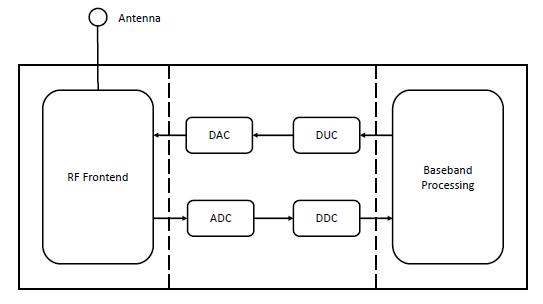
Figure1-1illustratesoneofthefundamentalbuildingblocks that comprise the digital communication system. It is equipped with an RF front end that is connected to the antenna.Amplificationoftheanaloguesignalthateitherhas tobebroadcastorreceivedisperformedbythisblock.The conversioniscarriedoutviathedigitaltoanalogue(DAC) andanaloguetodigital(ADC)convertersrespectively.The basebandsignalsarechangedfromastopbandintoapass bandandbackagainbythedigitalup-conversion(DUC)and digital down-conversion (DDC) processes. In baseband processing, each and every processing activity, such as establishing a connection, frequency equalisation, and encoding/decoding, is carried out in its entirety [4]. This kindoftechnologyisreferredtoassoftware-definedradio (SDR),anditexecutesthesetasksonsoftwaremodulesthat are either operating on field-programmable gate arrays (FPGA) or digital signal processors (DSP), or a mix of the two.
Figure-1: A basic Digital Radio Block.
International Research Journal of Engineering and Technology (IRJET) e-ISSN: 2395-0056
Volume: 09 Issue: 08 | Aug 2022 www.irjet.net p-ISSN: 2395-0072
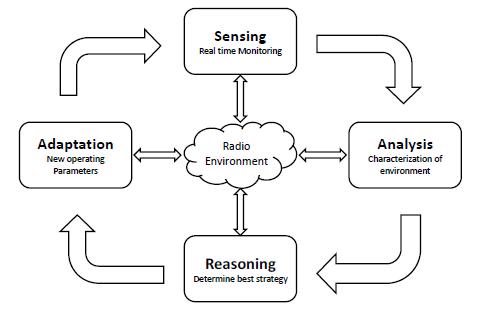
Radios are able to alter their functions and operations because reconfigurable characteristics supplied by SDRs makethispossible.However,theSDRisnotcapableofdoing these operations on its own; more specifically, it cannot reconfigureitselfintotheshapethatisgoingtobethemost usefulforitsuserunlessthatusergivesitinstructionstodo so.Adevicethatiscapableofself-reconfigurationinorderto improveitsperformanceisknownasacognitiveradio(CR) [4].Thesedays,CRsarebecomingmorepopularasaresult oftheperceivedlackofbandwidththatisgeneratedbythe fixed frequency allotment [2]. A CR is able to detect the currentstatusofthechannelandadjustitselfaccordinglyin order to get the highest possible throughput. In the beginning, the concept of CR was conceived with the intentionofgainingopportunisticaccessacrossthedigital TV bands in order to facilitate secondary communication insideawirelessregionalareanetwork.However,intoday's world,CRsarebeingutilisednotonlyinthebusinesssector butalsointhemilitarysector.Thisisduetothefactthat,in comparison to conventional radios, CRs provide the extra benefitofgreaterflexibilityandsecurity.
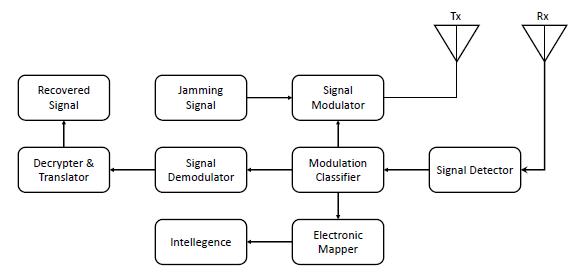
Figure-3: Illustration of AMC in Military applications.
Theparameterinitialisationisonedrawbackofthemixed model.Theissueisidentifyingmanytransmitterswithout priorknowledge,whichcannotbedoneoptimallyunlessthe starting values input into the algorithms are properly chosen.Furthermore,spectralmeasurementsareemployed in this technique. As a result, the measured log-spectral values should be linearized. After converting the data to linear form, it is divided into time-frequency bins and categorised.Multiscaleisthenameforthisgroupingmethod.
Table-1: Multiscale and time-frequency bins.
Serial Number Multiscale Resolution (Imax) T-F Bins
1 Imax=1.0 4
2 Imax=2.0 16
3 Imax=3.0 64
Figure-2: A basic block diagram of CR.
Becauseoftheriseindemandforwirelesscommunicationin today'sworld,thereisasignificantchallengeposedbythe staticspectrumallotmentaswellastherestrictednetwork coordinationamongmobiledevices[10].Alongthesesame lines,asignificantportionoftheradiospectrumisputtouse. Thevastmajorityoftherangeisratherlittleused,althougha few specific groupings are extremely obstructed. The solution to this problem is called dynamic range access (DSA),anditmaybefoundin[11].Theprimarygoalofthe DSA is to re-use recurrence groups with a low level of participantinvolvementwhileatthesametimecausingthe genuineauthorisedcustomersnoobstruction[12].
4 Imax=4.0 128
The IQ samples with known number of transmitters are required.Toaccomplishthis,aGNUradiotoolkitbasedon Pythonprogramminglanguageisusedtogeneratethedata. Thedataisdividedintothreesetscontaining500fileseach. Eachsethas100filesofIQsampleswith0,10,20,30,40dB of additive white Gaussian noise for statistical relevance. Also, each set has one, two, and five transmitters, respectively. The waterfall plot of the data in each set is showninfigure4tofigure-6
International Research Journal of Engineering and Technology (IRJET) e-ISSN: 2395-0056
Volume: 09 Issue: 08 | Aug 2022 www.irjet.net p-ISSN: 2395-0072
Figure-4: A spectrogram of generated data for 1 transmitter.
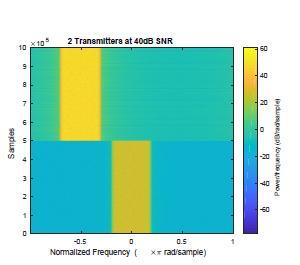
Figure-6: A spectrogram of generated data for 5 transmitters
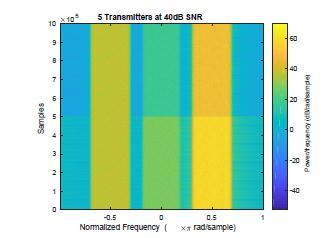
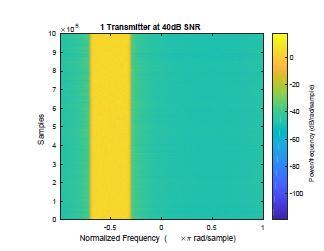
Figure-5: A spectrogram of generated data for 2 transmitters.
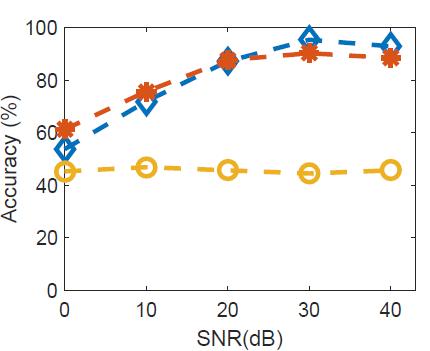
Figure-7: Accuracy comparison of multi-transmitter detection algorithms with time window = 0:5 ms, npoint fft= 2048. multiscale = 3 and No. of Tx's = 5
International Research Journal of Engineering and Technology (IRJET) e-ISSN: 2395-0056
Volume: 09 Issue: 08 | Aug 2022 www.irjet.net p-ISSN: 2395-0072
Figure-10: Time comparison of multi-transmitter detection algorithm time window = 0:5 ms, n-point fft= 1024.
Figure-8: Accuracy comparison of multi-transmitter detection algorithms with time window = 1 ms, npoint fft= 1024.T multiscale = 2 and No. of Tx's = 1.
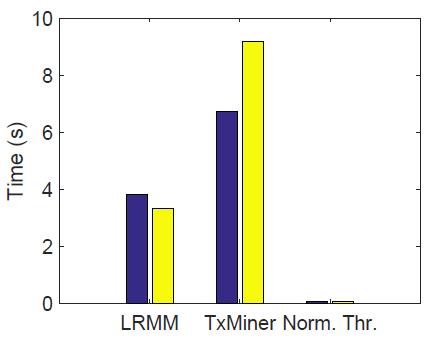
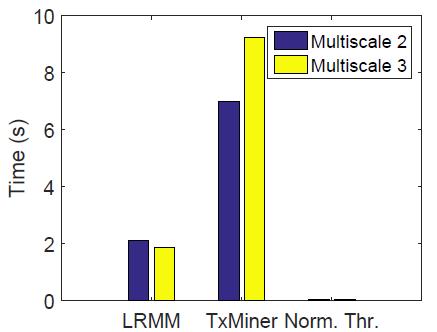
Figure-9: Accuracy comparison of multi-transmitter detection algorithms with time window = 1 ms, npoint fft= 1024, multiscale = 3 and No. of Tx's = 5.
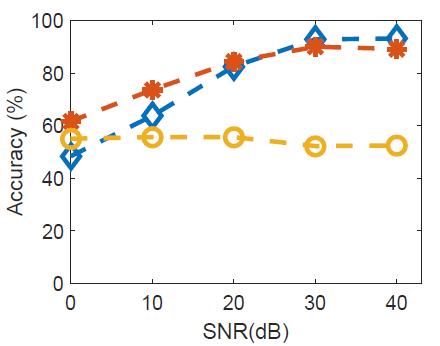
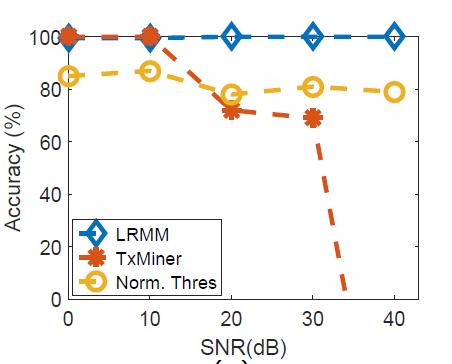
Figure-11: Time comparison of multi-transmitter detection algorithm time window = 1 ms, n-point fft = 2048.
CRswerethefocusofthisstudy,whichcomparedmachine learning and statistical signal processing techniques. AMC and multi-transmitter identification were selected as test tasks for this study. For the comparison of two novel methods, log-Rayleigh mixing model and normalised thresholdenergysensingtechniquebasedmulti-transmitter detection algorithm were utilised. The TxMiner algorithm was used as a benchmark for these algorithms. K-next
International Research Journal of Engineering and Technology (IRJET) e-ISSN: 2395-0056
Volume: 09 Issue: 08 | Aug 2022 www.irjet.net p-ISSN: 2395-0072
neighbourandgreatestlikelihoodAMCarealsoevaluated. Accordingtotheresultsofthecomparison,machinelearning algorithms outperform signal processing techniques. It is possible to boost the accuracy of supervised learning (knearest neighbour) by increasing the number of training samples.Alargeenoughnumberofsamplesisnecessaryfor unsupervisedlearningtechniques(EMalgorithm)inorderto ensurethattheresultsarestatisticallysignificant.Itisalso possibletodrawtheconclusionthatthetimerequiredtorun machine learning algorithms grows significantly as the number of samples for detection/classification processes increases. As a result, it is possible to think of algorithm selection as a trade-off between accuracy and execution time.
[1] K. Gamacharige and M. Thilina, “On spectrum sensing, resourceallocation,andmediumaccesscontrolincognitive radio networks,” 2015. [Online]. Available: http://mspace.lib.umanitoba.ca/xmlui/handle/1993/30650
[2] F. S. P. T. Force, “Report of the spectrum efficiency working group,” http://www. fcc. gov/sptf/reports. html, 2002.
[3]G.Sanjeev,“Spectrumsensingtechniquesforcognitive radio applications,” Ph.D. dissertation, Indian Institute of Science,Bangalore,2015.
[4]A.M.Wyglinski,M.Nekovee,andT.Hou,CognitiveRadio Communications and Networks: Principles and Practice. Academic Press, Nov. 2009, google- Books-ID: d3HBCmFEmicC.
[5] J. Mitola, “Cognitive radio: An integrated agent architecture for software defined radio, Doctor of Technology,”RoyalInst.Technol,pp.271–350,Jan.2000.
[6]S. Kompella, “Tutorial: Cognitive Radio Network Design and SDR Programming for Tactical Communications.” [Online]. Avail- able: http://events.afcea.org/milcom17/public/SessionDetails.as px?FromPage= Sessions.aspx&SessionID=6136&SessionDateID=480
[7] G. P. Joshi, S. Y. Nam, and S. W. Kim, “Cognitive Radio Wireless Sensor Networks: Applications, Challenges and ResearchTrends,”Sensors(Basel,Switzerland),vol.13,no. 9, pp. 11 196–11 228, Aug. 2013. [Online]. Available: https://www.ncbi.nlm.nih.gov/pmc/articles/PMC3821336/
[8]G.Zhou,J.A.Stankovic,andS.H.Son,“Crowdedspectrum inwirelesssensornetworks,”IEEEEmNets,vol.6,2006.
[9]J.Borms,K.Steenhaut,andB.Lemmens,“Low-Overhead DynamicMulti-channelMACforWirelessSensorNetworks,”
inWirelessSensorNetworks,ser.LectureNotesinComputer Science.Springer,Berlin,Heidelberg,Feb.2010,pp.81–96. [Online].Available: https://link.springer.com/chapter/10. 1007/978-3-642-11917-0 6
[10] I. F. Akyildiz, W.-Y. Lee, M. C. Vuran, and S. Mohanty, “NeXt generation/- dynamic spectrum access/cognitive RadioWirelessNetworks:ASurvey,”Com-puterNetworks Journal(elsevier,vol.50,pp.2127–2159,2006.
[11] Z. Tian and G. B. Giannakis, “A Wavelet Approach to WidebandSpectrumSensingforCognitiveRadios,”in2006 1st International Conference on Cognitive Radio Oriented WirelessNetworksandCommunications,Jun.2006,pp.1–5.
[12] S. Geirhofer, L. Tong, and B. M. Sadler, “COGNITIVE RADIOS FOR DY- NAMIC SPECTRUM ACCESS - Dynamic Spectrum Access in the Time Do- main: Modeling and Exploiting White Space,” IEEE Communications Magazine, vol.45,no.5,pp.66–72,May2007.
[13] H. C. Wu, M. Saquib, and Z. Yun, “Novel Automatic Modulation Classification Using Cumulant Features for CommunicationsviaMultipathChannels,”IEEETransactions onWirelessCommunications,vol.7,no.8,pp.3098–3105, Aug.2008.
[14] Z. Zhu and A. K. Nandi, Automatic Modulation Classification:Principles,Al-gorithmsandApplications.John Wiley&Sons,Dec.2014,google-Books-ID:l77eBQAAQBAJ.
[15]R.A.Poisel,IntroductiontoCommunicationElectronic WarfareSystems,2nded. Norwood,MA,USA:ArtechHouse, Inc.,2008.
[16] B. Suseela and D. Sivakumar, “Non-cooperative spectrumsensingtechniquesincognitiveradio-asurvey,”in 2015IEEETechnologicalInnovationinICTforAgriculture andRuralDevelopment(TIAR),Jul.2015,pp.127–133.
[17] J. G. Proakis, Digital Communications. McGraw-Hill, 2001,google-Books-ID:sbr8QwAACAAJ.
[18] R. Tandra and A. Sahai, “Fundamental limits on detection in low SNR un- der noise uncertainty,” in 2005 International Conference on Wireless Networks, CommunicationsandMobileComputing,vol.1,Jun.2005,pp. 464–469vol.1.