International Research Journal of Engineering and Technology (IRJET) e-ISSN: 2395-0056

Volume: 09 Issue: 08 | Aug 2022 www.irjet.net p-ISSN: 2395-0072
International Research Journal of Engineering and Technology (IRJET) e-ISSN: 2395-0056
Volume: 09 Issue: 08 | Aug 2022 www.irjet.net p-ISSN: 2395-0072
Chandramohan Dwivedi1, Ms. Shweta Singh2
1- Master of Technology, Electronic and Communication Engineering, GITM, Lucknow.India Assistant Professor, Electronic and Communication Engineering, GITM, Lucknow.India ***
Abstract - The average lifespanofhumansisincreasingata rate that has never been seen before. An ageing population presents a challenge for the development of a health care surveillance system that is both cost-effective and effective. However, the healthcare surveillance systems that are currently available on the market do not have a function that allows for two-way communication between physicians and patients. A Health Monitoring System that makes use of the Internet of Things is the solution that has been suggested for the issue. On the DE1-SoC, a system that can measure electrocardiograms, blood pressure, heart rate, and body temperature was proposed as part of this researchaspartofa system that contains a prototype of an embedded health monitoring system. Additionally included is the Internet of Things framework, which enables instantaneous datastorage on IBM Bluemix via the use of Node-RED. Using http GET and POST, a graphical user interface has been developedforuse on the World Wide Web with the purpose of displaying medical recommendations and measurements. Instead of relying on a complicated health care surveillance system, patients can use this system to check their own health at any time and in any location. The sensor's accuracy in measuring body temperature was 99.21 percent on average, while itsaccuracy in measuring heart rate was 99.26 percent, its accuracy in measuring high blood pressure was 99.17 percent, and its accuracy in measuring low blood pressure was 98.27 percent. The information obtained from the system was analysed, and the results were published on a regional website. This allowed for the anticipation of potential illnesses. When using an internet connection with 100 megabits per second(Mbps),the amount of time needed to store a single piece of data is 1.5 milliseconds. This system's functionality was evaluated with the help of ten different volunteers, and the results showed that the average accuracy of each sensor was able to reach more than 95 percent. In conclusion, the system that was proposed in this study functions effectively and has the potential to be beneficial to patients.
Key Words: Healthmonitoring,Internetofthing, Health device,BloodPressure,heartrate.
According to the statistics provided by the WHO, cardiovascular disease is responsible for the deaths of 12 millionindividualsthroughouttheglobeeverysingleyear [3]. Heart disease accounts for 41.8% of all deaths in
Malaysia,makingittheleadingcauseofdeathinthecountry [4]. These findings come from the WHO. If patients with cardiovasculardiseasehadreceivedtreatmentearlierinthe courseoftheirillness,itispossiblethatmillionsofdeaths causedbycardiovasculardiseasecouldhavebeenavoided. However, it may be challenging to maintain a day-to-day perspectiveonthehealthofone'spatients.Doctorsareonly abletomonitorandanalysepatients'healthwhiletheyare treating them at a hospital or doing other medical procedures on them. After patients are released from the hospital,itisimpossiblefordoctorstocontinuemonitoring theirhealth.Peoplemayberequiredtomakeappointments aheadoftimeorstandinlineatthehospitalinordertoget medicaltreatmentifthereareinsufficientmedicalresources in a particular region. Patients are inconvenienced as a result,whichcontributestotheissueofanexcessivenumber ofpeopleoccupyinghospitalbeds.Inaddition,inorderfor patients to get treatment, they may be needed to go to a hospitalorclinicthatislocatedasignificantdistancefrom their home. Traditional face-to-face consultations are analogoustolivecommunicationtelemedicineinthesense thatboththepatientandthephysicianareabletovieweach otherwhilethetreatmentisbeingadministered.Dataabout apatient'shealthmaybecollectedusingtelemedicineusing thestoreandforwardsapproach,andthenitcanbesenttoa physician working at a hospital. Live communication telemedicine is not as prevalent as store and forwards telemedicineduetothefactthatitsfunctionalityisrelianton thequalityofthevideoandtheinternetconnection.
TelemedicineisshownverywellbytheInternetofThingsHealthcareMonitoringSystem.[Citationneeded][Citation needed] Because of the possibility for lower costs, it has emergedasthesolutionofchoiceforthelimitsputonthe healthcaresystem[8].Patientsmaynotnecessaryneedtobe admittedtothehospitalinorderforInternetofThings(IoT) healthcare monitoring devices to be able to monitor and regulate their health problems [9]. IoT-Healthcare Monitoring System provides patients with healthcare servicesthataremoreconvenientforthemandsimplifies theprocessofmakingdiagnoses.Sensorsmaybeutilisedina monitoring system for healthcare that is based on the Internet of Things (IoT). These sensors may be used to measurevitalsignssuchasbloodpressure,heartrate,body temperature,andbreathingrate,amongstotherthings.The vitalsignsthataregatheredbysensorswillbesavedtothe
International Research Journal of Engineering and Technology (IRJET) e-ISSN: 2395-0056
Volume: 09 Issue: 08 | Aug 2022 www.irjet.net p-ISSN: 2395-0072
cloudasarecordinordertofacilitateafutureexamination by a physician utilising an IoT-Healthcare monitoring system.Thiswillbedoneinordertohelpthefutureyou.
healthcarethatisofferedtopatients(Bachhav,2018).Itis commonpractisetoimplementathree-tieredarchitecturein the software that is used to keep an eye on the health of distantpatients.
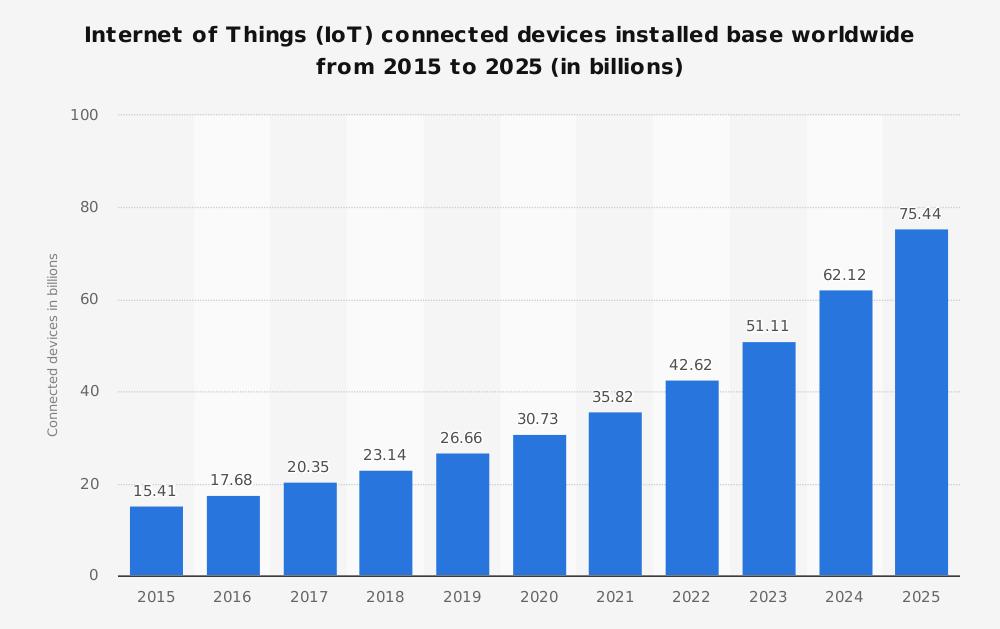
Figure-1: Information of IoT linked devices
Thischapterpresentstheresultsthatwereacquiredfrom the System Testing that was carried out as part of this researchproject.Thetestingwascarriedoutaspartofthis researchproject.Intheparagraphsthatfollow,thestructure of this chapter will be broken down even more and discussedingreaterdepth.Thestepsthatareoutlinedinthe area ofthedissertationthatislabelled"methodology" are followed in order to carry out the measurements, and the resultsofthesensoraccuracytestaregiveninthesectionof thedissertationthatisnamed"analysis."Inordertocreatea baselineforevaluatingthefindingsofintegratedsensors,the dataacquiredfromintegratedsensorsarecomparedtothe measurements obtained from commercial medical equipment.Thisallowsthefindingsofintegratedsensorsto beevaluated.Theamountoftimethatpasseswhendatais being sent from one platform to another using 100Mbps Ethernet;inthisscenario,thedataisbeingtransferredfrom theplatformthatusesDE1-SoCtotheplatformthatusesIBM BluemixCloud.Theanalysisofthesystemasawholecanbe foundinthepartthatislabelled"analysis,"andtendifferent peoplehavebeenaskedfortheiropinionsonhowwellthe suggested system will function in order to get input. The finalisedversionofthewebsitefortheneighbourhoodmay be found displayed for your perusal in Section 4.5, along withalistoferrorsthatcouldhavebeenoverlooked.
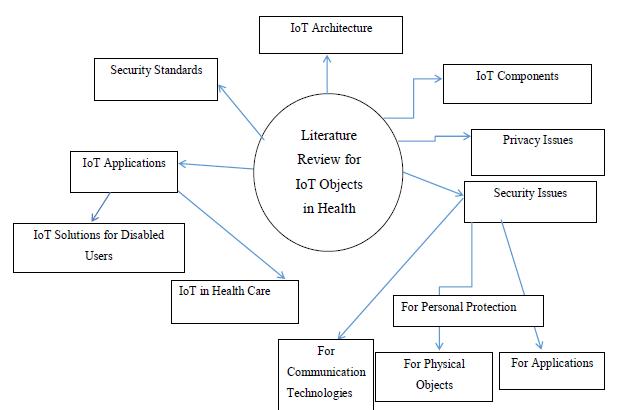
Figure-2: Healthcare IoT Object and Standard Classification in Graphical Form
ThesensorsthatareacomponentoftheInternetofThings area beneficial toolforthe healthcareindustrysincethey make it possible to remotely monitor a patient's physical state. This makes it feasible for medical personnel to continuemonitoringthephysicalstateoftheirpatientsand providing them with important information in real time, which ultimately leads to an increase in the quality of
The participants were asked to have their blood pressure measured,andtheresultsofthisexaminationcanbeseen summarised in the table that is located just below these instructions for the experiment. [T]he results of this examination can be seen summarised in the table that is located just below these instructions for the experiment. [T]heoutcomesofthisinvestigationarepresentedintabular formforyourperusalintheareathatisimmediatelytothe right of these guidelines for doing the experiment. The absoluteaccuracyoftheintegratedbloodpressuremonitor is shown in Table 1, together with the device's average degree of accuracy, in the same column. This information maybefoundinTable1.Bothofthesetiersofprecisionare locatedinthesamerowofthetable.Thefirstthingthatis goingtobehighlightedisthecompletelyunrivalledprecision ofthebloodpressuremonitorthatisalreadyincludedinto thedevice.Findingtheaveragemeasurementthathasbeen analysed is the first step in determining the average accuracy;next,onemustmakeuseoftheinformationthat canbegatheredfromthataveragemeasurement;finally,one must identify the average accuracy that has been determined.Afterthat,itwill befeasibletodeterminethe
International Research Journal of Engineering and Technology (IRJET) e-ISSN: 2395-0056
Volume: 09 Issue: 08 | Aug 2022 www.irjet.net p-ISSN: 2395-0072
averageaccuracyoftheresults.Afterthat,itwillbepossible to determine the overall correctness of the findings by computingtheaverage.
1 95.80 94.74 100.00 92.13 96.40 98.73
2 99.21 98.75 96.75 90.14 94.96 93.55
3 94.21 100.00 95.87 93.75 97.56 96.47
4 97.14 92.65 99.18 94.19 98.45 100.00
Average 99.17/98.72
Theintegratedbloodpressuresystemisusedtomeasurethe SystolicandDiastolicpressure.Fromthetable-1,theSystolic pressureliesbetween102to133mmHgwhiletheDiastolic pressure lies between 58 to 88 mmHg. The deviation betweenmeasurementsfromtwobloodpressuresystemis ranging between +7 and -7 mmHg. These deviations may causelargeerrorifthemeasuredbloodpressureisDiastolic pressure.
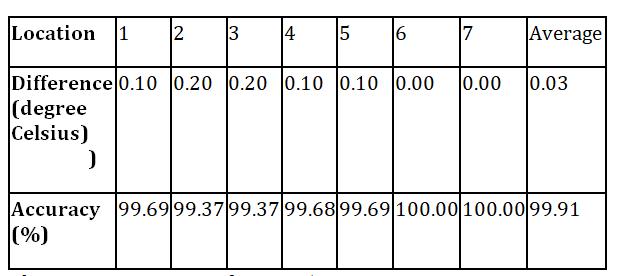
The temperature sensor LM35 and IT-903 are used to measurethesurroundingtemperatureandtheresultsare shown in Table 2. Seven locations are chosen and three measurementsarecollectedusingbothdevices.
Table-2:
Figure-3: Graph of Surrounding Temperature versus Location.
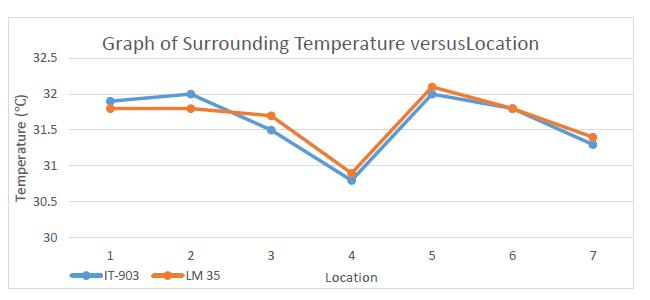
Generally, this test shows that the sensitivity of the LM35 temperaturesensortotemperatureisabout±0.2℃deviated fromIT-903.
The LM35 temperature sensor and IT-903 are used to measurethebodytemperatureandtheresultsareshownin Table-3. The surrounding temperature during body temperature test is between 30.9 to 32.9 ℃ . The measurementsaretakenbymeasuringthefingertipofuser.
Table-3: Comparing Result of Body Temperature Test.
Day Difference Accuracy (%)
1 0.20 0.40 0.40 99.45 98.91 98.91
2 0.30 0.20 0.20 99.18 99.46 99.45
3 0.20 0.30 0.40 99.46 99.18 98.92
Average 0.29 99.21
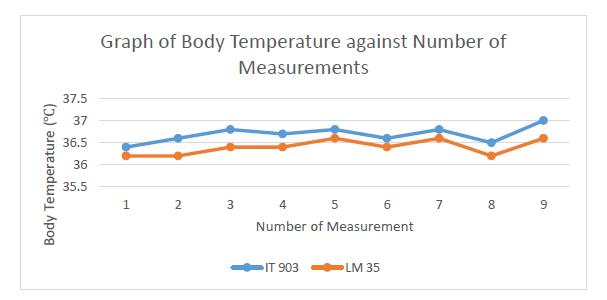
FromTable-3,theaverageaccuracyforLM35temperature sensor to measure body temperature is 99.21% and the largest error in measurement is 1.09 %. According to the graphplottedinFigure4,themeasurementsfromIT-903are alwayshigherthanthemeasurementsfromLM35.
From above Table, the average accuracy for LM35 temperature sensor to measure the surrounding temperature is 99.91% and the largest deviation in measurementis0.20℃.AgraphofSurroundingTemperature versusLocationisplottedandshowninFigure-3.Thegraph showssmalldeviationbetweenthemeasurementIT-903and LM35.
International Research Journal of Engineering and Technology (IRJET) e-ISSN: 2395-0056
Volume: 09 Issue: 08 | Aug 2022 www.irjet.net p-ISSN: 2395-0072
Figure-4: Graph of Body Temperature against Number of Measurements.
Theoverallfunctionofthesystemistestedontenvolunteers andhealthparametersarecollected.Thehealthparameters fromthevolunteersalsocollectedusingcommercialdevices.
The development of a portable health monitoring system that is capable of measuring ECG signal, pulse rate, body temperature,andbloodpressurehasbeensuccessful.The DE1-SoC platform is used to interface the LM 35, which includesanintegratedbloodpressuremonitorandanECG sensor module. The temperature sensor has an average accuracy of 99.21 percent, the pulse rate sensor has an average accuracy of 99.26 percent, the systolic pressure sensor hasanaccuracyof99.17percent, and the diastolic pressuresensorhasanaccuracyof98.72percent.Thedata thathavebeenmeasuredareuploadedtotheIBMBluemix Cloudplatformatarateof1.53millisecondspersampleof data.Toconnecttotheinternet,theDE1-SoCplatformmakes useoftheonboardRJ45port.Theuserwillbeabletoview theresultsofthemeasurementandultimatelycarryoutthe diseasepredictionthankstoalocallyhostedwebpagethat hasbeendeveloped.
TheInternetofThings (IoT) function of the system under considerationisabletooperateonceithasbeenconnected toEthernetandgivenanInternetconnection.TheInternetof Things (IoT) framework that runs on the Internet is developed using the IBM Bluemix Cloud platform, which receives support from IBM in the areas of API and cloud computing. The findings are uploaded to a cloud storage service and organised in accordance with the health parametertype.Thesehistoricalparameterswillbestored inthecloudandcanserveasareferenceforboththeuser andthephysicianwhendeterminingthemostrecenthealth trend.Thesavedhealthparametersareaccessibletodoctor andusersviathewebportalbasedonIBMBluemix.Oncea patientchoosestolookatit,thecommentfeaturethatthe doctor provides has been successfully stored in the cloud anddisplayedonthewebsite.
Figure-5:
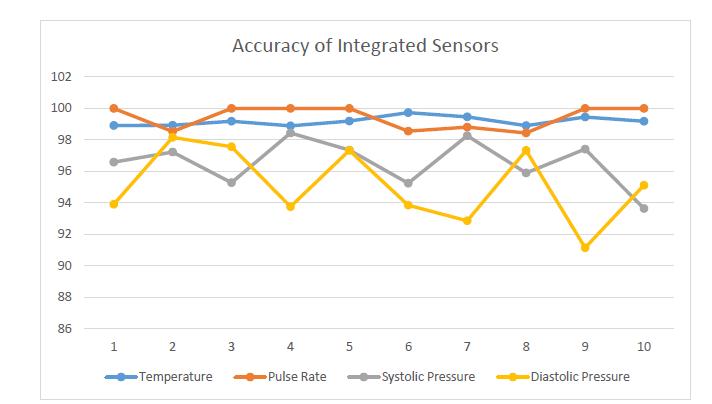
The accuracy of each sensor remains above 90% for the measurements.Theaverageaccuracyforthetestis99.4% forLM35,99.46%forECGsensormoduleandabove99% for integrated blood pressure monitor. The accuracy for LM35andECGsensormodulehaslessdeviationcompared totheintegratedbloodpressuresystembasedonthegraph plottedinabovegraph.TheLM35andECGsensormodule havehigheraccuracywheretheiraccuracyisabove98%for everymeasurement. Themeasurementfromtheintegrated bloodpressuresystemhasdeviationliedbetween±7mmHg and the largest error is 8.86%. The error could be due to body movement during measurement and other environmentfactor.
1. Darshana Varma , V. V. Shete , S. B. Somani, "DevelopmentofHomeHealthCareSelfMonitoring System," International JournalofAdvancedResearch in Computer and Communication Engineering, vol.4, no.6,pp.252-255,2015.
2. Amna Abdullah, Asma Ismael, Aisha Rashid, Ali Abou-ElNour,andMohammedTarique,"Realtime wirelesshealthmonitoringapplicationusingmobile devices," International Journal of Computer Networks & Communications (IJCNC), vol. 7, no. 3, pp.pp13-pp30,May2015.
3. YusufU.Khana,UtsavSharma,VishakhaChaudhary, "Arrhythmiadetectionbasedonderivativeanalysis ofQRScomplex,"in 3rd International Conference on Signal Processing and Integrated Networks (SPIN), 2016.
International Research Journal of Engineering and Technology (IRJET) e-ISSN: 2395-0056 Volume: 09 Issue: 08 | Aug 2022 www.irjet.net p-ISSN: 2395-0072
4. "Malaysia:WHO statistical profile," [Online]. Available: http://www.who.int/gho/countries/mys.pdf. [Accessed20January2017].
5. Jinsoo Hwang and Kichang Kim, "Maintaining IP connectivityforseamlessremotehealthmonitoring system," Advanced Science and Technology Letters(Healthcare and Nursing 2015), vol.116,pp. pp.84-87,2015.
6. Ali Abdullrahim and Rebecca De Coster, "A framework of e-health systems adoption and telemedicinereadinessindevelopingcountries,"in International Conference on Information Society (iSociety)),2016.
7. KayodeI.Adenuga,NoorminshahA.Iahad,Suraya Miskon, "Framework for rural cloud telemedicine developmentinSub-SaharanAfricancountries,"in IEEE EMBS Conference on Biomedical Engineering and Sciences (IECBES),2016.
8. Moeen Hassanalieragh, Alex Page, Tolga Soyata, Gaurav Sharma, Mehmet Aktas, Gonzalo Mateos,BurakKantarci,SilvanaAndreescu,"Health monitoring and management using internet-ofthings(IoT)sensingwithcloud-basedprocessing: opportunitiesandchallenges,"in IEEEInternational Conference on Services Computing,2015.
9. YvetteE.Gelogo,HaJinHwangandHaeng-KonKim, "Internet of things (IoT) framework for uhealthcaresystem," International Journal of Smart Home, vol.9,no.11,pp.pp.323-330,2015.
10. Iuliana Chiuchisan, Iulian Chiuchisan , and Mihai Dimian,"Internetofthingsfore-health:anapproach to medical applications," in Computational Intelligence for Multimedia Understanding (IWCIM), 2015 International Workshop,2015.
11. A. Monzon, "Smart cities concept and challenges: basesfortheassessmentofsmartcityprojects,"in International Conference on Smart Cities and Green ICT Systems (SMARTGREENS),Lisbon,2015.
12. D. Ding, M. Conti and A. Solanas, "A smart health applicationanditsrelatedprivacyissues,"in Smart City Security and Privacy Workshop (SCSP-W), Vienna,2016.
13. Hariprasad Anumala and Shiva Murthy Busetty, "Distributeddevicehealthplatformusinginternet ofthingsdevices,"in IEEE International Conference on Data Science and Data Intensive Systems,2015.
14. AmirM.Rahmani,TuanNguyenGia,BehailuNegash, ArmanAnzanpour,ImanAzimi,MingzheJiang,Pasi Liljeberg, "Exploiting smart e-Health gateways at the edge of healthcare Internet-of-Things: A fog computingapproach," Future Generation Computer Systems.
15. L.Pescosolido,R.Berta,L.Scalise,G.M.Revel,A.De GloriaandG.Orlandi,"AnIoT-inspiredcloud-based webservicearchitecturefore-healthapplications," in IEEE International Smart Cities Conference(ISC2), Trento,2016.
16. Jeroen ML Hendriks, Ulla Walfridsson, Peter Johansson,and Anna Strömberg, "E-health in patientswithatrialfibrillation," EuropeanJournalof Cardiovascular Nursing.