1,2,3,4
International Research Journal of Engineering and Technology (IRJET) e-ISSN: 2395-0056

Volume: 09 Issue: 08 | Aug 2022 www.irjet.net p-ISSN: 2395-0072
1,2,3,4
International Research Journal of Engineering and Technology (IRJET) e-ISSN: 2395-0056
Volume: 09 Issue: 08 | Aug 2022 www.irjet.net p-ISSN: 2395-0072
5
Abstract - Ride-Hailing has been a great way to travel from one place to another over the traditional ways of traveling. Despite, the great convenience at our hand, the market is captured by a few big companies, which are centralized and store the user data that is further usedfor various operations. With the advancement and Research in Blockchain Technology, the blockchain can be extended to Car Hailing applications tomake a decentralizedapplicationtoovercome the issues with the current Car Hailing Industry and take a step toward Web 3.0. In this paper, we will discuss a Decentralized Car Hailing System and the benefits it serves over traditional and current Car Hailing Industry.
Key Words: Blockchain, Decentralized, Peer-to-Peer, Car Hailing,Security
Transportationintoday'ssocietyshouldbesafeandeasyfor everyone, with a well-functioning public transportation system [9]. The present ride-hailing system, operated by companieslikeUberandOlathosearecentralized.Thereisa trustandtransparencyissuewithsuchacentralizedsystem where servers track every ride and rider's detail. This approachlookstobelessopenandraisesquestionsabout the customer's information and safety. In terms of data integrityandadaptability,centralizationcausessystemsto beuntrustworthy.
Blockchainisgainingpopularityintheride-hailingindustry byallowinguserstoconnectdirectlywithdriverswhoare prepared to carry them. Not just the banking sector, but everymajorbusinesswithdifferentiatingqualitiesisbeing transformedbyblockchain.Researchersareattemptingto figureoutwhereblockchainmayhelpsolveissuesandcreate excellentservices.Blockchainisalreadymakingheadwayin areas such as crowdfunding, insurance, healthcare, governance, and energy. By promoting cooperative managementbetweenpassengersanddrivers,blockchainbasedride-hailingcompaniesmightaddresstheneedforan hour.Participantsdistributetransactionaldataoveravast network ofnodesratherthandecidingona singletrusted central authority. This eliminates any intermediates who serveasadministrators.Transactioninformationisstoredin a distributed ledger that is accessible to all nodes in the blockchainnetwork,makingthenetworkmoretransparent.
In this paper, we discuss a mechanism to develop a ridehailing service that profits both Riders and Drivers in comparison to traditional or current models. Every ride detail will be recorded as a transaction in the blockchain, whichactsasashareddatabase.Inourcar-hailingservice, blockchainenablesdecentralizationbyallowingdriversand riders to interact directly through the app without the participation of a third party, and by automating all operationslikeridesetupandfaircomputation.Thisboosts the system's stability and fairness by making it more transparent.
TheBlockchainwasintroducedbySatoshiNakamoto [12] and has been one of the fastest-growing technology ever, withveryhighpotential anditisstill thebeginningofthe era.TheBlockchaincameintoexistenceasatechnologyused by Bitcoin to create a decentralized network for asset exchange,eversinceBitcoinhasattainedadrasticuserbase. Withmoreandmoreresearchintothefield,Blockchainisno morelimitedtoCryptoCurrencybutisaperfecttechnology to be used anywhere with the need for transparency, and improved security. Blockchain is the driving force for the newandupcomingWeb3.0.
In this paper, we will be trying to use the very same technology to create a Ride-Hailing System that is transparent, trustful, and privacy-oriented [8]. There has beenagreatamountofresearchinthe fieldofBlockchain that discusses the integration of blockchain in various applications.Wewillalsodiscusshowtodecideonpricingto createbetteraffordableridesfortheuserandatthesame timemoreprofitablesourceofincomefordrivers.
InapaperbyRuolinZhangandNedaMasoud[10],theyhave discussed a model for ride-sharing where based on geographicallocationtheuserscanbepickedbasedonthe owner’sroutepreference.ThiscanbeextendedtotheRideHailingsystemtoshowdriversbetterresultsbasedontheir currentgeographicalarea.
In a paper by Ryan Shivers, Mohammad Ashiqur Rahman, andHossainShahriar[1],theydiscussacar-hailingsystem with Autonomous Vehicles where users can enroll their vehicleforCarHailingServicewithouttheneedofadriver.
International Research Journal of Engineering and Technology (IRJET) e-ISSN: 2395-0056
Volume: 09 Issue: 08 | Aug 2022 www.irjet.net p-ISSN: 2395-0072
A Bengaluru-based start-up DRIFE [11] refers to itself as Taxi 3.0 as a reference from Web 3.0, is based on a subscription-basedservicefordriversratherthantakinga shareoftheFareeverytime.Usingautomatedalgorithmsfor pricecalculations,andprovidingsafetymeasures,keeping things decentralized along with maintaining the record of the necessary information, such as driver's background check.
The work in the category is endless, keeping the previous workinmind,wewillbeusingthepastwork,tocreatean applicationthatmeetstheneedoftheuser,andalsoprovide atrust-worthyenvironment,wheretheycanbepartofthe system,ratherthantrustingsomeoneblindly.
A blockchain is a digital ledger that contains several blockswhichareencryptedandcarriesouttransactionsthat are circulated across the whole network of a computer system.Transactionsarecarriedoutsafelywhichisdifficult tohackandeachrecordofthetransactionisappendedtothe participant’sledger.
Itismostlyusedinpaymentsindustries,healthcare,and alsoincybersecurityasthedataontheblockchainisdifficult to alter [5].It works on distributedledger technologythat follows certain protocols which can either be public or private and also it is permissioned or permissionless. DLT contains nodes that have a database that synchronizes transactionsintheircorrespondingledgerssothattheycan beeasilyaccessedbythepeopleandsites.
Theblockchainarchitectureconsistsof:-
1. Node: Nodes are generally the servers or the laptops/computers which act as a framework in the blockchain. They are mainly used for preserving the informationandspreadingitandareconnected.
2.Transaction:Atransactionisanyinteractionbetweenany nodesoftheBlockchain.Atransactionistherecordofsome data.Inbitcoin,itstorestheamountofbitcointransferredor received.
3.Block:Blockisthebasicbuildingblock.Itcontainsseveral datawhichaccountforinformationcorrespondingtotheuse case of the Blockchain. Generally, they contain several componentslikethenonce,roothash,versionnumber,hash ofthepreviousblock,andalsothetime.
4. Miners: They are the special nodes that use the mining hardwareandaddthetransactiontotheledger.Theyspend their computational power or other resources as per the
consensus used,andagainthe ability to adda transaction, they receive the reward in the native cryptocurrency for addingtheblock.
5.Chain:Arrangementofblocksinaparticularorder.They aregenerallyverylonginsize.
6.Consensus:Consensusisthecentralpartofablockchain network having distributed systems that contains a set of protocols.Allthepeersintheblockchainnetworkmustreach acommonandunifiedagreementonthedistributedledger forwhichaconsensusalgorithmiswidelyusedtodevelop thetrustbetweentheunknownpeers.
It accounts for open-source property in the blockchain network. It makes blockchain secure and faulttolerant and also makes sure in balancing economic incentives.
A blockchain is a digital ledger that contains several blockswhichareencryptedandcarriesouttransactionsthat are circulated across the whole network of a computer system.Transactionsarecarriedoutsafelywhichisdifficult tohackandeachrecordofthetransactionisappendedtothe participant’sledger.
1.Node:Itisdividedinto2types,FullNode,andPartialNode.
a. Full Node: They provide the full validation of transactionsusingfullcopy.Theycanvalidatetheaccuracyof transactionsandcanalsorejectaswellasacceptit.
b. Partial Node: It contains the lightweight node and doesn’t contain the full copy of the ledger. They have low storageaswellaslowcomputationalpower.
2. Ledger: Ledgers are the database that contains the information in the digital form which helps in exchanging currency(cryptocurrency).Generally,itisof3types,Public, Distributed,andDecentralized.
a.PublicLedger:-Itisaledgerthatiscompletelypublic whichmeansanyonecanperformreadandwriteactionsin this.
b.DistributedLedger:-Thedatabasecontainsthelocal copy of the node which can be easily attainable through different sites and is also synchronized. In a distributed ledger,variousnodesperformatransactionandensurethat thereshouldnotbeanycyber-attack.
c. Decentralized Ledger: - Each node helps in the completionofthejobandalsodoesn’thavecentralcontrol. Theyalsohelpinsynchronizingtransactionsintheirspecific ledgers.
International Research Journal of Engineering and Technology (IRJET) e-ISSN: 2395-0056
Volume: 09 Issue: 08 | Aug 2022 www.irjet.net p-ISSN: 2395-0072
3. Wallet: Wallets are used for storing different cryptocurrencieslikebitcoinandEthereumindigitalformto carryoutfasttransactions.Wecanaccesswalletsfromany devicelikemobilephonesbutatthesametime,itensuresthe privacyoftheidentityoftheuserusingkeypairs.Currencyin the wallet is sanctioned and uniform. Generally, it is of 2 types,HotWalletandColdWallet.
4.Nonce:NoncewhichisabbreviatedasNumberandcanbe usedonlyonceisa4byteorthe32-bitnumberwhichisused by the miners to create the hash value for the block. It generally changes with time so that each time its pseudorandom value can be used. It uses authentication and a certainsetofrulesisusedtoprotectthecommunications.
5.Hash:Hashisamathematicalfunctionthattakesinputand converts it into bytes of a string having a fixed length and producestheuniqueoutput.Intheblockchaincomputation,it ensures to reach encryption. Types of Hash, MD5, SHA-2, SHA-3,RIPEMD,BLAKE2.
Public Blockchain: It is fully decentralized and can be accessed by every user and is generally used for mining cryptocurrencycontrolledbyconsensusalgorithms.Itisalso calledapermission-lessblockchain.
Private Blockchain: It is also called permissioned blockchain as the name suggests. Now, to validate a transactionforreachingaconsensusitoffershighspeedas permissionisgrantedonlytoacertainnumberofusers.Itis alsoveryscalable.
ConsortiumBlockchain:Heretheminerrightsaregiven tosomespecificnodesonly.Thoughtheblockchaincanbe readandviewedbyanyonetheblockadditionislimitedtoa selectedsetofnodes.
The consensus algorithm aims to find a unique agreementintheentireblockchainnetworkandinvolvesthe essentialparticipationofallthenodes.Discussingthemost usedConsensusAlgorithms[7].
ProofofWork:-Itisadecentralizedmechanismthatis mostlyusedinminingcryptocurrencytogeneratethenext block.Itdecodescomplexmathematicalpuzzlesbyusinglong stringsandlotsofcomputationalpower.Thearbitraryhash function used in the proofof work algorithm generatesan outputthathasaminimumnumberofleadingzeroes.
Proof of Stake: - Instead of solving the complex mathematicalpuzzlesusersinvestinthecoinstobecomea validator.Hardwarerequirementsarelessinproofofstake and require fewer energy mining blocks. It motivates the
validators through an incentive mechanism to reach an agreement.
CarHailingIndustryisabillion-dollarmarketandiscaptured byfewcompaniesintoday’sworld.TowardsanApproachto Web 3.0, i.e., creating a network where no one else has control over your data. Only you own your data. These companies use your travel data, address, and other information to earn money. Apart from user data, these companiesactasamediatorbetweendriverandriderand take a big chuck out of the total fare, as per studies, the mediator may charge as much as 25% of the total share, whichisabigpercentage.ThisresultsinDrivershavingless incomeandatthesametime,ridershavetospendanextra amount which goes to the mediator. This Mediator can be removedbymakingthesystemdecentralized.Thoughthere areafewaspectsthatneedmonitoringsuchassafetyissues, duetowhichtakingsuchasystemcompletelydecentralized can be challenging. We can create a system that is trustworthy,open-sourced,transparent,andusesautomated algorithmsforpricecalculation.
WepurposetocreateamodelonConsortiumBlockchain,as discussed earlier it is a blockchain where the process of miningorinsimpletermstheadditionofblocksislimitedto afewindividuals.Themediatorortheapplicationownercan useasubscription-basedpackagefromdriverstobecomea part of the blockchain. Once a driver is a part of the blockchainafterverificationbytheappowner,thedrivercan haveaccesstotheDashboardwheretheycanaccessallthe available rides, can select from the pool of Rides, and the drivercanactasaminer.
Rather than charginga great percentage out of every ride, very affordable monthly subscription feescan be used. No databasehastobeused,ratheraBlockchain-basednetwork can be used which is transparent and trustworthy. TemporaryChatRoomscanbecreatedbetweenRiderand Driverforcommunicationwithouttheneedfordatabase.All ofthesetopicsarediscussedindetailinfurthersections.
Factor value:
International Research Journal of Engineering and Technology (IRJET) e-ISSN: 2395-0056
Volume: 09 Issue: 08 | Aug 2022 www.irjet.net p-ISSN: 2395-0072
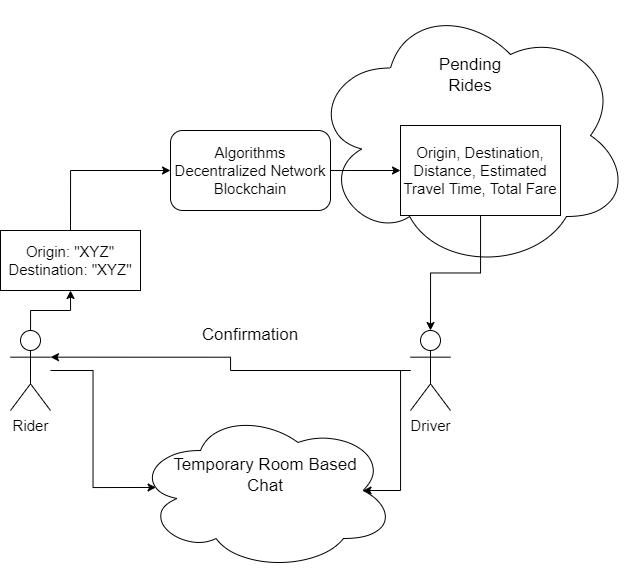
The system contains algorithms that are optimized to calculatepricesbasedondailyfuelpricesandotherfactors whicharediscussedindepthintheFareCalculationSection ofthispaper.First,auserchooseshisPickupandDestination, afterthatthesystemmakescalculationstocalculateDistance, EstimatedTravelTime,andTotalFarewhichareaddedtothe information along with Pickup and Destination, which are thensenttothemainBlockchainwhichcontainsallthedata. Onceadriveracceptstherequest,theblockisalsoappended to the Final Blockchain as a confirmation. The use of 2 Blockchainisdiscussedinthenextsection.Aconfirmationis senttotheRiderthathisrequesthasbeenapprovedandthe driverandrideraresenttoaChatApplicationwheretheycan sharefurtherrequireddetails.
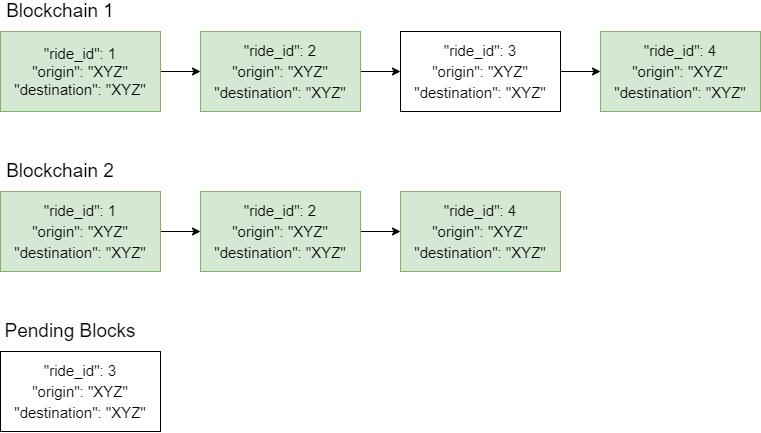
We will be using a 2 Blockchain-based approach for our model. First Blockchain will be used to record all the transactions and transactions that are completed, i.e., acceptedbythedriverareaddedtotheSecondBlockchain. Whena driverwantstolook upavailablerides,wewillbe travelingthefirstBlockchaininreverseorder,wewillalsobe makingsurethatweonlycheckblocksthatarenotolderthan 3minutes.AlltheblocksfromtheFirstBlockchainwhichare notolderthan3minutesareaddedtoavariablethatactsas temporary storage. Now, we will traverse the Second Blockchain,againinreverseorder.Wewillonlycheckblocks that are not older than 3 minutes. All such blocks are removed from the variable created during the previous iteration.Afterthis,wewillonlyhaveunaccepted,orpending requestsleftinthevariable.Allsuchridesareshowntothe driverandsortedintheEstimatedTimetoreachthelocation forthedriverandareshowntothedriver.OncetheRideis Accepted by the driver, the request will be added to the second blockchain, and both rider and driver will be redirectedto1on1chatwindow.Wheretheycansharetheir detailssuchasPhoneNumbers,orotherinformation.About the Communication between Rider and Driver is further discussedintheCommunicationsectionofthispaper.
ForaDecentralizedCarHailingSystem[2],itisimportantto have an Algorithm that takes into consideration various factorsforFareCalculation.AsmostofthedriversuseCNGas a preferred Gas Medium due to the less cost compared to DieselandPetrol.ThePricingwillbecalculatedbasedonthe CurrentPriceofCNG.AnAPIcallwillbeusedtofetchdaily CNGPricesinrespectiveCitiesandStatesandfurtherwillbe used for Fare Calculation. A CNG vehicle has an average Milage of 25-30 Km per Kg. Therefore, the algorithm will consider the lower limit i.e., 25 Km per Kg for Fare Calculation.
As per online articles from Hindustan Time, Financial Express,andFactoryDailyExistingMarketLeaderslikeOLA andUberusedtohaveagoodsharefordrivers,wheredrivers canearnagrossincomeof88,000to100,000permonthbut eventually, this has reduced to 25,000 to 35,000 in recent days.FromanarticlebyEntrackr,driverclaimstoearnRs7 perKmwhichislowerthetraditionaltaxiservices.
Considering the facts based on Articles and Research [4], Algorithmwillchargeabasefareof100RsforRideslessthan orequalto5KmandabovewhichtheDrivercanearnafeeof Rs11perKmexcludingtheGasPricewhichwillbeaddedto thefare.Thefareiscalculatedtoprovideabetterexperience toboththeDriversandUsers.MakesuretheDriverisearning agoodamountforliving,aswellasmakingitaffordablefora user. The Base Fare is kept at 100 Rs considering the distance driver would have to travel to reach the Pick-up Location.
International Research Journal of Engineering and Technology (IRJET) e-ISSN: 2395-0056
Volume: 09 Issue: 08 | Aug 2022 www.irjet.net p-ISSN: 2395-0072
AnextrafarewillbeaddedinthecaseofToll-Tax.
Supposearideof20Kmisassignedtoadriver,thefarewill beRs100(BaseFareof5Km)+Rs165(DriversProfitfor other15Km@Rs11perKm)+CNGPriceRs56(Calculated @CNGPriceofRs70PerKgandCarMileage@25KmPerKg) which results in Total of Rs 321 which is comparatively betterthancurrentMarketPriceforasimilardistanceaswell asgivesamuchbetterreturntoDriver.
Input: Pick-up Location, Destination Location
Output: Origin, Destination, Total Distance, Est. Travel Time, Total Fare
1. variable CNG Price = CNG Price API (Pass = Pick-up Location)
2. variable Travel Time, Total Distance=GoogleDistance Matrix API (Pass = Pick-up Location, Destination Location)
3. variable Base Fare = 100
4. variable CNG Cost = (Total Distance / Car Milage assumed = 25) * CNG Price
5. variable Driver Profit = Total Distance * ProfitPerKilo assumed = 11
6. variable Total Fare = Base Fare + CNG Cost + Driver Profit
AsweseeintheexistingCabHailingApplicationthereisa mechanism like sharing phone numbers and creating a privatechatroom.Thisfunctionalitycanbeeasilyachieved using a Database over a secured channel. But for the decentralizedapplication,wecan'thaveadatabasetostore user details. Therefore, we have to come up with a new innovativemodelthatcanbeusedtocreateacommunication betweenRiderandDriveroncetherideisconfirmed.
Whenarideisconfirmed,itisanecessarysteptoestablish communication between driver and rider. This can be a challengingstepwhenitcomestoDecentralizedApplications. Thisapplicationwillbeusingatemporaryroom-basedchat. Nodatabasewillbekepttostorethechat,ratheritwillbe savedinthebrowseritselfandwillbeclearedwhentheride iscompleted.
Wecanuseachatapplicationusingsocket.iowhichisusedto establishaconnectionbetweendriveranduseroveraprivate room.Theprivatechatroomcanbecreatedusingacommon featureorIDwhichcanbeaccessedbybothRiderandDriver, bothcanusetheprivatechattosharecommunicationdetails, sharelivelocation,orothernecessaryinformation.
ThereisalwaysascopeforImprovement,therearestillafew thingsthatshouldbetakencareoftomaketheapplication moresecure,reliableanduserfriendly.Belowarefewofthe topics which can be integrated and worked upon in the existingmodeltomakeitmorereliable.
1.OTPSystem:A“Onetimepassword”isauniquepasscode thattheriderwillreceiveafterbookingtheride.Therider willhavetosharetheOTPwiththedriverandthedriverwill havetoentertheOTPaccuratelybeforestartingtheride.This will make sure that the right customer is with the right driver.Thisisgoodforsafetyandabigconvenienceforany further mix-ups. Frequently,a traveler may hire a cab and boardtheincorrectcab,particularlyatcongestedlocations likeairports,railwaystations,etc.wheresuchmix-upscould happenandcausemajorissues.TheOTPsystemguarantees thatthecorrectpersonistransportedtothecorrectlocation [6].
2.TollsandTax:Therearemanyadditionalchargesonaride liketolls,MCDTax, Airport Surcharge, and other minor charges. All these charges will be included in the trip automatically with the totalfarewhichwilleasethetrip.Itwillpreventanysortof misunderstanding or last-minute mix-ups. The additional chargesvarybylocation.
3.Sortingnearbydrivers:Fromthepassenger'slocationpoint ofview,thedriver'slocationshouldbenearer[3].So,thereis anopportunitytobuildalocationsortingfunctionthatcan sortthenearestdriverlocationandconnectthatdriverwith thepassenger.Thiscaneffectivelysavethecostofthedriver for picking up a passenger and the waiting time of the passengerisalsoreduced.
4.LiveLocationSharing:TheLiveLocationfunctionenables userstosharetheircurrentlocationwithsomeone.Wecan usethistotrackthedriver'slocationandthenshowittothe passenger.Wecanalsousethisasasafetymeasurementand sharepassengers'locationswiththeirtrustedones.
5. Accuracy in Pricing: By Identifying the model, year, condition,andthethingswhichaffectthemileageofacarand adding the data for the calculation. We can have more accuratepricingbythismethodandduetothetransparency inpricing,thedrivergetsthefaircompensationinpricevalue andthepassengergetsthefairpricefortheride.
2022, IRJET | Impact Factor value: 7.529 | ISO 9001:2008 Certified Journal |
International Research Journal of Engineering and Technology (IRJET) e-ISSN: 2395-0056
Volume: 09 Issue: 08 | Aug 2022 www.irjet.net p-ISSN: 2395-0072
This paper provides a framework for developing a decentralized ride-hailing system that acts as an intermediarybetweendriversandpassengers.
Excessivetransactioncostswillbeeliminated,censorshipwill bereduced,andvaluewillberedistributedtothecommunity while transparency is improved. A zero-commission arrangementresultsinhigherearningsfordrivers,whocan then pass on part of these savings to customers who save moneyoncommuting.Asaresult,theplatformevolvesinto one that pays drivers well and offers good fare rides to passengers.
Existingride-hailingservices,whileusefulandpopular,still havesomescopeforimprovementintermsofpricingmodels, usersafety,transactiontransparency,anddatasecurity.Allof these problems can be solved with blockchain-based solutions,whichprovidemoreinnovativefunctionalitywith greater simplicity of use and control. Riders may communicate directly with drivers via the blockchain's decentralizednetwork,minimizingthecostofextraservices. As a consequence, the system acquires trust and transparencybyconsistentlyprovidingappropriateprices.
[1] Shivers, Ryan & Rahman, Mohammad & Shahriar, Hossain. (2019). Toward a Secure and Decentralized Blockchain-based Ride-Hailing Platform for AutonomousVehicles.
[2] J. Wang, J. Pan and Y. Li, "The Optimal Strategies of Online Car-Hailing Platform Based on the Cost Difference of Drivers," 2018 15th International ConferenceonServiceSystemsandServiceManagement (ICSSSM), 2018, pp. 1-5, doi: 10.1109/ICSSSM.2018.8464969.
[3] D. Wang, W. Cao, J. Li and J. Ye, "DeepSD: SupplyDemand Prediction for Online Car-Hailing Services Using Deep Neural Networks," 2017 IEEE 33rd International Conference on Data Engineering (ICDE), 2017,pp.243-254,doi:10.1109/ICDE.2017.83.
[4] T.Hu,Y.ZhangandM.Cheng,"PricingStrategyofCarHailingPlatformwithMaximizingSocialWelfare,"2019 6thInternationalConferenceonFrontiersofIndustrial Engineering (ICFIE), 2019, pp. 33-39, doi: 10.1109/ICFIE.2019.8907775.
[5] T.Alladi,V.Chamola,N.Sahu,V.Venkatesh,A.Goyaland M. Guizani, "A Comprehensive Survey on the Applications of Blockchain for Securing Vehicular Networks," in IEEE Communications Surveys & Tutorials,doi:10.1109/COMST.2022.3160925.
[6] K.Gai,J.Guo,L.ZhuandS.Yu,"BlockchainMeetsCloud Computing:ASurvey,"inIEEECommunicationsSurveys &Tutorials,vol.22,no.3,pp.2009-2030,thirdquarter 2020,doi:10.1109/COMST.2020.2989392.
[7] W. Gu, J. Li and Z. Tang, "A Survey on Consensus Mechanisms for Blockchain Technology," 2021 International Conferenceon Artificial Intelligence,Big Data and Algorithms (CAIBDA), 2021, pp. 46-49, doi: 10.1109/CAIBDA53561.2021.00017.
[8] Kudva, Sowmya & Norderhaug, Renat & Badsha, Shahriar&Sengupta,Shamik&Kayes,A.S.M..(2020). PEBERS:PracticalEthereumBlockchainbasedEfficient Ride Hailing Service. 10.1109/ICIoT48696.2020.9089473.
[9] Noh,DaehoonandTunca,TunayI.andXu,Yi,Evolution ofRideServices:FromTaxicabstoRideHailingandSelfDriving Cars (August 11, 2021). Available at SSRN: https://ssrn.com/abstract=3903493 or http://dx.doi.org/10.2139/ssrn.3903493
[10] RuolinZhang,NedaMasoud,Adistributedalgorithmfor operating large-scale ridesourcing systems, Transportation Research Part E: Logistics and Transportation Review, Volume 156, 2021, 102487, ISSN 1366-5545, https://doi.org/10.1016/j.tre.2021.102487.
[11] “Drife | Decentralized Taxi.” DRIFE, www.drife.io, https://www.drife.io/.
[12] Nakamoto,S.(2008)Bitcoin:APeer-to-PeerElectronic CashSystem.https://bitcoin.org/bitcoin.pdf
2022, IRJET | Impact Factor value: 7.529 | ISO 9001:2008 Certified Journal |