International Research Journal of Engineering and Technology (IRJET)
e-ISSN: 2395-0056
Volume: 09 Issue: 08 | Aug 2022
p-ISSN: 2395-0072
www.irjet.net
Geometric Features of Road and Causes of Accident Ancy Genu C George1, Abhirami K R2, Anakha Haridas3, Anusha Vinod4, Divya K M5 1Assistant
Professor, Dept. of Civil Engineering, Viswajyothi College of Engineering and Technology, Kerala, India Scholar, Dept. of Civil Engineering, Viswajyothi College of Engineering and Technology, Kerala, India ---------------------------------------------------------------------***--------------------------------------------------------------------2,3,4,5 B.Tech
Abstract - Road safety has very importance in our day-to-
speed, road user and vehicular characteristics, design traffic, traffic capacity, and benefit-cost considerations.
day life, as many of our activities are depending upon roads and vehicles. The outcome of road accidents includes severe social and economic problems. The analysis of geometric features and its design improves highway design and reduces accident rates on road. The influences of horizontal curves, lane width, superelevation, curve radius, sight distance, etc. on road safety have been analysed. It is clearly shown that insufficient geometric elements such as inadequate sight distance, and sharp horizontal curve results in hazards. In this paper, road geometric design elements of a curved road stretch is determined and studied. The main causes of accidents and mitigation measures are identified by studying geometrical features.
2. OBJECTIVES The main aim of our study are:
The geometric design of highways deals with the dimension and layout of visible features of highways such as horizontal and vertical alignments, sight distances, and intersections. Geometric design of highways deals with the elements consisting of cross-section elements, sight distance considerations, horizontal alignment details, vertical alignment details, and intersection elements. Under cross-sectional elements, the considerations for the width of pavement, formation, and land, the surface characteristics, and cross slope of pavements are included. The sight distance or clear distance visible ahead of a driver at horizontal and vertical curves and intersections govern the safe movements of vehicles. Changes in the road directions are made possible by introducing horizontal curves. The super elevation is provided by raising the outer edge of the pavement with respect to the inner edge to counteract part of the centrifugal force developed on a vehicle traversing a horizontal curve, extra width of the pavement is also provided on horizontal curves. In order to introduce the centrifugal force and the superelevation gradually, transition curves are introduced between the straight and circular curves. The gradients and vertical curves are introduced on the vertical alignment of a highway. Highway geometrics are greatly influenced by the topography or the terrain through which the highway is being aligned, the locality, traffic characteristics, and the requirements of design speed. The factors which control geometric design requirements are
Impact Factor value: 7.529
To identify the problems in road design
To put forward the mitigation measures
The study area is a 350m road stretch of MuvattupuzhaPunaloor road near to AVM Hospital, Karinkunnam. The road is accompanied with 4 consecutive curves. A number of accidents occurred here because of the problems in geometrical parameters at that road stretch.
1. INTRODUCTION
|
To identify the geometric features of road section
3. STUDY AREA
Key Words: Road safety, Accident, Geometric Features, Horizontal curves, Causes, Mitigation measures
© 2022, IRJET
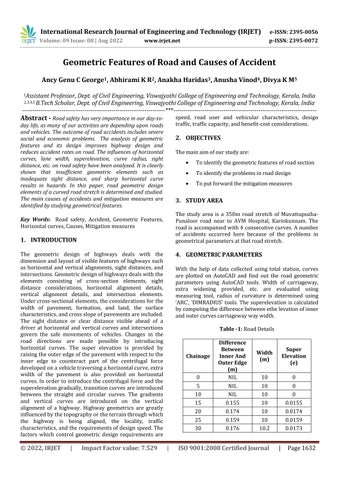
4. GEOMETRIC PARAMETERS With the help of data collected using total station, curves are plotted on AutoCAD and find out the road geometric parameters using AutoCAD tools. Width of carriageway, extra widening provided, etc. are evaluated using measuring tool, radius of curvature is determined using ‘ARC’, ‘DIMRADIUS’ tools. The superelevation is calculated by computing the difference between ethe levation of inner and outer curves carriageway way width. Table -1: Road Details
0
Difference Between Inner And Outer Edge (m) NIL
5 10 15 20
NIL NIL 0.155 0.174
10 10 10 10
0 0 0.0155 0.0174
25 30
0.159 0.176
10 10.2
0.0159 0.0173
Chainage
|
Width (m)
Super Elevation (e)
10
0
ISO 9001:2008 Certified Journal
|
Page 1632