ORGANIC PRODUCT DISEASE DETECTION USING CNN

Page 1

International Research Journal of Engineering and Technology (IRJET)

e-ISSN: 2395-0056

Volume: 09 Issue: 08 | Aug 2022

p-ISSN: 2395-0072

www.irjet.net

ORGANIC PRODUCT DISEASE DETECTION USING CNN B. Sandhya Rani1, B. Sai Sathyanarayana2, Dr.M.Saravanamuthu3 1Student, Department

of Computer Applications, Madanapalle institute of technology and science, India of Computer Applications, Madanapalle institute of technology and science, India ---------------------------------------------------------------------***--------------------------------------------------------------------3. LITARATURE REVIEW Abstract – Because agriculture is vital to the economy, 3Asst. Professor, Department

plant diseases must be kept to a minimum. Early problem detection is crucial, but manual inspections take a long time, are labour-intensive, and are prone to mistakes. Fruit colour, shape, or texture data can be extracted using artificial intelligence to help find diseases. Convolutional neural network (CNN) approaches have recently demonstrated outstanding results for image categorization problems. Large datasets can be processed quickly by CNN, which extracts more precise characteristics. In this study, we classified fruits and their diseases using a mixed deep neural network and contour feature-based technique.

[1] Fruit Grading and Disease Detection in Image Processing for Smart Farming Authors (Rushikesh Borse, Ashwani Kumar, and Monica Jhuria), 2013: Improved fruit production is vital because agricultural companies need large yields; to do this, automated techniques that can detect fruit disease are needed. For this, an artificial neural network methodology that can classify fruit infection is suggested. K-Means clustering is used to locate unhealthy fruit areas, although it has the drawback of a significant estimate load. It will motivate agronomists to improve production and exercise sound judgement from time to time.

1. INTRODUCTION Early plant disease diagnosis is economically crucial. Modern computer vision and machine learning technologies may detect and characterise diseases at an extremely early stage, hence limiting illness transmission and improving cure rates. When sickness symptoms first appear, it may be too late to take meaningful action, but in other A Creative Commons Attribution 4.0 International License has been applied to this work, allowing for its free use, distribution, and reproduction in any format as long as the original work is properly attributed. In this paper, three fruits—grapes, mango, and banana—have been studied. It is now possible to control black rot using a mix of good cultural techniques, fungicides, and resistant cultivars. The first indication of black rot is a black border forming around the edge of leaves.

[2] Manisha A. Bhange and Prof. H. A. Hingoliwala, authors, A Review of Image Processing for Pomegranate Disease Detection 2015: The procedure offers a suggestion for how to identify pomegranate fruit disease. In this procedure, a web-based technique is used to assist non-experts in diagnosing fruit diseases based on a photograph of the fruit's symptoms. Farmers are able to photograph fruit diseases and transmit the images to the system. Farmers would then be able to determine if the fruit has been impacted by bacterial blight or not. [3]Using image processing to grade tomato maturity at a low cost for farmers, Sudhir Rao Rupangadi, Ranjani B.S., Prathik Nagaraj, and Varsha G. Bhat, 2014:

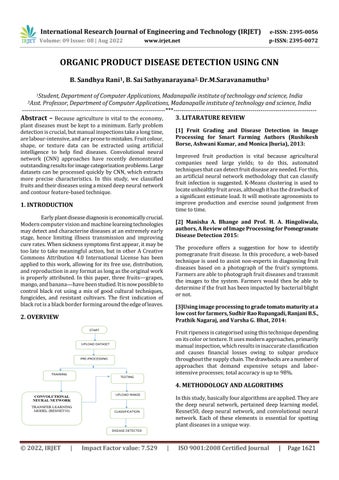
2. OVERVIEW

Fruit ripeness is categorised using this technique depending on its color or texture. It uses modern approaches, primarily manual inspection, which results in inaccurate classification and causes financial losses owing to subpar produce throughout the supply chain. The drawbacks are a number of approaches that demand expensive setups and laborintensive processes; total accuracy is up to 98%.

4. METHODOLOGY AND ALGORITHMS In this study, basically four algorithms are applied. They are the deep neural network, pertained deep learning model, Resnet50, deep neural network, and convolutional neural network. Each of these elements is essential for spotting plant diseases in a unique way.

© 2022, IRJET

|

Impact Factor value: 7.529

|

ISO 9001:2008 Certified Journal

|

Page 1621


Turn static files into dynamic content formats.
Create a flipbook