International Research Journal of Engineering and Technology (IRJET) e-ISSN: 2395-0056

Volume: 09 Issue: 08 | Aug 2022 www.irjet.net p-ISSN: 2395-0072
International Research Journal of Engineering and Technology (IRJET) e-ISSN: 2395-0056
Volume: 09 Issue: 08 | Aug 2022 www.irjet.net p-ISSN: 2395-0072
1
2
Abstract - In this study , atmospheric air pressure plasma and cellulase enzyme were treated with plain woven organic cotton fabric. The important part of doing this surface modification is to study the comfort properties of the effect made by plasma and enzyme treated organic cottonfabric.Moreattentionwasgiventoevaluatingtheair permeability, water vapour permeability, and wickability of the surface modified fabric. The results show that the plasma treated fabric outperforms the enzyme treated and untreated organic cotton fabrics in terms of air permeability and wickability in the warp and weft directions with a 5 minute interval time. But in enzyme treated fabric ,water vapour characteristics reveal the better characteristics compared to the others .Thus, this research work helps in understanding the comfort propertiesofsurfacemodifiedorganiccottonfabric.
Key Words: Organic Cotton Fabric, Plasma Treatment, Enzyme Treatment, Cellulose Enzyme, Air Permeability, Wickability
One of the main current concerns of textile and garment manufacturers is the comfort of clothing. The human sensory response to clothing materials serves as the foundationforcomfort,whichisinfluencedbyanumberof thermal, physiological, and mechanical factors. Textiles have many comfort features that make clothing comfortable, including heat transfer, thermal protection, airpermeability,moisturepermeability,waterabsorption, water repellency, size and fit. In order to meet unique requirements for a variety of applications, the surface of textiles provides an important platform for functional modifications. The surface of textiles can be altered using a variety of methods, from conventional solution treatment to biological methods. Here, organic cotton fabric has been treated with plasma with atmospheric air andacellulosicenzymecalledcellulosetomeetthevariety of applications along with comfort properties such as air permeability, water vapour permeability, and wickability. Why organic cotton ? Since organic cotton is grown naturally without using any pesticides or harmful fertilizers, The growing of organic cotton preserves a secure working environment for farmers and other negative effects on the ecosystem. The use of organic
***
cottoninthemanufactureofhigh-endfabricsisgrowingin popularitybecauseofitswhollynatural originandlackof toxicity. The atmospheric air plasma was done on the fabric with system frequency of 60KHZ in aluminium electrode with the electrode gap of 7.5 cm at room temperatur and cellulose enzyme was treated in the organiccottonfabricwhichiscellulosicinnaturewiththe help of Master Linen’s Inc., Karur. In this paper we are going to discuss whether the comfort qualities of organic cottonfabrichavebeenimpactedbysurfacemodifications.
"Organic cotton" is cotton grown without the use of genetically modified (GMO) seeds, dangerous pesticides, synthetic fertilisers, or chemicals. Organic cotton production reduces soil erosion and other detrimental effectsontheecosystemwhilemaintaininga safeworking environment for farmers and clean freshwater sources close to farms. Due to its complete natural origin and lack oftoxicity,organiccottonisbecomingincreasinglypopular in the production of high-end fabrics. Organic cotton fashionproductsareproducedinlargepartbytheapparel industry.Consumerdemandformoreorganicclothingwill force clothing manufacturers to use more organic cotton. Manydomesticandforeignbrandsarechoosingtoproduce their clothing from organic cotton. This paper discusses variousenvironmentallyfriendlymethodsandsuggestions for growing, processing, and producing organic cotton clothing.(1)
Consumers today are drawn to clothing that feels good in additiontolookinggood.Comfortisbeingemphasisedasa critical factor in clothing.A pleasant state of psychological, physiological,andphysicalharmonybetweenapersonand their surroundings is called comfort. In this paper, the comfort property of the cotton woven fabric was studied, specificallyitswatervapourtransmissionwasstudied.The watervapourtransmissionwasspecificallyinducedbythe combimation and characteristics of the fibres. The result showsthatpolyestercottonblendfabrichasahigherwater transmission rate than polyester viscose. However, the combination of natural fibre and synthetic fibre results in superior comfort when compared to the combination of twosyntheticfibres.(2)
International Research Journal of Engineering and Technology (IRJET) e-ISSN: 2395-0056
Volume: 09 Issue: 08 | Aug 2022 www.irjet.net p-ISSN: 2395-0072
The major focus of this paper is to study the characterizationoforganiccottonandconventionalcotton fibres . The fibre properties include surface morphology, surface chemical composition, surface elemental composition, and internal fibre structure, with organic cottonfibrehavingabettersurfaceelementalcomposition than conventional cotton. The remaining properties were similartoeachother.(3)
ThisstudycomparedtheairpermeabilityofASTMD737-04 conventionalandorganiccottonusedinsinglejerseysand themoisturemanagementofstandardASTMD737-04.The statistical analysis showed that their comfort characteristics differed noticeably. Compared to conventional cotton, organic cotton demonstrated better airpermeabilityandmoisturemanagementabilities.(4)
Vacuum oxygen plasma was used in this study to increase the comfort features. Evaluations of wickability, water vapour permeability/resistance, air permeability, and surface characterization received more focus. Results showed that, aside from air permeability of experimental runsat1O2and7O2,allplasmatreatedcomfortproperties improved. In particular, the warp and weft directions saw atleasta43.25%anda37.63%increaseinthewickability ofthefabric.(5)
The most common polymers used in the textile industry aresyntheticfibres,specificallypolyethyleneterephthalate (PET), polyamide (PA), polyacrylonitrile (PAN), and polypropylene (PP). Along with their positive traits, they also have a number of drawbacks, including hydrophobicity, poor wear comfort, poor dyeability, accumulation of electrostatic charge, pilling propensity, challenges during finishing, and inadequate washability due to their hydrophobic nature. To enhance their properties in this situation, various physical and chemical techniques are used. The application of recent techniques for the modification of synthetic textiles using vapour deposition,surfacegrafting,enzymaticmodification,sol-gel technique, layer-by-layer deposition of nanomaterials, and aqueousmethodsisthemainfocusofthisreview.(6)
One of the fundamental textile characteristics that affects how comfortable clothing is to wear is air permeability. Thisisespeciallytrueforwind-protectiveclothing,suchas motorcycle and ski sport overcoats, where low air permeability is required. Conversely, summer clothing needs to be sufficiently permeable to the air in order to improve heat transfer through ventilation. The porosity and thickness of the fabric as well as the spatial geometry of the pores all play major roles in air permeability. The thickness and structure of woven fabrics then play a key role, with the latter being influenced by the weave type, type of yarns, linear density of the yarns, warp/weft density,finishing,andotherfactors.Althoughmoststudies refer to fabric permeability under standard laboratory
conditions, fabrics are also used in real life under various climaticconditions.(7)
Accordingtotheliteratureresearch,organiccottonfabric's comfort qualities will undoubtedly have an impact on the treatmentofplasmaandenzymes.
An air tronic tester with model number 3240A and ASTM D737 (figure 2) is used to test air permeability. It has a volumetric counter with a minimum capacity of 50 litres perhourandamaximumcapacityof5800litresperhour. Itisalsoavailablewithdifferenttestingareasof20,20,10, 5, 2 cm2. We tested organic cotton fabric that had been plasma and enzyme treated versus untreated using a test area of 10 cm2 with a pressure drop of 100 Pa and a measuring volume of 10 litres per minute, and readings wererecorded.
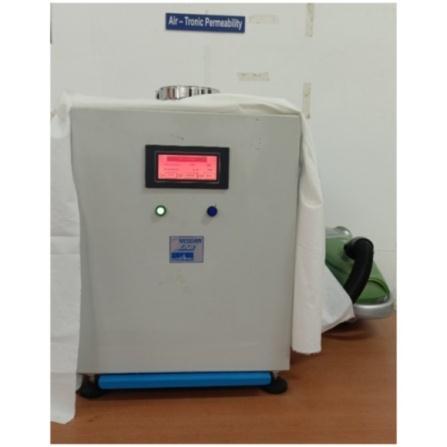
Fig -1:Airtronictester
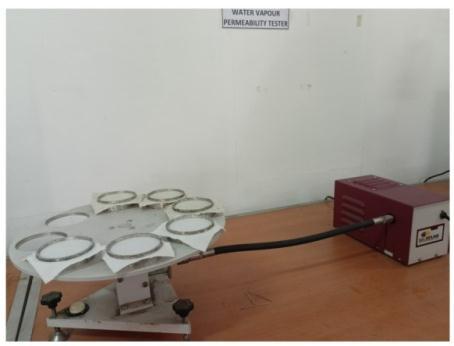
The testing of fabrics in the Water Vapour Permeability Tester Model M261(figure 3) with the specifications of ASTME96isusedwith46mlofwaterat20°C±2°Cineach opendishpredeterminedfromthedimensionsofthedish to give an air layer which is 10±1mm deep between the surface of the water and the underside of the supported specimens.Thespecimenswereplacedovertheturntable and the water vapour permeability readings of different fabricswerecalculated.
International Research Journal of Engineering and Technology (IRJET) e-ISSN: 2395-0056
Volume: 09 Issue: 08 | Aug 2022 www.irjet.net p-ISSN: 2395-0072
Fabric type (plain woven organic cotton fabric)
Air permeability (lit/min)


Plasmatreatedfabric 15.26 Enzymetreatedfabric 13.76 untreatedfabric 14.38

Fig -2 Watervapourpermeabilitytester(cupmethod M261)
Thewickabilitytestwasconductedmanually.Inthistest,a stripoffabricissuspendedverticallyindistilledwaterwith its lower edge exposed. The rate of rise of the water's leadingedgeisthenmeasuredatvariousintervals.Thetest fabric's capacity to wick moisture is directly measured by theheightoftherisethatisobservedovertime.Onewayto account forthisisto weighthe fabric after the testto find out how much water it has absorbed. After that, the readingswereevaluatedandthemass,whichisequivalent tothemeasuredheightofwaterrise,couldbeexpressedas apercentageofthemassofthelengthofdryfabric.
Table -1: PhysicalPropertiesofOrganiccottonFabric
Properties / fabric Plain Organic cotton fabric
Thickness(mm) 17
FabricGSM (g/m2) 100
Fabricweavetype Twillweave
The air permeability of the fabric samples was tested and the results are given in table no 2.The result shows that plasma treated organic cotton fabric has slightly higher air permeability characteristics when compared to the untreated organic cotton fabric, while the enzyme treated fabric has fewer air permeability characteristics thanboththeplasmatreatedanduntreatedorganiccotton fabric samples. Hypothesis testing (T-Test) was carried out for the plasma treated and enzyme treated organic cotton fabricswithuntreatedfabricsandtheresultswere analysed.
15.5
15
14.5
14
13.5
15.26 13.76



14.38 13
plasma treated enzyme treated untreated Air permeability (lit/min) of plain woven organic cotton fabric
Chart -1:air permeability
By using a PAIRED T-TEST with one tail at the 95% significant level to compare the means of plain woven organic cotton fabrics that have been plasma treated and those that have not, P value = 0.089784>0.05 Consequently, there is no significant difference between plainwovenorganiccotton fabricsthat have beenplasma treatedandthosethathavenot.
By using the PAIRED T-TEST with one tail at the 95% significantlevel:Pvalue=0.002585<0.05tocomparethe means of plain woven organic cotton fabrics that have been enzyme treated and those that have not. The plain wovenorganiccottonfabricthathasbeenenzymetreated asopposedtountreatedshowsasignificantdifferenceasa result.
Thewatervapourpermeabilityofthefabricsampleswere tested and results were given in table no 3.The result shows that enzyme treated organic cotton fabric has the higher water vapour permeability when compared to the plasmatreatedanduntreatedorganiccottonfabric.plasma treated fabric has the poor water vapour characteristic whencomparedtotheothers.
By using a PAIRED T-TEST with one tail at the 95% significant level to compare the means of plain woven
International Research Journal of Engineering and Technology (IRJET) e-ISSN: 2395-0056
Volume: 09 Issue: 08 | Aug 2022 www.irjet.net p-ISSN: 2395-0072
organic cotton fabrics that have been plasma treated and those that have not, P value = 0.004463<0.05. Consequently, there is a significant difference between plainwovenorganiccotton fabricsthat have beenplasma treatedandthosethathavenot
Table -3: WatervapourPermeabilityoftheFabric samples
Fabric type (plain woven organic cotton fabric)
Water vapour permeability (g/m2/24hr)
Plasmatreatedfabric 1164.96 Enzymetreatedfabric 2117.04 Untreatedfabric 1785.88
vapour permeability
Table - 4:wickabilityofthefabricsampleinwarp direction
Time in minutes Wickability of Plasma treated organic cotton fabric (cms)
Wickability in Enzyme treated organic cotton fabric (cms)
Wickability in untreated organic cotton fabric (cms)
1min 2.4 0.4 0.9 3min 3.7 1.4 1.8 5min 4.6 2 2.3
1164.96
wvp (g/m2/24 hr) 0 1 2 3 4 5
2117.04 1785.88
plasma treated fabric enzyme treated fabric untreated fabric
Chart -2: watervapourpermeabilityofthefabrics samples
By using the PAIRED T-TEST with one tail at the 95% significantlevel:Pvalue=0.011583<0.05tocomparethe means of plain woven organic cotton fabrics that have been enzyme treated and those that have not. The plain wovenorganiccottonfabricthathasbeenenzymetreated asopposedtountreatedshowsasignificantdifferenceasa result.
The wickability of the fabric samples was tested, and the resultsaregivenintableno4and5.Theresultshowsthat plasma treated organic cotton fabric has a higher wickability property when compared to enzyme treated anduntreatedorganiccottonfabric.Hypothesistesting(TTest)wascarriedoutbetweentheplasmatreated,enzyme treatedanduntreatedorganiccottonfabric.
wickability of the fabric sample in warp direction 1 min 3 min 5 min
plasma treated fabric
enzyme treated fabric
time in minutes organic cotton fabric
untreated fabric
Chart -3: wickabilityofthefabricsampleinwarp direction
Bycomparingthemeansofplasmatreated anduntreated plainwovenorganiccotton fabricsusingPAIREDT-TEST with one tail at 95% significant level:P value = 0.007227<0.05 Result: there is significant difference between the plasma treated and untreated plain woven organiccotton fabricsinthewarpdirection.
Bycomparingthemeansofenzymetreated anduntreated plainwovenorganiccotton fabricsusingPAIREDT-TEST with one tail at 95% significant level: P value = 0.010102<0.05 Result: there is significant difference between the enzyme treated and untreated plain woven organiccotton fabricsinthewarpdirection
2022, IRJET | Impact Factor value: 7.529 | ISO 9001:2008 Certified Journal |
International Research Journal of Engineering and Technology (IRJET) e-ISSN: 2395-0056
Volume: 09 Issue: 08 | Aug 2022 www.irjet.net p-ISSN: 2395-0072
Table - 4:wickabilityofthefabricsampleinweft direction
Time in minutes Wickability in Plasma treated organic cotton fabric (cms)
Wickability Enzyme treated organic cotton fabric (cms)
Wickability in untreated organic cotton fabric (cms) 1min 2 0.3 0.7 3min 3.6 1.1 1.4 5min 4.4 1.5 1.9
direction and weft direction of the plasma treated fabric had the higher wicking property. Thus, this study demonstrates that there are slight changes that occur in the comfort properties of surface modified fabrics, and each surface modified fabric performs differently in each comfort property such as air permeability, water vapour permeabilityandwickability.
We thank the management of Kumaraguru College of Technology and research center of Department of fashion technology. KCT – TIFAC core and Master Linen’s Inc., Karur for providing the necessary support in submitting thispaper.
4
wickability of the fabric sample in weft direction 1 min 3 min 5 min
1. Dhange, V. K., Landage, S. M., & Moog, G. M. (2022). Organic Cotton: Fibre to Fashion. InSustainable Approaches in Textiles and Fashion(pp.275-306.Springer,Singapore
3
2
1
5 plasma treated fabric
2. Das, S. (2016). Study on comfort properties of different woven fabric.International Journal of ManagementandAppliedScience,2(8),57-61.
0
enzyme treated fabric
time in minutes organic cotton fabric
untreated fabric
Chart -4: wickabilityofthefabricsampleinweftdirection
Bycomparingthemeansofplasmatreated anduntreated plainwovenorganiccotton fabricsusingPAIREDT-TEST with one tail at 95% significant level:P value = 0.015498<0.05 Result: there is significant difference between the plasma treated and untreated plain woven organiccotton fabricsinthewarpdirection.
Bycomparingthemeansofenzymetreated anduntreated plainwovenorganiccotton fabricsusingPAIREDT-TEST with one tail at 95% significant level:P value = 0.004082<0.05 Result: there is significant difference between the enzyme treated and untreated plain woven organiccotton fabricsintheweftdirection.
From the analysis of the results, it is found that the plasma treated organic cotton fabric has a higher air permeability property. In the water vapour permeability test, enzyme treated fabric performed the best of the others, and at least in the wickability test, the warp
3. Murugesh Babu, K., Selvadass, M., & Somashekar, R. (2013). Characterization of the conventional and organic cotton fibres.Journal of the Textile Institute,104(10),1101-1112.
4. Nautiyal, M. M., & Vasugi, N. Comparing Comfort Properties of Single Jersey Conventional and OrganicCotton.
5. Yilma,B.B.,Luebben,J.F.,&Tadesse,M.G.(2021). Effect of plasma surface modification on comfort properties of polyester/cotton blend fabric.MaterialsResearch,24.
6. Parvinzadeh, M. (2012). Surface modification of synthetic fibers to improve performance: recent approaches.GlobalJPhysChem,3(2).
7. Hes, L., Bajzik, V., & Boguslawska–Bazek, M. Variations of the air permeability of selected woven fabrics due to changes of the air temperature and humidity. InInternational conferenceIITAS(pp.1-6).