International Research Journal of Engineering and Technology (IRJET) e-ISSN:2395-0056

Volume: 09 Issue: 08 | Aug 2022 www.irjet.net p-ISSN:2395-0072
International Research Journal of Engineering and Technology (IRJET) e-ISSN:2395-0056
Volume: 09 Issue: 08 | Aug 2022 www.irjet.net p-ISSN:2395-0072
-IOT (internet of things) describes the network of physically objects that are nested with sensors, software’s and other technologies for the purpose of connecting and exchanging data with other devices and system over internet. In the area of IOT the major issue was security and privacy remain a major challenge, mainly due to the massive scale and distributed nature of IoT networks. For this problem blockchain(a blockchain is a distributed ledger capable of maintaining immutable records of transactions happening in a network) adds the category of security and privacy, The Blockchain is a great source of providing security to new era technological applications. In the upcoming era of industrialization, high growth of IoT based smart applications have high demand of security to manage and maintain the IoT based application’s data safety, security integrity, and authentication. A Blockchain technology prevents from the unauthorized third parties and acts as a firewall against a single point of failure and other issues. . This has inspired researchers to investigate block chain’s adoption into IoT ecosystem. Blockchain for IOT in the context of eHealth, smart cities, intelligent transport and other applications are analyzed. Blockchain is a distributed and a decentralized ledger technology that combines with IOT to make machine to machine transactions possible. It uses a set of transactions that are recorded in database, verified by multiple sources and entered in a common ledger distributed across every node.
IOTseamlesslyinterconnectsdevicesandobjectstocreate a physical network in which sensing, processing, and communicationprocessesareautomaticallycontrolledand managed without human intervention. IOT consists of networked objects that sense and gather data from their surroundings, which is then used to perform automated functions to aid human use. The IOT is still steadily growing worldwide, expanding Internet and wireless access, the introduction of wearable devices, the progress of storage technology and cloud computing. With each passing day, smaller and smarter devices are being implemented in multiple IOT domains, including housing, precision agriculture, infrastructure monitoring, personal healthcare, and autonomous vehicles and in many more fieldsalso.
However, data information by IOT devices might contain confidential and personal data , and plenty of security threats have emerged that aim to take advantage of the weaknesses of current IOT infrastructures. Briefly we will observethattheentireIOTnetworkworksasacentralized system, for improvement in privacy and security criteria we’dneedtoadopt BLOCKCHAIN TECHNOLOGY.
Centralized specification for the IOT is faced with the subsequentchallenges:
• Information keep in centralized servers is analyzed to reveal specific personal information relevant to health, shopping for preferences and behaviors . Users have restrictedmanagementover,howevertheirinformation is employedandbywhom.
• Information keep in centralized cloud lacks secure responsibleness and traceability. Information keep on centralized servers has the chance of being deleted or tamperedwith.
• With the exponential growth of the IOT, centralized serverswon’tbeeconomicallyenoughinhandlingthehigh or rich amount of end-to-end communications that facilitate IOT automation functions. Therefore, a
International Research Journal of Engineering and Technology (IRJET) e-ISSN:2395-0056
Volume: 09 Issue: 08 | Aug 2022 www.irjet.net p-ISSN:2395-0072
centralized approach can hamper the enlargement of the IOT.
Currently Blockchain is the new phase or an emerging technology which would be able to support a secure and safe distributed ecosystem for the IOT systems.
Block chains to modify IOT communications and to eliminatetherequirementforcentralizedsureauthorities. The concept of a block chain-based IOT has gather the importance of analysis interest, since decentralizing the IOT through block chains has the subsequent potential benefits:
• A decentralized peer-to-peer network architecture enables IOT device autonomy, and end-to-end communications don’t have to be compelled to undergo a centralizedserverforperformingautomationservices
•Participants in block chain networks can verify the integrity of the information they’re sent, moreover as a result ofthecausingparticipant.
•Since no single entity controls the contents of a blockchain, IOT information and event logs hold on the block chain square measure immutable, thus there’s bonded responsibleness , traceability, dependability and trustless.
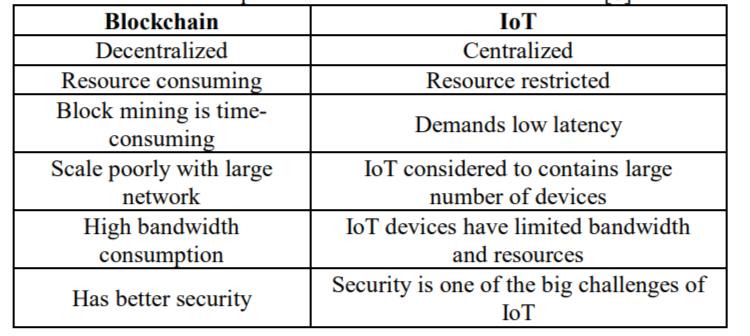
• The trustless network surroundings of block chains permits secure micro-transactions for IoT services and information Table A shows comparisons between block chain and IOT.
TABLE: A
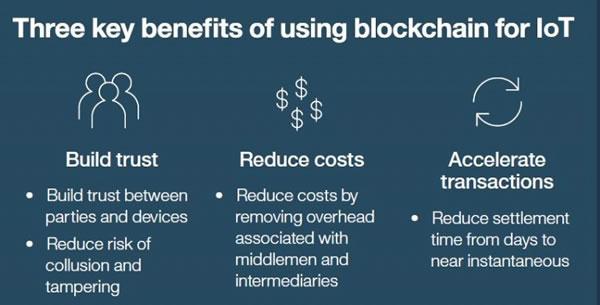
BENEFITS OF USING BLOCK CHAIN FOR IOT: FIGURE: 1
A SINGLE BLOCK OF A BLOCKCHAIN:
FIGURE: 2

International Research Journal of Engineering and Technology (IRJET) e-ISSN:2395-0056
Volume: 09 Issue: 08 | Aug 2022 www.irjet.net p-ISSN:2395-0072
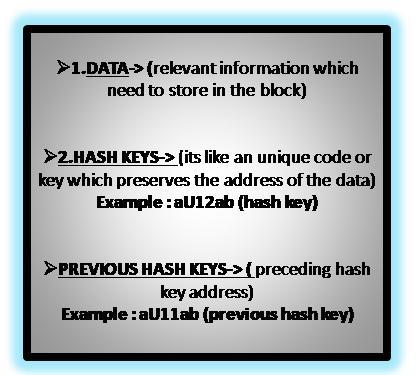
A block chain is created from of blocks containing details of transactions that have occurred at intervals the network. The dealing information will be thought to be token transfers occurring in a network, or any manner of knowledge exchange. Every block is largely divided into two elements, namely, the header and also the body. Transactions area unit keep at interval of the body of the block,whereastheheaderof everyblockcontains,among alternative fields, the symbol of the previous block. A singleblockisshowninabovefigure2
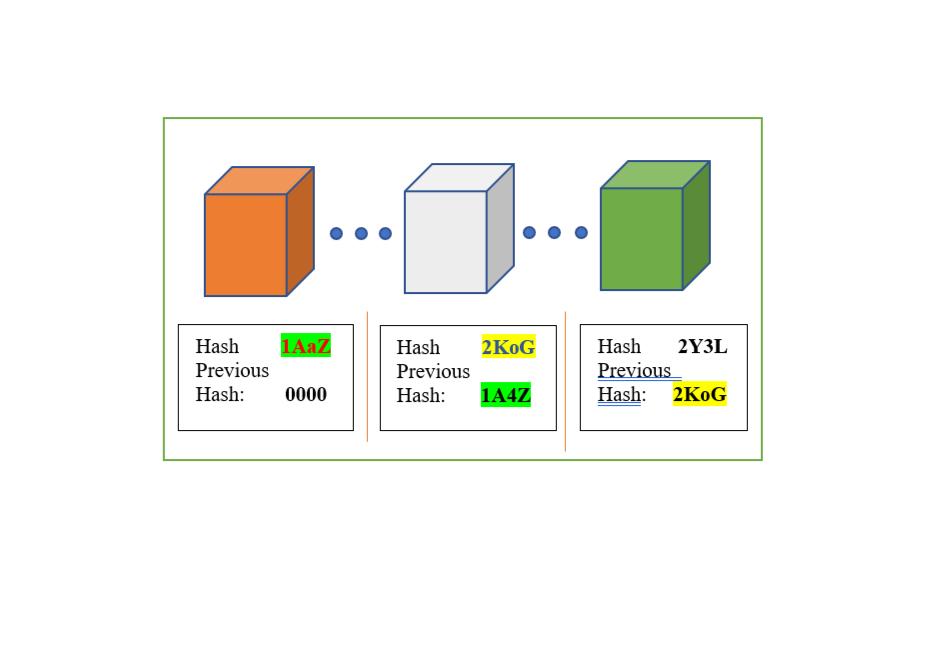
The first block within the chain is named “genesis” block, that is shown in the below figure 2. The symbol of every block is obtained by taking its cryptographic hash, that is why having every block coupled to the previous block helps the block chain accomplish immutableness of its contents. If a hackers (data fetchers) were to change the contents of a past block, its symbol would now not be valid,andaratherchangeswouldoccur,rendertheparent block hashes within the later blocks invalid in addition Therefore, to with success alter the contents of one block, associatedegreewrongdoerwouldgottoaltertheheaders all told sequent blocks and have this alteration crop up within the majority of the nodes within the network, therefore on have the peers reach agreement on this altered block chain. The group actions among a block have a transaction ID, whereby every group action ID is that the cryptographic hash of the corresponding transaction’s data hold on within the block. A tampered group action would turn out altered hashes among its branch and would be detected while not a lot of machine effort.

FIGURE: 3
The Blockchain is associate degree electronic mechanism that deals with money transactions and uses the "Peer to Peer"technology.Ithasthreebasicfunctions:
1. Permits money transactions between people and institutions around the world with a high degree of reliableness and security as a result they destroytheso-called"doublespending".
2. Altertraceability(theabilitytotraceonethingon the web to its assets) for transactions and data, which suggest that transactions are clear; clear havehigherlevelsofsecurity.
3. Defends users from any attacks or violations by malicioususersviatheconstantsystem.Andthere is no need for central authorities to participate in financial transactions, and to ensure lower expenses.
The most important features that turn the block chain technology into something with the potential of radically reshapingseveralIOTindustriesare:
1) Decentralization: In centralized network infrastructures, knowledge exchanges (i.e., the transactions) are valid and approved by trusty central
International Research Journal of Engineering and Technology (IRJET) e-ISSN:2395-0056


Volume: 09 Issue: 08 | Aug 2022 www.irjet.net p-ISSN:2395-0072
third-party entities. In block chain-based infrastructures, two nodes can engage in transactions with each other without the need to place trust upon a central entity to maintainrecordsorperformauthorization.
2) Immutability: If any party wishes to make a change in theblockchainareagreeduponbypeersviadecentralized consensus algorithm, the block chain is censorshipresistant and is nearly impossible to tamper. Similarly, all previously held records in the block chain are also immutable and, in order to alter any previous records, an attacker would need to compromise a majority of the nodesinvolvedintheblockchainnetwork.Otherwise,any changesin the block chaincontentsare easilydetected. In block chain technology every data holders need to follow theCONSENSUSPROTOCOL.





{CONSENSUS PROTOCOL:“Itstatesthattheparticipants make decisions by agreement rather than by majority vote.”Aconsensusalgorithmisaprocedurethroughwhich all the peers of the block chain network reach a common agreement about the present state of the distributed ledger.}
3) Fault tolerance:Allblockchainpeerscontainidentical replicas of the ledger records. Any faults or data leakages that occur in the block chain network can be identified throughdecentralizedconsensus,anddataleakagescanbe easily restored using the replicas stored in block chain peers.
Supply chain managementis one in all the foremost sample of sectors with promisingblockchainIOT cums projects. The worldwide offers chain network includes variedstakeholders,aswellasbrokersyetasrawmaterial suppliers.Asaresult,itisoffenchargeableforintroducing complications inend-to-endvisibility into the supply chain.Curiously,thesupplychainmayadditionallyinvolve varied payments yet as invoices, extending the length of fulfillment by months. Additionally, the participation of multiplestakeholdersendsupindelaysindelivery.
EnterprisesareaunitengagedontheusesofIOTandblock chain along by creating IOT-enabled vehicles chargeable for chase shipments. The mixture of block chain and IOT may improve the dependableness and traceability of the network. IOT sensors may offer crucial information regarding the cargo standing. A number of the notable IOTsensorsembody,
Temperaturesensors

Vehicleinformation

TheblockchainIOT examplesin supply chain management then store the detector information on the block chain. When savinginformtion on the block chain, stakeholders outline within the sensible contracts may acquire period information access. As a result, stakeholders within thesupplychainmayprepare adequatelyfortransactions acrosstotallydifferentshipmentsandborders.
The most outstanding example of mistreatment block chain and IOT functionalities along in supply chain management refers toCalifornia Foods. It’s a varied provider specializing within the manufacture and distribution offoodproducts. California Foods has collaborated with IBM for the improvement of its supply chainprocessesthroughIOTandblockchain
1. The application of block chain and IOT in smart homes gives another excellent declare ‘How block are often utilized in IOT?’ with ease. IOT-enabled devices have provided the best foundation for encouraging the concept of smart homes. With the assistance of IOTblock chain, smart homes could find better ways for managing home
International Research Journal of Engineering and Technology (IRJET) e-ISSN:2395-0056
Volume: 09 Issue: 08 | Aug 2022 www.irjet.net p-ISSN:2395-0072
securitysystemsremotelyfromsmartphones.Blockchain removes the concerns associated with the conventional centralized approach for exchanging information generatedthroughIOTdevices.
2. One of the notableblock chainIOT examplesin the field of smart homes refers toTelstra. The Australian telecommunication giant offers smart home solutions poweredby blockchainandbiometricsecurity.Thesmart home solutions offered by Telstra ensure the storage of sensitive user data on the block chain for better security. Thesensitiveuserinformationmightbeassociatewith, 3.Facialrecognition
4.Biometrics 5.Voicerecognition
6.Afterrecordingdataontheblockchain,theimmutability trait ensures that only authorized individuals can obtain accesstosmarthomes.







Theblock chain IOT use caseswithin thepharmaceutical sector specialize in addressing essential problems like counterfeit medicines. The pharmaceutical trade takes care of the development, manufacturing, and distribution of medicine, thereby making difficulties in tracking the complete lifecycle of drugs. The traceability and transparency related to block chain might facilitate inmonitoring the shipment of medicine from the point of manufacturingtotheend-user.
The most prolific example of theuse of block chainIOTin thepharmacysector Offeringcomprehensivecontrolover useraccess
Preventing the increasing growth of counterfeit drug within the international pharmacy offer chain. Enabling simpler and easily navigable payment processes with higher security, isMediledger. It’s a block chain IOT application developed for trailing legal changes in possession of prescription medicines. Observance sensitiveattentionproduct needsattention ontraceability and transparency. Mediledger ensures that data on the block chain has the correct and correct timestamp. It is immutableandpermitsaccessonlyto:
Mediledger offers an easy interface for exploitation using block chain and IOT functionalities along for several value-based advantages. It will make sure the following benefits.
In this paper 1: BlockchainforInternetofThings (IoT) Research Issues Challenges & Future Directions:AReview. InMay2019,thispaperwas published by Malak Alamri , NZ Jhanjhi, and Mamoona Humayun. It was published in IJCSNS (International Journal of Computer Science and Network Security). The Researchers had enlightened through this paper that IOT have the ability to connect billions of things at the same time, which seeks to develop information sharing requirements that improve our daily lives. This paper also signifies that the integration of BlockchainwithIOTprovidessignificantsolutions ofsecurityandprivacytoIoTbasedsystem.
In this paper 2: A survey on the adoption of blockchaininIoT:challengesandsolutions.
International Research Journal of Engineering and Technology (IRJET) e-ISSN:2395-0056
Volume: 09 Issue: 08 | Aug 2022 www.irjet.net p-ISSN:2395-0072
InFebruary2021,thispaperwaspublishedbyMd Ashraf Uddin, Andrew Stranieri, Iqbal Gondal, Venki Balasubramanian. It was published in Elsevier. They said in their paper that Blockchain technologies avoid trusted third parties and safeguard against a single point of failure and otherissues.Inthispaper,recentstate-of-the-arts advances in blockchain for IoT in the context of eHealth, smart cities, intelligent transport and otherapplicationsareanalyzed.
In this paper 3: Applications of Block chains in the Internet of Things: A Comprehensive Survey. In 2nd quarter 2019, this paper was published by Muhammad Salek Ali, Massimo Vecchio , Miguel Pincheira, Koustabh Dolui, Fabio Antonelli and Mubashir Husain Rehmani. It was published in IEEE (Institute of Electrical and Electronics Engineering) Communications Survey and Tutorials. The Researchers had enlighten through this paper that the blockchain is seen as the missinglinktowardbuildingatrulydecentralized, trustless, and secure environment for the IoT . In this paper they start with fundamental working principles of block chains and how blockchainbased systems achieve the characteristics of decentralization,security,andauditability.
andtheadditionof Block chain withtheinternetofthings for providing security and privacy is a better possible solution.
We found that the integration of both technologies will be able to address the existing security issue of IOT based applications.
[1] Michael, J., Cohn, A., & Butcher, J. R, "Block Chain technology,"TheJournal.Retrieved from:https://www.steptoe.com/images/content/1/7/v2/ 171967/LITFebMar18-Feature-Blockchain.pdf,2018.
[2] Lin, J., Shen, Z., & Miao, C. , "Using blockchain technology to build trust in sharing LoRaWAN IoT.," In Proceedingsofthe2ndInternationalConferenceonCrowd ScienceandEngineering,pp.38-43,2017.
[3]Progressif,"TheBlockchain”:https://progresif.com/how blockchain-will-revolutionise-our-lives/,retrieved2019.
[4] D.C. Nguyen, P.N. Pathirana, M. Ding, et al., Integration of Blockchain and Cloud of Things: Architecture, ApplicationsandChallenges,arXiv,2019.preprint.
Block chain further can be used exclusively in the field of encrypted currencies, where it will greatly increase the compatibility of the Internet of things and block chain. In addition, block chain can be further explored to integrate with IOT for providing better security and privacy in differentsmartapplicationdomains.
The current era witnessing a great technological revolution in various domains such as Health, Finance, Education,Economicsandinmanymoreaspect.Thismain reasonofthisrevolutionistheInternetofthingsemerging. The world has begun to resort too many of these techniquesthathelppeople tomeettheirdemandswithin the shortest time and efforts. Block chains achieve immutable and secure records through distributed consensus algorithms. Therefore, block chains provide a “trustless”environmentforrecordkeeping,wherenotrust is required to be placed on any individual centralized ecosystem. The security and privacy is the major concern oforganizationsespeciallyincaseoftheinternetofthings
[5]F.Ellouze,G.Fersi,M.Jmaiel,Blockchainforinternetof medical things: a technical review, in: M. Jmaiel, M. Mokhtari,B.Abdulrazak,etal.(Eds.),TheImpactofDigital Technologies on Public Health in Developed and Developing Countries, vol. 12157, Springer, Cham, France, 2020,pp.259–267.
[6] M.H. ur Rehman, I. Yaqoob, K. Salah, et al., The role of big data analytics in industrial internet of things, Future Generat.Comput.Syst.99(2019)247–259.
[7]K.Ashton,“That‘InternetofThings’thing,”RFIDJ.,Jun. 2009
[8] R. Minerva, A. Biru, and D. Rotondi, “Towards a definition of the Internet of Things (IoT),” IEEE Internet Initiative,vol.1,pp.1–86,2015.
[9] A. Al-Fuqaha, M.Guizani, M. Mohammadi, M. Aledhari, and M. Ayyash, “Internet of Things: A survey on enabling technologies, protocols, and applications,” IEEE Commun. Surveys Tuts., vol. 17, no. 4, pp. 2347–2376, 4th Quart., 2015.
[10]F.A.Alaba,M.Othman,I.A.T.Hashem,andF.Alotaibi, “Internet of Things security: A survey,” J. Netw. Comput. Appl.,vol.88,pp.10–28,Jun.2017.
[11]R.Mahmud,R.Kotagiri,andR.Buyya,“Fogcomputing: A taxonomy, survey and future directions,” in Internet of Everything.Singapore:Springer,2018,pp.103–130.
[12] Wüst, K., & Gervais, A. , "Do you need a Blockchain?," Crypto Valley Conference on Blockchain Technology (CVCBT),pp.45-54.
International Research Journal of Engineering and Technology (IRJET) e-ISSN:2395-0056 Volume: 09 Issue: 08 | Aug 2022 www.irjet.net p-ISSN:2395-0072 © 2022, IRJET | Impact Factor value: 7.529 | ISO 9001:2008 Certified Journal | Page1506