International Research Journal of Engineering and Technology (IRJET) e-ISSN: 2395-0056

Volume: 09 Issue: 08 | Aug 2022 www.irjet.net p-ISSN: 2395-0072
International Research Journal of Engineering and Technology (IRJET) e-ISSN: 2395-0056
Volume: 09 Issue: 08 | Aug 2022 www.irjet.net p-ISSN: 2395-0072
1Ecole Nationale Supérieure Polytechnique (ENSP), Université Marien Ngouabi-Brazzaville, Congo.
2Institut d'Architecture, Urbanisme, Bâtiment et Travaux Publics (ISAUBTP), Université Denis SASSOU NGUESSOBrazzaville, Congo. ***
Abstract - This work presents the results of modelling the behavior of deep foundations subjected to cyclic lateral and static loads in sand. The behavior of deep foundations is modelled with the PLAXIS 2D software according to the geometric characteristics of pile and geotechnical of soil. Modelling is an alternative solution to the high cost of in-situ tests and allows the behavior of deep foundations to be described as accurately as possible. The results obtained show that piles subjected to lateral head loading cause a horizontal head displacement that depends on the geometric shape of pile and characteristics of soil. The cyclic loading of pile causes a progressive mobilisation of soil mass on surface. The lateral displacement increases from the first cycles until it stabilises and generates an irreversible residual displacement due to the progressive plasticisation of soil. Lateral cyclic loading has a positive influence on the behavior of pile under cyclic loading, due to reversible effect of pile displacement.
Key Words: Cyclic loading, Geometry, Geotechnical characteristics,Sand,Pilemodeling.
Civilengineeringstructuressuchasbridgesandtunnels for example are sometimes subjected to cyclic loading in normal oraccidental situations.Duringthistime,the deep foundationsthatsupportthestructureareusuallysubjected to cyclic loading in the axial or transverse directions. The variableandrepetitiveloadingisappliedoverseveralcycles withaconstantmagnitudeandperiod.Theseloadscancause problems with the stability or durability of piles in the operationalphaseforfoundationsanchoredinsoilswithlow bearing capacity The soil-pile connection under cyclic loadingdependsonthenatureofthesoil.
Indeed,Randolphetal.[1]notethatduringcyclicloading appliedtoaclay;thereisanincreaseordissipationofpore pressure causing the degradation of undrained shear strengthandanaccumulationofpermanentdisplacements. The cyclically loaded sand under the effect of pile is associatedwithapotentialforliquefaction,accumulationof displacementsandapossibleincreaseinporepressurewhich dependsonthefrequencyofloadingandthepermeabilityof sand.
The cyclic loading of deep foundations on piles or micropilesremainsundetermined,oratleasttobeperfected accordingtogeotechnicaldata.Despitethefactthatthesoilstructurefrictioncoefficientvarieslittle,cyclicdegradationis sometimesobservedduringtheoperationofstructures.The degradationmechanismisrelatedtovariationsinthenormal stressofthesoilonthepile,evenforasmallnumberofcycles [2-4]. The problem of cyclically stressed soils has been extensively studied. Soil-shrinkage interfaces have so far beenstudiedinthelaboratory,forasmallnumberofcycles, typically<10^2 [5-10].Theuse ofthecyclic load behavior lawisverycomplextoapplyinlarge-scaletests.Fewstudies reportonthemodellingofcyclicloadsimportantforthesoilstructureinterfaceandonpileinlaboratoryorinsitufora largenumberofcycles,duetothecomplexityofperforming thetests[11].
To overcome the complexity and high cost of in situ testing,numericalmodellingcanbeanalternativesolutionto theproblemathand.Theobjectiveofthisworkistopredict the behaviour of piles under cyclic loading, for a better understandingofthesoil-structurebehaviourinsitu.
The study site is located on the Brazzaville corniche alongtheCongoRiverbetweenthecable-stayedbridgeand the Mami-Wata restaurant. This study was based on geotechnical studies of the roadbed by means of pressuremetersurveys,carriedoutbytheControlOfficefor BuildingandPublicWorksofCongo(BCBTP).
The results of the investigations of the site identified duringthedrillingaredescribedbelow:Atadepthof10to15 m,silty-claysedimentsattheedgeoftheCongoRiver,and sandycovermaterials(sands)movingawayfromtheriver;
Beyondadepthof15m,thesoftsandstonebedrockofthe Stanley Pool, with marly or sandy layers, more or less cemented.Thephysic-mechanicalcharacteristicsofsoilson theprojectsitearecontainedinTable1
International Research Journal of Engineering and Technology (IRJET) e-ISSN: 2395-0056
Table -1: Mechanicalcharacteristicsmeasuredinnearbypressurewells
Training
Depth (m) Pl (MPa) EM (MPa) Internal friction coefficient (ϕ)
Cohesion not drained (Cu)
Wet density h (KN/m3)
Dry soil density d (KN/m3)
Water content W (%)
Sylt-clay sediment 0-10 (River bank) 0.40 4 0 Sands 10-20 0.70 7 28 5 21 18 17 Soft Sandstone >20 5 50
The density is determined by soil mechanics formulas. Thevoidindex(e)andporosity(n)aredeterminedbythe followingformulas: (1) (2)
Theshearmodulus(Gs)istakentobe2.65.
Plaxis 2D, is a software package suitable for analysing the deformation and stability of the structure for various geotechnical applications.This programproducesaplastic calculation,aconsolidationanalysisandavariableanalysis.It allowstheanalysisofelastic,elastoplastic,elastoviscoplastic problems in 2D or 3D and in large displacements by the updatedLagrangianmethod.Table2showsthedataforthe Batékéseriessandandthecharacteristicsofpiletreatedwith Plaxis2Dsoftware.
Table -2:Processingofgeotechnicalsoildataandmechanicalpropertiesofpilesinplaxis2Dversion8.2.
Parameters Symbol Values

Normalstiffness(KN/m) EA 100995,57e3 227240e3
Bendingstiffness(KN/m) EI 25248e3 127822,52e3
Young'smodulus(MPa) E 32164,195 Densityofconcrete(KN/m3) 25 25
Fishcoefficient 0,2 0.2 Pilesection(2-3m2) A 3.14 7.07
Referencesecantmodulus (EM:4;7;50)
Properties Plaxis data HSMmodel 32000 96000 18000
Referenceunloadingmodule
Referenceodometermodule
Fishcoefficient 0.2 0.2 Cohesion Cu 0 5 Power M 0.5
Volume: 09 Issue: 08 | Aug 2022 www.irjet.net p-ISSN: 2395-0072 © 2022, IRJET | Impact Factor value: 7.529 | ISO 9001:2008 Certified Journal |
International Research Journal of Engineering and Technology (IRJET) e-ISSN: 2395-0056
Volume: 09 Issue: 08 | Aug 2022 www.irjet.net p-ISSN: 2395-0072
Thenumberofcyclesistakenequalto10cycles,thelength ofthepileequalto20m,twotypesofpilegeometrycircular (2m)andsquare (2x2 m; 3x3m),aswell asthe different variations of geotechnical characteristics (cohesion and internal friction coefficient) are chosen for the study in a sandbedof(50m2).Theloadsusedforthemodellingare: 250KN,450KN,650KN,900KN.
ThebehaviourlawusedforthesandistheHardeningSoil Model(HSM)andMohrCoulombfortheinfluenceofYoung's modulus. This law has a non-linear hyperbolic behaviour basedonthewellknownmodel[12].
TheplasticitysurfaceisnotfixedasintheMohr-Coulomb (MC)perfectplasticitymodels.Hardeningisallowedinshear andsimplecompression(isotropichardening).Thismodel wasdevelopedforthebehaviourofpowderysoils.TheHSM (Hardening Soil Model), implemented in the Plaxis calculation code, is a hyperbolic model that was originally established by Kondner [8], then taken up by Duncan and Chang[12],completedbytheuseofthetheoryofplasticity andtheintroductionoftheloadsurfaceandsoildilatancy.It has8parameters(m:afittingparameterwhichdependson thesoiltype;E50ref:referencesecantYoung'smodulus,at 50%ofthedeflectoratfailure,underconfiningstress = =100kPa;
:referenceodometermodulefor = ;


:referenceunloadingmodule;
υur:Poisson'sratioinloadingandunloading; c,ϕetψα=0,5:Mohr-Coulombplasticparameters).


Thedifferentmoduliwereevaluatedatthemid-heightof eachlayer,andthereferencemoduliwerededucedfromthe following formulae and from the equivalence diameter proposedbythePlaxisfiniteelementcalculation:
(3)
Where: ; ; (4)
(5)
This study modelled with Plaxis 2D software the behaviour of an isolated pile under monotonic and cyclic lateralloadingonthebasisofgeotechnicalandgeometrical formdata.
Fig1showthedifferentdeformationandmomentcurvesof anisolatedpileundermonotonicandcycliclateralloadingin ofsand.
With,
2022, IRJET | Impact Factor value: 7.529 | ISO 9001:2008 Certified Journal
International Research Journal of Engineering and Technology (IRJET) e-ISSN: 2395-0056
Volume: 09 Issue: 08 | Aug 2022 www.irjet.net p-ISSN: 2395-0072
(a) (b)
(c) (d)
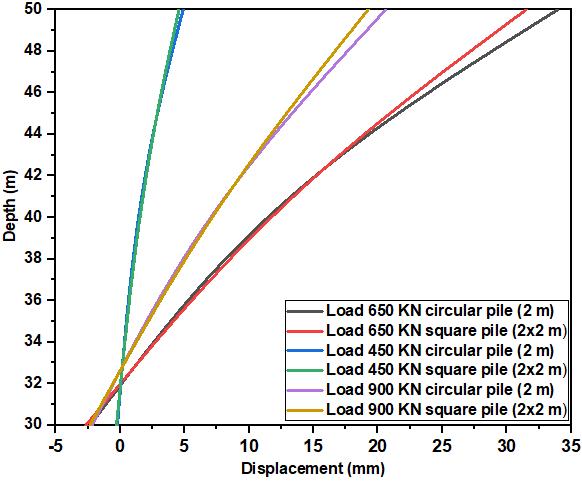
Fig.-1:Comparativecurveofinsulatedpilesunderstatic(pre-andpost)cycliclateralloadingandcyclicloadingasa functionofdifferentgeometricshapes(circularandsquare)
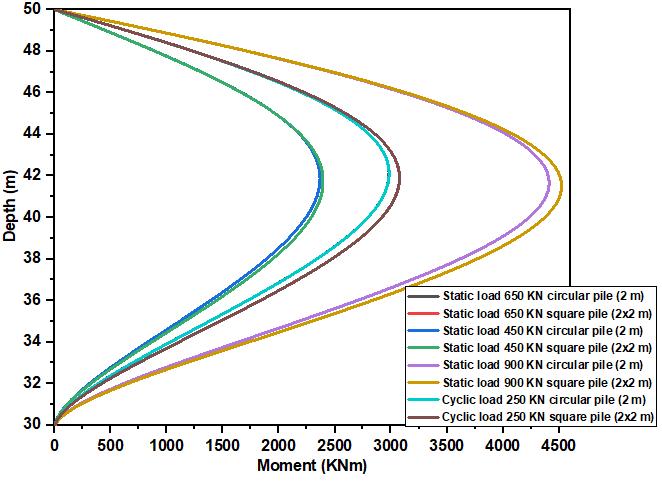
Fig.(1a)showstheevolutionofthelateraldeformationsatthe pilehead,includingthegeometricshapesunderstaticlateral loading(preandpost)cyclicinthesand.Itcanbeseenthat themaximumdisplacementsareinthevicinityofpilehead andthendecreasewithdepth,thisisvalidforbothgeometric shapes.Thecircularpilehasadisplacementof33.96mmfor aloadof650KN,whichisgreaterthanthesquarepile31.50 mm,thatisadifferenceindeformationofabout7.23%.The final static lateral load of 450 KN, gives a difference in displacementbetweenthetwotypesofcircularandsquare pilesoftheorderof4.88mmand44.55mmrespectively,a difference of 6.76%. The same phenomenon is observed whenthestaticloadisincreasedto900KN.Inthiscase,the deformationbetweenthecircularandsquarepileshapesisof the order of 20.61 mm and 19.24 mm respectively, a differenceof6.64%.Itcanbeconcludedthatthesquarepile hasgoodresistancetocycliclateralload(beforeandafter) due to the interlocking action with the surrounding soil, unlikethecircularpile.
Fig.(1b) shows the evolution of pile moments for both geometric shapes. The observed results illustrate that the bending moments developed in the square piles are more pronouncedthanthemomentsfoundinthecircularshaped piles, both under static lateral loading and under cyclic loading, the effect of cycling on the maximum moment is small [13-14], the differenceis3.02% foran initial loadof 650KN,aswellasinthecaseofcyclicloading.
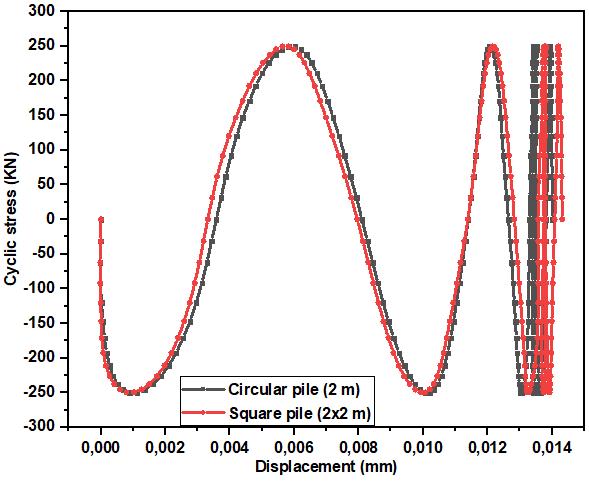
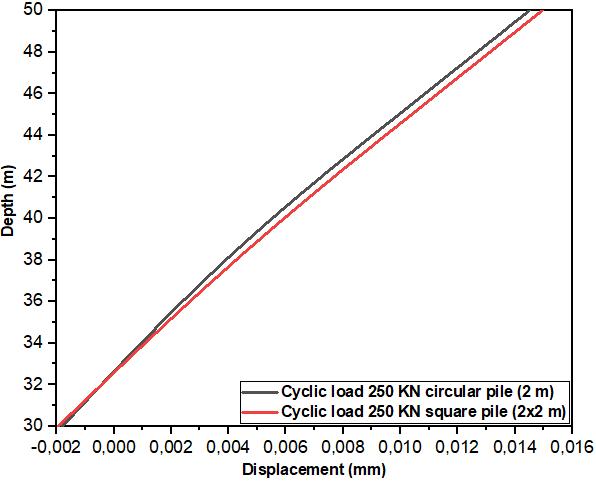
Fig.(1c)showstheinfluenceoftwogeometricshapesona pileinsandundercycliclateralloading.ThecurvesinFig.(1c) showaslightdifferenceinlateraldeformationbetweenthe squarepileandthecircularpileatthehead.Thesquarepile hasasmallerlateraldisplacementof0.0149mmwhilethatof thecircularpileis0.0144mmunderacyclicloadof250KN andastaticloadof650KN,dependingonthechangeinradial stresses in the soil. Thus, the difference is of the order of 6.04%.
International Research Journal of Engineering and Technology (IRJET) e-ISSN: 2395-0056
Volume: 09 Issue: 08 | Aug 2022 www.irjet.net p-ISSN: 2395-0072
Fig.1dshowsthecyclicstress-displacementbehaviourasa functionofthegeometricshapeofthepile.Thesquarepile showsamoreexcessivedisplacementthanthecircularpile. Thedifferenceindisplacementbetweenthetwotypesofpile is0.0140mmand0.0143mmrespectively,i.e.apercentage
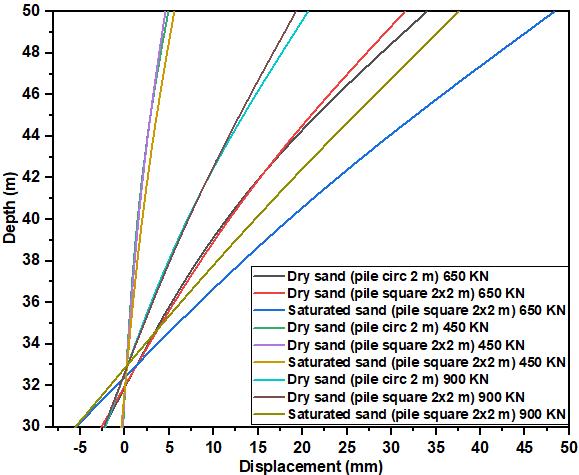
displacementof2.09%.Therefore,thesquarepilefailsduring the cyclic stress displacement. Fig.2a and 2b show the influenceofthewatertableonthesquareandcircularpile understaticandcyclicloading. (a) (b)
Fig.-2:Displacementcurveandbendingmomentofisolatedpileunderinfluenceofgeometricalshapeincomparison tosquarepileinsaturatedsand
Fig.2a shows the deformation pattern of a square pile in saturatedsandunderstaticlateralloadof650KN,450KN and900KN(preandpost)cyclicdependingonthegeometry of piles (circular or square) in dry soil. The square pile in saturated sand has large deformations of 48.31 mm comparedtothecircularandsquarepileswhichareabout 33.96mmand31.50mmindrysoil.Thedeformationisless thantheheadaftercyclicloadinginbothdryandsaturated soilconditions.Foranappliedloadof450KNand900KNat the pile head (circular and square), gives a difference in displacementof18.01%and48.77%betweenthetwosoil characteristics(dryandsaturated).Evenwhenincreasingthe finalloadto900KN,
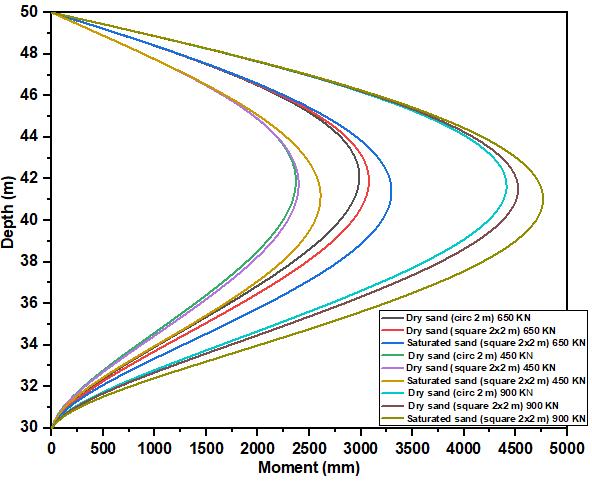
the displacement decreases under cyclic loading, for the squarepileinsaturatedsoilis37.56mmandtheothertwo are 20.61 mm and 19.24 mm. The cyclic lateral loading stabilisesthedisplacementsandchangesthestressesaround thepile,causingthesoiltoinvertanddissipateporepressure in the soil. Fig.2b shows the development of the bending moments of different pile shapes (circular and square) takingintoaccounttherheologicalstate(dryandsaturated) of the soil. The development of the moment is always a functionoftheincreaseoftheappliedloads.Fig.2bshowsa differencebetweenthemomentsindryandsaturatedsoil. The saturated square pile develops large moments comparedtothe(circularandsquare)pileindrysoilwhich havesmallmoments.
(a) (b)
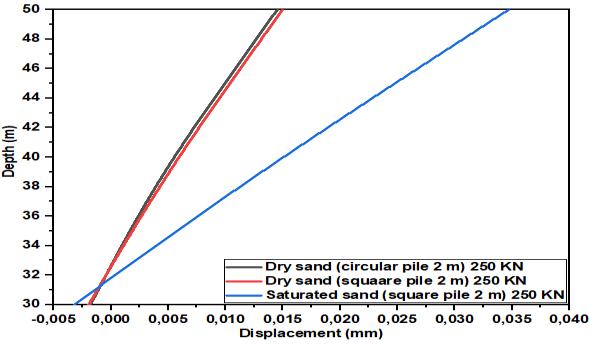
Fig.-3 Curvesofcycliclateraldisplacementsandbendingmomentsasafunctionofpilegeometryandsoilrheology underpost-staticcycliclateralloading
e-ISSN: 2395-0056
Volume: 09 Issue: 08 | Aug 2022 www.irjet.net p-ISSN: 2395-0072
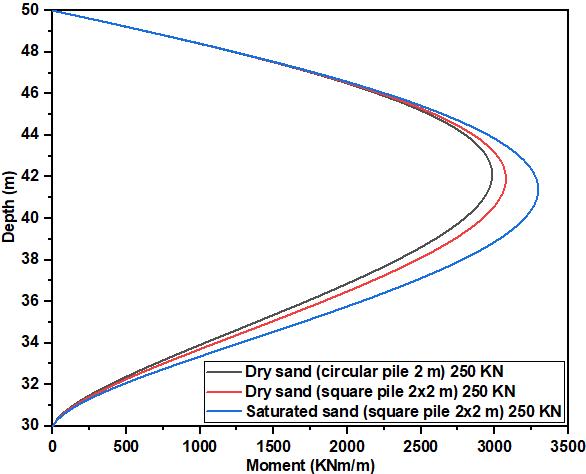
Fig.3ashowsthedifference indisplacementofthecircular pile of 0.0144 mm and the square pile of 0.0149 mm, all drilledindrysandcomparedtothecurveofthesquarepile of 0.0347 mm in saturated sand under post-static cyclic loading.Thedifferenceindisplacementbetweenthecircular pileandthesquarepileinsaturatedsandis58.50%.Fig.3b shows the evolution of the bending moments in dry, saturatedsoilasafunctionofgeometricshape.
Themomentisgreaterforthesquarepileinsaturatedsand, whichis3295KNm,twoshapesofcircularandsquarepiles of 2984 KNm and 3077 KNm respectively. Pore pressure plays an important role in the behavior of square piles installed in saturated soil. Square piles develop excessive moments compared to circular piles in dry and saturated soils.Fig.4showsthecyclicforce-displacementofanisolated pileasafunctionofgeometricshapeandsoilcondition(dry andsaturated)inthesandoftheBatékésseries.
Fig.-4:Cyclicforce-displacementofanisolatedpileasafunctionofgeometricshapeandsoilcondition (dryand saturated)insand.
Fig.4 shows the cyclic stress-displacement behavior. The square pile in the saturated condition has a large cyclic displacementof0.0333mm,comparedtothecircularand squarepilesindrysoilwhichhavedisplacementsof0.0140 mm and 0.0143 mm respectively. The difference between thesquarepileinsaturatedsandandthecircularpileindry sandis57.95%.
The square pile in saturated sand undergoes large displacementsfromthefirstcyclesuntilstabilisationbythe accommodation effect. The hydrostatic water table influences the behaviour of the square pile under cyclic loading. Fig.5 shows the influence of cohesion on the behaviorunderstaticlateralloadandcyclicload. s
(a) (b)
Fig.-5:Influenceofcohesionondisplacementandmomentinanisolatedpileunderstatic(preandpost)cyclic lateralloadinginBatékéseriessand
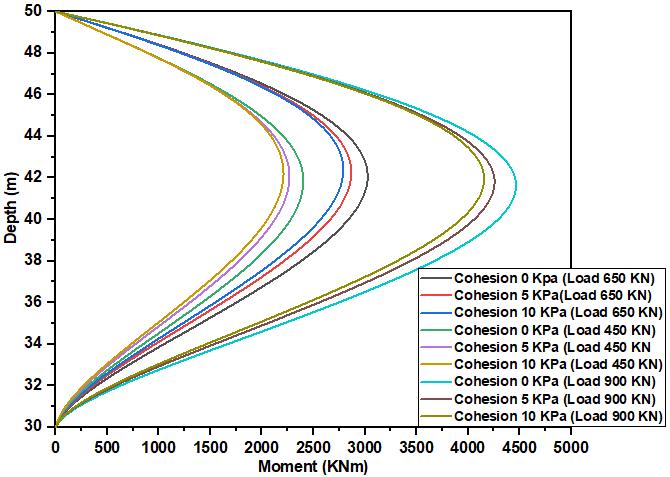
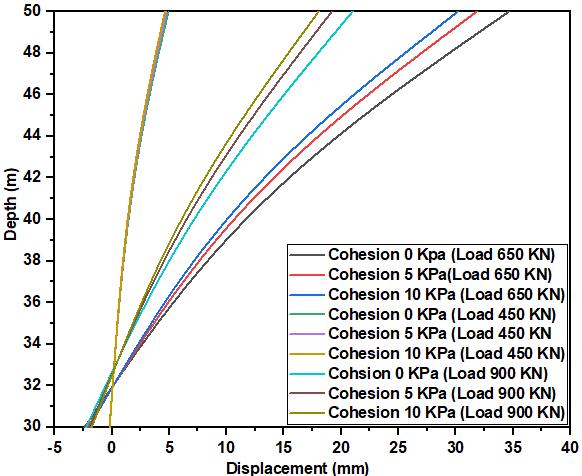
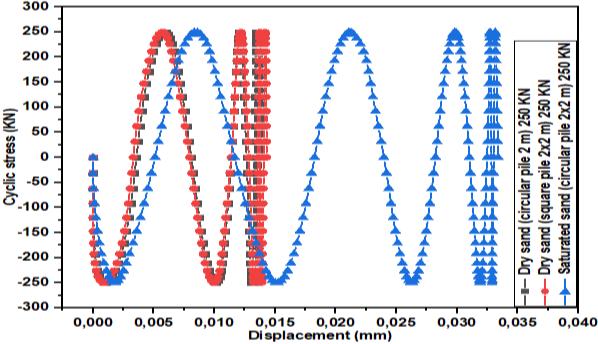
Fig.5aand5bshowthedisplacementandbendingmoment curvesasafunctionofcohesionandtheevolutionoflateral displacementsandthedecreaseinbendingmomentsunder monotonicloading(pre-andpost-cyclic).Thedeformations
recordedattheheadofthepilesforacohesionof0KPa,5 KPaand10KPaarerespectively34.64mm,31.81mmand 30.19mm,thatis,adifferenceofabout12.84%.
International Research Journal of Engineering and Technology (IRJET) e-ISSN: 2395-0056
Volume: 09 Issue: 08 | Aug 2022 www.irjet.net p-ISSN: 2395-0072
Themomentschangewiththevariationofcohesion;alarge momentisobservedwithanequalcohesionof0KPaandthe smallestwithacohesionof10KPa.Thecohesiontherefore hasasignificantinfluenceonthebehaviouroftheisolated
pile under lateral loading (pre and post) and under cyclic loading.The Fig.6, shows the lateral displacement and the lateralforce-displacementcurvesundercyclicloadingasa functionofcohesion.
l
Fig.-6:Lateraldisplacementandthelateralforce-displacementcurvesundercyclicloadingasafunctionofcohesion
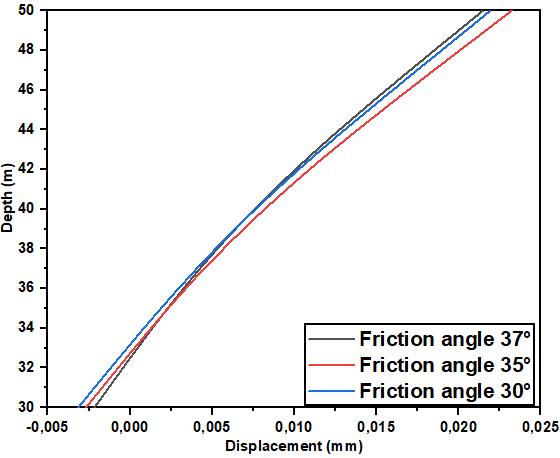
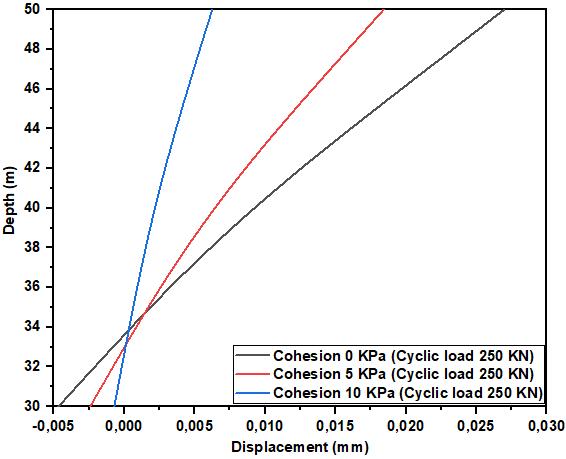
Fig.(6a)showstheevolutionofthelateraldisplacementof thepileasafunctionofthecohesionundercyclicloading.
For a change in cohesion of 0 KPa, 5 KPa and 10 KPa, the lateral displacement decreasesby0.0269 mm,0.0184 mm and0.00624mmrespectively,adifferenceof76.80%.
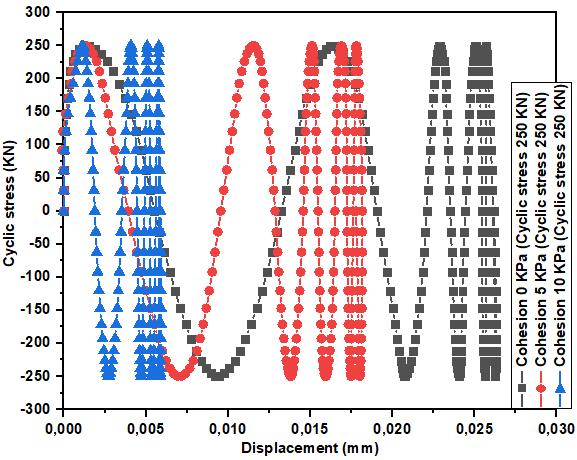
The cyclic lateral displacement decreases with increasing cohesion(Fig.6a).Fig.6bshowsthedecreaseincyclicstressdisplacementasafunctionofcohesionchange.
Inotherwords,thestraindecreaseswithincreasingcohesion andforcohesionof0KPaand10KPa,thedisplacementsare 0.0263 mm and 0.0059 mm respectively, a difference of 77.56%.
Thus, cohesion plays a very important role in the stabilisationofcycliclateraldisplacements.Fig.7showsthe behaviourofaninsulatedpileunderstatic(beforeandafter) andcycliclateralloadingundertheinfluenceofthevariation oftheinternalfrictionangleof(30°;35°and37°).
(a)
(b)
International Research Journal of Engineering and Technology (IRJET) e-ISSN: 2395-0056 Volume: 09 Issue: 08 | Aug 2022 www.irjet.net p-ISSN: 2395-0072
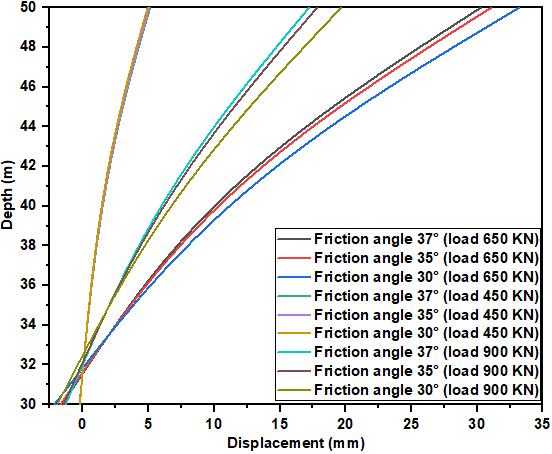
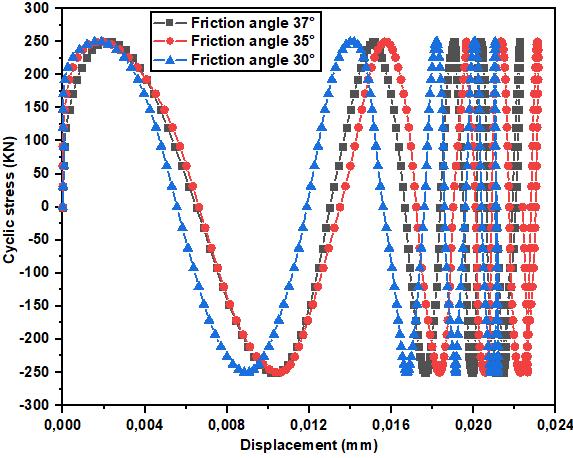
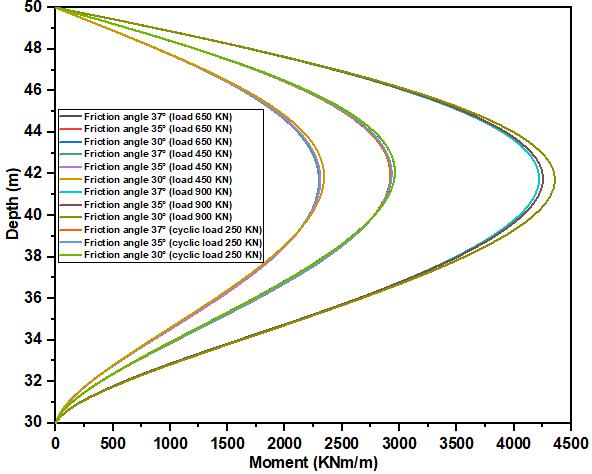
(c) (d) Fig.-7:Thebehaviourofanisolatedpileunderstaticandcycliclateralloadingasafunctionoftheinternalfrictionangle
Fig.7ashowsalargelateraldisplacementforthe30°angle under monotonic cyclic lateral loading (before and after). Thus,understaticlateralloading,thelateraldisplacementas afunctionofthe30°angleis33.20mm,andthedisplacement decreases with increasing friction angle. By increasing the frictionanglefrom35°to37°,adeformationatthepilehead intherangeof31.08mmto30.29mmisobserved.
Fig.7bshowsadifferentbehaviourundercyclicloading thanthatobservedinFigure7a.The35°angleshowsasmall lateraldisplacementof0.0232mmattheheadcomparedto the other two angles of 30° and 37° which have lateral displacements of the order of 0.0219 mm and 0.0214 mm respectively.Thedifferenceindisplacementbetweenthe35° and37°frictionanglesis7.75%,whereasitisaround2.28% forthe30°and37°angles.
ItcanbeseenfromFigure7cthatthemomentvarieswith the friction angle. In other words, as the angle of friction increases, the moment decreases, whether under static or cyclic loading. At an angle of friction of 30° the maximum momentis2959KNm/m,at35°themomentis2930KNm/m, whileat37°themaximummomentisabout2920KNm/m. Thedifferencebetweentheangleat30°and37°is1.31%,i.e. thecyclicloadafterthestaticloadhasnogreatinfluenceon the moment. The bending moment is influenced by the highestloadappliedtothepilehead.
Fig.7d shows the influence of the friction angle on the cyclic force-displacement. The displacement is very considerable with increasing friction angle.For angles 35° and 37°, the large lateral displacements are close and at 0.0231 mm and 0.0222 mm respectively. However, for a frictionangleof30°,thedisplacementis0.0211mm,whichis a difference of4.95% forangles 30°and37°. On the other hand,thedifferenceindisplacementforthefrictionanglesof 30° and 35° is about 8.65%. Finally, the increase of the
friction angle has an influence on the cyclic forcedisplacement, it develops excessive displacements as a functionofthefrictionangleincrease.
In this study, the geotechnical parameters as well as the geometricalshapeofpilesarevaried,inordertoassesstheir impact on the lateral displacements and moments under cyclic loading. It was found that each parameter acts differentlyandinfluencesthebehaviourofthepile.Theplaxis code was used tohighlight the influence ofsquare pilesin saturated soil and to identify the influence of certain geotechnicalparametersonthepileundercyclicloading.
[1] Randolph,M.F.,C.Gaudin,S.M.Gourvenec,D.J.White (2011). Recent advances in offshore geotechnics for deep water oil and gas developments. Ocean Engineering,Vol.38,Issue7.
[2] Schlosser, F. and A. Guilloux (1981). Friction in soil reinforcement.FrenchJournalofGeotechnical,16,6579.
[3] Boulon, M., and P. Foray(1986). Digital and physical simulationofthebehavioroffoundationsandanchoring inmarinesoifs,pp.297-304, http://dx.doi.org/10.1051/Ihb/1986026
[4] Boulon,M.,C.Plytas,P.Foray(1986).Interfacebehavior andpredictionoflateralfrictionalongpilesandanchors. FrenchJournalofGeotechnical,pp.31-48.
International Research Journal of Engineering and Technology (IRJET) e-ISSN: 2395-0056
Volume: 09 Issue: 08 | Aug 2022 www.irjet.net p-ISSN: 2395-0072
[5] Al-Douri,R.H.,andH.G.Poulos(1991).Staticandcyclic sheartestsoncarbonatesands.ASTMGTJ,15(2),138157.
[6] Desai,C.S.,E.C.DrummandM.M.Zaman(1985).Cyclic testingandmodelingofinterfaces.JGE,ASCE,111(6), 793-815.
[7] Fakharian,K.,andE.EvginE.(1997).Cyclicsimpleshear behaviorofsand-steelinterfacesunderconstantnormal stiffnesscondition.JGGE,ASCE,123(12),1096-1105.
[8] Johnston,I.W.,LamT.S.K.,andA.F.Williams(1987) Constant normal stiffness direct shear testing for socketedpiledesigninweakrock.Géotechnique,37(1), 83-89.https://doi.org/10.1680/geot.1987.37.1.83
[9] Tabucanon,J.T.,D. W.Airey andH.G.Poulos ( 1995) Pileskinfrictioninsandfromconstantnormalstiffness tests.ASTMGTJ,18(3),350-364.
[10] Mortara, G., M. Boulon and V. Ghionna (2002). A 2D constitutive model for cyclic interface behavior, International Journal for Numerical and Analytical MethodsinGeomechanics,26,1071-1096.
[11] Boulon, M., A. Puech (1984). Numerical simulation of pilebehaviorundercyclicaxialloading,FrenchJournal ofCivilEngineering,Vol.26,pp7-20.
[12] Duncan,J.M.andC.Chang(2002).Nonlinearanalysisof stress and strain in soils. In A History of Progress: SelectedU.S.PapersinGeotechnicalEngineering.
[13] Rakotonindriana M. H. J. 2009. Behaviour of piles and groupsofpilesofpilesundercycliclateralloading.PhD thesis.EcoleNationaledesPontsetChaussées.381p.
[14] Rosquoët F., J.Garnier , L. Thorel, Y.Canepa (2004). Horizontal cyclic loading of piles installed in sand, In book: Cyclic Behaviour of Soils and Liquefaction Phenomena,pp.363-368 DOI:10.1201/9781439833452.ch45
2022, IRJET | Impact Factor value: 7.529 | ISO 9001:2008 Certified Journal |