International Research Journal of Engineering and Technology (IRJET) e-ISSN:2395-0056

Volume: 09 Issue: 08 | Aug 2022 www.irjet.net p-ISSN:2395-0072
International Research Journal of Engineering and Technology (IRJET) e-ISSN:2395-0056
Volume: 09 Issue: 08 | Aug 2022 www.irjet.net p-ISSN:2395-0072
1-5Student, Dept. of Civil Engineering, Dr. Vishwanath Karad MIT World PeaceUniversity, Maharashtra, India 6Professor, Dept. of Civil Engineering, Dr. Vishwanath Karad MIT World Peace
University, Maharashtra, India *** -
Abstract - This report offers direction on INDIAN educational building guidelines applying to safety assurance against fires in the accompanying general regions: means of escape in case of fire; careful steps to prevent fire, Fire alarm framework and fire extinguishing and damage control. It includes revisionsin the requirements for means of escape and the requirements aimed specifically at the designers of new construction. The utilization of fire-resistant construction in its capacity to confine the spread of smoke and fire. The manners in which fires can be forestalled through cautious design, the management,and maintenance practices; and thoughts for restricting fire harm. This examination planned to look at fire wellbeing measures and their suitability in instructive structures, the necessary measures are innovation based.Educational buildings are a type of government assetthat should be protected, and they play an important role as a temporary community gathering place for children, teachers and communities. To ensure the complete safety for buildings, fire safety management must be properly implemented through the full commitment of the local government authorities, educational building authorities or the users and residents of the building.
Key Words: Educational Building, Fire Safety, Fire Management, Fire Resistant
Asapartofthesocio-economic developmentofthenation,consistenturbanizationisgatheringmomentuminthenation. Therehas beenhugegrowth withintherangeofconstructions, particularly withintheurbanand encompassing areas,as well as high rise and special buildings. The ability of a building to identify, sustain, avert and reduce any damage to the building because of a sudden unexpected cause of fire refers to the fire safety of a building. The ability of a building to detect,withstand,prevent,andmitigatedamagetobuildingduetothecauseofasuddenandunexpectedfireisrelatedto thefiresafetyofthebuilding.Therecent firemishapatSerumInstituteofIndiahasgottentheattentionofthemediaand public consideration, which specifies the requirement for upgraded fire anticipation, concealment and evacuation measuresin the least response time. These fire perils are dependable in making significant harm to the tenantsand their resources.Thishasgivennewdifficultiestoengineersandfiresecurityspecialistorganizationstobuildupupgradedplans of structures and fire assurance strategies to lessen such misfortunes Bureau of Indian Standards published their first versionoftheNational BuildingCode(NBC)in1970 andthenonwardsit was revisedsubsequently. Part4of thelatest NBC2016ismanagingthefireandlifesecurityinIndia.Also,differentINDIANSTANDARDSareeludedforfiresafety.The entireobjectiveofthisregulatorydocumentistoensuretheachievementofbasicstandardsofconstructions,includingfire andlifesafetyineducationalbuildings.Asthearchitecturalandstructuraldesignsofabuildinghaveasubstantialeffecton thefiresafetyofabuilding,hencefireprotectionsystemsforthebuildingshavebeendividedintoactiveandpassivekinds. The degreeof fire can be limited by implementing the right fire security measures with the grouping of structures accordingtothenatureof exercisessoughtafterinthestructure.Themagnitudeoftheproblemcanbereducedonlywhen the structures are designed, constructed, equipped, maintained and operated to save the life andproperty of their inhabitants.
NBC suggests for periodical fire security examination by the critical staff of the inhabitantsof the structure to guarantee fire safetystandards.
NBC recommends for journal fire safety inspection by the key personnel of the inhabitants of the building to ensure fire safety norms. For industrial buildings, statutory authorities require a fire audit by an external agency, depending on the typeofactivityand materialusedinthebuilding.TheMaharashtraFirePreventionandLifeSafetyMeasuresRules,2009, madeitmandatoryforbuildingownersandresidents toconducthalf–yearlyfiresafetyauditsandsubmits thereportto the fire department authority. The National Building Code published by the Bureau ofIndian Standards (BIS) is the basic modelcode inIndiaonmattersrelatedtobuildingconstructionandfiresafety.
International Research Journal of Engineering and Technology (IRJET) e-ISSN:2395-0056
Volume: 09 Issue: 08 | Aug 2022 www.irjet.net p-ISSN:2395-0072
General Classification-all buildings should be classified,according to the use or the type of occupancy in one of the followinggroups:
Thedesignofabuilding’sexitsystemiscriticaltoensuringeverybodycansafelyevacuateintheeventofafire. Todeterminethenumberofexits required, thewidthoftheexits,andthenumber of peoplerequiredinthebuilding,itis necessarytoestimatetheoccupantload.AfterreferringIS1644,todeterminetheexit requirements,theoccupantloadis calculatedsoastoanticipatethenumberofpeopletooccupyabuildingroomorspacebuttheoccupantloadshouldnotbe lessthanthe numbermentionedinTable1.
Table – 1 Occupant Load S.NO Groupofoccupancy(IS:1641-1988) Occupantload,floorareainm2/person 1 Residential (A) 12.5 2 Educational (B) 4 3 Institutional (C) 15 4 Assembly (D) a) Withfixedorlooseseatsanddancefloors b) Without seatingfacilities includingdiningrooms
0.6 1.5 5 Mercantile (F) 3 6 Businessand industrial (EandG) 10 7 Storage (H) 30 8 Hazardous (J) 10
The National Building Code mentions the conditions of exitrequirements for different occupancies. In this report its mentionedabouttheeducationalbuilding.
The unit of exit width to measure the capacity of any exit is 50 cm. A clear width of 25 cm should be counted as an additionalhalfunit.Clearwidthlessthan25cmisnotconsideredforexitwidth.
The distance from any point to the final exit shall not be lower than 22.5 m for residential building while for others it shouldn’tbelessthan30m.
International Research Journal of Engineering and Technology (IRJET) e-ISSN:2395-0056
Volume: 09 Issue: 08 | Aug 2022 www.irjet.net p-ISSN:2395-0072
S.NO Groupofoccupancy(IS:1641-1988) Maximumtravel construction(IS:1642-1988) Type1and2 Type3 (m) (m)
1 Educational 22.5 22.5
Asperpart-4NBC,clearwidthlessthan250mmshallnotbemeasuredforexitwidth.
The numberof exitwidth needed for anyoccupancyis alsocalculatedon the basis ofexit width, ontheassumptions that widthofthepersonis50cm.
A horizontal exit shall be equipped with at-least one fire/ smoke self closing type door with minimum onehour fire resistance. Further, it is needed to have direct connectivity to the fire escape staircase for evacuation. For buildings of heightmorethan24m,refugeareaof15m2oranareaequivalentto0.3m2 perpersontoaccommodatetheinhabitantsof twosuccessivefloors,whicheverishigher,shallbeprovided.Therefugeareashallbeprovidedonthefringeoftheflooror preferablyonacantileverprojectionopentoairwithsuitablerailings.a)For floorsabove24mandupto39m,onerefuge areashouldbeprovidedonthefloorimmediatelyabove24m.
b)Forfloorsabove39m,onerefugeareaonthefloorimmediatelyabove39mandoneafterevery15m.
Specificationsof exit doorways asperNBCare, widthof exit doorways should be greater than 1m and shouldnotbeless than 2m for assembly halls. The height of door should be more than 2 m. The doors shall be opening-outwardly. Installment of overhead or sliding door shall be restricted. Each exit door should lead to a horizontal exit in an enclosed staircase or hallway or corridor, providing a continuous and protected exit.. Exit doorway shallnot be less than 1m in widthexceptassemblybuildingswheredoorwidthshallbenotless than2m.
Allbuildingswithanareaofmorethan500m2oneachfloorandaheightofmorethan15mmusthaveatleasttwoclosed staircases.Atleastoneofthesemustbeinstalledinanexteriorwallandopendirectly totheoutside,anopenspace,oran open security area. In addition, the provision of alternative stairs or other provision must be contingent upon meeting traveldistancerequirement
Control centers with an area of 16 m2 to 20 m2 should be installed in high-rise buildings and special buildings, where command and signaling equipment, power supply units and other fire protection substations shall be fitted. This should preferably be on the first floor. Thecontrol room must have an intercom and direct dial telephone facility. If possible, a directhotlineorothermeansofcommunicationshouldbeprovidedtothelocalfirebrigade.
• Widthoframpsandstaircasesshouldbeasperstandards
• Ventilation and illumination should be adequate.
• Safetyandemergencysignageshouldbeplaced.
• Emergencyplanandescaperoutesshouldbedisplayed.
International Research Journal of Engineering and Technology (IRJET) e-ISSN:2395-0056
Volume: 09 Issue: 08 | Aug 2022 www.irjet.net p-ISSN:2395-0072
• Refreshertrainingtobeconductedonregularbasis.
• Allemployeesshouldbegivenfire-fightingtraining.
• Mockdrillsshouldbeconductedonregularintervals.
• Alltheducts,openingsshouldbeproperlysealed.
• Asystemforreportingandinvestigatingincidentsneedstobeinplace
• Trainingand awareness programs onspecialsafetyrules,plantsafetyrulesshouldalsobeconducted.
• Thereshouldbeprovisionofpressurizedstaircases ifthefacilityiscentralizedairconditioned.
• Escaperoutesshouldbealwayskeptempty.
• All the fire fighting equipment’s should bemaintainedperiodically.
Passivefireprotectionmeasures shouldbeappliedtoincreasefireresistantcapacityofconstructionmaterial.
NOCforhighriseEducationalbuildingisa movetoensurefireprevention,lifesafety,fire-safedesignforbuildingsandto deal with the potential alarming hazardassociated therewith, the Delhi Government has directed the fire department to inspect buildings having five or more floors. NOC from the Fire Department The Maharashtra Fire Prevention and Life Safety Measures Rules, 2009,made it mandatory for building owners and residents to conduct half – yearly fire safety auditsandsubmitsthereporttothefireauthority.
FireDepartmentNOCsareissuedbytheirrespectivestatefiredepartmentsthatcheckthe fireresistanceofbuildingsand whethertheyareobservableforfire-relatedaccidents.
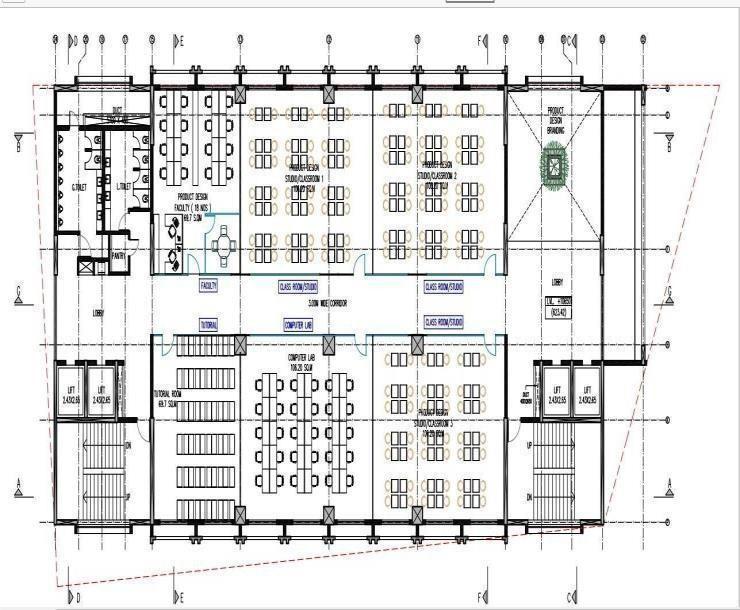
BuildingName:-MITWPUSCHOOLOFDESIGN
GroupB
Subdivision:-B2
Typeofconstruction:-Type1
Fig-1: Firstfloorplan
International Research Journal of Engineering and Technology (IRJET) e-ISSN:2395-0056
Volume: 09 Issue: 08 | Aug 2022 www.irjet.net p-ISSN:2395-0072
Table – 3 Occupant load
Occupantload 322 Occupantsperunitexitwidth 25 Widthbasedon onoccupantload 6.44m
occupantload 12.88m Widthperstairbased
Table – 4 Capacityofexits
Checklist
Distanceofanypointinthefloor<22.5mfromnearestexit √ Minimum2staircasesoneachfloorofarea>500sq.m √
Table – 5 Arrangementofexits
Name Area(sq.m) Loadfactor(m2/person) Occupantload
TutorialRoom 69.7 1.9 37 Computerlab 106.20 4.6 23 Classroom3 106.20 1.9 56 Productdesignfaculty 69.7 4 18 Classroom1 106.20 1.9 56 Classroom2 106.20 1.9 56 Productdesignbranding 59.67 4.6 13 corridor 92.55 4 24 Toilet 70.72 4 18 Lobby1 32.95 4 9 Lobby2 45.61 4 12 total 322
International Research Journal of Engineering and Technology (IRJET) e-ISSN:2395-0056
Volume: 09 Issue: 08 | Aug 2022 www.irjet.net p-ISSN:2395-0072
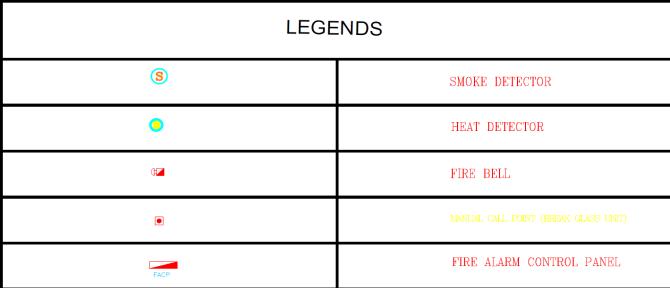
Fig-2: Proposedsittingoffirealarmsystem
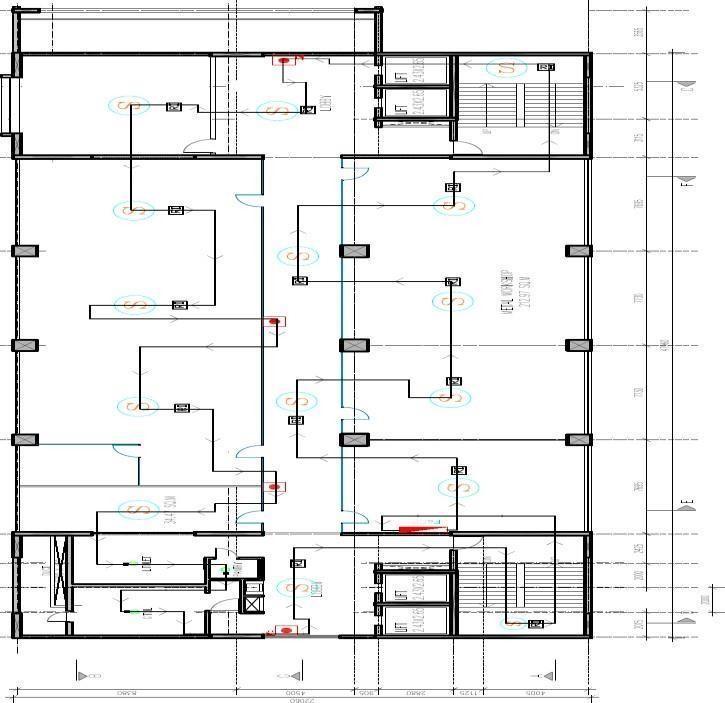
Fig- 3 Legends
Fire protection, timely safety measures, and preventative measures are just a few of the key factors that affect everyone today. As with the increasing number of fires in office buildings, hospitals and coaching centers, the Fire Department, undergovernmentdirection,isconductingthenecessaryinspectionsofallbuildingsfallingunderthe NBCPart4category toensurefurtheruseinaccordancewith regulations.SealthemuntilRecommendation.Therefore,itisimperativethatall usersadherestrictlytofiresafetyregulationsandprocedures,both onpaperandinpractice,inordertoavoidundesired occurrencesanddangertolifeduetosuddenfires.
• IS 1644 (1988): Code of practice for fire safety of buildings (general): Exit requirements and personalhazard[CED 36:FireSafety].
• IS14435(1997):Codeofpracticeforfiresafetyineducationalinstitutions[CED36:FireSafety].
• Venkatesh Kodur and Puneet Kumar , MuhammadMasood Rafi , Fire hazard in buildings: review, assessment and strategiesforimprovingfiresafety.ArpitSVyas,FireSafetyasperNationalBuildingCode-2016.DepartmentofCivil EngineeringThakurCollegeofEngineeringandTechnology.
International Research Journal of Engineering and Technology (IRJET) e-ISSN:2395-0056
Volume: 09 Issue: 08 | Aug 2022 www.irjet.net p-ISSN:2395-0072
• Mahesh Chopade MIT World Peace University, Fire Suppression Systems for High Rise Buildings in India: ReviewArticle.
• Indian Standard CODE OF PRACTICE FOR FIRE SAFETY OF BUILDING(GENERAL): GENERAL PRINCIPLES OF FIRE GRADINGANDCLASSIFICATION,FourthReprintSEPTEMBER2007.
• NationalBuildingCodeofIndiaPart4, FireAndLifeSafety,BureauOfIndianStandards.
• IS1641-1988CodeofpracticeoffiresafetyofBuilding