The Rural Settlements and Smart Green Cities.

Page 1

International Research Journal of Engineering and Technology (IRJET)

e-ISSN: 2395-0056

Volume: 09 Issue: 08 | Aug 2022

p-ISSN: 2395-0072

www.irjet.net

The Rural Settlements and Smart Green Cities. Patrícia Diogo1, Manuel Diogo4 1Associate

Professor, University of Architecture, Lusíada University, Porto, Portugal 2Full Professor, Cepese – Research Center, Porto, Portugal

---------------------------------------------------------------------***---------------------------------------------------------------------

Abstract – Our research that takes a look in the analysis in

the field where we can find the type of settlement considered the set that tracks the material culture of the societies that occupied them, shows us obstacles that hampered the rigorous evaluation of their origin, in some cases because there are no sufficient scientific knowledge and, in other cases because the shortage of surface materials limited the approached field and hindered the approach to occupation modes, to the land use and to demographic realities that sustain them. In this terms Coastal cities are prioritized and relevant to climate change, sea-level rise, temperature and natural disaster monitoring, and the development of potential solutions to emerging urban problems. Key Words: Climate Change, Smart Green Cities, Sustainable Cities, Rural Settlements, United Nations.

1.INTRODUCTION In a place in which cultural heritage represents a value from the historical, aesthetic, ethnological or anthropological point of view, urban rehabilitation will emerge as a commitment ring between sustainable, inclusive and intelligent development, in a line of reflection where different levels of analysis of urban space stands out, highlighting sustainability and integrated urban regeneration. Linking these elementals, from an objective point of view, the investigation will not seek miraculous solutions to old difficulties of spatial planning or rapid resolution of emerging problems, because more than expanding the generalist field of knowledge or giving a new academic precision to an empirical approach, the research aims to deepen scientific knowledge about the fishing settlements located on the border line provided by the sea line, and about the rural settlements delimited by the plow wake that once furrowed the land, with resilient particularities achieved in an unique and shared ambience because we will support the investigation in this “living-lab” and reapply the research on similar large-scale environments on Earth.

understand the relationship between human structures and their physical surroundings and, from them, their evolutionary sense, considering the different stages of analysis:

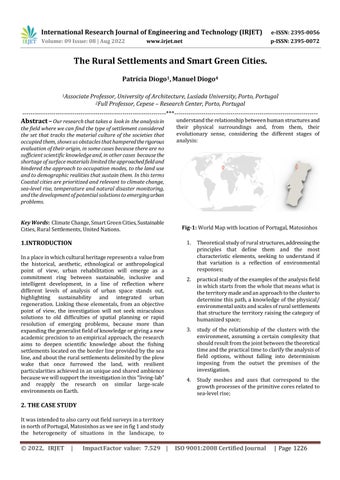
Fig-1: World Map with location of Portugal, Matosinhos 1.

Theoretical study of rural structures, addressing the principles that define them and the most characteristic elements, seeking to understand if that variation is a reflection of environmental responses;

2.

practical study of the examples of the analysis field in which starts from the whole that means what is the territory made and an approach to the cluster to determine this path, a knowledge of the physical/ environmental units and scales of rural settlements that structure the territory raising the category of humanized space;

3.

study of the relationship of the clusters with the environment, assuming a certain complexity that should result from the joint between the theoretical time and the practical time to clarify the analysis of field options, without falling into determinism imposing from the outset the premises of the investigation.

4.

Study meshes and axes that correspond to the growth processes of the primitive cores related to sea-level rise;

2. THE CASE STUDY It was intended to also carry out field surveys in a territory in north of Portugal, Matosinhos as we see in fig 1 and study the heterogeneity of situations in the landscape, to

© 2022, IRJET

|

ImpactFactor value: 7.529 |

ISO 9001:2008 Certified Journal

| Page 1226


Turn static files into dynamic content formats.
Create a flipbook