International Research Journal of Engineering and Technology (IRJET) e-ISSN:2395-0056

Volume: 09 Issue: 08 | Aug 2022 www.irjet.net p-ISSN:2395-0072
International Research Journal of Engineering and Technology (IRJET) e-ISSN:2395-0056
Volume: 09 Issue: 08 | Aug 2022 www.irjet.net p-ISSN:2395-0072
1Student, Department of Computer Applications, Madanapalle institute of technology and science, India
2Student, Department of Computer Applications, Madanapalle institute of technology and science, India
3Asst Professor, Department of Computer Applications, Madanapalle institute of technology and science, India ***
ABSTRACT - With the non-stop evolve of E-commerce systems, on-line opinions are mostly regarded as a critical component for building and retaining a proper reputation. Moreover, they have an tremendous function in the selection making procedure for give up users. Usually, a high-quality evaluate for a goal object attracts greater clients and lead to excessive extend in sales. Nowadays, misleading or faux opinions are intentionally written to construct digital popularity and attracting conceivable customers. Thus, figuring out pretend evaluations is a vivid and ongoing lookup area. Identifying faux opinions relies upon now not solely on the key aspects of the evaluations however additionally on the behaviors of the reviewers. This paper proposes a computing device mastering strategy to perceive pretend reviews. In addition to the elements extraction technique of the reviews, this paper applies numerous facets engineering to extract a number of behaviors of the reviewers. The paper compares the overall performance of countless experiments accomplished on a actual Yelp dataset of eating places critiques with and barring facets extracted from customers behaviors. In each cases, we examine the overall performance of a number of classifiers; KNN, Naive Bayes (NB), SVM, Logistic Regression and Random forest. Also, extraordinary language fashions of n-gram in precise bigram and tri-gram are taken into issues for the duration of the evaluations. The effects expose that KNN(K=7) outperforms the relaxation of classifiers in phrases of f-score reaching exceptional f-score 82.40%. The effects exhibit that the f-score has improved by using 3.80% when taking the extracted reviewers’ behavioral points into consideration.
Keywords - Fake reviews detection; data mining; supervisedmachine learning
Nowadays, when clients choose to draw a choice about offerings or products, critiques end up the predominant supply of their information. For example, when clients take the initiation to e book a hotel, they examine the opinions ontheopinionsofdifferentclientsonthemotelservices.
Depending on the comments of the reviews, they determine to e book room or not. If they got here to high quality remarks from the reviews, they in all likelihood proceed to e book the room. Thus, historic opinions grew tobeverycrediblesourcesofrecordstomosthumansina number of on-line services. Since, critiques are viewed varietiesofsharingactualremarksaboutfantasticorpoor services, any strive to manipulate these critiques through writing deceptive or inauthentic content material is regarded as misleading motion and such opinions are labeledasfaux[1].
DiscoverandextractbeneficialSuchcaseleadsusto suppose what if now not all the written critiques are truthful or credible. What if some of these critiques are fake. Thus, detecting pretend overview has end up and nevertheless in the nation of lively and required lookup vicinity[2].
Machinemasteringmethodscangrantalargecontribution to realize pretend evaluations of net contents. Generally, internet mining methods [3] records the usage of various computer getting to know algorithms. One of the internet mining duties is content material mining. A normal instance of content material mining is opinion mining [4] which is involved of discovering the sentiment of textual content (positive or negative) by using desktop gaining knowledge of the place a classifier is educated to analyze the facets of the evaluations collectively with the sentiments. Usually, pretend critiques detection relies upon no longer solely on the class of critiques however additionally on positive elements that are now not immediately related to the content. Building elements of evaluations usually entails textual content and herbal languageprocessingNLP.However,pretendopinionsmay additionally require constructing different elements linkedtothereviewerhimselflikeforinstanceevaluation time/date or his writing styles. Thus, the profitable pretend critiques detection lies on the development of significantaspectsextractionofthereviewers.
International Research Journal of Engineering and Technology (IRJET) e-ISSN:2395-0056
Volume: 09 Issue: 08 | Aug 2022 www.irjet.net p-ISSN:2395-0072
To this end, this paper applies several machine learning classifiers to identify fake reviews based on the content of the reviews as well asseveral extracted features from the reviewers. We apply the classifiers on real corpus of reviews taken from Yelp [5]. Besides the normal natural language processing on the corpus to extract and feed the features of the evaluations to the classifiers, the paper additionally applies countless points engineering on the corpus to extract a number of behaviors of the reviewers. The paper compares the influence of extracted elements of thereviewersiftheyaretakenintoconsiderationinsidethe classifiers. The papers examine the effects in the absence and the presence of the extracted facets in two special language fashions particularly TF-IDF with bi-grams and TF-IDF with tri-grams. The outcomes shows that the engineered elements amplify the overall performance of pretend evaluations detection process. The relaxation of this paper is prepared as follows: Section IISummarizesthekingdomofartworkindetectingpretend reviews. Section III introduces a historical past about the laptopgainingknowledgeoftechniques.SectionIVprovides the small print of the proposed approach. Conclusions and futureworkarebroughtinSectionVI.
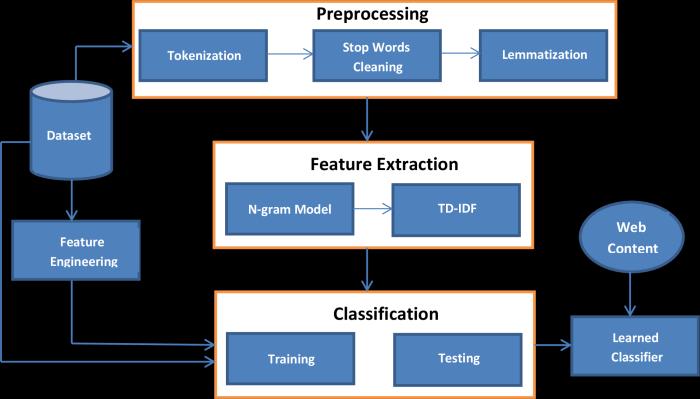
This area explains the small print of the proposed strategyprovenindiscern1.Theproposedstrategyconsists of three fundamental phases in order to get the first-class mannequin that will be used for faux critiques detection. These phases are defined in the following:
The first step in the proposed method is information preprocessing [26]; one of the integral steps in desktop gaining knowledge of approaches. Data preprocessing is a vital undertakingastheworldfactsisinnowaysuitableto beused.Asequence ofpreprocessingstepshavebeen used in this work to put together the uncooked facts of the Yelp dataset for computational activities. This can be summarizedasfollows:
1) Tokenization: Tokenization is one of the most frequent herbal language processing techniques. It is a primary step earlier than making use of any different preprocessing techniques. The textual content is divided into man or woman phrases referred to as tokens. For example, if we have a sentence (“wearing helmets is a ought to for pedal cyclists”), tokenization will divide it into the following tokens (“wearing” , “helmets” , “is” , “a”, “must”, “for” , “pedal”,“cyclists”)[27].
2)StopWordsCleaning:Stopphrases[28]arethephrases which are used the most but they preserve no value. Common examples of the give up phrases are (an, a, the, this). In this paper, all statistics are cleaned from cease phrases earlier than going ahead in the pretend opinions detectionprocess.
3) Lemmatization: Lemmatization approach is used to con-vertthepluralstructuretoasingularone.Itisaiming to cast off inflectional endings solely and to return the base or dictionary structure of the word. For example: changingthephrase(“plays”)to(“play”)[29].
Fig.1.TheProposed Framework.
Feature extraction is a step which ambitions to amplify the overall performance both for a sample cognizance or laptop studying system. Feature extraction represents a discount segment of the information to its essential elements which yields in feeding computer and deepgetting toknow fashionswith greater preciousdata. Itiscommonlyamannerofdoingawaywiththeunneeded attributes from facts that may additionally absolutely decreasetheaccuracyofthemannequin.
Several procedures have been developed in the literature to extract points for faux critiques detection. Textual points is one famous method [31]. It consists of sentiment classification[32] which relies upon on getting the percentage of fantastic and terrible phrases in the review; e.g. “good”, “weak”. Also, the Cosine similarity is considered. The Cosine similarity is the cosine of the attitude between two n-dimensional vectors in an ndimensionalhouseandthedotproductofthetwovectors divided by means of the product of the two vectors’ lengths(ormagnitudes)[33].TF-IDFissomeothertextual characteristic technique that receives the frequency of
International Research Journal of Engineering and Technology (IRJET) e-ISSN:2395-0056
Volume: 09 Issue: 08 | Aug 2022 www.irjet.net p-ISSN:2395-0072
each genuine and false (TF) and the inverse record (IDF). Each phrase has a respective TF and IDF rating and the productoftheTFandIDF ratingsof a timeisknownasthe TF-IDF weight of that time period [34]. A confusion matrix isusedtoclassifytheopinionsinto4results;TrueNegative (TN): Real activities are categorised as actual events, True Positive (TP): Fake occasions are categorised as fake, False Positive(FP):Realoccasionsarecategorizedasfauxevents, and False Negative (FN): Fake activities are categorised as real.
Second there are person private profile and behavioural features. These aspects are the two methods used to pick out spammers Whether through the usage of time-stampofuser’sremarkisestablishedandspecial than different ordinary customers or if the person posts a redundant evaluate and has no relation to area of target. Inthispaper,WeobserveTF-IDFtoextractthefacetsofthe contents in two languages models; commonly bi-gram and tri-gram. In each language models, we follow additionally the prolonged dataset after extracting the points representingthecustomersbehaviours.
Fake reviews are known to have other descriptive features [35] related to behaviors of the reviewers during writing their reviews. In this paper, we consider some of these feature and their impact on the performance of the fake reviews detection process. We consider caps-count, punctcount, and emojis behavioral features. caps-count represents the total capital character a reviewer use when writingthereview,punct-countrepresentsthetotalnumber ofpunctuationthatfoundineachreview,andemojiscounts the total number of emojis in each review. Also, we have usedstatisticalanalysisonreviewersbehaviorsbyapplying “groupby” function, that gets the number of fake or real reviewsbyeachreviewerthatarewrittenonacertaindate and on each hotel. All these features are taken into considerationtoseetheeffectoftheusersbehaviorsonthe performanceoftheclassifiers.
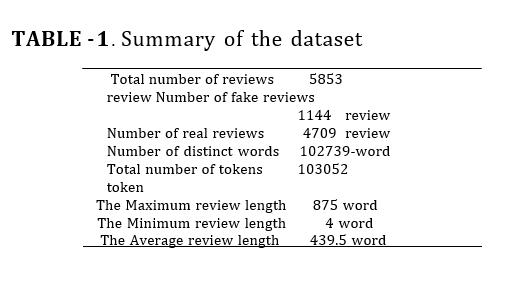
We evaluated our proposed device on Yelp dataset [5]. This dataset consists of 5853 opinions of 201 inns in Chicago written with the aid of 38, sixty-three reviewers. The evaluations are categorized into 4, 709 assessments labeled as actual and 1, a hundred and forty-four opinions labeledasfake.Yelphascategorizedtheopinionsintoactual and fake. Each occasion of the evaluate in the dataset consists of the evaluation date, evaluation ID, reviewer ID, product ID, evaluation label and megastar rating. The
statistic of dataset is summarized in Table I. The most assessment size in the information includes 875 words, theminimalevaluatesizecarriesfourwords,thecommon size of all the critiques is 439.5 word, the whole quantity of tokens of the facts is 103052 words, and the variety of specialphrasesis102739word.
In addition to the dataset and its statistics, we extracted other features representing the behaviors of reviewers during writing their reviews. These features include caps-count which represents the total capital character a reviewer use when writing the review, punct-count which represents the total number of punctuations that found in each review, and emojis whichcountsthetotalnumberofemojisineachreview. We will take all these features into consideration to see theeffectof the users behaviors on the performance of the classifiers.
In this part, we present the results for several experiments and their evaluation using five different machine learning classifiers. We first apply TF-IDF to extract the features ofthe contents in two languages models; mainly bi-gram and tri- gram. In both language models, we apply also the extended dataset after extractingthefeatures representingtheusersbehaviors mentioned in the last section. Since the dataset is unbalanced in terms of positive and negative labels, we take intoconsiderationthe precisionandtherecall,and hence and hence f1-score is considered as a
e-ISSN:2395-0056
Volume: 09 Issue: 08 | Aug 2022 www.irjet.net p-ISSN:2395-0072
performance measure inaddition to accuracy. 70% of the dataset is used for training while30% is usedfortesting. The classifiers are first evaluated in the absence of extracted features behaviors of users and then in the presence of the extracted behaviors. In each case, we compare the performance of classifiers in Bi-gram and Tri-gram language models.
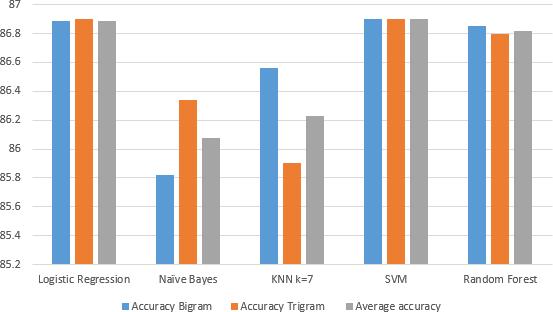
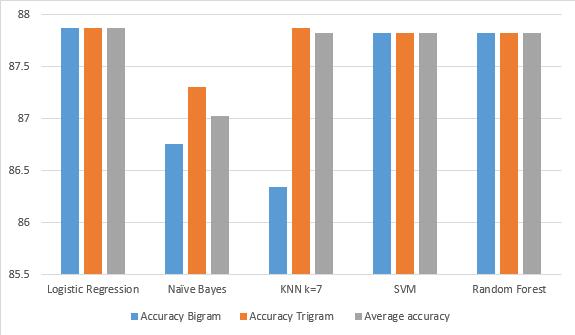
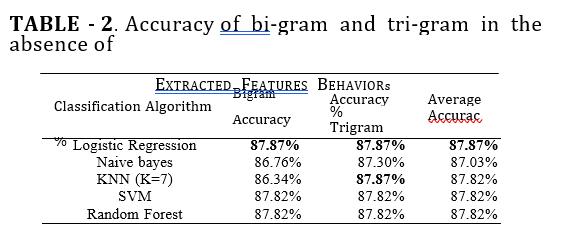
Table II Summarizes the results of accuracy in the absence of extracted features behaviors of users in the two language models. The average accuracy for each classifierofthetwolanguagemodelsisshown.Itisfound that the logistic re- gression classifier gives the highest accuracy of 87.87% in Bi-gram model. SVM and Random forest classifiers have relatively close accuracy to logistic regression. In Tri-gram model, KNN and Logistic regressionarethebestwithaccuracyof 87.87%. SVM and Randomforesthaverelativelycloseaccuracywithscoreof 87.82%. In order to evaluate the overallperformance, we take into consideration the average accuracy of each classifier in both language models. It is found thatthe highestaverageaccuracyisachievedinlogisticregression with 87.87%. The summary of the results are shown in Fig.2.
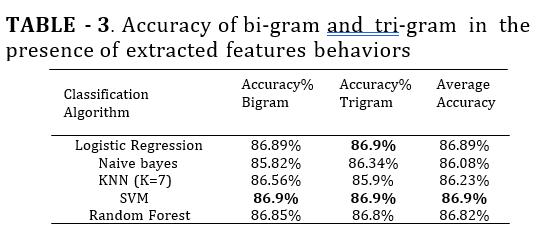
Ontheotherhand,TableIIIsummarizestheaccuracyof theclassifiers in the presence of the extracted features behaviorsof the users in the two language models. The results revealthat the classifiers that give the highest accuracy in Bi-gramis SVM with score of 86.9%. Logistic regression and Random Forest have relativity close accuracy with score of 86.89% and 86.85%, respectively. While in Tri-gram model, both SVM, and logistic regression give the best accuracy with score of 86.9%. The Random Forest gives a close score of 86.8%. The summary of the results is illustrated in Fig. 3. Also, it isfoundthatthehighestaverageaccuracyisobtainedwith SVMclassifier with score of 86.9%.
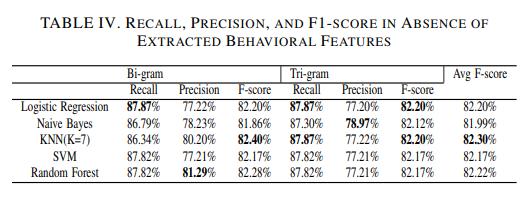
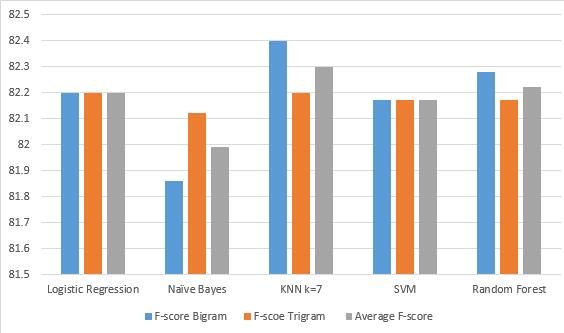
Additionally, precision, Recall and f1-score are taken into consideration as evaluation metrics. Actually, they are key indicators when the data is unbalanced similar to the previous, table 4 represents the recall, precision, and hence f-score in the absence of the extracted features behaviors of the user in the two language models. For the trade off between recall and precision,f1-scoreistakenintoaccountas theevaluation criterion of each classifier. In bi-gram, KNN(k=7) outperforms all other classifiers with f1-score Value of 82.40%. Whereas, in Tri-gram, both logistic regression and KNN(K-7) outperform other classifiers with f1-score value of 82.20%. To evaluate the overall performance of theclassifiersinbothlanguagemodels,
Fig -2. Accuracy,andAverageAccuracyinAbsenceof ExtractedBehavioral Features.
Fig -3.TheAccuracy,andtheAverageAccuracyafter ApplyingFeatureEngineering
The average f1-score is calculated. It is found that, KNN
outperformstheoverallclassifierswithaveragef1-score of 82.30%. Fig. 4 depicts the the overall performance of allclassifiers.
International Research Journal of Engineering and Technology (IRJET) e-ISSN:2395-0056
Volume: 09 Issue: 08 | Aug 2022 www.irjet.net p-ISSN:2395-0072
Fig-4.f-score,andAveragef-scoreinAbsenceof ExtractedBehavioralFeatures.
Fig -5.f-score,andAveragef-scoreinPresenceof Extracted BehavioralFeatures.
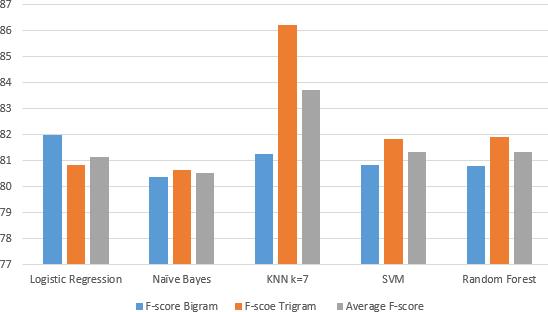
Similarly, Table V summarizes the recall, precision, and f1-score in the presence of the extracted features behaviors of the users in the two language models. It is found that, the highest f1-score value is achieved by Logistic regressionwithf1-scorevalueof82%incaseof Bi-gram. While the highest f1-score value in Tri-gram is achieved in KNN with f1-score value of 86.20%. Fig. 5 illustrates the performance of all classifiers.The KNN classifier outperforms all classifiers in terms of the overall average f1-score with value of 83.73%.
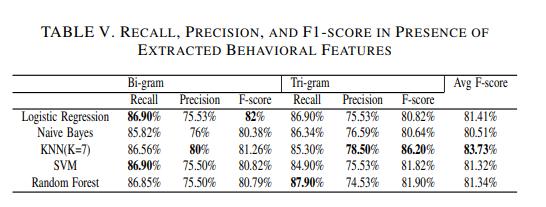
The results reveal that KNN(K=7) outperforms the rest of classifiers in terms of f-score with the best achievingf-score82.40%.Theresultisraisedby3.80% when taking the extracted features into consideration givingbestf-scorevalueof86.20%
It is obvious that reviews play a crucial role in people’sdecision.Thus,fakereviewsdetectionisavivid and ongoing research area. In this paper, a machine learning fake reviews detection approach is presented. In the proposed approach, both the features of the reviewsandthebehavioralfeaturesofthereviewersare considered. The Yelp dataset is used to evaluate the proposed approach. Different classifiers are implemented in the developed approach. The Bi-gram and Tri- gram language models are used and compared in the developed approach. The results reveal that KNN(with K=7) classifier outperforms the rest of classifiers in the fake reviews detection process. Also, the results show that considering the behavioral features of the reviewers increase the f-score by 3.80%. Not all reviewers behavioral features have been taken intoconsiderationinthecurrentwork.Futureworkmay consider including other behavioral features such as features that depend on the frequent times the reviewers do the reviews, the time reviewers take to completereviews,andhowfrequenttheyaresubmitting positive or negative reviews. It is highly expected that considering more behavioral features will enhance the performance of the presented fake reviews detection approach.
In this paper, we showed the importance of reviews and how they affect almost everything related to web baseddata.
The authors would like to thank the Deanship of Scientific Research in Prince Sattam Bin Abdelaziz
International Research Journal of Engineering and Technology (IRJET) e-ISSN:2395-0056
Volume: 09 Issue: 08 | Aug 2022 www.irjet.net p-ISSN:2395-0072
University,KSAforhis support during the stages of this research.
[1] R. Barbado, O. Araque, and C. A. Iglesias, “A framework for fake review detection in online consumer electronics retailers,” Information Processing & Management, vol. 56, no. 4, pp. 1234 –1244,2019.
[2] S. Tadelis, “The economics of reputation and feedback systems in e- commerce marketplaces,” IEEE Internet Computing, vol. 20, no. 1, pp. 12–19, 2016.
[3] M. J. H. Mughal, “Data mining: Web data mining techniques, tools and algorithms: An overview,” Information Retrieval,vol.9,no.6,2018.
[4] C. C. Aggarwal, “Opinion mining and sentiment analysis,” in Machine Learning for Text. Springer, 2018,pp.413–434.
[5] A. Mukherjee, V. Venkataraman, B. Liu, and N. Glance, “What yelp fake review filter might be doing?”in Seventh international AAAI conference on weblogs and social media,2013.
[6] N. Jindal and B. Liu, “Review spam detection,” in Proceedings of the 16th International Conference on WorldWide Web,ser.WWW’07,2007.
[7] E. Elmurngi and A. Gherbi, Detecting Fake Reviews through Sentiment Analysis Using Machine Learning Techniques.IARIA/DATAANA-LYTICS, 2017.
[8] V. Singh, R. Piryani, A. Uddin, and P. Waila, “Sentiment analysis of movie reviews and blog posts,” in Advance Computing Conference (IACC), 2013, pp. 893–898.
[9] A. Molla, Y. Biadgie, and K.-A. Sohn, “Detecting Negative Deceptive Opinion from Tweets.” in International Conference on Mobile and Wireless Technology Singapore: Springer, 2017.
[10] S.Shojaee et al.,“Detectingdeceptivereviewsusing lexicalandsyntactic features.” 2013.
[11] Y. Ren and D. Ji, “Neural networks for deceptive opinion spam detection: An empirical study,” InformationSciences,vol.385,pp.213–224,2017.
[12] H. Li et al., “Spotting fake reviews via collective positive-unlabeledlearning.” 2014.
[13] N. Jindal and B. Liu, “Opinion spam and analysis,” in Proceedings of the 2008 International Conference on Web Search and Data Mining, ser. WSDM ’08, 2008, pp. 219–230.
[14] D. Zhang, L. Zhou, J. L. Kehoe, and I. Y. Kilic, “What online reviewer behaviors really matter? effects of verbal and nonverbal behaviors on detection of fake online reviews,” Journal of Management Information Systems,vol. 33, no. 2, pp.456–481,2016.
[15] E. D. Wahyuni and A. Djunaidy, “Fake review detection from a product review using modified methodofiterativecomputationframework.”2016.
[16] D. Michie, D. J. Spiegelhalter, C. Taylor et al., “Machine learning,”
Neural and Statistical Classification,vol.13,1994.
[17] T. O. Ayodele, “Types of machine learning algorithms,” in New ad- vances in machine learning InTech, 2010.
[18] F. Sebastiani, “Machine learning in automated text categorization,” ACM computing surveys (CSUR), vol. 34,no. 1,pp.1–47, 2002.
[19] T.Joachims,“Textcategorizationwithsupportvector machines: Learn-ing with many relevant features.” 1998.
[20] T. R. Patil and S. S. Sherekar, “Performance analysis of naive bayesand j48 classification algorithm for dataclassification,”pp.256–261,2013.
[21] M.-L. Zhang and Z.-H. Zhou, “Ml-knn: A lazy learning approach to multi-label learning,” Pattern recognition,vol.40,no.7,pp.2038–2048,2007.
[22] N. Suguna and K. Thanushkodi, “An improved knearest neighbor clas- sification using genetic algorithm,” International Journal of Computer Science Issues,vol.7, no. 2, pp. 18–21, 2010.
[23] M. A. Friedl and C. E. Brodley, “Decision tree classification of land cover from remotely sensed data,” Remote sensing of environment,vol. 61, no. 3,pp.399–409, 1997.
[24] A. Liaw, M. Wiener et al., “Classification and regressionbyrandom-forest,” R news, vol. 2, no. 3, pp.18–22, 2002.
International Research Journal of Engineering and Technology (IRJET) e-ISSN:2395-0056
Volume: 09 Issue: 08 | Aug 2022 www.irjet.net p-ISSN:2395-0072
[25] D. G. Kleinbaum, K. Dietz, M. Gail, M. Klein, and M. Klein, Logistic regression. Springer, 2002.
[26] G. G. Chowdhury, “Natural language processing,” Annual review of information science and technology,vol.37, no.1,pp.51–89,2003.
[27] J. J. Webster and C. Kit, “Tokenization as the initial phase in nlp,”in Proceedings of the 14th conference on Computational linguistics- Volume 4. Association forComputationalLinguistics,1992,pp.1106–1110.
[28] C.SilvaandB.Ribeiro,“Theimportanceofstopword removal on recallvalues in text categorization,” in Neural Networks, 2003. Proceedings of the International Joint Conference on, vol. 3. IEEE, 2003, pp.1661–1666.
[29] J.Plisson,N.Lavrac,D.Mladenic´ et al.,“Arulebased approachtowordlemmatization,” 2004.
[30] C. Lee and D. A. Landgrebe, “Feature extraction basedondecisionboundaries,” IEEE Transactions on Pattern Analysis & Machine Intel- ligence, no. 4, pp. 388–400,1993.
[31] N. Jindal and B. Liu, “Opinion spam and analysis.” in Proceedingsof the 2008 international conference onwebsearchanddatamining.ACM,2008.
[32] M. Hu and B. Liu, “Mining and summarizing customerreviews.”2004.
[33] R.Mihalcea,C.Corley,C.Strapparava et al.,“Corpusbased and knowledge-based measures of text semantic similarity,” in AAAI, vol. 6,2006, pp. 775–780.
[34] J. Ramos et al., “Using tf-idf to determine word relevanceindocumentqueries,”in Proceedingsofthe firstinstructionalconferenceonmachinelearning, vol. 242,2003,pp. 133–142.
[35] G.Fei,A.Mukherjee,B.Liu,M.Hsu,M.Castellanos,and R.Ghosh,“Exploitingburstinessinreviewsforreview spammer detection,” in Seventh international AAAI conference onweblogsandsocial media,2013.