STRENGTH IMPROVEMENT OF CLAYEY SOIL WITH GLASS FIBRE AND WHEAT HUSK ASH

Page 1

International Research Journal of Engineering and Technology (IRJET)

e-ISSN: 2395-0056

Volume: 09 Issue: 08 | Aug 2022

p-ISSN: 2395-0072

www.irjet.net

STRENGTH IMPROVEMENT OF CLAYEY SOIL WITH GLASS FIBRE AND WHEAT HUSK ASH Karandeep singh1, Amit Talgotra2 scholar, Sri sai college of engineering and technology Badhani, Pathankot professor,Dept. Of Civil engg. Sri sai college of engineering and technology Badhani, Pathankot ---------------------------------------------------------------------***--------------------------------------------------------------------2Assistant

1M.tech

Abstract - The motivation behind this research was to learn

the effect of the fibre content on the index properties of the soil like LL, PL, plasticity index, compaction characteristics are also studied

more regarding the properties of soilstrengthened with Wheat Husk Ash and Glass fiber, which are industrial waste products and Agricultural products, respectively. The use of these waste materials reduces pollution and human reliance on natural resources, resulting in a more sustainable construction approach. The consequences of Wheat Husk Ash and Glass fiber on soil strength prospects for clayey soilare investigated in this study. The Wheat Husk Ash was blended in various amounts with the soil at the rate 10%, 20%, 30%, and 40%. After that Glass fiber was mixed with soil and ash at various rates in this study, including 0.5 %, 1 %, 1.5 %, and 2 %. The investigation of an influence of Wheat Husk Ash and Glass fiber on Atterberg limits, C.B.R., U.C.S., O.M.C., and M.D.D. was done. Adding Wheat Husk Ash and Glass fiber improved the U.C.S. and C.B.R. As per experimental results, the ideal value of C.B.R. and U.C.S. was at 30 % Wheat Husk Ash, 69.5 % soil and 0.5 % Glass fiber. So, after this research work, we find out that the stabilizationcan be done to some extent

1.1 Wheat husk Ash Wheat husk ash is a agricultural waste which obtained from burning wheat straw. When crops of wheat is cut then husk is remain in the ground itself, this husk is a complete waste. But now days by burning these husk its ash can replace by cement. Much literature is not available on wheat straw ash but it completely shows that it posses’ pozzolanic properties. 1.2 Glass Fibre E-glass fibre Electronic grade glass fibres are recycled glass fibre that are obtained from the glass of television, computer, laptops, etc. E glass fibres are composed of 40% recycled glasses, 54% of silicon oxide (SiO2), 15% of aluminium oxide (Al2O3), 12% of calcium oxide (CaO). The length and diameter of the fibres are 12 and 19 mm respectively. E glass fibres have a density of 2.54 g/cm3.

Key Words: Soil, Wheat husk ash, Glass fiber, OMC, MDD etc

2. Maximum dry density and Optimum Moisture Content

1.INTRODUCTION

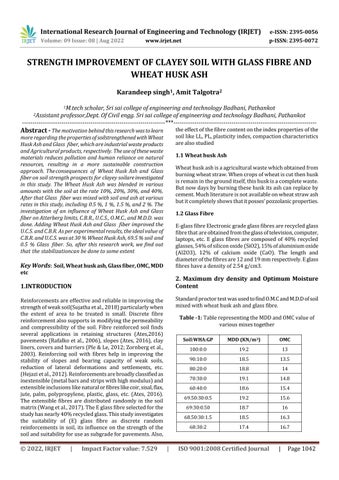
Standard proctor test was used to find O.M.C and M.D.D of soil mixed with wheat husk ash and glass fibre.

Reinforcements are effective and reliable in improving the strength of weak soil(Sujatha et al., 2018) particularly when the extent of area to be treated is small. Discrete fibre reinforcement also supports in modifying the permeability and compressibility of the soil. Fibre reinforced soil finds several applications in retaining structures (Ates,2016) pavements (Rafalko et al., 2006), slopes (Ates, 2016), clay liners, covers and barriers (Ple & Le, 2012; Zornberg et al., 2003). Reinforcing soil with fibres help in improving the stability of slopes and bearing capacity of weak soils, reduction of lateral deformations and settlements, etc. (Hejazi et al., 2012). Reinforcements are broadly classified as inextensible (metal bars and strips with high modulus) and extensible inclusions like natural or fibres like coir, sisal, flax, jute, palm, polypropylene, plastic, glass, etc. (Ates, 2016). The extensible fibres are distributed randomly in the soil matrix (Wang et al., 2017). The E glass fibre selected for the study has nearly 40% recycled glass. This study investigates the suitability of (E) glass fibre as discrete random reinforcements in soil, its influence on the strength of the soil and suitability for use as subgrade for pavements. Also,

© 2022, IRJET

|

Impact Factor value: 7.529

Table -1: Table representing the MDD and OMC value of various mixes together

|

Soil:WHA:GP

MDD (KN/m3)

OMC

100:0:0

19.2

13

90:10:0

18.5

13.5

80:20:0

18.8

14

70:30:0

19.1

14.8

60:40:0

18.6

15.4

69.50:30:0.5

19.2

15.6

69:30:0.50

18.7

16

68.50:30:1.5

18.5

16.3

68:30:2

17.4

16.7

ISO 9001:2008 Certified Journal

|

Page 1042


Turn static files into dynamic content formats.
Create a flipbook