International Research Journal of Engineering and Technology (IRJET) e-ISSN: 2395-0056
Volume: 09 Issue: 08 | Aug 2022 www.irjet.net p-ISSN: 2395-0072
International Research Journal of Engineering and Technology (IRJET) e-ISSN: 2395-0056
Volume: 09 Issue: 08 | Aug 2022 www.irjet.net p-ISSN: 2395-0072
Department
of Electrical and Electronics Engineering IASSCOM FORTUNE INSTITUTE OF TECHNOLOGY, BHOPAL (M.P.)Abstract – Recent some decades witness the peak in application of power electronic devices such as power converters used in high voltage transmission; customized power quality improvement converters;loads at consumer end like; laptop, power computers, versatile sensitive loads, high frequency drives with variablespeedfeature, UPS, etc. Allthese loads draw the harmonic current from the source leading to the injection high degree of distortionofthesinusoidalvoltage and current of the distribution system. This harmonics in the supply system may result is sever stability issues. Hence the distortion generated due to non-linear loads must be rectified then and there. In this work a power quality conditioner used in distribution system to mitigate harmonics is presented. A Static Compensator (STATCOM), is a shunt connected active power filter which is widely adopted to reduce the harmonics in source voltage as well as current generated due to nonlinear load. TheproposedDistributionSTATCOM (DSTATCOM) is designed with conventional voltage source converter. The performance analysis is presented for linear and non-linear loading. The harmonic content is compared with and without STATCOM connected. The power quality issues are also discussed with results which the proposed DSTATCOM addresses in distribution system.
Key Words: Power Electronic Devices (PED), Power Quality (PQ), Modern Distribution System (MDS), DistributionStaticCompensator(D-STATCOM),Synchronous RotatingReferenceFrame(SRF).
Inmodernpowersystem,powerelectronichasaverystrong predominancy. There has been a versatile load profile available using Power Electronic Devices (PED). These devices are good in efficiency since losses are low in semiconductor devices, highly reliability, life span is long and demands low maintenance cost. But they have disadvantages like; harmonic injection, low Power Factor (PF)andoverloadingcapacityisalsolowsincetheyperform onlyatratedvoltageandcurrent[1].Theadverseeffectof PEDisgenerationofcurrent-relatedintrusionattheirinput, which injects noise into the utility system, and voltage intrusion at their outputs which may hinder the system stabilityandleadstovariousPowerQuality(PQ)issues[2].
The PQ issues generated due to non-linear and unbalance loading can also be rectified by designing a proper PED based Converter (PEC). PECs are network of power/semiconductor switches which provide power conditioningwithhighefficiencyandreliability.InModern Distribution System (MDS) various PEC based power conditioningdevicesareavailablewhichareinstalledbothat load-endandsource-endtoimprovePQofthesystem.This research presents the application of Distribution Static Compensator(D-STATCOM)forpowerqualitycompensation inMDS.TheproposedtopologyisbasedonaVoltageSource Inverter (VSI), controlled by Sinusoidal- Pulse Width Modulation(S-PWM).
The D-STATCOM is a PEC which provides reactive power compensation.Itisshunt-connectedatapointofapplication in the MDS. The main building of the configuration of DSTATCOMisthree-phaseVSI[3].VSIconsistofthreearms for three phase having 6 switches as shown in Fig. 1. Upstreamisconnectedtowardthesubstationandismodelled asthree-phasesourcewhiledownstreamisconnectedacross non-linear and unbalance load [4]. This will generate harmonic currents to represent the aggregate behavior of load.Inthisworkcontrolofthewiththree-phaseinverteris designedsoastoeliminatetheharmonicsproducedbythe loads such as personal computers, television sets, energy efficient lamps (fluorescent and LED). The D-STATCOM is shunt-connected across the load and injects current to mitigate harmonic and to make current drawn from the source (Is) sinusoidal and in phase with the voltage. The sourcesideharmonicsarefilteredoutwiththefilteringunit connectedacrosstheSTATCO.Thefilterisactivetypewhose outputiscontrolledwithrespecttoSTATCOM.Hencesystem retainsitscharacteristicsandsoasstability.
TheD-STATCOMisshowninthefigure1,whichconsistsof VSI unit shunted between source and load [5]. It injects requiredcurrentIINJtocompensateforharmonicloadcurrent insuchawaysoasthesourcedrawssinusoidalcurrent.The VDC is the DC voltage across the DC side of VSI which is suppliedbyDC-link-capacitor.VSIisaconventionaltwolevel voltagesourceconverterwhosereferenceisthethreephase voltages Va, Vb, Vc tracked from the source. Theses references are compared with the calculated three phase
2022, IRJET | Impact Factor value: 7.529 | ISO 9001:2008 Certified Journal | Page1017

International Research Journal of Engineering and Technology (IRJET) e-ISSN: 2395-0056
Volume: 09 Issue: 08 | Aug 2022 www.irjet.net p-ISSN: 2395-0072
voltagesofthesysteminordertoobtainerrorfreerectified outputsignals.Thistypeofcontrolinliteratureistermedas synchronousstatuaryframecontrolwhichiswidelyadopted incommercialaswellastestsystembytheresearchers.
Isa Isb Isc Vsa Vsb Vsc
Fig. 1 SchematicofDSTATCOM
The performance of the PV-D-STATCOM depends primarily on the control strategy adopted for VSI and the referencecurrentdetectiontechniqueused[7].Inthispaper, for reference current detection, SynchronousRotating Reference Frame(SRF) method has been adopted. The controlforswitchingofpowerelectronicswitchesofVSIis presentedin figure 3.For girdSRF drawsthethree-phase referencesignalofvoltagesandcurrents[8].Threephaseto two phase i.e., abc-dq0 transformation is carried out to obtaindirectaxiscomponentequivalentinordertosimplify the control design as presented Eq. (1). Phase Lock Loop (PLL)isusedtocalculatethephaseangleofthereference signal[9].ALowPassFilter(LPF),removestheharmonics from direct axis current component Id, PI controller calculatesthemagnitudeofthepulsesgeneratedandfedto thedq0-abctransformtoobtaintheequivalentthreephase output[10].Thesynchronizedthreephasevoltagesobtained fromPIcontrollerisfedtothePWMgeneratortoobtainthe gatepulsesforuniversalbridge. (1)
Vdc Id CosƟ
SinƟ
PI V*dc PI+
+ + Iq
Toconverter
LPF
+
VLd VLq
dq0 To abc + + +
PI
Va Vb Vc
abc To dq0 PWM PLL
Fig. 2 Schematicdiagramforthecontrolofconverter


InthisworkperformanceanalysisofD-STATCOMhasbeen presented using MATLAB (R2016a) in simulation environment of simulink tool-kit. Simulation model have been built with the configuration shown infigure 3. The parameters used for designing the system is presented in Table1.
Fig. 3 SimulationmodelofD-STATCOMwithlinearand non-linearloading
Parameter Valuesselected

Voltage,RMS(L-L) 415 V
Sourceimpedance 1.58mH Frequency 50 Hz VDC 1000V
FilterinductanceLf 310mH
FilterresistanceRf 0.1Ω FiltercapacitorCf 500uF
International Research Journal of Engineering and Technology (IRJET) e-ISSN: 2395-0056
Volume: 09 Issue: 08 | Aug 2022 www.irjet.net p-ISSN: 2395-0072
Three phase rectifier resistorRNLL
125 Ω
Couplingcapacitance 4500µF PIgains 0.04,500
Linearload 1MW Non-linearload 8KW
Variableload 1 KW, 20 KVAR inductive
The upstream portion of the system is comprising of a balancedthree-phasevoltagesourcehavingseriesimpedance Zs,andtheloadsideisparallelwithathree-phaserectifier connectedwithresistanceof40Ωtomodel thenon-linear loads.Thevoltageandcurrentfornon-linearloadingwithout connectingthedesignedPV-D-STATCOMispresentedinFig. 4.Whenthecontrollerisnotconnected,bothloadandsource voltageaswellascurrentgetdistortedduetotheharmonics injected by the non-linear loading. The THD under this conditionispresentedinFig.5forvoltageandforcurrentis presentedinFig.6.
Fig. 6. THDofcurrentfornon-linearloadingwithoutDSTATCOM
WhenD-STATCOMisconnectedintothesystem,iteliminates the harmonics of voltage and current at source side and source draws the sinusoidal parameters with low THD as shown in Fig. 7. The THD of source voltage and current is presentedinFig.8andFig.9respectively.Italsoreducesthe loadcurrentaswellasloadvoltageharmonicsto25%and 0.5%respectively.
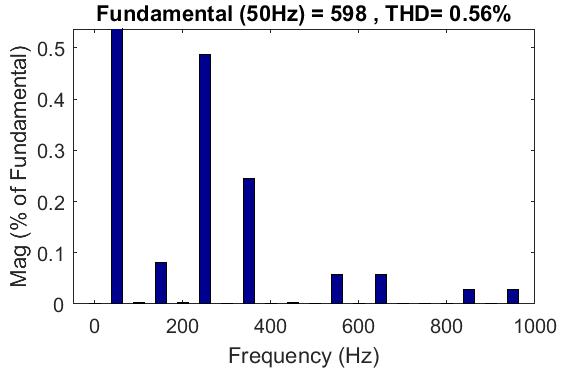
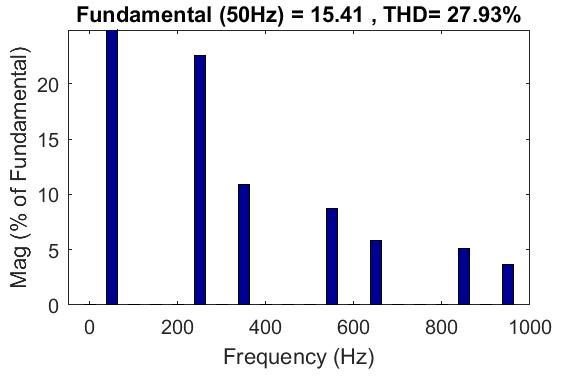
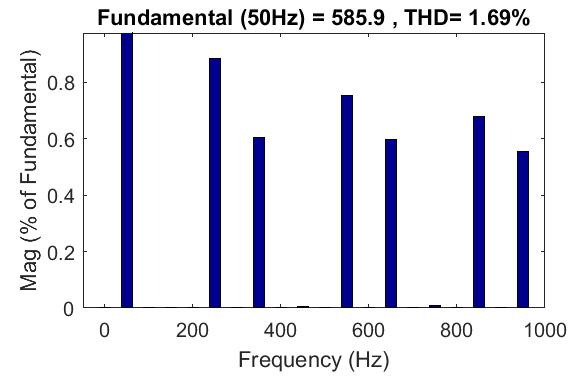
Fig. 4. Voltageandcurrentbothatgridsideaswellasload sidefornon-linearloadingwithoutD-STATCOM
Fig. 7. Voltageandcurrentbothatgridsidefornon-linear loadingwithPV-D-STATCOM
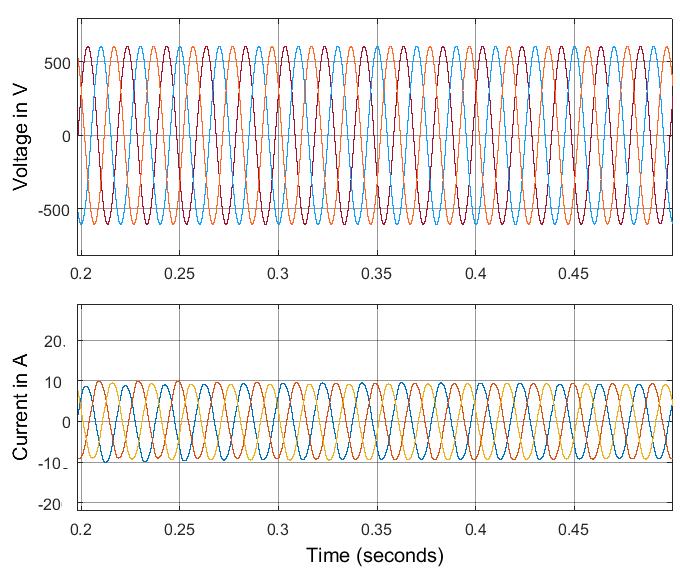
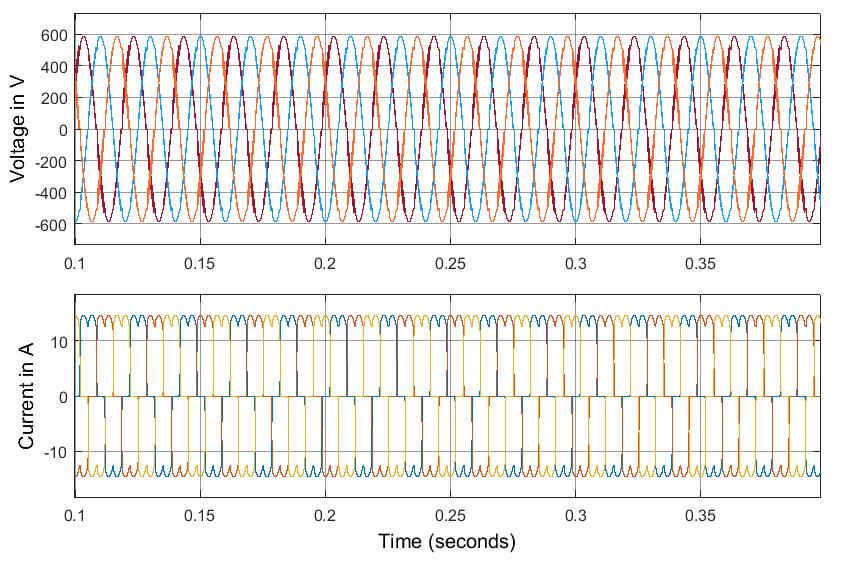
Fig. 5. THDofvoltagefornon-linearloadingwithoutDSTATCOM
Fig. 9. THDofvoltagefornon-linearloadingwithPV-DSTATCOM
International Research Journal of Engineering and Technology (IRJET) e-ISSN: 2395-0056
Volume: 09 Issue: 08 | Aug 2022 www.irjet.net p-ISSN: 2395-0072
10.
PV-DSTATCOM
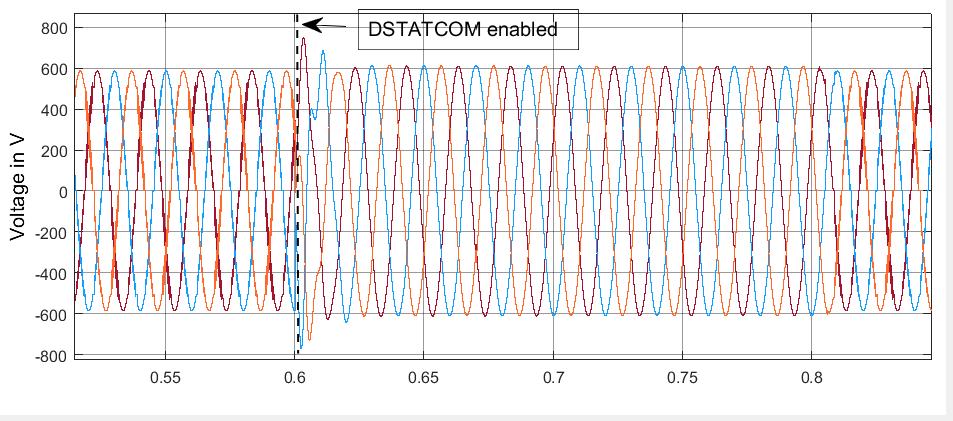
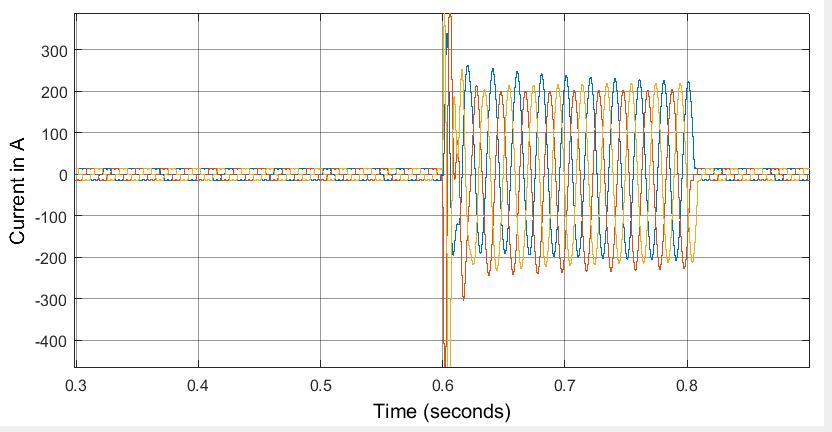
ForbetterunderstandingofworkingofPV-D-STATCOM, preandpostconnectionwaveformsofvoltageiscomparedas shown in Fig. 11. The DSTATCOM supplies the required compensation current as shown in Fig. 12, to mitigate the sourceandloadharmonics.PVsuppliestherequiredreactive powertomitigatethePQissuesgeneratedduetonon-linear loading.
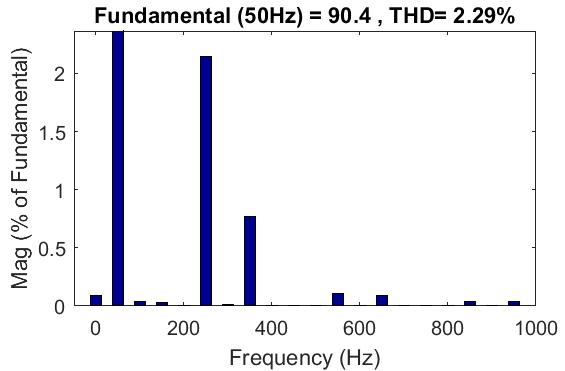
Fig. 13. In-phasevoltageandcurrentrepresentingunity powerfactor
The DSTATCOM is very popular harmonic mitigation controller adopted in distribution system. Harmonics present a very sever threat to the present day highly burdenedpowersystem.It notonlypollutethesinusoidal voltage and current waveforms but also results in power lossesparticularlyactiveonesincefortheharmonics,system feedsthereactivepower.Thisinturnresultsinthevoltage deregulation.Henceharmonicsneedsaimmediateactionto mitigateit.InthisworkaversatileDSTATCOMispresented whichaffectedlymitigatetheharmonicsgeneratedbynonlinearloads.

[1] Varma,R.K.,&Siavashi,E.M.(2018).PV-STATCOM:A new smart inverter for voltage control in distribution systems.IEEETransactionsonSustainableEnergy,9(4), 1681-1691.
Fig. 11. Simulationresultsofthesourcevoltagepriorto andafterenablingtheD-STATCOM
[2] G S. Bhattacharyya, J.M.A. Myrzik, W.L. Kling, Consequencesofpoorpowerquality-anoverview,in: 2007 42nd International Universities Power EngineeringConference,2007,pp.651e656.
[3] P. Acuna, L. Moran, M. Rivera, J. Dixon, J. Rodriguez, Improvedactivepowerfilterperformanceforrenewable powergenerationsystems,IEEETrans.PowerElectron. 29(2)(2014)687-694.Feb.
Fig. 12. CompensationcurrentsuppliedbyPV-D-STATCOM thedesignedD-STATCOMisalsocapableofmaintainingunity powerfactor,hencemakesthesourceandloadcurrentinPhasetovoltageasshowninFig.13.
[4] U. Das Gupta, P. Das, M.A. Hoque, A fuzzy controlled shuntactivepowerfilterforreducingcurrentharmonics andreactivepowercompensation,in:Presentedatthe 2015InternationalConferenceonElectricalEngineering andInformationCommunicationTechnology(ICEEICT), 2015,21-23May.
[5] W.-K.Chen,LinearNetworksandSystems.Belmont,CA: Wadsworth,1993,pp.123-135.
International Research Journal of Engineering and Technology (IRJET) e-ISSN: 2395-0056
Volume: 09 Issue: 08 | Aug 2022 www.irjet.net p-ISSN: 2395-0072
[6] Rohouma,W.,Balog,R.S.,Peerzada,A.A.,&Begovic,M. M.(2020).D-STATCOMforharmonicmitigationinlow voltagedistribution network withhigh penetration of nonlinearloads.RenewableEnergy,145,1449-1464.
[7] Kamran, F.; and Habetler, T.G.; (Jan. 1998). Combined deadbeat control of a series-parallel converter combination used as universal power filter. IEEE Transactions on Power Electronics, Vol. 13, No. 1, pp. 160-168.
[8] Aredes, M.; Heumann, K.; and Watanabe, E.H. (April 1998).Anuniversalactivepowerlineconditioner.IEEE TransactionsonPowerDelivery,Vol.13,No.2,pp.545551.
[9] Muneer, V., & Bhattacharya, A. (December, 2018). CascadedH BridgeMultiLevel InverterBasedUnified Power Quality Conditioner. In 2018 IEEE 8th Power IndiaInternationalConference(PIICON).pp.1-6.
[10] Muneer,V.,Bhattacharya,A.,&Gupta,C.P.(December, 2018). Eight Switch CHB based Three-Phase Shunt ActiveFilter.In2018IEEEInternationalConferenceon PowerElectronics,DrivesandEnergySystems(PEDES). pp.1-6.
[11] Kouro, S., Malinowski, M., Gopakumar, K., Pou, J., Franquelo, L. G., Wu, B., & Leon, J. I. (2010). Recent advances and industrial applications of power converters.IEEETransactionsonindustrialelectronics, 57(8),2553-2580
2022, IRJET | Impact Factor value: 7.529 | ISO 9001:2008 Certified Journal