International Research Journal of Engineering and Technology (IRJET)
e-ISSN: 2395-0056
Volume: 09 Issue: 08 | Aug 2022
p-ISSN: 2395-0072
www.irjet.net
Case study and design for Pale Bk as green village Prof. Nilesh Ahire1,Abhishek Sudinsing Pardeshi2, Aditi Mahindra Wani3, Ritesh Sanjay Shinde4 Yash Pramod Aswale5 *1Assistant
Professor, Civil Engineering, K. K. Wagh Institute of Engineering Education research, Nashik, Maharashtra, India 2,3,4,5 Student, Civil Engineering, K. K. Wagh Institute of Engineering Education & Research, Nashik, Maharashtra, India. ---------------------------------------------------------------------***--------------------------------------------------------------------is progressing and large scale migration taking place from Abstract - Green village is a process that can keep a village
rural areas to cities. and towns, majority of the Indian people lives in villages and is dependent on land. Since time immemorial, agriculture has been a kind of religion in the country. Villages in India often recognized a headman and listened with respect to the decisions of the panchayat. In present-day India, the government supports an elected panchayat and headman system, which is distinct from the traditional council and headman. Indian Villagers share use of common village facilities like the village pond, grazing grounds, temples and shrines, cremation grounds, schools, sitting spaces under large shade trees, wells, and wastelands.
attaining sustainable development. It is also the habitat on which human being can live with pleasant environment. Effective and efficient planning of green village is main consideration for its maximum benefits. Aim of designing and planning is based on its energy conservation, efficient transportation, biodiversity, waste management, watershed management, rain water harvesting structure, on conventional resources etc.
In present project work an attempt has been made to reveal feasibility of use of Green village. Under this project work detailed studies will be conducted for analyzing the problem of rural areas. The concept of green village seems to be the best solution for many problems of rural areas.
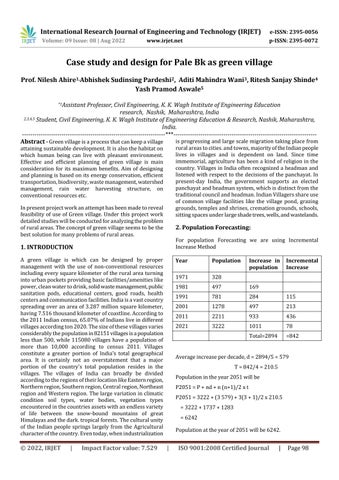
2. Population Forecasting: For population Forecasting we are using Incremental Increase Method
1. INTRODUCTION A green village is which can be designed by proper management with the use of non-conventional resources including every square kilometer of the rural area turning into urban pockets providing basic facilities/amenities like power, clean water to drink, solid waste management, public sanitation pods, educational centers, good roads, health centers and communication facilities. India is a vast country spreading over an area of 3.287 million square kilometer, having 7.516 thousand kilometer of coastline. According to the 2011 Indian census, 65.07% of Indians live in different villages according ton 2020. The size of these villages varies considerably the population in 82151 villages is a population less than 500, while 115080 villages have a population of more than 10,000 according to census 2011. Villages constitute a greater portion of India's total geographical area. It is certainly not an overstatement that a major portion of the country's total population resides in the villages. The villages of India can broadly be divided according to the regions of their location like Eastern region, Northern region, Southern region, Central region, Northeast region and Western region. The large variation in climatic condition soil types, water bodies, vegetation types encountered in the countries assets with an endless variety of life between the snow-bound mountains of great Himalayas and the dark. tropical forests. The cultural unity of the Indian people springs largely from the Agricultural character of the country. Even today, when industrialization
© 2022, IRJET
|
Impact Factor value: 7.529
Year
Population
Increase in population
Incremental Increase
1971
328
1981
497
169
1991
781
284
115
2001
1278
497
213
2011
2211
933
436
2021
3222
1011
78
Total=2894
=842
Average increase per decade, d = 2894/5 = 579 T = 842/4 = 210.5 Population in the year 2051 will be P2051 = P + nd + n (n+1)/2 x t P2051 = 3222 + (3 579) + 3(3 + 1)/2 x 210.5 = 3222 + 1737 + 1283 = 6242 Population at the year of 2051 will be 6242.
|
ISO 9001:2008 Certified Journal
|
Page 98