International Research Journal of Engineering and Technology (IRJET)
e-ISSN: 2395-0056
Volume: 09 Issue: 08 | Aug 2022
p-ISSN: 2395-0072
www.irjet.net
Comparative Study on Soil Stabilization Using Terrazyme and Flyash Brunda L1, Ashwini Satyanarayana2, Dr. Dushyanth V. Babu R3 1Brunda
L, M. Tech Student, DSCE Satyanarayana, Assistant Professor, Dept of CTM, DSCE, B ’lore / Research Scholar, Dept of Civil Eng., JAIN (Deemed to be University), B ’lore 3Dr. Dushyanth V. Babu R, School of Civil Eng., FET-JAIN (Deemed to be University), B ‘lore ---------------------------------------------------------------------***--------------------------------------------------------------------1.1 Terrazyme Abstract - The qualities of the soil subgrade have a big 2Ashwini
impact on how well pavement works. In order to improve weak subgrade, the most effective stabilisation method should be used. Flyash and bioenzymes are compared for soil stabilisation since bioenzymes are more affordable and environmental friendly. Fly ash toxics can move across the environment via runoff, erosion, and fine dust in the atmosphere. The potential for the ash's pollutants to elude containment and spread throughout the environment The current work provides a bio-enzyme and Flyash-based approach for improving soil. Class F flyash and a bio-enzyme called Terrazyme are both employed in this investigation. Both sets of results are contrasted. An organic, non-toxic, liquid enzyme is called Terrazyme. Fruit extract, vegetable extract, and plant fermentation are used in its production. The finely separated byproduct of pulverised coal combustion is known as flyash. Terrazyme can be utilised as a soil stabiliser and can raise the CBR value in road construction, according to a comparison of the results of of flyash and terrazyme.
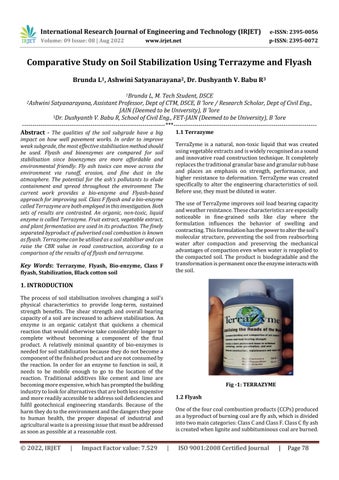
TerraZyme is a natural, non-toxic liquid that was created using vegetable extracts and is widely recognised as a sound and innovative road construction technique. It completely replaces the traditional granular base and granular sub base and places an emphasis on strength, performance, and higher resistance to deformation. TerraZyme was created specifically to alter the engineering characteristics of soil. Before use, they must be diluted in water. The use of TerraZyme improves soil load bearing capacity and weather resistance. These characteristics are especially noticeable in fine-grained soils like clay where the formulation influences the behavior of swelling and contracting. This formulation has the power to alter the soil's molecular structure, preventing the soil from reabsorbing water after compaction and preserving the mechanical advantages of compaction even when water is reapplied to the compacted soil. The product is biodegradable and the transformation is permanent once the enzyme interacts with the soil.
Key Words: Terrazyme, Flyash, Bio-enzyme, Class F flyash, Stabilization, Black cotton soil
1. INTRODUCTION The process of soil stabilisation involves changing a soil's physical characteristics to provide long-term, sustained strength benefits. The shear strength and overall bearing capacity of a soil are increased to achieve stabilisation. An enzyme is an organic catalyst that quickens a chemical reaction that would otherwise take considerably longer to complete without becoming a component of the final product. A relatively minimal quantity of bio-enzymes is needed for soil stabilization because they do not become a component of the finished product and are not consumed by the reaction. In order for an enzyme to function in soil, it needs to be mobile enough to go to the location of the reaction. Traditional additives like cement and lime are becoming more expensive, which has prompted the building industry to look for alternatives that are both less expensive and more readily accessible to address soil deficiencies and fulfil geotechnical engineering standards. Because of the harm they do to the environment and the dangers they pose to human health, the proper disposal of industrial and agricultural waste is a pressing issue that must be addressed as soon as possible at a reasonable cost.
© 2022, IRJET
|
Impact Factor value: 7.529
Fig -1: TERRAZYME 1.2 Flyash One of the four coal combustion products (CCPs) produced as a byproduct of burning coal are fly ash, which is divided into two main categories: Class C and Class F. Class C fly ash is created when lignite and subbituminous coal are burned.
|
ISO 9001:2008 Certified Journal
|
Page 78