International Research Journal of Engineering and Technology (IRJET)
e-ISSN: 2395-0056
Volume: 09 Issue: 07 | July 2022
p-ISSN: 2395-0072
www.irjet.net
Performance Evaluation of Different Grades of Polymer Modified Bitumen in Stone Mastic Asphalt Smita Sen1, Pramod Chandra2 1PG
student, Department Of Civil Engineering, CTM, RGVP University, M.P. India PG student, Department Of Civil Engineering, CTM, RGVP University, M.P. India ---------------------------------------------------------------------***--------------------------------------------------------------------2
Abstract - In the present investigation SMA samples are
Specification for paving bitumen IS 73 or modified bitumen (MB) of appropriate grade complying with IS 15462.
prepared by adding Polymer Modified Bitumen, i.e. PMB 40 and PMB 70. This study was done to find the improvement in the properties of SMA due to addition of modified bitumen. This examination was done to discover which review of bitumen is most appropriate for stone grid blacktop mix. Marshall Samples were prepared using SMA mixes with different binders, varying the binder content. Two types of binders, PMB 40 and PMB 70 binder were used in varying proportions 5-7% (5, 5.5, 6, 6.5 and 7%) to make a comparative study. The results show that addition of PMB improves the volumetric properties of SMA.
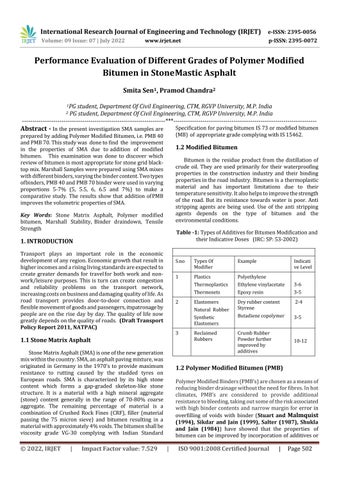
1.2 Modified Bitumen Bitumen is the residue product from the distillation of crude oil. They are used primarily for their waterproofing properties in the construction industry and their binding properties in the road industry. Bitumen is a thermoplastic material and has important limitations due to their temperature sensitivity. It also helps to improve the strength of the road. But its resistance towards water is poor. Anti stripping agents are being used. Use of the anti stripping agents depends on the type of bitumen and the environmental conditions.
Key Words: Stone Matrix Asphalt, Polymer modified bitumen, Marshall Stability, Binder draindown, Tensile Strength
Table -1: Types of Additives for Bitumen Modification and their Indicative Doses (IRC: SP: 53-2002)
1. INTRODUCTION Transport plays an important role in the economic development of any region. Economic growth that result in higher incomes and a rising living standards are expected to create greater demands for travel for both work and nonwork/leisure purposes. This is turn can create congestion and reliability problems on the transport network, increasing costs on business and damaging quality of life. As road transport provides door-to-door connection and flexible movement of goods and passengers, itspatronage by people are on the rise day by day. The quality of life now greatly depends on the quality of roads. (Draft Transport Policy Report 2011, NATPAC)
Impact Factor value: 7.529
Example
1
Plastics
Polyethylene
Thermoplastics
Ethylene vinylacetate
3-6
Thermosets
Epoxy resin
3-5
Elastomers
Dry rubber content Styrene
2-4
Synthetic Elastomers
Butadiene copolymer
3-5
Reclaimed Rubbers
Crumb Rubber Powder further improved by additives
10-12
Natural Rubber
3
Stone Matrix Asphalt (SMA) is one of the new generation mix within the country. SMA, an asphalt paving mixture, was originated in Germany in the 1970’s to provide maximum resistance to rutting caused by the studded tyres on European roads. SMA is characterized by its high stone content which forms a gap-graded skeleton-like stone structure. It is a material with a high mineral aggregate (stone) content generally in the range of 70-80% coarse aggregate. The remaining percentage of material is a combination of Crushed Rock Fines (CRF), filler (material passing the 75 micron sieve) and bitumen resulting in a material with approximately 4% voids. The bitumen shall be viscosity grade VG-30 complying with Indian Standard
|
Types Of Modifier
2
1.1 Stone Matrix Asphalt
© 2022, IRJET
S.no
Indicati ve Level
1.2 Polymer Modified Bitumen (PMB) Polymer Modified Binders (PMB’s) are chosen as a means of reducing binder drainage without the need for fibres. In hot climates, PMB’s are considered to provide additional resistance to bleeding, taking out some of the risk associated with high binder contents and narrow margin for error in overfilling of voids with binder (Stuart and Malmquist (1994), Sikdar and Jain (1999), Salter (1987), Shukla and Jain (1984)) have showed that the properties of bitumen can be improved by incorporation of additives or
|
ISO 9001:2008 Certified Journal
|
Page 502