International Research Journal of Engineering and Technology (IRJET) e ISSN:2395 0056 Volume:09Issue:07|July2022 www.irjet.net p-ISSN:2395-0072

International Research Journal of Engineering and Technology (IRJET) e ISSN:2395 0056 Volume:09Issue:07|July2022 www.irjet.net p-ISSN:2395-0072
Abstract The Meenachil river flows through the heart of the Kottayam district of Kerala state, India. The river which is 78 km long, flows through poonjar, teekoy, erattupetta, pala, ettumanoor and kottayam reaching itself into vembanad lake at kumarakom. It has four main tributaries. The river has a total annual yield of 2,394 million cubic meter. The river has 38 tributaries including major and minor ones. The river has 47 sub watersheds and 114 micro watersheds. This is a society based and environmental friendly project which aims to improve the water quality level of the Meenachil river to class B standard (IS 2296:1992) by analyzing the present pollution levels of the river. The main part of the project was the collection and testing of the water samples from the selected points and these test results indicated pollution levels at these points. Also, a survey was conducted to know the opinion of the public on the pollution level in meenachil river and several suggestions were taken from them on improving the water quality level in the river. The main objectives of the project were to assess the water quality parameters of the meenachil river in wet and dry periods, to provide suggestions on improving present water quality in meenachil river, to improve the health of the people by reducing the water pollution effects caused, and to encourage and develop proper waste disposal practices. This project has good scope in future and will be very beneficial in assessing the pollution and water quality levels of Meenachil river in future by comparing with previously collected data and information. This project can also be extended as a multidimensionalproject.Pollution rate in the Meenachil river is observed and studied in this project and suggestions are provided to reduce the pollution rate and improvethe waterqualityof theriver.
Key Words: (Size10&Bold)Keyword1,Keyword2,Key word3,etc(Minimum5to8keywords)…
Waterisauniversalsymboloflifeanditcovers71%ofthe earth’s surface. It is vital for all known forms of life. On earth 96.5% of the planet’s water is found in seas and oceans,1.7%ingroundwater,1.7%inglaciersandtheice
capsofAntarcticaandGreenland,asmallfractioninother largewaterbodies,and0.001%intheairasvapor,clouds (formed of solid and liquid water particles suspended in air), and precipitation. Only 2.5% of the Earth’s water is freshwater, and 98.8% of that water is in ice and groundwater.Lessthan0.3%ofallfreshwateris inrivers, lakesandtheatmosphere,andanevensmalleramount of the Earth’s freshwater (0.003%) is contained within biologicalmanufacturedproducts.
MeenachilriveristhemajorriverinKottayamdistrictand many major towns and cities like Erattupetta, Pala, Ettumannur, and Kottayam depend upon this river for drinking water and water for commercial activities. Thousands of farmers use water from the river for agriculture.
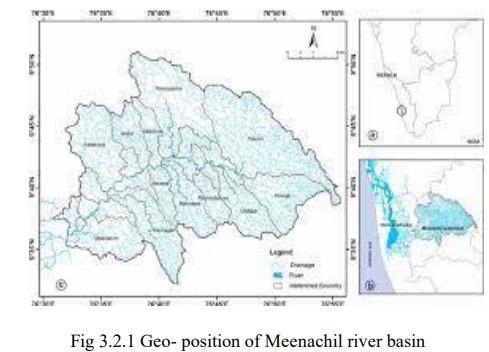
The river Meenachil is formed by several streams originating from the Western Ghats of India. One of the tributaries originates from the southern valley of the Kurishumala hills and flows through Adivaram, Peringalam, and Poonjar. Another tributary is formed by thestreamoriginatingatIllikkalkallunearThalanaduand flowing through Mankombu and Vakakkadu. These two streams join together and flow south eastwards and join withTeekoyriverwhichfurtherflowssouthwardtoenter the north side of Erattupetta. Since the river originates from the Western Ghats, considered to be a protected regionundertheReserveForestArea,thequalityofwater impliestobepristineinnature.
With exploding population, increasing industrialization and urbanization, water pollution by agriculture, municipal,domesticandindustrialsourceshavebecomea majorconcernfor the welfare ofmankind. Surfacewaters are most vulnerable to pollution due to their accessibility for disposal of waste waters. Since rivers constitute the maininland water resource from domestic,industrial and irrigation purposes, the monitoring of toxic pollutants is necessary.
Water quality refers to the chemical, physical, biological, radiologicalcharacteristicsofwater.Itisameasureofthe condition of water relative to the requirements of one or
International Research Journal of Engineering and Technology (IRJET) e ISSN:2395 0056
Volume:09Issue:07|July2022 www.irjet.net p-ISSN:2395-0072
morebioticspeciesandortoanyhumanneedorpurpose. It is most frequently used by reference to a set of standards against which compliance can be assessed. The most common standards used to assess water quality relatetohealthofecosystems,safetyofhumancontactand drinkingwater.
The study involves determination of chemical parameters of surface water at 13 locations along the river. The locations are Moonnilaavu, Payyanithotta, Cherppunkal, Pala, Assissi, Mutholi, Poonjar, Almanar, Aruvithura, Edathilkavu, Panackappalam, Vattolikadavu, Tharappel. Theobjectivesofthestudyaretoassessthepresentwater quality, through analysis of some selected water quality parameters like temperature, pH, total dissolved solids, acidity, alkalinity, turbidity and electrical conductivity, BOD, DO. The MPN method is a well established and fully documented method of estimating the number of viable microorganismsinaproductinwhichthemicroorganisms arerandomlydistributed.Thetestisamethodtoestimate theconcentrationofviablemicroorganisms.
The human body contains 55 78% water, depending on body size. To function properly, the body requires between 1 and 7 liters of water per day to avoid dehydration; the precise amount depends on the level of activity,temperature,humidityandother factors. With an exploding population, increasing industrialization and urbanization, water pollution by agricultural, municipal, domestic and industrial sources has become a major concern for the welfare of mankind. Surface waters are mostvulnerabletopollutionduetotheireasyaccessibility for disposal of waste waters. Rivers play a major role in imitatingorcarryingindustrialandmunicipalwastewater, runoff from agricultural fields, roadways and streets which are major sources of pollution. Among various organic and inorganic water pollutants, metal ions are toxic, dangerous and harmful because of their carcinogenicnature.
Meenachil river is the main source of the water to meet the domestic and drinking purpose of the people in MeenachilTaluk.Henceitisimportanttotestthewaterof the Meenachil river in order to find the degree of contamination.
• Water quality parameters of Meenachil river in 2 seasons(wetanddryseasons).
Thewaterqualitytestsaretobedonefor13locations.The tests that are to be conducted are pH, turbidity, Electrical conductivity,TDS,Hardness,Acidity,Alkalinity,MPN,BOD,
DO, COD. The results obtained are compared in order to findthevariationinwaterqualityinbothseasons.
• Comparison of the result obtained with the previousresult.
The results obtained from the 13 locations are compared with the results obtained two years back to find out the variation in the quality of water. The locations to be selected are the same as the locations where water analysiswasdonetwoyearsback.
● The study is envisaging an assessment of water qualityofMeenachilriverfordifferent monthsincludingleanperiods.
● The pollution abatement measures that can be followedtokeepthewaterinMeenachil river good for domestic purposes is proposed tobeanoutcome.
2.1 Water Quality Analysis of Narmada River with ReferencetoPhysico Chemical
Parameters at Hoshangabad City, M.P; India Dr. D. S. SalujaProfessorofChemistry,Govt. M.V.M.College,Bhopal(M.P.),India,2018
Rivers are a major source for drinking water supply. Narmada River is considered to be the lifeline and west flowingriverofthestateofMadhyaPradesh,whichcovers 98797sq.km.oftotalwatershedareainIndia.Thewater samples collected from four main sampling stations at downstream
Hoshangabad city was analyzed as per standard methods suggested by APHA (2012). The parameters as pH and Turbidity were determined in situ. Statistical analysis is also carried out through correlation method and also evaluatesAverageValue(AV),StandardDeviation(SD),
Standard Variance (SV), Standard Error (SE) and 95% Confidence Limit (CL) to assess the pollution load. The results revealed that Narmada River water quality is suitableandsafefordomesticandirrigationpurposesbut not for drinking purpose without proper treatment because of Turbidity and TDS are not in the range of permissible limit according to the WHO and BIS standard suggested.
International Research Journal of Engineering and Technology (IRJET) e ISSN:2395 0056
Volume:09Issue:07|July2022 www.irjet.net p-ISSN:2395-0072
2.2 Water quality assessment and apportionment of pollution sources of Gomti river (India) using multivariate statistical techniques a case study, panelKunwarP.Singh, AmritaMalik,SaritaSinha,2018
This study presents usefulness of multivariate statistical techniques for evaluation and interpretation of large complex water quality data sets and apportionment of pollution sources/factors with a view to get better information about the water quality and design of monitoring network for effective management of water resources.Theseincludedthetracemetalsgroup(leaching from soil and industrial waste disposal sites), organic pollution group (municipal and industrial effluents), nutrients group (agricultural runoff), alkalinity, hardness, EC and solids (soil leaching and runoff process). DA showed the best results for data reduction and pattern recognition during both temporal and spatial analysis. It renderedfiveparameters(temperature,totalalkalinity,Cl, Na and K) affording more than 94% right assignations in temporal analysis, while 10 parameters (river discharge, pH,BOD,Cl,F,PO4,NH4 N,NO3 N,TKNandZn)toafford 97% right assignations in spatial analysis of three differentregionsinthebasin.
Planning and selection of suitable sites and suitable periodsforthecollectionofsamplesisthefirststep.
• Parameters of assessing the water quality are selected. (Various physical chemical parameters such as Ph, electricalconductivity,temperature,totalhardness)
•Studyarea:
i)Erattupetta(upstreamanddownstreamofcheckdam)
ii)Bharananganam
iii)Pala iv)Cherpunkal v)Poonjar
vi)Kidangoor
•Methodsofwaterqualityanalysisareselectedaccording totherequirement.
i)Volumeandnumberofsamplestobeanalyzed ii)Costofanalysis
iii)Precisionrequired iv)Promptnessoftheanalysisasrequired
• Collected sample is tested by conducting suitable tests andresultsonvariousparameters areobtained.
•Obtainedresultsaremonitored,comparedandstudied.
• Suggestions for adopting water conservation practices. Managementofwastedisposalispreparedbasedonstudy results.
WatersamplesarecollectedfromCherpunkal,Erattupetta, Bharanganam,Poonjar, Aruvithura, Kidangoor and Pala of Meenachil river. It was collected in pre cleaned non reactive plastic containers and were transported to the laboratory. The containers were transported to the laboratory. The containers must be cleaned periodically to prevent build up of dirt. To do this:
Tur bidi ty (NT U)
p H Te mp erat ure (˚C)
CO D (mg /L)
BO D (m g/L )
DO (m g/L )
1.Rinsethehecontainerwellwithtapwater 2.Rinseitwithdistilledwaterthreetimes 3.Allowittodry 4. Before collecting sample, the container must be thoroughlyrinsedwiththeriverwaterthreetimes 5.Allowittodry 4.1TESTRESULTS Station Elec trica l con duct ivity
1 Erattupetta 38.5 /32˚ C
0.2 8 5. 9 32˚ C 16 10. 2 10. 3 2 Poonjar 38.7 /32 ˚C
0.2 9 6 32 ˚C 16 10, 2 10. 2 3 Bharanang a nam 39/ 31˚C 0.3 6. 0 4
31˚ C 16. 4 9.4 11. 4
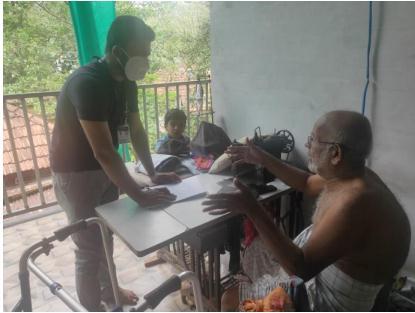
Surveying is done to gather data or information from common people through direct communication. We conducted the survey in 6 major stations of the Meenachil river. The stations selected were Poonjar, Erattupetta, Bharananganam, Pala, Cherpunkal and Kidangoor. We visited 60 houses, 10 houses from each station. A questionnaire was prepared which included various questions regarding the water availability, water sources, waste disposal method, and awareness of the pollution in the river. Recommendation of the people for keeping the river cleaned etc. We received very much pleasing reviews fromthehouseholdswevisited.
The water samples collected from Meenachil river were analyzed for various water quality parameters like pH, temperature,electricalconductivity,COD,BOD,DOetc.
The class B criteria for bathing purposes defined by the centralpollutioncontrolboardare:
1.PHbetween6.5and8.5
2.Dissolvedoxygen5mg/Lormore
3.Biochemicaloxygendemand5days20°C
3mg/Lorless
4. Total coliforms organism MPN/ 100Ml shall be 500 or less
The following recommendations have been made for keeping Meenachil river water conforming to class B standards,throughouttheyear.
A. Short term methods include immediate, visible impact activitiessuchasriversurfacecleaning,ruralsanitationto preventpollution entering theriverthroughrural sewage drains, renovation, and modernization. Among the above mentionedmeasures
01.fittingofcameras
02. awareness programmesfalls under short term methods.
B. Medium term methods comprise activities that arrest municipal and industrial pollution entering the river. Amongtheabovementionedmeasures
01.Constructionofbottlebooths
International Research Journal of Engineering and Technology (IRJET) e ISSN:2395 0056
Volume:09Issue:07|July2022 www.irjet.net p-ISSN:2395-0072
02. proper monitoring and imposing of Punishments on violatingthelawsfallundermediumtermmethods.
C. Long term methods consist of providing adequate flow totheriver,enhancingusageefficiencyandimprovingthe efficiency of surface irrigation. Among the above mentionedmeasures
01.Fencingalongbridges
02.Constructionofsewagetreatmentplan
1. Riyola George and Asha Joseph(2020), Flood FrequencyAnalysisofaSub watershedinMeenachilRiver BasinUsingGumbelsExtremeValueDistribution
2. P. R. Muduli, A. Kumar(09March2021),Waterquality assessment of the Ganges River during COVID 19 lockdown.
3. Romana Rima and Sabbir Azam(April 8 2020) ,AssessmentofWaterQualityParametersofMeghnaRiver Kishoreganj,Bangladesh.
4. Dr. D. S. Saluja (Dec 2020)Water Quality Analysis of Narmada River with Reference to Physico Chemical ParametersatHoshangabadCity,M.P;India
5. Tanushree Chakravarty, Susmita Gupta(2021)Assessmentofwaterqualityofahillyriverof south Assam, north east India using water quality index andmultivariatestatisticalanalysis.
6. Peter Chatangaa, Victor Ntulia, Eltony Mugomeri, Tumo Keketsi, Noel V.T.Chikowore(2019)Situational analysis of physico chemical, biochemical and microbiological quantity of water along Mohokare river, Lesotho,
7. Water resources Department, Government of Kerala(Feb 2021), Abatement of polluted stretch of river ManimalafromKalloopparatoThondra
8. S. SUKANYA and SABU JOSEPH(2020), Water Quality AssessmentusingEnvironmetricsandPollutionIndicesin ATropicalRiver,Kerala,SWCoastofIndia.
9. Ahmed Amin Soltania, Amar Oukil, Hamouda Boutaghane, Abdelmalek Bermad, Mohamed-Rachid Boulassel(2021),Anewmethodologyforassessingwater quality,basedondataenvelopmentanalysis.
10. Kalimur Rahman Ph.D, Saurav Barua.Sc, H.M.ImranPh.D(2021). Assessment of water quality and apportionmentofpollutionsourcesofanurbanlakeusing multivariatestatisticalanalysis.
11. Cao Truong Son; Nguyen Thị Huong Giang; Trieu Phuong Thao; Nguyen Hai Nui; (Jan 2020) Assessment ofCauriverwaterqualityassessmentusingacombination ofwaterqualityandpollutionindices.