International Research Journal of Engineering and Technology (IRJET)

e-ISSN: 2395-0056
Volume: 09 Issue: 07 | July 2022 www.irjet.net p-ISSN: 2395-0072
e-ISSN: 2395-0056
Volume: 09 Issue: 07 | July 2022 www.irjet.net p-ISSN: 2395-0072
PG Scholar, Assistant Professor, Assistant Professor Department of Computer Science and Engineering Vivekananda College of Engineering for Women ***
ABSTRACT: This article is to develop a system for distinguishing retinal diseases from fundus images. Accurate and programmed analysis of retinal images is believed to be an effective method for determining retinal disorders such as diabetic retinopathy, hypertension and atherosclerosis.Inthistask,aconvolutedneuralnetworkis used to extract various retinal features such as the retina, optic nerve, and lesions, and to detect multiple retinal diseases in fundus photographs participating in a structured analysis (STARE) database of the retina. I applied the base model. He described an innovative solutionthatusedconvolutionalneuralnetworks(CNNs)to enable efficient disease detection and deep learning, with great success in the classification of various retinal diseases. Various neural and slice by slice visualization techniques were applied using CNNs trained on publicly available retinal disease image datasets. Neural networks have been observed to be able to capture the color and texture of disease specific lesions at diagnosis. This is similar to human decision making. And this model for deploying the Django web framework. Experiment with various retinal features as input to a convolutional neural networkforeffectiveclassificationofretinalimages.
Keywords:Retinal,deeplearning,TensorFlow,Keras, CNN
Data science uses scientific methods, processes, algorithms, and systems to extract knowledge and insights from structured and unstructured data, and apply knowledge and practical insights from data in a variety of application disciplines. It is an interdisciplinary field to do. The term "data science" can be traced back, when Peter Naur proposed it as an alternative to computer science. In 1996, the International Association of Classification Societieswasthefirstconferencededicatedtodatascience. Butthedefinitionwasstillinflux.
Theterm"datascience"wasfirstcoinedbyDJ.Patil and Jeff Hammerbacher, pioneers in data and analytics
efforts on LinkedIn and Facebook. In less than a decade, it has become one of the hottest and trendiest professions in theworld.Datascienceisaresearchdisciplinethatcombines subjectualknowledge,programmingskills,andknowledgeof mathematics and statistics to derive meaningful insights from data. Data science can be defined as a combination of mathematics, business sense, tools, algorithms and machine learning techniques. All of this helps reveal insights and patterns hidden from raw data that are very helpful in initiatinggoodbusinessdecisions.




Data scientists find out which questions need to be answered and where the relevant data is. In addition to business insight and analytical skills, you have the ability to mine, clean up, and present data. Enterprises use data scientists to procure, manage, and analyze large amounts of unstructureddata.
Programming:Python,SQL,Scala,Java,R,
Machine Learning: Natural Language Processing, Classification, Clustering. Data Visualization: Tableau, SAS, D3.js,Python,Java,Rlibraries.Bigdataplatforms:MongoDB, Oracle,MicrosoftAzure,Cloudera.
Model Preprocessing and Training (CNN): The dataset is preprocessed. B. Image conversion, resizing, and conversion to array format. The same process is performed onthetestimage.Forexample,adatasetconsistingofimages of retinal disease. Each image can be used as a software test image.
CNN Weights
Raw image Build a sequentia l model CNN train
e-ISSN: 2395-0056
Volume: 09 Issue: 07 | July 2022 www.irjet.net p-ISSN: 2395-0072
Thetrainingdatasetis usedtotrainthemodel (CNN). This allows the model to identify the test image and the disease. CNN has various layers such as Dense, Dropout, Activation,Flatten,Convolution2DandMaxPooling2D.After the model has been successfully trained, the software can identify the disease if a retinal image is included in the dataset.Aftersuccessfultrainingandpretreatment,thetest image and the trained model are compared to predict the disease.
Requirements are the basic constraints needed to develop a system. Requirements are collected during system design. The following are the requirements to be discussed.
processinghaveproliferatedtheuseofretinalimageanalysis in screening and diagnosis. The ability to accurately analyze fundus images has promoted the use of noninvasive, fundus imaging in these domains. Moreover, the invention of new imaging modalities, such as optical coherence tomography (OCT) and scanning laser ophthalmoscopy (SLO), has broadened the scope and applications of retinal image processing. This review regards both fundus imaging, as implemented by fundus photography and SLO and OCT imaging.
Functional requirements:
Software requirements specifications are technical specificationsofsoftwareproductrequirements.Thisisthe first step in the requirements analysis process. Lists the requirements for a particular software system. The following details follow special libraries such as TensorFlow,Keras,Matplotlib. Non
[2] Rubina sarki , Khandakar Ahmed , (senior member, IEEE), Hua wang , (Member, IEEE), and Yanchun zhang DiabetesMellitus,or Diabetes, isa disease in whicha person’s body fails to respond to insulin released by their pancreas, or it does not produce sufficient insulin. People sufferingfromdiabetesareathighriskofdevelopingvarious eye diseases over time. As a result of advances in machine learning techniques, early detection of diabetic eye disease using an automated system brings substantial benefits over manual detection. A variety of advanced studies relating to the detection of diabetic eye disease have recently been published. This article presents a systematic survey of automatedapproachestodiabeticeyediseasedetectionfrom several aspects, namely: i) available datasets, ii) image preprocessing techniques, iii) deep learning models and iv) performance evaluation metrics. The survey provides a comprehensive synopsis of diabetic eye disease detection approaches,includingstateoftheartfieldapproaches,which aim to provide valuable insight into research communities, healthcareprofessionalsandpatientswithdiabetes.
CarlosHernandez Matasa,AntonisA.Argyrosa,b , Xenophon Zabulisa [1] The first fundus images were acquired after the invention of the ophthalmoscope. The concept of storing and analyzing retinal images for diagnostic purposes exists ever since. The first work on retinal image processing was based on analog images and regarded the detection of vessels in fundus images with fluorescein . The fluorescent agent enhances the appearance of vessels in the image, facilitating their detectionand measurement bythemedical professional or the computer. However, fluorescein angiography is an invasive and time consuming procedure and is associated with the cost of the fluorescent agent and its administration. Digital imaging and digital image
Baidaa Al Bander [3] The interpretation of ophthalmic images is typically performed by trained clinical experts.However,duetothevolumeandcomplexityofthese images, and the large variation in pathology, in addition to the variation among experts, there has been increasing interest in computer assisted assessment and diagnosis of such images. There has been particular interest in finding a cost effective approach with high sensitivity and specificity, independentofhumanintervention,androbustenoughtobe applied to large populations in a timely manner to identify retinal diseases. This thesis introduces novel deep learning methodologies based on convolutional neural networks (CNNs) to address key challenges in different retinal image analysis tasks. Three retinal image analysis objectives have beenconsideredinthisresearchproject:foveaandopticdisc (OD) localisation, choroid and optic disc/cup segmentation, anddiseaseandlesionclassificationtasks.Inthefirstretinal imageanalysistask,simultaneous detectionofthecentresof the fovea and the optic disc from colour fundus images is consideredasaregressionproblem.
e-ISSN: 2395-0056
Volume: 09 Issue: 07 | July 2022 www.irjet.net p-ISSN: 2395-0072
SuvajitDutta,BonthalaCSManideep,SyedMuzamil Basha, Ronnie D. Caytiles1 and N. Ch. S. N. Iyengar2 [4]
Diabetes or more precisely Diabetes Mellitus (DM) is a metabolic disorder happens because of high blood sugar level in the body. Over the time, diabetes creates eye deficiency also called as Diabetic Retinopathy (DR) causes major loss of vision. The symptoms can originate in the retinal area are augmented blood vessels, fluid drip, exudates, hemorrhages, and micro aneurysms. In modern medical science, images are the indispensable tool for precisediagnosisofpatients.Inthemeantimeevaluationof contemporary medical imageries remains complex. In recent times computer vision with Deep Neural Networks cantrainamodelperfectlyandlevelofaccuracyalsowillbe higher than other neural network models. In this study fundus images containing diabetic retinopathy has been taken into consideration. The idea behind this paper is to proposeanautomatedknowledgemodeltoidentifythekey antecedentsofDR.ProposedModelhavebeentrainedwith three types, back propagation NN, Deep Neural Network (DNN) and Convolutional Neural Network (CNN) after testing models with CPU trained Neural network gives lowest accuracy because of one hidden layers whereas the deep learning models are out performing NN. The Deep Learning models are capable of quantifying the features as blood vessels, fluid drip, exudates, hemorrhages and micro aneurysms into different classes. Model will calculate the weights which gives severity level of the patient’s eye. The foremost challenge of this study is the accurate verdict of eachfeatureclassthresholds.
Carlos Hernandez Matasa , Antonis A. Argyrosa,b , Xenophon Zabulisa [5] The diabetes retinopathy is the applicationofmedicalimageprocessing.Theretinalimages are evaluated to diagnose the DR. It is however, time consuming and resource demanding to manually grade the images such that the severity of DR can be defined. When the tiny blood vessels present within the retina are damaged,onlythencanonenoticethisproblem.Bloodwill flow from this tiny blood vessel and features are formed from the fluid that exists on retina. The kinds of features involvedhereduetotheleakageoffluidandbloodfromthe blood vessels are considered to be the most important factors to study this problem. The diabetes retinopathy detection techniques has the three phase which pre processing, segmentation and classification. In this work, NN approach is used for the classification of diabetes portion from the image. The proposed model is implementedinMATLABandresultsareanalyzedinterms ofcertainparameters.
The proposed approach consists stage pretreatments were performed in retinal images from data sets and standardize them to size then classification was made by Convolutional Neural Network which is a deep learning algorithm and success was achieved to deep learning technique so that a person with lesser expertise in software should also be able to use it easily. It proposed system to predicting retinal disease. It explains about the experimentalanalysisofSamplesofimagesarecollectedthat comprised of different retinal. The primary attributes of the image are relied upon the shape and texture oriented features. An efficient disease detection and deep learning with convolutional neural networks (CNNs) has achieved great success in the classification of various retinal diseases. A variety of neuron wise and layer wise visualization methods were applied using a CNN, trained with a publicly available retinal disease given image dataset. The sample screenshotsdisplaystheretinaldiseasedetectionusingcolor based classification model. And to deploy this model in web applicationforDjangoframework.
Increasing throughput & reducing subjectiveness arising from human experts in detecting the retinal decease. It is essential to detect a particular disease. In our country manyfarmersarenotsoeducatedtogetcorrectinformation aboutalldiseases.
Here is an overview of what we are going to cover:
Download and install anaconda and get the most useful package for machine learning in Python. Load a dataset and understand its structure using statistical summariesanddatavisualization.
Machinelearning models,pick the best and build confidence thattheaccuracyisreliable.
Python isa popular and powerful interpreted language. Unlike R, Python is a complete language and platformthatyoucanuseforbothresearchanddevelopment and developing production systems. There are also a lot of
e-ISSN: 2395-0056
Volume: 09 Issue: 07 | July 2022 www.irjet.net p-ISSN: 2395-0072
modules and libraries to choose from, providing multiple waystodoeachtask.overwhelming.
When you are applying machine learning to your own datasets,youare workingona project. Amachinelearning projectmaynotbelinear,butithasanumber.
The best way to really come to terms with a new platform or tool is to work through a machine learning project end to end and cover the key steps. Namely, from loading data, summarizing data, evaluating algorithms and makingsomepredictions.
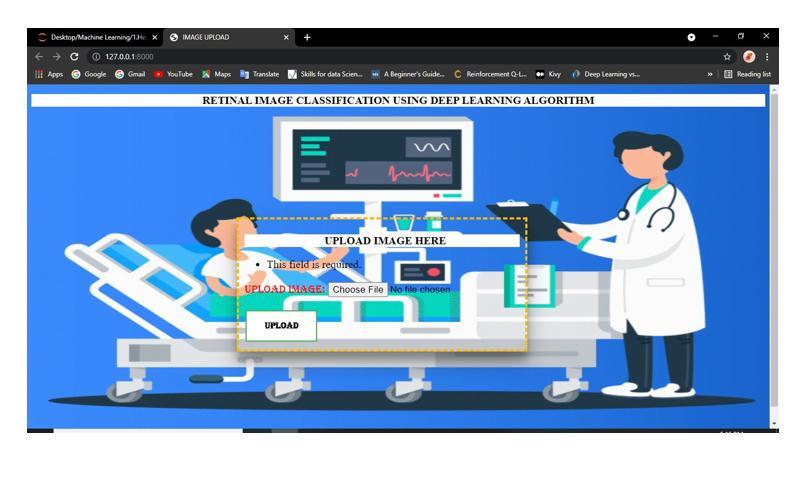
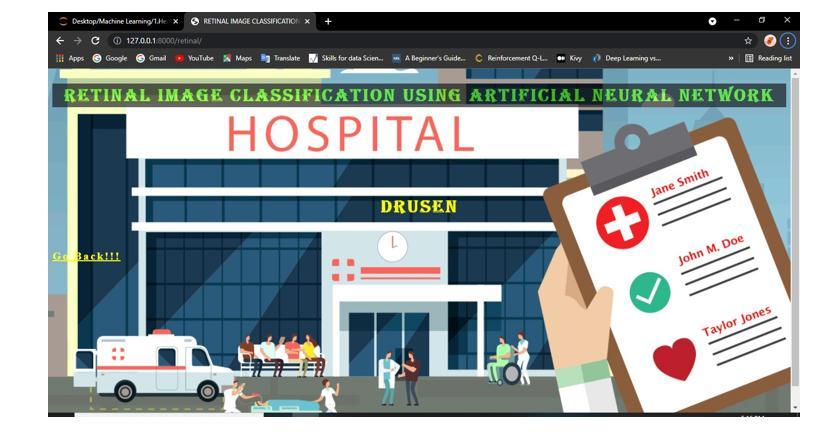
In this module the trained deep learning model is converted into hierarchical data format file (.h5 file) which is then deployed in our django framework for providing betteruserinterfaceandpredictingtheoutputwhetherthe givenOCTimageisCNV/DME/DRUSEN/NORMAL.
Django is a high level Python web framework that enables rapid development ofsecure and maintainable websites. Built by experienced developers, Django takes care of much of the hassle of web development, so you can focus on writing your app without needing to reinvent the wheel. It is free and open source,has a thriving and active community,greatdocumentation,andmanyoptionsforfree and paid for support.Django helps you write software that is:
Django follows the "Batteries included" philosophy and provides almost everything developers might want to do "out of the box". Because everything you need is part of the one "product",it all works seamlessly together, follows consistent design principles, and has extensive andup to datedocumentation
Django can be (and has been) used to build almost any type of website from content management systems andwikis,throughtosocialnetworksandnewssites.Itcan work with any client side framework, and can deliver content in almost any format (including HTML, RSS feeds, JSON, XML, etc). The site you are currently reading is built with Django!
Internally, while it provides choices for almost any functionality you might want(e.g. several popular
databases,templatingengines,etc.),itcanalsobeextendedto useothercomponentsifneeded.
Django helps developers avoid many common security mistakes by providing a framework that has been engineered to "do the right things" to protect the website automatically. For example, Django provides a secure way to manage user accounts and passwords, avoiding common mistakeslike puttingsession information incookies where it is vulnerable(instead cookies just contain a key, and the actual data is stored in the database) or directly storing passwordsratherthanapasswordhash.Apasswordhashisa fixed length value created by sending the password through a cryptographichashfunction
Django can check if an enteredpassword is correct by running it through the hash functionand comparing the output tothe stored hash value However due tothe "one way" nature of the function,even if a stored hash value is compromisedit is hard for an attacker to work outthe original password. Django enables protection against many vulnerabilities by default, includingSQL injection, cross site scripting, cross site request forgery and clickjacking (seeWebsitesecurityformoredetailsofsuchattacks).
Django uses a component based “shared nothing” architecture (each part of the architecture is independent of the others,and canhence be replaced orchanged if needed). Having aclear separation between the different parts means that it can scale for increased traffic by adding hardware at anylevel: caching servers,database servers, or application servers.Some of the busiest sites have successfully scaled Django to meet their demands (e.g.Instagram and Disqus, to namejusttwo).
Django code is written using design principles and patterns that encourage the creation of maintainable and reusable code. In particular,it makesuse ofthe Don'tRepeat Yourself (DRY) principle so there is no unnecessary duplication, reducing the amount of code. Django also promotes the grouping ofrelated functionality into reusable "applications"and, at a lower level, groups related codeintomodules (along the lines of theModel View Controller(MVC)pattern).
(IRJET) e-ISSN: 2395-0056
Volume: 09 Issue: 07 | July 2022 www.irjet.net p-ISSN: 2395-0072
Django is written in Python, which runs on many platforms.Thatmeansthatyouarenottiedtoanyparticular server platform, and can run your applications on many flavours of Linux, Windows, and Mac OS X. Furthermore,Django is well supported by many web hostingproviders,whooftenprovidespecificinfrastructure anddocumentationforhostingDjangosites.
FIGURE 1 : INPUT
It focused on how to use CNN models to predict patterns of retinal disease using images from specific datasets (trained datasets) and previous datasets. This provides some of the following insights into the prediction of retinal disease: The main advantage of the CNN classification framework is the ability to automatically classify images. Eye disorders are a major cause of blindness and are often too late to correct. This study provided an overview of how to detect retinal image anomalies, including retinal image dataset collection, preprocessing techniques, feature extraction techniques, andclassificationschemes.
[1] Choi JY, Yoo TK, Seo JG, Kwak J, Um TT, Rim TH (2017) Multi categorical deep learning Neural network to classify retinal images:a pilot study employing small database. PLoS One12(11):e0187336
[2] Abramoff MD, Garvin MK, Sonka M (2010) Retinal imaging and image analysis. IEEE Rev Biomed Eng. 3:169 208
[3] Sinthanayothin C, Boyce JF, Cook HL, Williamson TH (1999) Automated localisation of the optic disc, fovea, and retinal blood vessels from digital color fundus images. Br J Ophthalmol83(8):902 910
[4]HooverA,GoldbaumM(2003)Locatingtheopticnervein a retinal image using the fuzzy convergence of the blood vessels.IEEETransMedImag22(8):951 958
[5] Sánchez CI, Hornero R, LopezMI, Poza J (2004) Retinal imageanalysistodetectandquantifylesionsassociatedwith diabetic retinopathy. In: 26thAnnual International Conference of the IEEE engineering in medicine and biology society,IEMBS’04,vol1.IEEE,pp1624 1627
[6] Mishra M, Nath MK, Dandapat S (2011) Glaucoma detection from color fundus images. Int JComput Commun Technol(IJCCT)2(6):7 10
[7] Patton N, Aslam TM, MacGillivray T, Deary IJ, Dhillon B, Eikelboom RH,YogesanK,Constable IJ(2006)Retinal image analysis: concepts, applications and potential. Prog Retinal EyeRes25(1):99 127
[8] Verma K, Deep P, Ramakrishnan A (2011) Detection and classificationofdiabeticretinopathyusingretinalimages.In: 2011AnnualIEEEIndiaconference(INDICON),pp1 6.IEEE
[9] Priyadarshini BH Devi MR (2014) Analysis of retinal blood vessels using image processing techniques. In: 2014 international conference on intelligent computing applications(ICICA),pp.244 248.IEEE1280K.RajanandC. Sreejith