International Research Journal of Engineering and Technology (IRJET) e ISSN: 2395 0056

Volume: 09 Issue: 07 | July 2022 www.irjet.net p ISSN: 2395 0072
International Research Journal of Engineering and Technology (IRJET) e ISSN: 2395 0056
Volume: 09 Issue: 07 | July 2022 www.irjet.net p ISSN: 2395 0072
Abstract With increasing industrialization and explicitly developing economies, the demand for energy has considerably increased. Though the world is slowly moving towards carbon free living, the majority percentage of the electrical energy utilized over the globe is stillgeneratedusing fossil fuels. The larger economies including the United States, India, China, and the EuropeanUnioncountries accounting for the majority stake in energyrequirements are dependent upon non renewable sources for their energy requirement fulfillment. Moreover, the conventional energy sources are limited in nature and account for the emission of harmful pollutants resulting in the global warming crisis. To provide a sustainable and prudent solution to this alarming emergency, the usage of renewable sources can play a vital role in the generation of emission free and clean electricity production. However, storage of this high voltage electricity for a lasting duration is a rising challenge. For such applications, battery storage systems are developed to store green electricalenergy while laptops, mobile phones, and other battery operated types of equipment are the best day to day simple examples of these systems. The present study focuses on the existing techniques of battery energy storage, the latest progress, and the future scope of development in this area. In addition, the economic aspects of the system have also been discussedin the present study.
Words: Energy storage, Renewable energy, Electric Vehicles, Energy sustainability, Electric battery storage systems
The demand for energy been drastically increased over the lastdecades.Thisismoreparticularlydue tothe major developments in industrialization and human territoryexpansion.Accordingtothedatareleasedin2015, thenetgenerationofelectricityhasaccountedforthevalue of around 25000 TWh, which is produced by the head of non renewable resources including coal being one of the majorenergy producingfuels.Withtheincreaseintheneed forelectricalenergy,resourcesprovidingtheenergygetting strinkedovertheyears.Moreover,theenergygeneratedby the use of fossil fuels is harmful to the environment and producestoxicgasesaswellasreleaseschemicallyharmful liquid to the water resources. To tackle this alarming situation,severalattentionsmadebythemajoreconomies overtheglobe.CountriesincludingtheUnitedStates,China,
India, the United Kingdom, and the European Union are steppingintogenerateelectricitybyusinggreentechnology. This initiative will not only reduce the dependency of countriesonfossilfuelsincludingcrudeoilandcoalbutalso account for the production of pollution free electrical energy. The major contributor to the generation of green electricalenergyincludessolarpowerplants,windmills,and hydroelectric power plants. However, the initial capital requiredtosetupthegreenpowerplantsismultipletimes morethantheconventionalenergysourcingpowerplants, whichisamajorproblemformiddle incomeandlow income economies. While climate change is the common and concentratedpointofdiscussioninannualmeetingsofG7 andG20countries,severalinitiativesarebeingtakeninthe directiontoreducethedependencyonfossilfuels.Themajor countrieshavesetupachallengingtargetforthemselvesas net carbon free emission countries, the time duration for which is varied according to the energy demand and the economicprospectofthatspecificcountry. Accordingtothe statementsgivenbythecountryrepresentativesatCOP26 held in the year 2021 at Glasgow, the Republic of India is targetingtowardsbecominganetcarbonemissioncountry bytheyeararound2070,whiletheUnitedStatespromised to do so by the year 2050. China being one of the huge economiesandaccountingforthemajorityofthepercentage ofenergydemandhasaimedtoproducenetemissionsbythe year2060.
Thejourneyofbecominganemission freecountrycan beachievedifdirectedstepsaretakenbythecountryand theconcernedgovernment.Themajorstepsincludesetting up renewable power plants and replacing conventional engine basedvehicleswithelectricvehicles.Moreover,the solarpowerplantscanbeinstalledoveralargeareaofland aswellasfloatingsolarpowerplantscanbedevelopedon the seawater. The country has large water sources that shouldempowerwaterintoelectricalenergybyconstructing hydropower plants at the originating places or over the dams. The electrical energy generated with the ad of renewable resources including solar, wind, and water are dynamicinnatureanditdependsuponthevariablefactors. Such energy needs to be stabilized before transporting to industrial or household applications. Renewable energy sources are irregular in nature, in order to have system stability and reliability, energy generation and load maintenanceareimportant,alsoenergyconsumptionlevels are changing with increased consumers so there is a
International Research Journal of Engineering and Technology (IRJET) e ISSN: 2395 0056
Volume: 09 Issue: 07 | July 2022 www.irjet.net p ISSN: 2395 0072
requirement for an energy storage system for renewable sources.Electricitycanbestoredinlarge scalebatteries.In ordertofulfilldemand,thenewstoragesystemisrequired forrenewablesources.Installationandoperatingcostsfor large scalestorageofelectricityusingbatteriesaredifferent and its performance can vary. Prudent research has been carried out overthe pastfewyearsto tacklethisproblem andithasbeenobservedthatElectricalEnergyStorageisthe perfect system that full fields all the energy stabilizing requirements.Withtheaidofelectricalenergysources,the energyistransformedintotherequiredformwhereitcanbe storedandpreservedinmultiplemediums.Themediumof storagecanbecategorizedintopurelyMechanical,Electrical, Electrochemical,Chemical,andThermal.Thestoredstable electric energy is then wire transported to the end user application[1,2].
Theelectronicenergystoragesystemsplayseveraldutiesin green energy development including the attainment of maximum load requirements during peak demand, redeveloping the quality of the grid power being collected fromrenewableresources,and,optimumusageofenergy storingequipment.
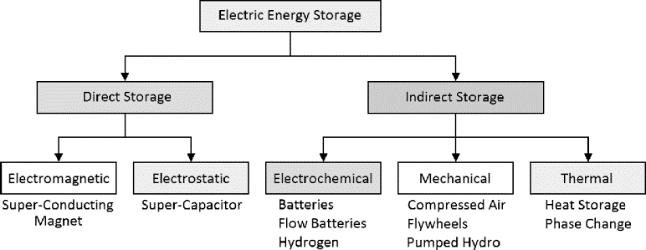
Figure1showsthebroadclassificationofelectricalenergy storingsystemsusedtostoreandsupplyelectricalenergyfor domestic and industrial usage. As can be seen in the classification the storage is categorized into direct and indirect storage. In the direct type of electrical energy storage,thegreenenergygeneratorfromrenewablesources is stored in the superconducting magnet i.e., in case of electromagneticstorageorinthesupercapacitors.Whilein the indirect type of storage the energy is stored in the mechanical,thermal,andelectrochemicalforms
maximum efficiency of 99% in contrast to other methods wheretheGrid TieBESSmethodprovides92.8%efficiency. Theselectionoftheproperelectricstoragesystemmethodis valid in accordance with the end application. It has been seenthattheNASbatteryenergystoringmethodismajorly utilizedinelectricvehicles,whereasahybridenergystorage systemisusuallyusedforwindenergyresourcesandgrid operation.Forcarbatteries,lithium sulphurbatteriesand lithium air batteries are widely used for electrical energy storage,whilesuperconductingmagneticenergystorageis preferablyusedforhigh endapplicationsincludingpumping hydrostations[5,6].
A battery is an electrochemical cell in which electrical energy is generated during chemical reaction. Battery has two types namely primary and secondary battery.Primarybatteriesareusedforsingleuse.Primary batteriesareusedinsmall portablegadgets,watches,and torches They cannot be rechargeable whereas secondary batteries can be rechargeable. In the secondary batteries, chemicalenergyisconvertedintoelectricalenergyandvice versa.Theyareusedforenergystorageinmobile,laptops electricalvehicles.
The secondary batteries can be recharged and reused; however, these batteries are costlier than the primarybatteries.Secondarybatteriesareusedforenergy storagedevices.Electricalenergystoragei.e.,EES.toreduce pollution due to conventional fuel in vehicles electrical vehiclescanbeusedanditisneededforthefutureinorder tosavetheenvironment.Anothereasilyavailablesourceis renewable energy sources i.e., wind and solar power. ElectricalenergycanbeproducedfromtheseREsources[7 10].
Types of modern secondary batteries can be summarisedas:
Lead AcidBatteries
Nickel CadmiumBatteries
Nickel MetalHydrideBatteries
Lithium IonBatteries Cobalt basedLi ion batteries;
Phosphate basedLi ionBatteries.
SodiumSulphurBatteries
AfewenergystoringsystemsincludesinNASbattery, Superconducting magnet energy storage, Lithium sulphur battery and lithium ion battery, VRB flow batteries, supercapacitors, or double layer supercapacitors, and Hybrid energy storage systems. The range, efficiency, and durabilityofeachsystemarevariedfromeachotherwhile superconducting magnetic energy storage provides
In the battery energy stream, the electrochemical batteriesareconnectedinacircuitwhereinthebatterycells are joined in parallel or in series depending upon the requirement of the energy. There are multiple types of battery cells including Lead Acid battery, Lithium Ion battery, Sodium Sulphur battery, Nickel Cadmium battery andVanadiumRodexFlowbattery.Thedepthofchargeof eachbatteryisveryinaccordancetothedischargeratefora
International Research Journal of Engineering and Technology (IRJET) e ISSN: 2395 0056
Volume: 09 Issue: 07 | July 2022 www.irjet.net p ISSN: 2395 0072
cycle.Theapplicationofeachbatteryvariesinaccordanceto theenvironment,voltagerequirementandcycle time.The batteries and its battery energy storing capacity can be discussedasfurther.Lead acidbatteriesarewidelyutilized in applications where the battery cannot be interchanged and requires its recharging after certain duration. These batteries are rechargeable and can be utilized fully for a complete cycle. In this type of battery, the electrolyte solution is sulphuric acid, Lead acts as an anode whereas Lead oxideactsasacathode.Theefficiencythesebatteries dependupontheenvironmentaltemperature,asinwinter,it providespoorperformancewhileinsummersitworkswith its maximum efficiency. The performance of this kind of batteries is operated and manipulated by the proper implementationofthermalmanagementsystems.[8 11]
Anotherkindofwidelyusedbatteryisalithium ion battery.Inthiskind,theelectrolyteisusedasnon aqueous solution, graphite carbon access anode and lithium metal oxide act as a cathode. These batteries provide maximum efficiency of up to 98 percent while the cycle time is dependent upon the depth of discharge and can be significantly affected by it. In recent days, these kinds of batteries are widely used in electric vehicles as primary electricalenergystorageequipment.Anothertypeofbattery which includes beta alumina, molten Pharma sodium and sulphur as energy storing medium is sodium sulphur battery.Inthiskindthesodiumandsulphuraselectrodes andaluminaactsassolidelectrolyte.Thegreateradvantage ofoperatingsulphursodiumbatteryisitsmaximumability of recycling, the result of which, these are usually incorporatedforhighenergystorageapplications.
Otherformofbatteryi.e.,Nickel Cadmiumbattery usestwoelectrolytesofnickelhydroxideandcadmiuminits metallicform.Themajordrawbackofusingthesebatteriesis itstoxicityinnatureandlowefficiencyinhightemperatures. Therefore,thesekindsofbatteriesareusuallyusedinlow temperatureapplications.
Apart from the discussed batteries, the flow batteriesarewidelyusedinenhancingpowerqualitiesand powersecuritydevices.TheseareusuallygivenasVanadium Redox Flow Battery. The battery includes to separate electoral tanks and the energy is stored using vanadium redox acting as electrodes. This battery is provided high performance and quick response to maximum power requirement. While being operated for load leveling and electricalsecurity,theoperatingcostofthesebatteriesisa bitexpensive.
Some factors are taken into consideration while choosing EEStechnologysuchas.
1. Small discharge time: Discharge time is between secondstominutes.e.g.,flywheels.
2. Medium discharge time: Discharge time is between minutestohours.e.g.,largecapacityelectrochemical batteries
3. Largedischargetime:Dischargetimeisbetweendays tomonthe.g.,Syntheticnaturalgas(SNG)
Capital cost is an important factor when installing an EES systeminindustrialandcommercialuse.Itisexpressedin kWhr,Rs/kWhrandRs/kWhr/cycle.
The current profile of the load Understanding the currentprofileoftheloadis essential whendimensioning the battery capacity, and is very often overlooked. This is acceptablewhentheloaddoesnotchangeduringoperation, butitisunacceptablewhensuchchangesoccur
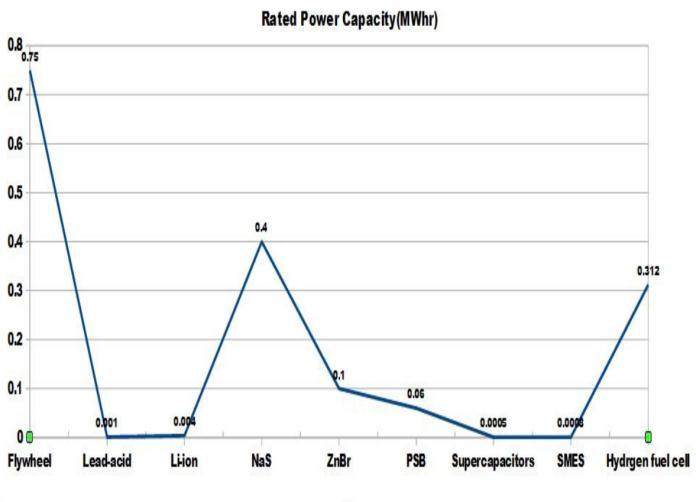
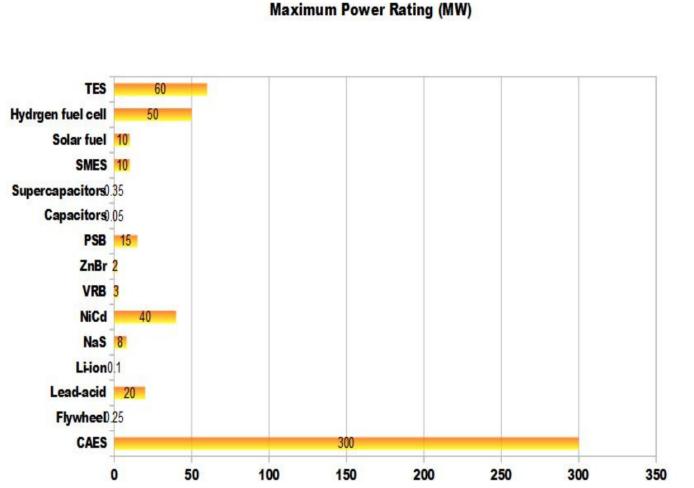
Thepowergridsizeandtheenergyrequirementisan importantaspectoftheselectionofproperelectricstorage systems for a particular application. If the energy requirementanditsdensityareonthehigherside,thenthe requirementofthesizeconsidersmall.Figure2andfigure3 giveanoverviewofthePowercapacityanddensityofthe electricalenergyforelectronicenergystoragesystems,while 4showsthemaximumpowerratingofEES[9 12]
Fig 2: Rated power capacity of EES
International Research Journal of Engineering and Technology (IRJET) e ISSN: 2395 0056
Volume: 09 Issue: 07 | July 2022 www.irjet.net p ISSN: 2395 0072
costofenergy.Thepowerexpensesforindustrialaswellas household applications can be significantly reduced by implantingBESS.
Further, the undeveloped areas where electricity is not available and transportation of energy cannot be implemented, the battery energy storage systems can be installedatsearchremoteareastherebyreducingthecostof transportation wirelines and energy loss due to its heavy energytransfer[12 16]
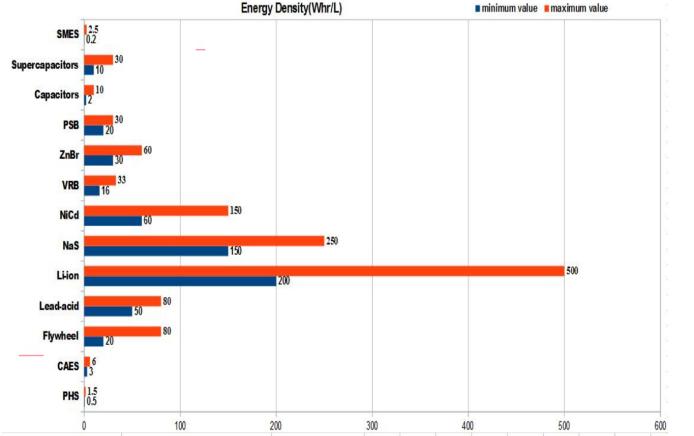
Further, the rating of energy differs from type of energy storage system used, the comparison analysis of whichisshowninFigure.
Ananalysisiscarriedoutconsideringtheeconomic aspectsandfoundthattheoptimizedusageofelectricenergy systemscansignificantlyreducethecostrequiredforenergy production, storage, and transformation. This can be financiallybeneficialiftheconventionalsourcesofenergy production are replaced by the energy storage systems whichproviderenewablegreenenergy.Further,afewother economicperspectivesinclude:
Most of the higher economies are reducing their dependency on fossil fuels and shifting to renewable resources,asaresultofwhichthecostofenergyisbecoming economical.Theenergystoragesystemsareplayingvitaland beneficialroleinthisrevolutionarychangebycuttingdown theexcessivecostofgeneratingenergythroughfuels.
Thereasonablegridcanbeprovidedasanadditional servicebyimplantingthebatteryenergystorageequipment which significantly reduces the cost, thereby reducing the
The demand for energy has increased over the few decades as the major economies are you moving towards heavyindustrializationand humanexpansion.Theenergy generated by fossil fuels is not only hazardous but also limited in nature. Providing a prudent solution to this alarmingsituation,the worldisfastlyadapting renewable sources to fulfill its energy requirements. However, the storage of high voltage energy and its transportation has beenamajorpointofconcern.Thelatestdevelopmentsin thisregardfoundthatenergystoragesystemscaneffectively storegreenenergy,thetypeofwhichvariesinaccordanceto theenvironment,voltagerequirement,andcycletime.Inthe presentstudy, differentenergystoragemethodsandtheir usagehavebeendiscussed.Furthermore,thebatteryenergy storagesystemwastheprimefocusofdiscussionwerethe types of batteries, their significance, and economic perspectiveshavealsobeenshowcased.Themainfocusison secondary storage batteries which it is used in large application such as electrical vehicles. Here the main functionofelectricalenergystorageismatchingthedemand andsupplyofelectricityi.e.,time shiftingforsmallandlarge industrial and commercial applications. If we want sustainabledevelopmentin thecomingdecades,theglobe needs to shift from conventional and depleting natural resources we have to shift to Energy storage devices consideringallthreepillarsofsustainabledevelopmenti.e. society, economy, and environment. The biggest factor is environmental issues like global warming and ozone depletionetc.whichareforcingustoshiftoursystemsfrom CO2emissionstoeco friendlydevicesandenergystorageis playingavitalroleinthisdevelopment
[1] Vidyanandan,K.V.(2014).K.V.Vidyanandan,"Roleof EnergyStorageintheGridIntegrationofWindandSolar PVEnergySystems",GlobalEnergyTechnologySummit (GETS) 2014,pp.1 13,NewDelhi,India,7 9,Nov.2014.
[2] W. V. Hassenzahl, "Superconducting magnetic energy storage,"inProceedingsoftheIEEE,vol.71,no.9,pp. 1089 1098,Sept.1983.doi:10.1109/PROC.1983.12727
[8]T.OhtakaandS.Iwamoto,"PossibilityofusingNAS batterysystemsfordynamiccontroloflineoverloads,"
International Research Journal of Engineering and Technology (IRJET) e ISSN: 2395 0056
IEEE/PES Transmission and Distribution Conference and Exhibition, 2002, pp. 44 49 vol.1. doi: 10.1109/TDC.2002.1178258
[3] H.Qian,J.Zhang,J.S.LaiandW.Yu,"Ahigh efficiency grid tie battery energy storage system," in IEEE Transactions on Power Electronics, vol. 26, no. 3, pp. 886 896, March 2011. doi: 10.1109/TPEL.2010.2096562
[4] Girishkumar(2010):“Lithium−AirBattery:Promiseand Challenges” Available online at http://pubs.acs.org/doi/abs/10.1021/jz1005384 checkedon05/2016
[5] Buchheim(2014):“Vanadiumflowbatteries”Available online at http://www.chemgeo.unijena.de/chegemedia/Institute /ITUC/Praktiku+Versuche+/7_+Vanadium_Redox_Flow_ Batteries(de).docxpage7
[6] J. W. Shim, Y. Cho, S. J. Kim, S. W. Min and K. Hur, "SynergisticControlofSMESandBatteryEnergyStorage for Enabling Dispatchability of Renewable Energy Sources," in IEEE Transactions on Applied Superconductivity,vol.23,no.3,pp.5701205 5701205, June2013.doi:10.1109/TASC.2013.2241385
[7] B. J. Davidson et al., "Large scale electrical energy storage," in IEE Proceedings A Physical Science, Measurement and Instrumentation, Management and Education Reviews, vol.127,no. 6,pp.345 385, July 1980.doi:10.1049/ip a 1.1980.0054
[8] XingLuo,JihongWang,MarkDooner,JonathanClarke, “Overviewofcurrentdevelopmentinelectricalenergy storage technologies and the application potential in power system operation”, In Applied Energy, Volume 137, 2015, Pages 511 536, ISSN 0306 2619, https://doi.org/10.1016/j.apenergy.2014.09.081
[9] AndreasPoullikkas,"Acomparativeoverviewoflarge scale battery systems for electricity storage", In RenewableandSustainableEnergyReviews,Volume27, 2013, Pages 778 788, ISSN 1364 0321, doi:10.1016/j.rser.2013.07.017.
[10] HaishengChen,ThangNgocCong,WeiYang,Chunqing Tan, Yongliang Li, Yulong Ding, “Progress in electrical energystoragesystem:Acriticalreview”,InProgressin NaturalScience,Volume19,Issue3,2009,Pages291 312,ISSN1002 0071,doi:10.1016/j.pnsc.2008.07.014
[11] M. S. Whittingham, "History, Evolution, and Future Status of Energy Storage," in Proceedings of the IEEE, vol. 100, no. Special Centennial Issue, pp. 1518 1534, May132012.doi:10.1109/JPROC.2012.2190170
[12] Y.Zheng,D.J.HillandZ.Y.Dong,"Multi agentOptimal Allocation of Energy Storage Systems in Distribution Systems,"inIEEETransactionsonSustainableEnergy, vol. PP, no. 99, pp. 1 1. doi:10.1109/SSSTSTE.2017.2705838
[13] X.Zhang, Y.Chen, Y.Zhou,Z.Xu,Z. Huangand W.Liu, "An adaptive energy allocation strategy for battery/supercapacitorhybridenergystoragesystem," 2017 29th Chinese Control And Decision Conference (CCDC), Chongqing, 2017, pp. 7007 7012. doi: 10.1109/CCDC.2017.7978445
[14] V.Kalkhambkar,R.KumarandR.Bhakar,"Jointoptimal allocation of battery storage and hybrid renewable distributed generation," 2016 IEEE 6th International ConferenceonPowerSystems(ICPS),NewDelhi,2016, pp.1 6.doi:10.1109/ICPES.2016.7584058
[15] N. A. Ashtiani, M. Gholami and G. B. Gharehpetian, "Optimal allocation of energy storage systems in connectedmicrogridtominimizetheenergycost,"2014 19th Conference on Electrical Power Distribution Networks (EPDC), Tehran, 2014, pp. 25 28. doi: 10.1109/EPDC.2014.6867493
[16] D.Q.HungandN.Mithulananthan,"Communityenergy storage and capacitor allocation in distribution systems,"AUPEC2011,Brisbane,QLD,2011,pp.1 6.
Volume: 09 Issue: 07 | July 2022 www.irjet.net p ISSN: 2395 0072 © 2022, IRJET | Impact Factor value: 7.529 | ISO 9001:2008 Certified Journal | Page399