International Research Journal of Engineering and Technology (IRJET) e ISSN: 2395 0056

Volume: 09 Issue: 07 | July 2022 www.irjet.net p ISSN: 2395 0072
SNAKE CATCHER - SNAKE RESCUE AND AWARENESS APP
Abstract Effective data storage management is more important than ever. Storage management ensures data availability to users. It enhances performance and safeguards against data loss. It also makes sure that data is secure from outside danger, unintentional errors from humans, and system crashes. This project focuses on building an application with a database to help utilize and sort the data according to the user. All the data being uploaded will get saved on the application, plus the verified snake catchers will have their respective accounts on which their personal details will be displayed so the locals can contact them. There will be an option provided for the users(snake catcher) to add, delete, update and search for the data. Information about poisonous snakes and their medicinal treatment will be displayed on the application. The application will help to predict the snake species established on the characteristics like length and shape of its body, colour, and pattern, scale texture, etc. The symptoms produced after the snake bite are also helpful to predictthesnakespecies.
These predictions can be done using classification algorithmslikeJ48.
Key Words: Classifications, decision tree, data management, identification.
1. INTRODUCTION
There exists a community of people who rescues snakes. Every time after the rescue they need to update the data like the location, date, time, image, etc. on their existing WhatsApp group and one person has to note down all thesedetailsinabookwhichisaverytedioustask.Sothe data they are updating every day is not properly getting managedandstoredandisalsoinsecure.Soeffectivedata storage management is more important. Storage management assures data is obtainable to users when they need it. It enhances performance and guards against dataloss.
It also makes certain that data is secure from external threats, human mishandles and system crashes. This projectfocusesonbuildinganapplicationwithadatabase tohelputilizeandsortthedataaccordingtotheuser.
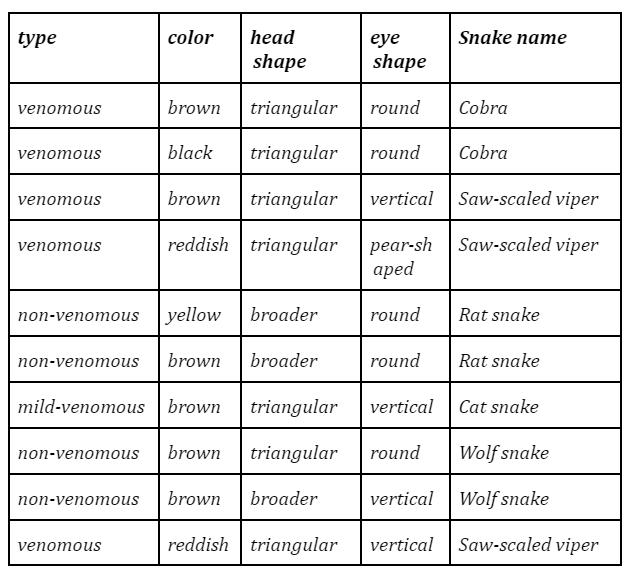
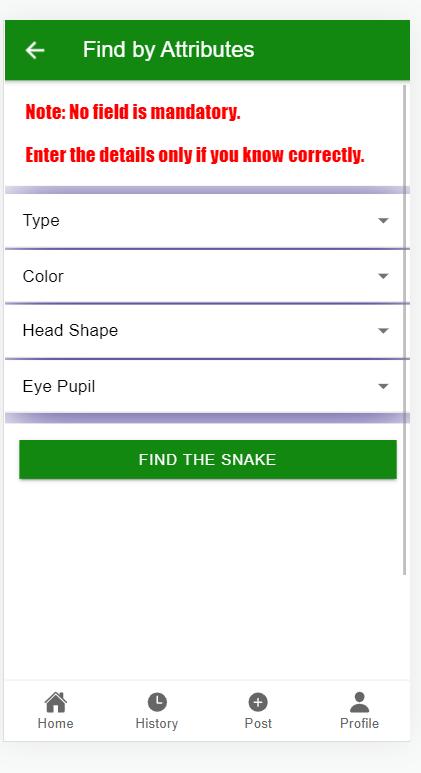
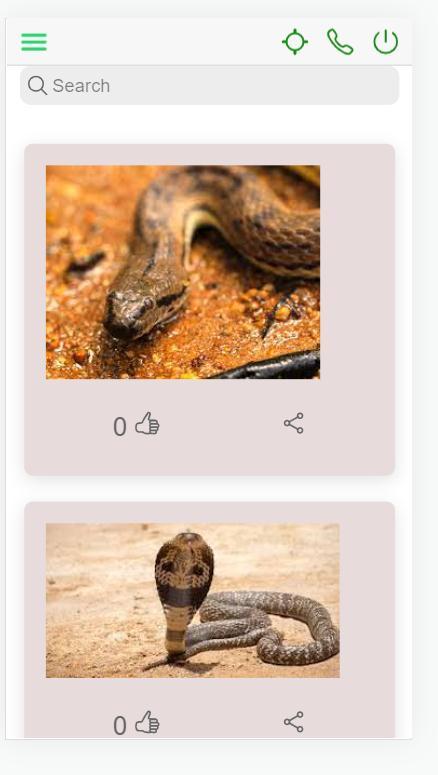
All the data being uploaded will get saved on the application,plustheverifiedsnakerescuerswillhavetheir respectiveaccountsonwhichtheirpersonaldetailswillbe displayed so the locals can contact them. Information aboutpoisonoussnakesandtheirmedicinaltreatmentwill be displayed on the application. The application will help to predict the snake species based on the image being uploaded or the attributes like type, head shape, colour and pattern, scale texture, etc. These predictions can be doneusingclassificationalgorithmslikeJ48/C4.5.
1.1 Problem Definition
When a rescuer catches a snake it is very difficult to maintainthedataorkeeptrackofthedataoftheuserwho calls them for snake rescue. The contact details may get lostinahurryandcancreateastateofconfusion.
The problem here is that there is no connection between the rescuer and the people. When there is an emergency likeasnakebiteorasnakeinvadingourhomesthereisno contactorarescuertoreachonspotontime.Manydeaths have occurred due to this. There is no proper medication ontimeordelayofthepatientinreachingthehealthcare centres.Snake killing is the most common activity that reduces the snake population and affects the natural animallifesystem.
1.2 Problem Specification
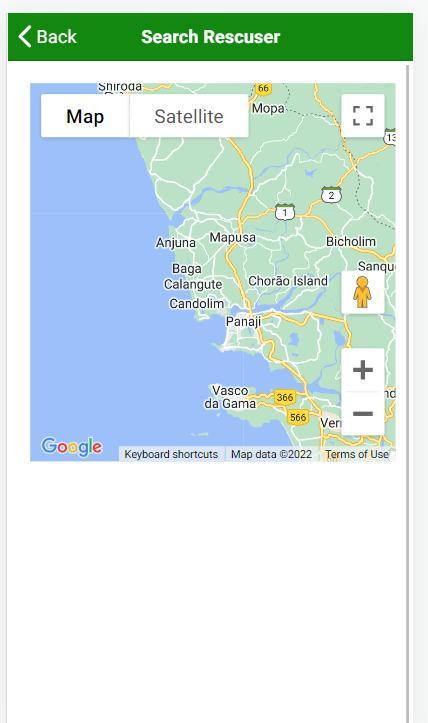
Herewetrytosolvetheproblemofrescuersbymanaging the data and transactions between the user and the rescuer. This application will help users to connect with rescuers by finding nearby rescuers quickly and avoiding any further emergencies. This will also help rescuers to keeparecordoftheuserandtheircontactdetails.
It will also have other features like first aid, and hospital details which can help users to give proper first aid on time and can save a person's life. The rescued snakes can be left in the uninhabited area which will ensure their safety too. Getting to know more about snakes and their specieswillhelppeopletohandleanyemergencies.
International Research Journal of Engineering and Technology (IRJET) e ISSN: 2395 0056
2. LITERATURE SURVEY
2.1 Past Research
technique.Itstartswithatrainingcollectionoftuplesand their associated category labels. The training set is recursively partitioned into shorter subsets as the tree is beingassembled.
Epidemiology and Clinical Profile of Snakebites
in Goa and Surrounding Areas[1]
Snakebites are a very common medical emergency in Goa whichcanoccurinanyseason. Thereisnospecificperson oroccupationwithariskofsnakebite.Snakebiteprimarily occursinhomemakers,students,oragedpeople.Thereare manysymptomsthatcanbeseenafterabitelikevomiting, breathing, breathlessness, chest pain, etc. The majority receive anti venom within 6 hours of intoxication. Snakebiteisamistreatedgeneralhealthhazardgloballyas well as in India. Many people die or are disabled due to snakebites. Anti snake venom (ASV) 5 is the only snake bitetreatmentavailableinhospitals.Duetopooraccessto health facilities, scarcity of anti venom, lack of adequate knowledgeandtrainingofdoctors,latereportingtohealth centresleadstodelaysinadministration.
Snake species identification by using natural language processing[2]
Thispaperhelpsustounderstandthatpeopledescribinga snake using natural language and the medical administratorunderstanding whichtypeofsnakeitiscan go wrong and due to that some wrong anti venom given willcausemoreseveremorbidityandmortality.
So to predict what species of the snake using natural languageinwhichthepersondescribesthesnakeinwords and based on their visual view this research paper used different classification algorithms. First, a lot of preliminary processing, character extraction, and classification was done on the data. Then four machine learning algorithms which are naïve Bayes, K nearest Neighbor, support vector Machine, and Decision trees J48 wasusedfortrainingandclassificationofdata.
Results show that the J48 algorithm gained the highest classification precision of 71.6% accurate prediction for theNaturalLanguageProcessing Snakedatasetwithhigh accuracyandrecollection.
2.2 Present Research
J48 Classification (C4.5 Algorithm) in a Nutshell[3]
Thisalgorithmisbasedonconceptlearningsystemsandis a supervised learning algorithm. J in J48 stands for java. J48isanon proprietyJavaapplicationofC4.5.J48permits classification via either decision trees or rules developed from them. This is a classification algorithm that yields decision trees based on Informationtheory. Thisadopts a non backtracking strategy in which decision trees are produced in a top down recursive divide and conquer
This implementation has many more features including interpreting the unknown values, decision tree pruning, constantattributevaluespans,derivationofrules,etc.
Performance tuning of J48 Algorithm for prediction of soil fertility [4]
SoilfertilityisamajorissueinIndia.Modernresearchand data mining techniques should be used for predicting the soil fertility of Indian soil. A large dataset which are samples of soil was used to find out different types of fertility aspects and measures. Using the data analyses were done using three different classification algorithms which are NBTree, simple CART, and J48. NBTree is a classification based on Naive Bayes classifiers. Simple CART is a multivariate decision tree learning method that generates either classification or regression trees, depending on whether the subjected variable is categorical or numeric. And J48 is a non propriety Java applicationoftheC4.5algorithmintheWekadata mining tool. C4.5 is a program that creates a decision tree based on a collection of labelled input data. The accuracy of the J48 algorithm for estimating soil fertility was leading, thereforeitwasutilisedasaweaklearner.
So now with that accuracy, they can use other meta strategies like feature selection and enabling in the weka tool.
Attribute selection reduces dataset size by removing irrelevant/redundantattributesandBoostingisamachine learning meta algorithm for performing supervised learning.
3. Prerequisites
3.1 Decision Tree
A decision tree is a tree like structure, where each sub node (non leaf tuple) denotes a check on a feature, each branch depicts an answer to the test, and an individual leaf node (or terminal node) has a category label. The highestsinglenodeinthetreeistherootnode.
Provided a tuple, X, for which the connected class label is unspecified, the feature values of the tuple are checked against the decision tree. From the root to the leaf node the path is tracked, which retains the class prediction for thattuple.Forclassificationdecisiontreealgorithmshave been used in many application areas such as medicine, manufacturing and production, financial analysis, astronomy,andmolecularbiology.
Volume: 09 Issue: 07 | July 2022 www.irjet.net p ISSN: 2395 0072 © 2022, IRJET | Impact Factor value: 7.529 | ISO 9001:2008 Certified Journal |
International Research Journal of Engineering and Technology (IRJET) e ISSN: 2395 0056
During tree structure, attribute selecting techniques are usedtochoosetheattributesthatbestpartitionthetuples intodiscreteclasses.
When decision trees are constructed, many of the branchesmaypredictnoiseoroutliersinthetrainingdata. Tree pruning attempts to identify and eradicate such branches, with the main purpose of enhancing classificationprecisiononhiddendata.
3.2 C4.5 / J48 Algorithm
The C4.5 algorithm is a classification algorithm that producesdecisiontreesbasedoninformationtheory.Itis acontinuationofRossQuinlan’searlierID3algorithmalso known in Weka as J48, J standing for Java. The decision treesdevelopedbyC4.5areusedforclassification,andfor this reason, C4.5 is usually referred to as a statistical classifier..C4.5 adopts a greedy process in which decision treesareconstructedina top downrecursivedivide and conquerapproach.
I. Calculate the appearance frequency of individual attributesinthesurveydata.
2.CalculatetheEntropyvalueofeachattribute.
3. Compute the Information Gain value using the known Entropyvaluecalculatedbeforehand.
4.CalculatetheSplitInfovalueofeachattribute.
5.CalculateGainRatiovalueusingInformationGainvalue andSplitInfovalue.
6.ChoosethebiggestGainRatioandmakeittherootnode.
7. Eliminate the attributes that have been chosen before, and repeat the calculations of Entropy value, Information Gain value, Split Info value, and Gain Ratio value by choosing the biggest Gain Ratio and making it the tree internalnode.
8. Repeat all the calculation processes until all the attributesarecategorizedintoclasses.
9.Afterallthetreesarecategorizedintotheclasses,show the initial decision tree and generate the initial decision rule.
Algorithm
Input:trainingsamples,traininglabels,attributes
● Buildingrootnodesforthetree
● If all the samples are positive, stop after a tree witharootnode,andlabelitwith(+)
● If all the samples are negative, stop after a tree witharootnode,labelitwith( )
●
Iftheattributesaremissing,stopafteratreewith a root node, label it with the frequently appearing valueintraininglabel
● Fortheothers:
A←attributethatclassifiessampleswiththebestresult (basedongainratio)
Decisionattributeforarootnode←A
ForeachVi valuethatispossibleforA
● AdditionalbranchundertherootrelatedwithA= Vi
● Determine sample Svi as a subset from the sampleshavingVi valueforattributeA
●
IfsampleSVi ismissing
● Under the branch, add a leaf node and the label = the frequently appearing valueintraininglabel
● For others, add a new branch under the currentbranch
Pseudo-Code for C4.5
1. First,noticethebase
2. For per attribute X, find the normalized data gain ratiobydividingbetweenX.
3. Assume that X is an attribute with the highest normalizeddatagain.
4. Createadecisionnodethatseparatesonattribute X.
5. Repeat it on the sublists acquired by splitting the attribute X, and count these nodes as children of thenode.
Mathematical Model for C4.5 Algorithm
SplitInfoA(D) = ∑ X Log2( )
GainRatio(A) =
Volume: 09 Issue: 07 | July 2022 www.irjet.net p ISSN: 2395 0072 © 2022, IRJET | Impact Factor value: 7.529 | ISO 9001:2008 Certified Journal | Page
International Research Journal of Engineering and Technology (IRJET) e ISSN: 2395 0056
Volume: 09 Issue: 07 | July 2022 www.irjet.net p ISSN: 2395 0072
4.3 Registration (User/Rescuer)
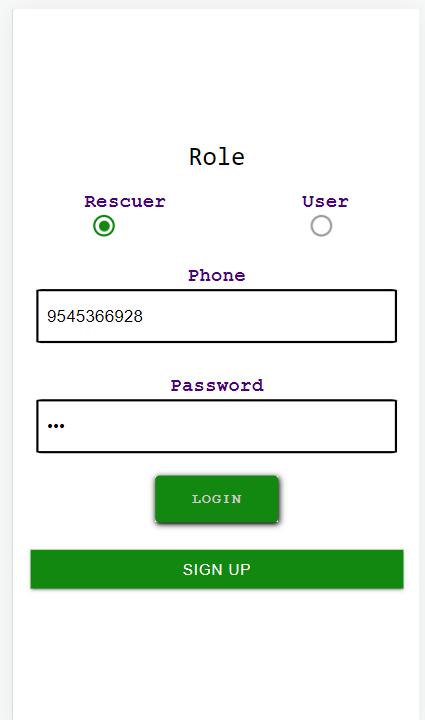
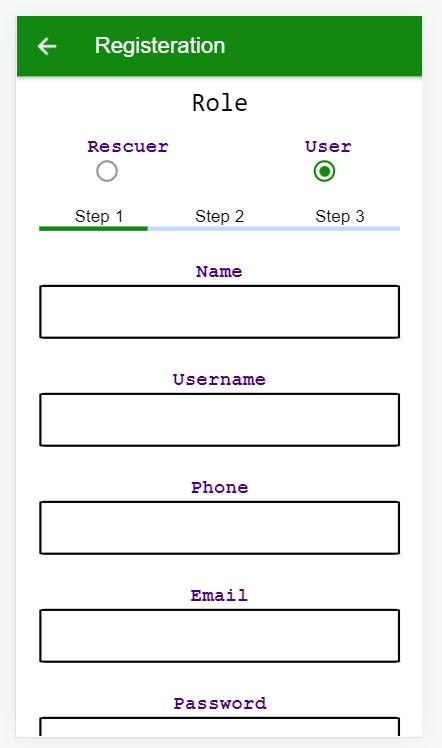
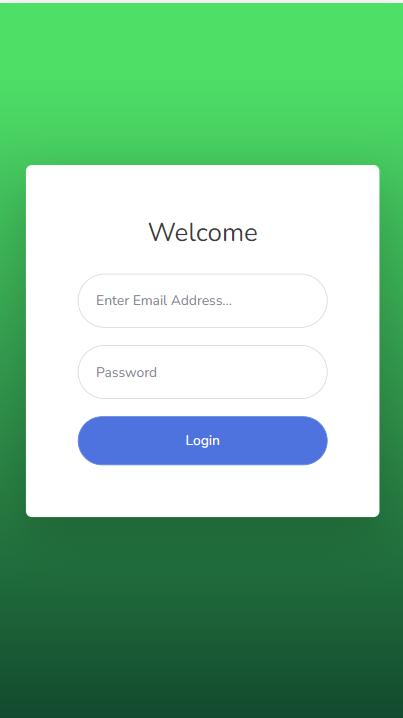
Fig
International Research Journal of Engineering and Technology (IRJET) e ISSN: 2395 0056
Volume: 09 Issue: 07 | July 2022 www.irjet.net p ISSN: 2395 0072
5. Conclusion
On the completion of this project there will be an app which will help snake rescuers to maintain their data properly and will have a platform to show their achievements. This will also help users to get in contact with the rescuers very fast.This will also help to save the livesofpeoplebittenbysnakes.Thisappwillprovidealot of knowledge about snakes to users.This project will showcase the dynamism of rescuers and appreciate what they do for society and protect the reptiles. This app will helptokeepdatasecureandindatalossproblem solving. The killing of snakes will reduce due to the faster availabilityofrescuers.
REFERENCES
[1] Narvencar, K., Favas, T. T., & Dias, A. (2020). Epidemiology and Clinical Profile of Snakebites in Goa and Surrounding Areas. The Journal of the AssociationofPhysiciansofIndia,68(3),28 32.
[2] Rusli, N. L. I., Amir, A., Zahri, N. A. H., & Ahmad, R. B. (2019). Snake species identification by using natural language processing. Indones. J. Electr. Eng. Comp.Sci,13,999 1006.
[3] Gholap, J. (2012). Performance tuning of J48 Algorithm for prediction of soil fertility. arXiv preprintarXiv:1208.3943.
[4] Nilima Khanna, Professor Amrinder Arora, J48 Classification (C4.5 Algorithm) in a Nutshell, GeorgeWashingtonUniversity